
Courses
Pythonでのハイパーパラメータチューニング
4時間
25.3K
The accuracy of your model isn't bad because you chose the wrong algorithm - it's because you never tuned it.
Most people train a model with default settings, see the accuracy settle around 80-ish percent, and say the algorithm isn't suited for their task. But the algorithm isn't the problem. Every ML model has parameters that control how it learns, and those parameters are set before training even starts. If you get them right, you can get out 10-20% more accuracy from the same model on the same data.
These parameters are called hyperparameters, and choosing them well will separate a model that's okay from the one that always seems to get it right. Hyperparameter tuning is the process of searching for the combination that gives you the best performance.
In this article, I'll walk you through what hyperparameter tuning is, the search strategies that work best, how to evaluate results without fooling yourself, and how to run it all in Python and R.
If you're new to data science and machine learning, check the Machine Learning Fundamentals in Python course before working on more advanced topics.
Hyperparameter tuning is the process of finding the settings that make a model learn best.
Every ML model has two sorts of numbers. Some are learned from the data during training, like the weights in a neural network or the split points in a decision tree. Others are set before training even begins, and those are the hyperparameters. They control how the model learns - how fast, how deep, how much it should generalize or memorize.
Default hyperparameters exist to get you a model that runs. They're not built to give you the best model for your specific dataset. A default learning rate that works for image classification logically won't perform well on tabular data. A default tree depth that's fine for a clean dataset will overfit on a noisy one. You get the idea.
The process of tuning searches through different combinations of hyperparameter values, training a model for each, and keeping the one that performs best on your validation data.
What you can get from this is often better than switching to a better but untuned algorithm.
The difference comes down to who sets them and when.
Model parameters are learned by the algorithm during training. You never set them yourself. The training process adjusts them by looking at the data and minimizing a loss function. For example:
Hyperparameters are chosen by you before training starts. They control how the learning process works, but the algorithm won't adjust them in any way. If you don't set them, the library uses its defaults. For example:
Here's a side-by-side comparison:
| Model parameters | Hyperparameters | |
|---|---|---|
| Set by | The training algorithm | You |
| When | During training | Before training |
| Learned from data | Yes | No |
| Examples | Weights, coefficients, split points | Learning rate, tree depth, regularization strength |
| Changes between runs | Every time you retrain | Only if you change them |
Model parameters answer what the model learned. Hyperparameters answer how it learned.
Tuning is a loop.
You start by picking the hyperparameters you want to search over and defining a range of values for each. Then you train a model with one combination, measure how it performs on validation data, and use that result to decide what to try next.
The loop looks like this:
The choice of how you update between iterations separates one search method from another. Manual tuning updates by intuition. Grid search updates by walking through a predefined list. Bayesian methods update by building a model of which combinations are likely to work.
Let me dive into these methods next.
The search method you choose controls how much compute you go through and how likely you are to find good hyperparameters.
Manual search is the simplest method. You pick a combination of hyperparameters, train the model, look at the result, and adjust based on what you saw.
It works when you have a small model, a few hyperparameters, and prior experience with the algorithm. If you already know that XGBoost usually likes a learning rate around 0.05 and a tree depth of 6, you can start there and adjust from what you observe.
Manual search doesn't work when the search space grows. Three hyperparameters with five reasonable values each already give you 125 combinations, and no human tunes 125 models by hand.
Grid search checks every combination in a predefined list of values.
You define a grid - for example, learning rates of [0.01, 0.05, 0.1] and tree depths of [3, 5, 7] - and grid search trains a model for each of the nine combinations. It's exhaustive and reproducible.
The problem is the compute cost.
Adding one more hyperparameter with five values multiplies your training runs by five. Grid search also wastes effort on values that don't matter - if tree depth barely affects your score, grid search still trains a model for every depth you listed.
Grid search is a good default for small search spaces with two or three hyperparameters.
Random search samples random combinations from a range instead of walking through a fixed grid.
You define a distribution for each hyperparameter and random search draws combinations from those distributions. It's more efficient than grid search because it doesn't waste runs on values that don't matter - if only one out of three hyperparameters affects performance, random search still explores the important one across many different values.
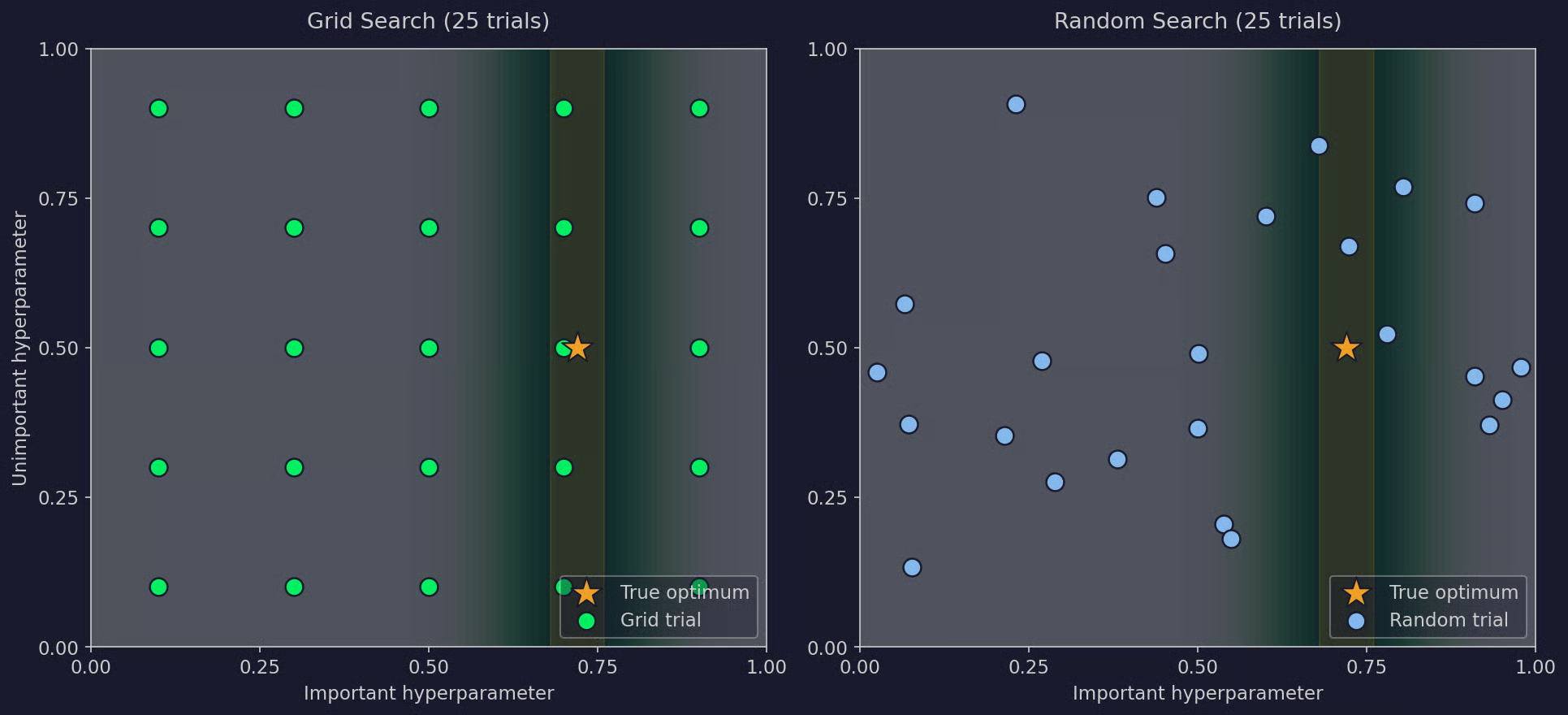
Grid search versus random search
Random search is the better default for anything with more than two hyperparameters.
Bayesian optimization uses the results from previous trials to decide what to try next.
It builds a probabilistic model of how hyperparameter combinations map to performance, then picks the next combination that either has the highest expected score or the highest uncertainty. This is the exploration-exploitation tradeoff, meaning you either explore new regions that might be good, or exploit regions you already know are good.
Bayesian methods find good hyperparameters in far fewer trials than random or grid search. The tradeoff is that each trial takes a bit longer because the algorithm has to fit its internal model before choosing the next point. Libraries like Optuna and Hyperopt do this for you.
Use Bayesian optimization when training is expensive and you can only afford a small number of runs.
Successive halving and Hyperband reduce compute time by stopping bad runs early.
Successive halving starts many hyperparameter combinations with a small training budget, throws out the worst half, doubles the budget for the survivors, and repeats.
Hyperband is a wrapper around successive halving that runs it multiple times with different budget splits, so you don't have to guess the right starting configuration.
Both methods are useful when training is slow and you have a large search space. They work best when early performance is a decent signal for final performance, which is usually true for neural networks and gradient boosting.
Here's how the methods compare:
| Compute cost | Search efficiency | Best for | |
|---|---|---|---|
| Manual search | Low | Low | Small models, prior experience |
| Grid search | High | Low | 2-3 hyperparameters, small ranges |
| Random search | Medium | Medium | 4+ hyperparameters, unknown importance |
| Bayesian optimization | Medium | High | Expensive training, small budget |
| Successive halving / Hyperband | Low to medium | High | Large search spaces, slow training |
Tuning won't get you far if you don't choose a correct range of values.
If your evaluation is off, you'll pick the wrong hyperparameters. There are four things to get right - how you split the data, how you measure performance, which metric you optimize, and how you keep the test set clean.
Split your data into three parts before tuning.
The training set is what the model learns from. The validation set is what you use to score each hyperparameter combination during tuning. The test set is what you use once, at the very end, to measure how the final model performs on unseen data.
If you tune against the test set, you'll get an accuracy number that looks great and a model that underperforms in production. Every tuning decision you make against the test set leaks information about it into your model.
A common split is 60/20/20 for medium-sized datasets or 80/10/10 for larger ones.
Cross-validation is a better way to score hyperparameters when your validation set is small.
You split the training data into k folds - usually 5 or 10. For each hyperparameter combination, you train on k-1 folds and validate on the remaining one, then rotate. The final score is the average across all folds.
Cross-validation gives you a more stable estimate of how well a hyperparameter combination generalizes, because you're not relying on a single lucky or unlucky validation split. The cost is that you train k models per combination instead of one.
Use cross-validation when your dataset is small enough that a single validation split isn't reliable, and when you can afford the extra training cost.
The metric you optimize should match what you actually care about.
Accuracy is fine for balanced classification but doesn't make sense for imbalanced problems. For example, a fraud detection model that predicts "not fraud" for everything can get 99% accuracy while missing every case. For imbalanced classification, use precision, recall, F1, or ROC-AUC. For regression, use RMSE, MAE, or R squared depending if outliers matter.
Just pick one primary metric before you start tuning and stick with it.
Data leakage happens when information from your validation or test set gets into training.
Here are some common ways it happens:
Fit all preprocessing steps on the training set only, then apply them to validation and test. In scikit-learn, this is what Pipeline is for - it wraps preprocessing and modeling into one object that respects your splits.
Most ML libraries include tools that do the search and the cross-validation, so you don't have to implement anything from scratch.
Scikit-learn comes with two tuning classes that cover most use cases - GridSearchCV for grid search and RandomizedSearchCV for random search. Both wrap around any scikit-learn estimator, run cross-validation for each combination, and give you the best model at the end.
GridSearchCV takes an estimator, a dictionary of hyperparameter values, and the number of cross-validation folds. It trains a model for every combination and keeps the one with the best score.
from sklearn.ensemble import RandomForestClassifier
from sklearn.model_selection import GridSearchCV
from sklearn.datasets import make_classification

X, y = make_classification(n_samples=1000, random_state=42)

param_grid = {
    "n_estimators": [100, 200, 500],
    "max_depth": [5, 10, 20],
    "min_samples_leaf": [1, 5, 10],
}

grid = GridSearchCV(RandomForestClassifier(random_state=42), param_grid, cv=5)
grid.fit(X, y)

print(grid.best_params_)
print(grid.best_score_)
GridSearchCV results in Python
RandomizedSearchCV uses the same interface but samples from distributions instead of going through a fixed list. This lets you cover a wider range with a fixed number of trials.
from sklearn.model_selection import RandomizedSearchCV
from scipy.stats import randint

param_dist = {
    "n_estimators": randint(100, 500),
    "max_depth": randint(3, 20),
    "min_samples_leaf": randint(1, 10),
}

random_search = RandomizedSearchCV(
    RandomForestClassifier(random_state=42),
    param_dist,
    n_iter=30,
    cv=5,
    random_state=42,
)
random_search.fit(X, y)

print(random_search.best_params_)
RandomizedSearchCV results in Python
For Bayesian optimization, Optuna is the standard choice. It picks the next combination based on previous results, so it converges faster than random search when training is expensive.
import optuna
from sklearn.ensemble import RandomForestClassifier
from sklearn.model_selection import cross_val_score

def objective(trial):
    params = {
        "n_estimators": trial.suggest_int("n_estimators", 100, 500),
        "max_depth": trial.suggest_int("max_depth", 3, 20),
        "min_samples_leaf": trial.suggest_int("min_samples_leaf", 1, 10),
    }
    model = RandomForestClassifier(**params, random_state=42)
    return cross_val_score(model, X, y, cv=5).mean()

study = optuna.create_study(direction="maximize")
study.optimize(objective, n_trials=30)

print(study.best_params)
Optuna results in Python
The trial.suggest_* methods define the search space, and Optuna decides which combination to try next based on the scores it has seen so far.
R has two great options - caret and tidymodels. Both do the same - define a grid, run cross-validation, return the best model - but tidymodels is the modern default.
With caret, you pass a tuning grid to the train() function and specify the resampling method.
library(caret)

data <- iris
ctrl <- trainControl(method = "cv", number = 5)

grid <- expand.grid(
  mtry = c(2, 3, 4)
)

model <- train(
  Species ~ .,
  data = data,
  method = "rf",
  trControl = ctrl,
  tuneGrid = grid
)

print(model$bestTune)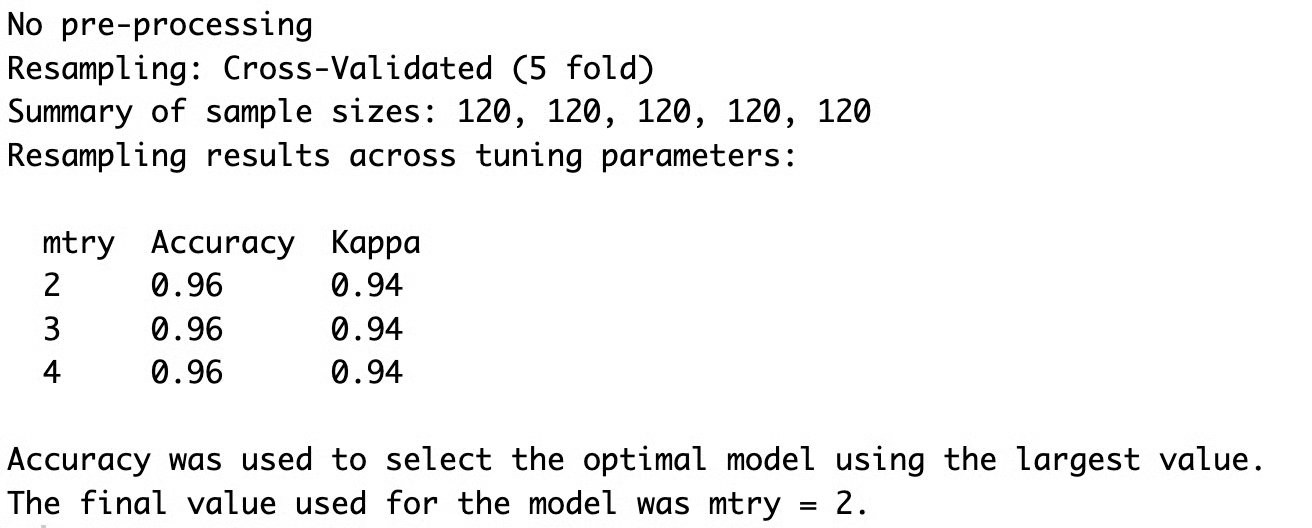
Caret results in R
tidymodels splits the workflow into clear steps - a model spec, a recipe for preprocessing, and a tuning grid. It's more verbose but in practice is more scalable.
library(tidymodels)

data <- iris
split <- initial_split(data, prop = 0.8)
train_data <- training(split)

rf_spec <- rand_forest(
  mtry = tune(),
  trees = tune(),
  min_n = tune()
) |>
  set_engine("ranger") |>
  set_mode("classification")

grid <- grid_regular(
  mtry(range = c(2, 4)),
  trees(range = c(100, 500)),
  min_n(range = c(1, 10)),
  levels = 3
)

folds <- vfold_cv(train_data, v = 5)

results <- tune_grid(
  rf_spec,
  Species ~ .,
  resamples = folds,
  grid = grid
)

show_best(results, metric = "accuracy")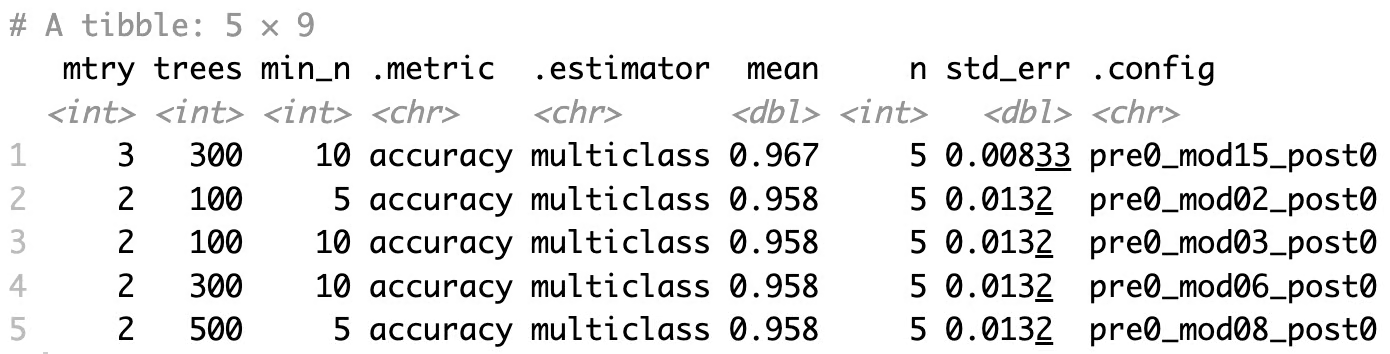
Tidymodels results in R
The workflow is exactly the same as in Python - you define what to search over, define how to score it, and let the library run the loop.
Not every hyperparameter is worth tuning because usually only a few control most of the performance. Here are the ones that usually matter first, by model family.
You should always tune these three:
Gradient boosting (XGBoost, LightGBM, CatBoost) is more sensitive to hyperparameters than random forests. Pay attention to these:
With SVMs, the choice of hyperparameters matters a lot, arguably more than with other models:
rbf for non-linear problems and linear for high-dimensional sparse data.Neural networks have the largest search space of any common model family. Tune these first:
1e-4, 1e-3, 1e-2.Tuning is expensive, especially when you want to test multiple values per parameter and have many parameters to tune. Here are some common challenges to know.
Compute cost is the biggest constraint. Every combination you try means training a full model, and cross-validation multiplies that by the number of folds. A grid of 100 combinations with 5-fold CV is 500 model fits. If each fit takes 10 minutes, that's over three days.
Large search spaces grow multiplicatively. Five hyperparameters with five values each is 3,125 combinations. This is where grid search is no longer an option and is replaced with random search or Bayesian methods.
Diminishing returns are visible earlier than most people expect. The first few tuning runs usually give you the biggest gains. The next 50 might get out another percent of accuracy. At some point the extra compute would be better spent on getting more data or fixing your features.
The accuracy-time tradeoff matters more in production than in development. A model that scores 0.5% higher but takes twice as long to train might not be worth it if you retrain daily. You should decide up front how much accuracy is worth how much compute.
Here are some good habits to follow when tuning hyperparameters of a machine learning model:
[0.001, 100], you'll waste time on values that never work. Start with ranges that are known to be reasonable for your algorithm, then narrow them based on what you see.Most tuning fails are due to mistakes that are easy to avoid. Here are a couple:
Both improve your model, but they work on different parts of the problem.
Feature engineering improves the input data. You create new features from existing ones, encode categorical variables, handle missing values, and remove noise. Better features give the model more useful signals to learn from.
Hyperparameter tuning improves how the model learns from whatever features you give it. It changes the algorithm's behavior on the data instead of changing the data.
The two are complementary. Feature engineering usually gives you the largest gains early in a project, when the data is still raw and the model is missing obvious signals. Hyperparameter tuning gives you smaller but consistent gains once your features are good enough.
If your model is stuck and you're not sure which one to try first, look at your errors. If the model is missing patterns that seem obvious from the data, you have a feature problem. If it's overfitting or underfitting, you have a tuning problem.
Tuning is a standard step in any ML workflow.
It often gives you larger gains than switching algorithms. For example, a well-tuned random forest will often beat a poorly-tuned gradient boosting model on the same data, even though gradient boosting is the more sophisticated algorithm.
Tuning also helps with generalization. Hyperparameters like max depth and dropout rate directly control how much the model can overfit. Getting these right is what makes the difference between a model that memorizes the training set and one that performs well on new data.
In production, tuning turns a proof-of-concept into a system that is reliable.
The default settings get you started, but these are not the settings that will keep the model competitive against retraining and business requirements. Every serious ML team treats tuning as part of the process.
Hyperparameter tuning is an iterative loop of searching, evaluating, and narrowing in on what works for your specific data.
The best results come from combining three things - a search method that fits your compute budget, validation that gives you a score that's relevant, and experiment tracking that lets you go back and see what you tried.
Start with random search or grid search. Move to Bayesian optimization when training gets expensive enough that trial count actually matters. Either way, tune the hyperparameters that are relevant for your model, keep your test set clean, and log every run.
If you're considering a career in machine learning, enroll in our Machine Learning Engineer track to get job-ready in 2026.
Learn with DataCamp
Courses
Courses
Courses
tutorials
Sayak Paul
15 分
tutorials
Zoumana Keita
11 分
tutorials
Bunmi Akinremi
11 分
tutorials
Kurtis Pykes
11 分
tutorials
Bex Tuychiev
15 分
tutorials
Dario Radečić
12 分