Our biggest-ever sale. 60% off AI & data skills
Buy Now

실습 문제하고 트랙하세요.
Google로 계속하기계속 진행하시면 다음 사항에 동의하는 것으로 간주됩니다: 이용약관 및 개인정보 처리방침 그리고 귀하의 데이터가 미국에 저장된다는 점에 동의하는 것으로 간주됩니다.
Both Google AI and OpenAI have a history of releasing cutting-edge AI technologies. Yet the landscape has changed with the introduction of ChatGPT, which has ignited a new race where big tech companies like Google are desperately trying to launch similar AI models.
In this post, we will learn about OpenAI and Google AI's recent developments and what we can expect in the future. Moreover, we will also learn how advancement in AI is changing the field of data science and how we can use it to boost productivity.
OpenAI API is a platform that allows us to access cutting-edge generative models via API. We can generate high-quality images using DALLE-2, text and code generation using GPT-3, and use embedding for other language-related tasks. Furthermore, it allows you to moderate results, add rate limits, and fine-tune the model on a specific dataset. Learn about GPT-3 by reading our Beginner's Guide to GPT-3 blog.
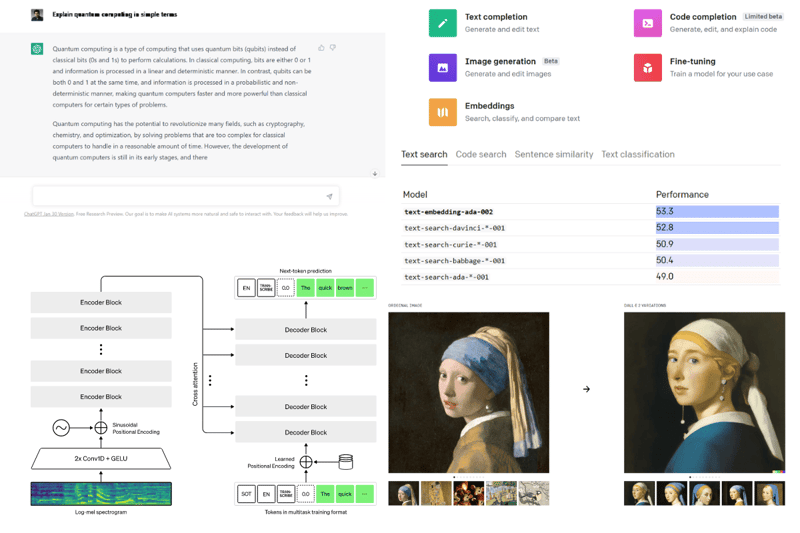
Image by Author | Source OpenAI
These all are commercial products, and they follow the pay-as-you-go model, but from time to time, OpenAI has released open-source tools and models, such as:
The APIs, toolkits, and large language models are great, but they don’t manage to come close to the success of ChatGPT.
The ChatGPT model was trained using Reinforcement Learning from Human Feedback (RLHF), similar to InstructGPT (a better version of GPT-3), but the data collection stage is slightly different.
How is it different from the previous generations of models? The conversation AI was able to ask follow-up questions, challenge incorrect premises, admit mistakes, and demonstrate safety mitigations.
Recently, OpenAI partner Microsoft has introduced an improved version of ChatGPT. With OpenAI’s iterative deployment, we can see a new wave of AI technologies that understand our needs and provide us with assistance.
If you are completely new to Artificial intelligence, take a no-code AI Fundamentals course. It covers the basics of machine learning, like supervised and unsupervised learning, deep learning, and beyond.
Apart from ChatGPT, we are expecting GPT-4, which will be the most advanced large language model. In the Greylock podcast, OpenAI CEO Sam Altman has disclosed a little information about GPT-4. He said that rumors about GPT-4 on Twitter are false, it will not have 100 trillion parameters, and people are begging to be disappointed. He also disclosed that "we will release the GPT-4 when we think it is safe and functional".
Image by Author
What can you expect in GPT-4?
Learn all about GPT-1, GPT-2, GPT-3, and GPT-4 by reading our Everything We Know About GPT-4 So Far post.
During the interview with StrictlyVC, Altman disclosed a few points on how far we are developing AGI (Artificial General Intelligence).
He said: “The closer we get, the harder it is to answer. Because I think it’s going to be much blurrier and much more of a gradual transition than people think.”
He also debunked the rumors about AGI. In the interview, he said OpenAI does not have AGI that can learn like humans.
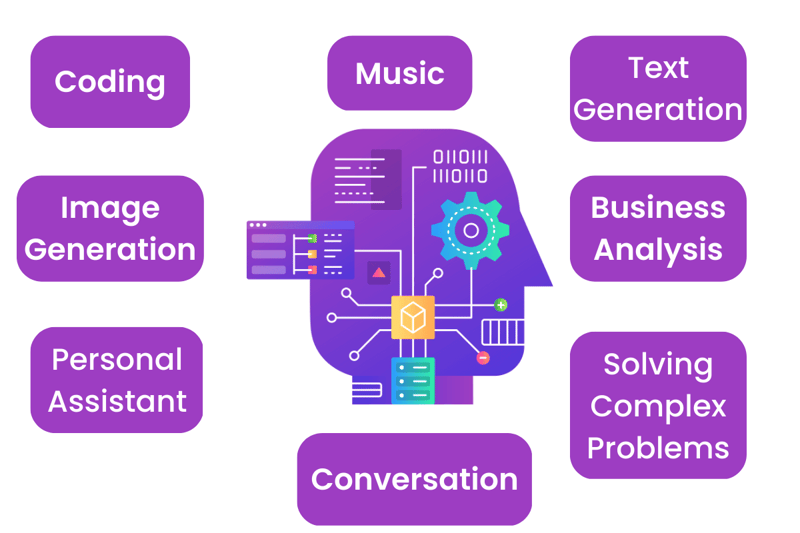
Image by Author
OpenAI is on the right path to developing safe AGI, but it is far from perfect. The AGI people are talking about is a multimodal model that can understand speech, text, image, and video. It will be the combination of ChatGPT, DALLE-2, Whisper, a video generations model, and other reinforcement learning algorithms.
To develop AGI, OpenAI needs to work on multimodal models, not just text-to-image, but text-to-video and audio-to-video and audio. It means you will be able to talk to a natural-sounding and looking bot. It has already been achieved by a few developers, such as the AI-generated Twitch streamer persona. It is not perfect, but it is a start.
During the StrictlyVC program, Sam Altman disclosed that they are working on a video model, and we can safely assume that it will be the text-to-video generation with an audio model, adding another layer of complexity. We already have a video generation technology where developers are overlapping frames generated using the stable diffusion model.
Google AI is the backbone of Google’s ecosystem. It is used in Google maps, photos, applications, and Cloud. Google has been at the forefront of developing AI tools and models. Most products are available on the Google Cloud, from AutoML to state-of-the-art large vision and language models.
It has also released multiple tools and state-of-the-art models that have changed the space of natural language processing, speech processing, and computer vision. From TensorFlow to BERT (Bidirectional Encoder Representations from Transformers), Google has paved a new way for AI and machine learning research and development.

Gif from LaMDA
In 2020, Google research introduced Meena, a neural conversational model that understands the context and learns to respond sensibly. After that, Google released the LaMDA model, which is similar to ChatGPT. It was a breakthrough conversation technology built using transformers but trained on dialogues.
Every year, we see new technology from Google, and in the future, we can expect an advanced Google search engine powered by AI Bard, language, vision, generative mode, and multimodel models that will make AI multipurpose.
After the launch of ChatGPT, people started spreading rumors of how it is the ‘Google killer.’ The extended partnership between Microsoft and OpenAI made that more likely. Microsoft is ready to take on Google in the search engine business with its OpenAI-infused Bing.
To counter that, Google launched its version of ChatGPT called Google AI Bard. Check out our comparison of ChatGPT and Google Bard in a separate article.

Gif from Bard and new AI features
In the recent Google AI updates, Sundar Pichai, the CEO of Google and Alphabet, introduced a new experimental conversation AI service called Bard that is powered by LaMDA. Google has announced that it has given access to trusted testers, and in the coming weeks, it will be available to the public.
Bard uses information from the web to provide high-quality responses. Unlike the ChatGPT model, Bard is a service that combines the world’s knowledge with power, intelligence, and creativity. Initially, Google is releasing it with a lightweight model version of LaMDA, and with time it will introduce more powerful language models.
According to recent reports from Google Research, they have made advancements in language technologies, computer vision, and generative models.
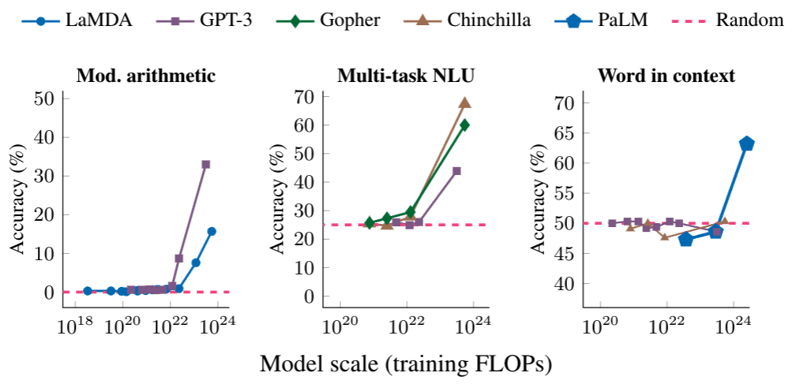
Image from Google AI
Start your Deep Learning (AI) career by taking our Deep Learning in Python skill track. The skill track consists of four courses that will take your machine learning skill to the next level.
Most ML models focus on a single modality of data (text classification, image segmentation, or speech recognition). But due to DALL-E 2 and Stable Diffusion, companies are now focusing on multimodal models to achieve state-of-the-art results.
Google AI has achieved multimodality by passing the data through modality-specific processing layers and mixing the features from different modalities via the bottleneck layer. Combining modalities can also increase the performance of single-modality tasks.

Gif from Google AI
Here are some of the latest research developments from Google AI on multimodal model developments:
We can assume that in the future, you will see the adoption of these models in Google ecosystems to increase user engagement and develop new products.
Modern AI is driven by data science, algorithms, and data engineering. To create cutting-edge technology like ChatGPT and LaMDA, we must start from the basics, understand how to handle the data and apply various natural language processing and reinforcement learning techniques, learn about deep learning algorithms and transformers, and model optimization.
Start your data science career by completing Data Scientist with Python career track. It will teach you essential skills for becoming a professional data scientist.
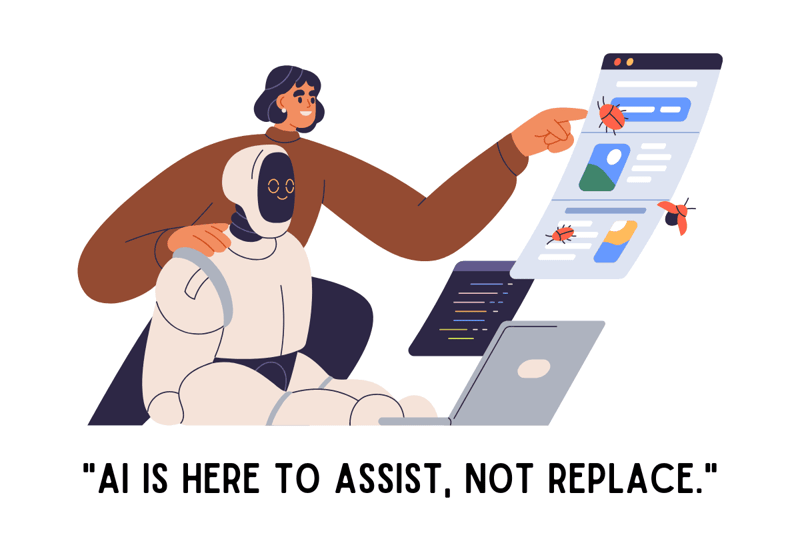
Image by Author
So, let’s answer the elephant in the room. Will AI replace data scientists, analysts, or engineers? The simple answer is “NO.” Maybe in the far future, but even then, we will have different jobs, more creative and decision-making jobs. With the development of AI, we will also grow.
GitHub Copilot, DALL-E 2, ChatGPT, and other cutting-edge technologies are here to assist us. They are here to make us productive and efficient.
Andrej Karpathy, Previously Director of AI at Tesla and OpenAI says:
“Copilot has dramatically accelerated my coding, it's hard to imagine going back to "manual coding." Still learning to use it but it already writes ~80% of my code, ~80% accuracy. I don't even really code, I prompt. & edit.” - Twitter
It shows that many people who understand technology will use it to get better at programming, logic, data analysis, and decision-making.
Microsoft, with the partnership of OpenAI, has integrated ChatGPT into the new Bing search engine, which is called a copilot for the web. With this announcement, a new race to achieve tech supremacy has started.
Microsoft is planning to integrate ChatGPT and other GPT models into its ecosystem. It will change everything as users won’t even have to leave the application. They can perform searches, add content, edit the content, and come up with ideas by just chatting with a bot.

Bing Copilot Demo
At the Paris event, Google launched its version of ChatGPT called Bard. It is powered by a lightweight LaMDA. The Bard is quite similar to Microsoft’s copilot for the web; it is also integrated into Google's search engine and offers similar features.
These issues will be resolved, and we will see new legislation regulating the use of AI. The schools and content giants have already started implementing AI-generated content policies.
So, what can we do about it? We can start learning about these new technologies and start using them ethically. You can start learning AI by enrolling in our Machine Learning Scientist with Python career track. The career track will teach you the essential machine-learning skills for landing a job as an AI engineer.

블로그
 Travis Tang • 15분

블로그
 Alex Olteanu• 8분

블로그
 Javier Canales Luna• 8분
Top Courses
트랙
Python으로 머신 러닝을 익히고 머신 러닝 과학자가 되기 위한 길을 걸어보세요. 지도학습, 비지도학습, 그리고 딥러닝을 살펴보세요.
실습 문제하고 트랙하세요.
Google로 계속하기계속 진행하시면 다음 사항에 동의하는 것으로 간주됩니다: 이용약관 및 개인정보 처리방침 그리고 귀하의 데이터가 미국에 저장된다는 점에 동의하는 것으로 간주됩니다.