
Ga naar hoofdinhoud

Meta Muse: The Personal AI Agent Built for Everyone

Meta's Muse is a personal AI agent that runs on a dedicated secure VM and does real tasks for you, from booking travel to lowering bills.
9 sep 2026  · 10 min lezen

Verkennen met AI

ChatGPTClaudePerplexity

The agentic era of consumer AI is crowding fast.

OpenAI has been pushing Gemini-, Spark- and Claude Cowork-style task runners, and now Meta has thrown its own hat in the ring with Muse, a personal AI agent that it claims is the first built for billions of people.

It launched a week after GPT-6 Astra in the US on iOS, Android, and via muse.ai, with WhatsApp chat support on day one.

Muse is not a typical chatbot that answers questions.

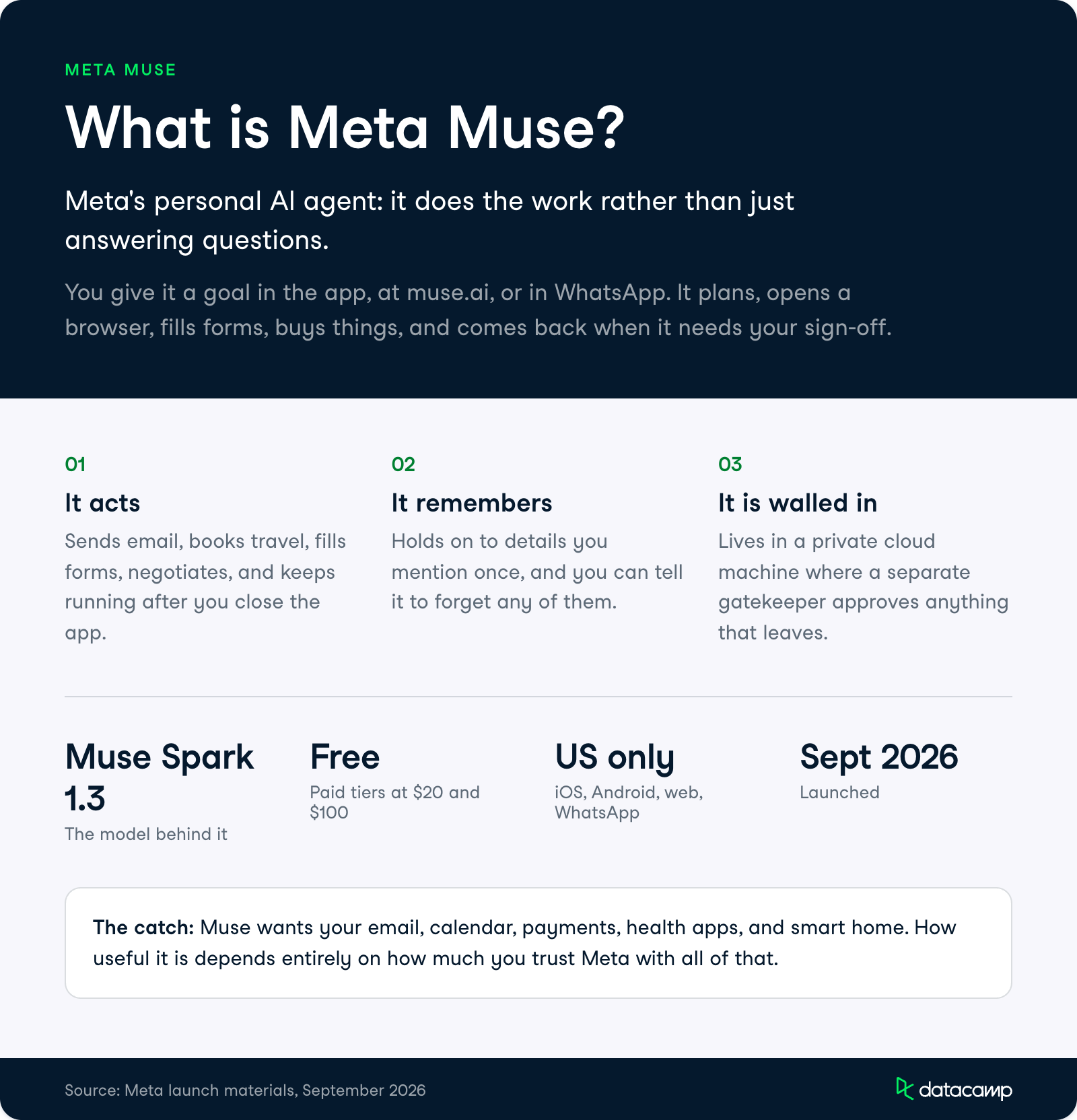
Meta pitches it as an agent that does the work, such as sending emails, booking travel, filling out forms, and even negotiating on your behalf.

It runs on Muse Spark 1.3, described by Meta as its most capable model to date, and lives inside a dedicated cloud computer called Muse Secure VM.

In this article, I'll cover what Muse is, why it matters, how its security model actually works, what it costs, and how to get access.

If you want context on the wider agentic landscape, our Grok Build tutorial and Grok Voice Agent Builder guide are good companions for the developer-facing side of this trend.

TL;DR

  • Muse is Meta's consumer personal AI agent that takes tasks and long-term goals off your plate, not just a Q&A chatbot.
  • It runs on Muse Secure VM, a dedicated cloud computer with a Sentinel gatekeeper agent controlling what reaches the internet.
  • Muse can pay for things using Link by Stripe, with a one-time-use card so your real card details stay hidden.
  • It's free for most everyday use, with Power at $20/month and Maximum at $100/month for heavier usage.
  • The whole thing rests on trusting Meta with your email, calendar, and payment connections, which is the real question here.

What Is Meta Muse?

Muse is a personal AI agent from Meta that proactively works toward your goals and acts across the apps you already use.

You talk to it like you would message a friend, either inside the Muse app or directly in WhatsApp, and it takes action rather than just replying.

What's new here is the architecture underneath.

Meta built Muse to run on Muse Secure VM, a dedicated virtual machine in the cloud that houses both the agent and your connected data.

It's powered by Muse Spark 1.3, the first flagship model from Meta's Superintelligence Labs, released September 2, 2026 with a 1M-token context window.

This is perhaps Meta's biggest bet on consumer AI to date, and it comes less than two weeks after Meta agreed to an $18 billion multistate settlement over social media harms.

That timing matters because Muse asks for more personal access than any Meta product before it, including your email, calendar, payments, health apps, smart home, dining, shopping, and more.

Meta Muse Key Features

Muse's selling point is that it acts autonomously across your connected services, then checks in when it needs approval.

Here are the capabilities that define what it can actually do for you.

Take on goals, not just one-off tasks

Muse handles quick jobs like sending an email or booking a flight, but Meta designed it for larger goals too.

Once you share a goal, it builds a personalized plan, coordinates your time and resources, and advances the work on its own.

It can open a browser, fill out forms, and negotiate on your behalf.

For work that takes longer, Muse keeps running after you close the app and returns when something changes or when it needs sign-off before an action like sending an email or making a purchase.

For practitioners, this is the difference between a copilot and an agent.

The trade-off is control: complex multi-step automations can trigger large-scale changes, so reviewers have flagged the need for manual guardrails on things like bulk edits or mass messaging.

Pay for things with built-in protection

Muse can check out using Link built by Stripe, and Meta says it's the first AI agent covered by Link's purchase protections.

That covers damaged or lost items, price drops, no-fee returns, and a return guarantee on eligible purchases.

Link's wallet for agents generates a one-time-use card, so your real card details stay hidden when Muse buys something for you.

Shop Pay and 1Password support are coming soon, the latter so Muse can use logins you already have.

This is a smart move. Letting an AI spend your money is the single scariest part of the agentic pitch, and wrapping every purchase in Stripe's protections directly targets that fear.

Remember what matters to you

Muse remembers details you mention once and acts on them later, which is how it makes unprompted suggestions.

Meta's own example is turning a recipe reel you saved on Instagram into a grocery list and remembering friends' dietary restrictions before sending party invites.

My own version of this: you mention offhand that you're training for a half-marathon, and weeks later Muse adjusts your plan when a work trip eats into your long-run days. You can also tell it to "forget" specific things it's learned whenever you want.

Connect your apps one at a time

You choose which apps Muse connects to and exactly how much access each one gets.

For email, you decide whether Muse can only read your mail or also send on your behalf.

Muse ships with built-in connectors for several services and adds more over time. If a service isn't supported but offers a public API, Muse can set up a connection using credentials you provide, and where there's no API, it falls back to accessing the service through the browser.

Reviewers have asked for more granular permission controls, for example, restricting Muse to specific Instagram accounts or business assets rather than everything under one login. That's a fair criticism for anyone whose Meta account mixes personal and work identities.

The connected-apps list

Muse ships with connectors for several categories of everyday service, and understanding which ones are supported at launch helps set expectations. Based on Meta's launch materials, the categories include email, calendars, payments, health and fitness apps, smart home, dining, shopping, music, and events.

The connector list is expected to grow over time. Where a service isn't yet supported but exposes a public API, Muse can connect using credentials you provide, and it falls back to browser access when no API exists.

How Muse's Security Model Works

The security story underlines the whole pitch, so it's worth walking through how Muse Secure VM actually contains things.

Meta claims these protections are first-of-their-kind and that no other agent provides them, though security experts will need time to verify that.

The Secure VM and the Sentinel gatekeeper

Muse runs on its own dedicated computer in the cloud, isolated so no one else's agent can reach it.

That VM is where Muse lives and where the credentials for any service you connect are stored.

A separate Sentinel agent runs on the same machine but is kept apart from Muse at the system level.

Nothing Muse does reaches the internet unless Sentinel approves it, and Sentinel asks you for permission when needed.

Meta also says Muse has no visibility into your passwords or payment methods. Credentials you share go into secure storage, so Muse can use them without seeing them, including passwords you type into the browser yourself.

Approvals, audit trails, and data control

Muse checks with you before sensitive actions and shows a complete audit trail of everything it has done and plans to do.

You can change access or disconnect any service whenever you want.

On the data side, Meta makes a few specific commitments worth listing out:

  • Muse doesn't share your conversations or VM data with Meta's ad systems.
  • You can opt out of your interactions being used to train Meta's AI models.
  • You can tell Muse to "forget" specific things it has learned about you.
  • Later in 2026, Meta will introduce Muse Confidential VM, where the whole VM is encrypted with a key only you hold, so not even Meta can access it.

I'd take the ad-system claim seriously and the training opt-out with a note of caution.

Meta's chief AI officer described Muse Spark's frontier performance as "almost too cheap to meter," but cheap inference doesn't answer the harder question of whether people trust Meta specifically with their inbox and calendar.

Where Muse falls short today

Early reviewer feedback surfaces a few consistent limitations worth knowing before you rely on Muse.

Complex multi-step automations often need manual confirmation to avoid unintended large-scale changes, such as bulk edits or mass messaging.

Audio handling is also a weak spot, with degraded input compared to prior Meta speech capabilities and inconsistent latency when requests route to Muse Voice Transcribe or older models.

Reviewers also want finer-grained permission controls, and lingering questions about data retention and how deeply the agent can act on personal social data remain.

How Muse Compares to Other Agentic Tools

Muse enters a market that OpenAI, Anthropic, and xAI are already contesting, though Meta's angle is tighter integration with its social apps. The concept itself is not unique to Meta.

Here's how the current field stacks up on the dimensions that matter for a consumer agent.

Tool Company Distinguishing angle Underlying model
Muse Meta Consumer agent, deep Meta app integration, Secure VM Muse Spark 1.3
Gemini Spark Google Agentic task runner tied to Workspace Gemini frontier line
Claude Cowork Anthropic Task orchestration for developers and enterprise Claude Fable 5.1
Grok Build SpaceXAI Terminal-based coding agent Grok 4.6

Third-party reactions are split.

BuildFastWithAI gave Muse 9.0/10 overall, praising task automation (9.3/10) and usability (9.1/10) but scoring trust and safety lower at 8.3/10. Toolradar was more critical at 55/100, calling the $100/month tier steep and the usage-cap documentation opaque.

The recurring caveat across analysts is that Meta's parity claims for Muse Spark come from Meta, not from a neutral benchmark consortium.

The Muse Spark model behind the agent

Muse Spark 1.3, released September 2, 2026, is the first flagship model from Meta's Superintelligence Labs and the engine behind Muse.

Meta targets it at agentic work, claiming roughly 20% fewer tool calls and 25% lower token usage on agent tasks compared to prior Meta models, with a 1M-token context window.

The top reasoning mode is held back pending safety testing, and audio input is degraded relative to earlier versions, routed instead to Muse Spark 1.2 or Muse Voice Transcribe. Independent benchmark reproductions were not available at launch, so the parity-with-OpenAI-and-Anthropic claim rests on Meta's own numbers.

I recommend checking out our Muse Spark 1.3 tutorial if you want to get hands-on with the model itself. 

Meta Muse Pricing and Availability

Muse is free for most everyday use, with two paid subscription tiers for heavier workloads.

Meta believes most people will stay on the free tier and even ships a usage meter that shows how much of your allowance is left, warning you before free usage runs out.

  • Free tier: covers standard consumer interaction and light task usage.
  • Power: $20/month, more Muse usage for handing off everyday tasks.
  • Maximum: $100/month, the highest usage limits.

Both paid plans scale with usage, though exact task and message quotas for each tier are not clearly published, and that lack of clarity is frustrating. Note that Muse requires a payment card to get started, even on the free tier, because subscriptions kick in as usage rises.

Muse is rolling out in the US only at launch, available on iOS, Android, muse.ai, and through WhatsApp chats. Meta says support for its AI glasses is coming soon.

This is a consumer product, not an API, so there's no model ID to call. To start using it, you reach it on one of four surfaces:

  • The web app at muse.ai
  • The iOS app
  • The Android app
  • WhatsApp chats, where you message Muse the way you'd message a contact

Once you're in, you connect apps one at a time and set exactly how much access each gets.

Final Thoughts

Muse is Meta making a serious statement about consumer agents, and the Secure VM plus Sentinel design is a genuinely thoughtful answer to the "do I trust an AI with my inbox" problem. The Link by Stripe purchase protections are the detail I'd point to as the most practical piece of the launch.

Whether it's worth using comes down to one thing: how much you trust Meta specifically. If you already live in WhatsApp and Instagram, Muse's integration is hard to beat, and the training opt-out and forthcoming Confidential VM are real controls. If you don't, an agent that wants your email, calendar, and card is a big ask from a company that just settled an $18 billion consumer-harms case.

If you want to understand the agent patterns underneath products like this, I'd start with our AI Agent Fundamentals skill track

FAQs

What is Meta Muse and what can it do?

Muse is Meta's personal AI agent that takes tasks and long-term goals off your plate rather than just answering questions. It can send emails, book travel, fill out forms, negotiate, make purchases, and turn saved content like recipe reels into grocery lists, all across the apps you connect to it.

How do I get access to Meta Muse?

Muse launched in the US on iOS, Android, the web at muse.ai, and through WhatsApp chats, with AI glasses support coming soon. You'll need to add a payment card even to use the free tier, then connect apps one at a time and set how much access each gets.

How much does Meta Muse cost?

Muse is free for most everyday use. Two paid tiers are available: Power at $20/month and Maximum at $100/month, both offering higher usage limits for handing off more tasks. Meta expects most people to stay on the free tier and includes a usage meter that warns you before free usage runs out.

Is Meta Muse safe and private to use?

Meta built Muse to run on Muse Secure VM, a dedicated cloud computer where a separate Sentinel agent controls what reaches the internet. Muse has no visibility into your passwords or payment methods, doesn't share your data with Meta's ad systems, and lets you opt out of AI training. A fully encrypted Muse Confidential VM is planned for later in 2026, though security experts will need time to verify these claims.

How does Meta Muse compare to Gemini Spark and Claude Cowork?

All three are agentic task runners, but Muse's angle is tighter integration with Meta's social apps like Instagram and WhatsApp, plus its Secure VM architecture. Gemini Spark ties into Google Workspace and Claude Cowork targets developers and enterprise workflows. Muse is powered by Muse Spark 1.3, though Meta's parity claims against OpenAI and Anthropic come from Meta rather than independent benchmarks.


Matt Crabtree's photo
Author
Matt Crabtree
LinkedIn

A senior editor in the AI and edtech space. Committed to exploring data and AI trends.  

Onderwerpen
Artificial Intelligence
AI Agents

Top DataCamp Courses

Leerpad

Basisprincipes van AI-agenten

6 Hr
Ontdek hoe AI-agenten je manier van werken kunnen veranderen en waarde kunnen toevoegen aan je organisatie!
Bekijk detailsRight Arrow
Begin Met De Cursus
Meer zienRight Arrow
Gerelateerd

blog

Muse Image: Meta's New AI Image Model Explained

Meta's Superintelligence Labs releases Muse Image, an agentic image model that reasons through prompts and can pull public Instagram photos into your creations.
Matt Crabtree's photo

Matt Crabtree

10 min

blog

Muse Glimmer: Meta's Open Agentic Model That Runs on Your Device

Meta Superintelligence Labs released Muse Glimmer, a 30B open-weight agentic model that runs locally on a single 24 GB consumer GPU. Here's what it does and how it works.
Matt Crabtree's photo

Matt Crabtree

10 min

blog

Muse Spark 1.1: Meta's Agentic Reasoning Model and the New Meta Model API

Meta released Muse Spark 1.1, a multimodal reasoning model built for agentic tasks, alongside a public preview of the Meta Model API for developers.
Matt Crabtree's photo

Matt Crabtree

8 min

blog

Muse Spark: Features, Benchmarks, and How to Use It

After a long quiet, Meta is back with a new model, a new lab, and a phrase it really wants you to remember. Learn about Muse Spark, its features, and more.
Khalid Abdelaty's photo

Khalid Abdelaty

14 min

blog

Muse Spark 1.3: Meta's Agentic and Coding Model Update

Meta's Muse Spark 1.3 improves agentic workflows and coding, using ~20% fewer tool calls and ~25% fewer tokens than 1.2, with a 1M context window.
Matt Crabtree's photo

Matt Crabtree

10 min

Tutorial

Muse Spark 1.3 Tutorial: A Hands-On Developer Guide

Set up Muse Spark 1.3 in Muse Code and the Meta Model API, choose between the contributor and standard tiers, and see whether Meta's efficiency claims hold.
Josep Ferrer's photo

Josep Ferrer

15 min

Meer ZienMeer Zien