Share this webinar
Close your data and AI skills gap
We're the only platform uniquely engineered to advance data and AI skills across your entire organization. Let's explore a tailored program.
Book an Enterprise DemoLeading an AI Literacy Transformation
September 2026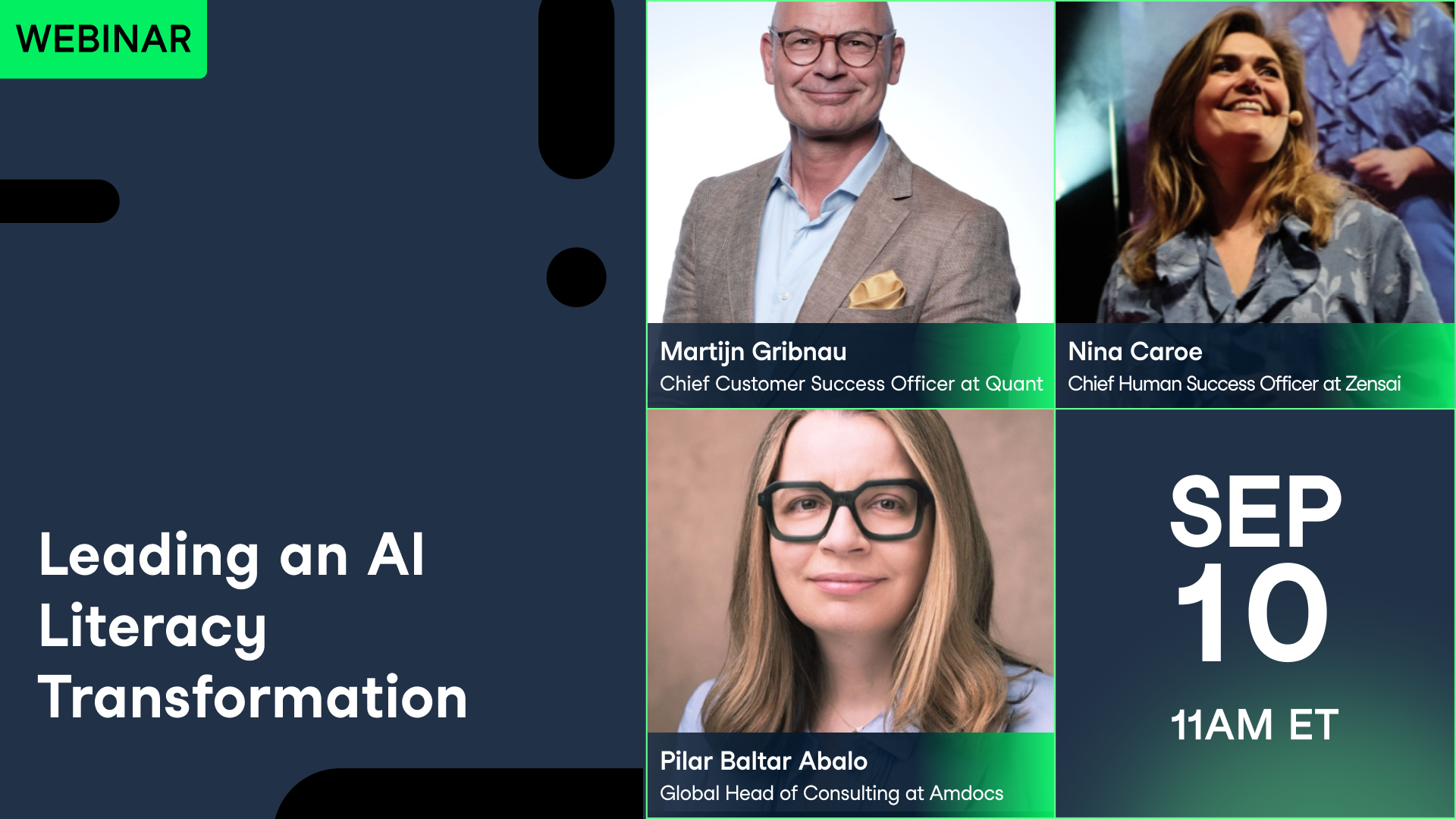
Your Presenter(s)

Martijn Gribnau
Chief Customer Success Officer at Quant

Martijn leads customer success at Quant, a New York-based AI firm specialising in agentic AI and digital employee technology. He has deep expertise in business transformation across banking, insurance, and tech. He is a TEDx speaker and award-winning customer advocate. Previously, he served as CEO of Volksbank in the Netherlands, COO and Chief Transformation Officer at Genworth Financial, and held senior roles at ING including CEO of ING Insurance in Hungary and Bulgaria.

Nina Caroe
Chief Human Success Officer at Zensai

Nina Caroe is Chief Human Success Officer at Zensai, where she leads a bold vision for the future of work—placing HR at the heart of strategy and culture. A co-founder of Valuebeat, acquired by Zensai, she previously led People & Culture at Dixa and held senior roles at Unity. With a background in HRM from Copenhagen Business School, Nina empowers HR leaders to build purpose-driven organizations where people thrive amid technological change.

Pilar Baltar Abalo
Global Head of Consulting at Amdocs

Pilar Baltar Abalo is Global Head of Consulting at Amdocs, where she partners with boards and executive teams to transform businesses through technology. With a career spanning Capgemini, Avanade, DXC Technology, and Nasstar, she brings deep expertise in large-scale programme management and technology-led transformation. She holds an MSc in Major Programme Management from the University of Oxford's Saïd Business School and advises organizations on AI strategy, digital change, and building future-ready operating models.
Summary
Most companies that say they are transforming with AI haven't actually finished, and few can say what "finished" would even look like.
That was the starting point for a DataCamp panel on leading AI transformation, part of the platform's AI and data literacy week. Richie Cotton hosted three guests who deal with this problem daily: Nina Caroe, chief human success officer at the HR platform Zensai; Pilar Baltar Abalo, global head of consulting at Amdocs; and Martijn Gribnau, chief enabling officer at the agentic automation company Quandt. Their shared position: employees picking up AI tools on their own is not transformation. Real transformation means rethinking how the business runs, and most organizations are still a step behind that.
The conversation covered what leadership has to own directly (a clear outcome, and using the technology themselves before asking anyone else to), why change management built around eventually reaching a stable state breaks down when the technology itself won't sit still, which skills matter when there's no comparable company to benchmark against, and how to avoid paying for AI activity instead of AI results. None of the three offered a finished playbook. All three agreed that waiting for one is itself the mistake.
Key Takeaways
- The best case study for AI transformation is usually already inside your own company: find the team or person quietly getting it right before looking for outside examples.
- True AI transformation means redesigning how the whole operating model works, not stacking individual use cases on top of processes built for a pre-AI business.
- Leaders who won't use AI themselves lose the standing to set its strategy, because decisions made without hands-on experience get overtaken by how fast the technology changes.
- Older change management assumed things would eventually settle into a new stable state; AI keeps changing, so psychological safety has to be built for permanent disruption instead.
- Paying people to use more AI without a defined outcome leads to what one panelist called "token maxing": burning budget on activity that doesn't produce value.
- The most useful skill right now isn't a technical one. It's knowing what to keep learning, what to hand off to AI, and what to let go of.
- Peer communities where colleagues show each other what they've built are outperforming formal AI training courses.
- One panelist's company is already routing 70% of customer contacts through an AI agent with no human involved, a sign of how quickly the stakes are rising.
Deep Dives
What Actually Counts as AI Transformation
Ask executives for an AI transformation success story and most will point outward, to some other company's press release. The panel argued that's the wrong place to look. Pilar Baltar Abalo described searching instead for what she calls positive deviation: pockets inside an organization that are already working in an AI-native way, whether anyone has noticed or not. "Rather than shining the light on this one company that already done it, which is not very useful because you don't really know where they started," she said, "it's actually going internally in your own company, in your own network, and look for the parts of the company that are already showing positive deviation." Sometimes, she added, you have to become that example yourself before anyone else in the company will.
Nina Caroe sees a similar split when she talks to customers of Zensai's HR platform. Most companies fall into one of two groups: those getting individual efficiency gains from AI tools, and a smaller set investing in bigger transformation projects tied to a new product or business line. Neither group, in her experience, is done. "There isn't many companies from before AI that has fully transformed yet," she said. Pilar agreed, comparing it to an earlier wave of change: "It's like the way I look at transformation... it's a process. It's not the destination that you can finish." When digital transformation arrived, she said, people asked the same question, are we done yet, and the answer was always no.
Martijn Gribnau drew a sharper line between improvement and transformation. Running a hundred successful AI pilots, he argued, doesn't add up to a transformed company if none of them touch how the business fundamentally works. "For me, transformation is when you use AI to revisit your strategy and really rethink your operating model," he said. "If that happens, you talk about a true transformation. For me, for the rest is just improvements." What makes this round different from the shift to digital, he added, is speed: the window to react has compressed so much that companies are forced to rethink their operating model rather than easing into change gradually.
The Leadership Mandate: Own the Outcome, Use It Yourself
Setting a direction for AI, in Pilar's view, starts with resisting the urge to measure adoption for its own sake. "If you're just measuring adoption, what are you measuring?" she asked. "Are you measuring that someone connects every day to your AI? Maybe there are asking about their fight with husband last night. You don't want to be measuring that." What she recommends instead is a single, outcome-based measure that a named person in the organization owns completely, including the downside. "You need to find a node in the organization that's going to move this that can own both" the benefit and the impact, she said, because it's easy to claim credit for the upside while leaving someone else to absorb the pain.
That ownership, in her framing, has to include direct, personal use of the technology. "This is not a technology that leaders will be able to sit out," she said. "They need to use it themselves." She compared it to a basic standard in her own life: "I don't serve people things I have not tasted. And I think AI is even more important," partly because assumptions about the technology can go stale within weeks. "You might make decisions on AI based on where the technology was two weeks ago, that are wrong today."
Nina described how this plays out inside her own company: a small group made up of the head of people, the CFO, and the technical lead, aligned around one shared metric, value created per employee, rather than a scatter of smaller initiatives. Martijn went further on how much authority leadership should hold. He generally prefers to delegate, joking that "the CEO doesn't stand for achieve everything officer." But on AI specifically, he's changed his position. "With a true breakthrough technology, I happen to believe that you really use force from the top to get it done, because everybody will be against it," he said, pointing to IT teams that insist they can build everything in-house and risk functions that reach for the brakes by default. "I tend to go to a direction that it needs more top down guidance than I would have thought in the past."
Psychological Safety When Nothing Stays Stable
Pilar's central argument on change management is that AI breaks the model most HR teams have relied on for decades. Past transformations, however disruptive, eventually settled: a new system went live, people adapted, and the change stopped. "In older transformations, we have changed, but people had islands of stability," she said. "The item that changed stayed... was stable. AI is not stable yet." That means employees who spend real effort mastering a tool or workflow can find it superseded within months, with no plateau in sight. Building safety around that kind of instability, she said, is a fundamentally different job than managing a single rollout.
Part of the difficulty, in her view, is a narrative problem the AI industry created for itself. "The narrative that has been created is a narrative that AI is anti-human, or superhuman," she said, and people have noticed. She recalled executives asking her, after a presentation, what their own children should study, a question she says she'd never been asked before AI. "When people ask you this, it's because they're afraid for their children... themselves maybe." Fear, she argued, is also bad for the work itself: "If you approach the technology with fear and not with curiosity, you're not going to find the great things about it. You might find the bad things about it, but definitely not the great things," because spotting new opportunities takes people with deep knowledge of the business who feel safe enough to be creative. "Creativity rarely comes from fear."
Nina was candid about experiencing that pressure herself, not just observing it in employees. "I go and I see my... colleague having done something with AI that I didn't speak about at all," she said. "And I think, oh, I'm not good enough with AI. Now I'm gonna be redundant." She also pointed out that leaders have lost their usual reference points: past benchmarks for growing a company no longer apply cleanly, so decisions increasingly rest on judgment rather than precedent. Martijn didn't dispute the scale of what's at stake: his own company already routes 70% of customer contacts through an AI agent, no human involved, but argued the honest response is to name that plainly rather than soften it. "It's a responsibility," he said. "I don't want to hide it."
The Skills That Matter Right Now
Asked what capability separates companies that adapt well from those that don't, Martijn named two: adaptability and comfort with ambiguity. "Making decisions with not perfect information" is, in his view, the most important skill of this period, because waiting for a complete plan means falling behind. "Winning is the organization which starts experiments and adapts the fast," he said. "Basically, you probably work by strategic intent, then just start experiments, adapt, learn, adapt, and learn towards that intent... at the same time, changing your intent."
Pilar added curiosity as a third pillar, then went further, arguing that self-awareness about learning itself is becoming the more important skill. "Acquiring awareness of your own learning, metacognitive skills," she said. "And that's not just about learning. It's also about what you choose to delegate, what skills you give up, which skills you take. It's going to be so important moving forward." She pointed to prompt engineering as a cautionary example: a role many treated as a durable career path a year ago, already reshaped by how the underlying models have changed.
On how to actually build these skills at scale, Pilar was direct that formal courses aren't the main lever. "It's not training. It's formation," she said, meaning something ongoing rather than a completed course. Her recommendation is peer communities that deliberately mix people from different job functions, so someone in HR can watch what a colleague in finance built and adapt the idea. "This is not for lone ranger," she said. "It's creating community, creating cohorts, and creating safe places with the right tools." She also flagged a real risk that communities need to guard against: unsupervised experimentation with agents can go wrong quickly, including agents that "end up deleting your production data." Richie noted the same pattern shows up across DataCamp's customer base. Training programs paired with a social element consistently see better results than courses alone.
Paying for AI: Cost Per Outcome, Not Cost Per Token
Budgeting for AI is unusually easy to get wrong in both directions, according to Pilar. "If you don't know what you're using AI for, it's always going to be too expensive," she said, but companies also can't sit out for fear of falling behind. Her fix is to establish a baseline before spending anything: measure the current cost of producing a given outcome under existing processes, then compare that to the cost of the same outcome under a new AI-enabled model. Without that baseline, she warned, incentives go wrong fast. "If you give incentives to use as many AI tokens as you can, you end up token maxing," she said. "If I give you a bunch of dollars and I tell you to burn them, you burn them." The deeper issue, she added, is that most finance functions still allocate cost per employee, a model that breaks down for organizations built around AI agents rather than headcount: "an agent is an economic factor," and there isn't yet an established way to budget for one.
Nina offered a concrete comparator from her own sector. AI-first software companies she benchmarks against generate roughly $2 million in revenue per employee, against roughly $200,000 at more traditional software companies, her own included. That gap, she argued, is the real pressure behind the push toward AI-enabled operating models. Not hype, but a plain competitiveness problem. She was careful to separate that from headcount cuts: "I wouldn't say that means it has to hurt the employees," she said, framing the priority as finding new revenue and new lines of business that AI makes possible, rather than only cutting cost. She did concede some short-term pain is likely as workers transition roles, comparing it to past industrial revolutions, while noting that overall employment has historically recovered as new jobs replaced old ones.
Martijn's version of the same discipline is to keep the number of active AI use cases small and give each one a fixed budget and a clear KPI, rather than spreading investment across many pilots at once. "You cannot do thousand use cases anyway," he said. "Have less use cases, give it a fixed budget, learn fast, fail fast." His preferred test for any new initiative is more radical: design the function as if it were being built from scratch today, with full use of AI, and ask how close the current organization is to that version.
Related
white paper
The Learning Leader's Guide to AI Literacy
Find out how learning leaders should be approaching AI literacy within their organization, focusing on the what, why, and how of fostering organization-wide AI literacy.webinar
AI Literacy in Action: Driving Workforce Transformation
Find out how to drive workforce transformation through AI literacy. You’ll learn how to increase AI adoption across the enterprise, align AI initiatives with strategic priorities, and redesign workflows to take full advantage of AI capabilities.webinar
Leading with AI: Leadership Insights on Driving Successful AI Transformation
C-level leaders from industry and government will explore how they're harnessing AI to propel their organizations forward.webinar
Driving AI Literacy in Organizations
Gain insight into the growing importance of AI literacy and its role in driving success for modern organizations.webinar
AI Literacy at Scale: Building a Future-Ready Workforce
Industry experts explore strategies for scaling AI literacy across diverse teams, bridging the gap between technical expertise and business understanding.webinar