Reskilling for AI in the Middle of Your Career
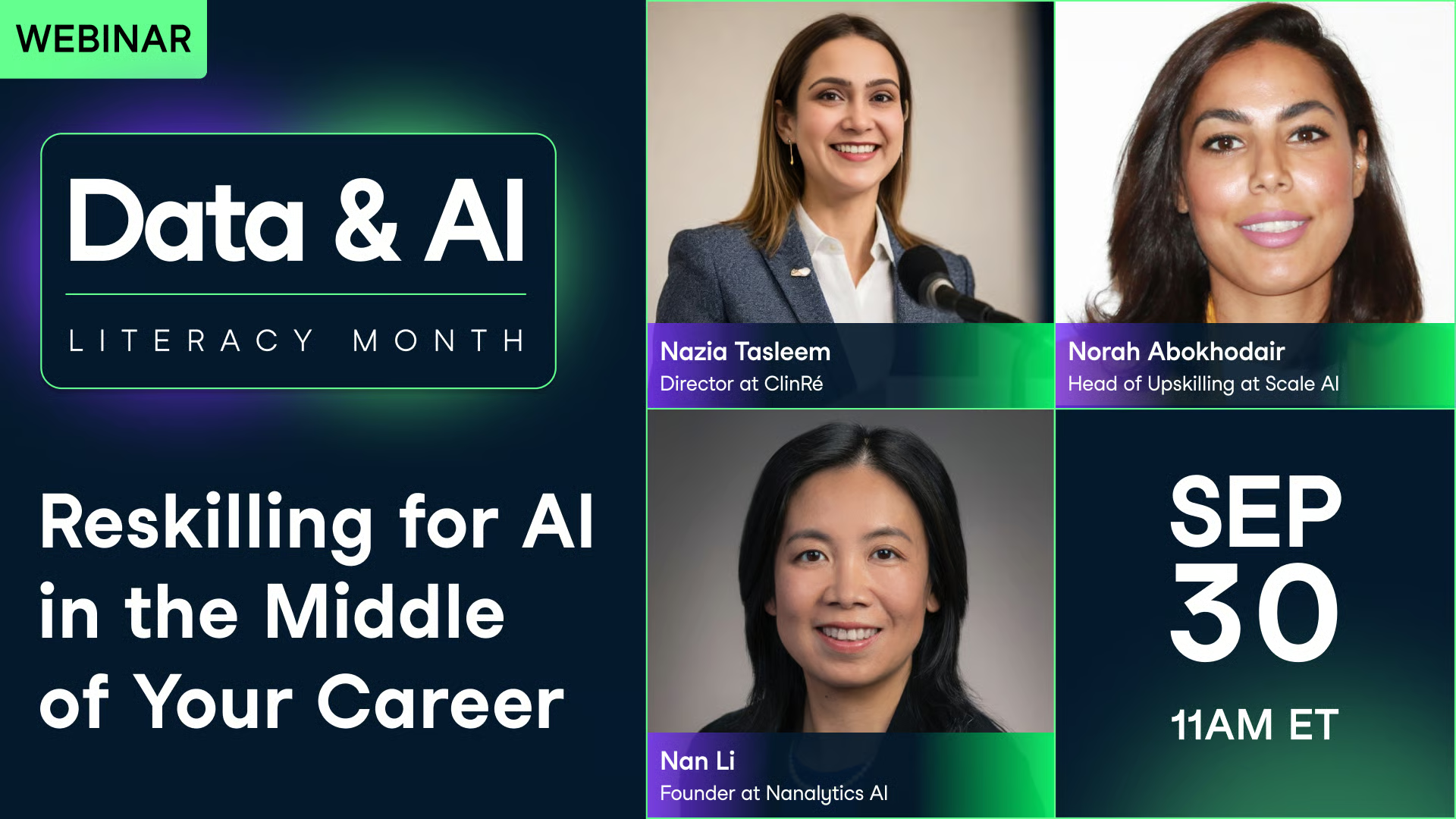
Your Presenter(s)

Nazia Tasleem
Director HR Technology & Data Strategy at ClinRé
Nazia Tasleem is Director of HR Technology & Data Strategy at ClinRé, where she turns AI, automation, and human-centered design into scalable people solutions. She has over 15 years leading HR transformation at Deloitte, Citi, Bank of America, and Pearson, spanning AI upskilling, responsible adoption frameworks, and data products that improve workforce planning and employee experience. A certified PMP with executive education in AI for People Management (Wharton), Nazia also serves on editorial boards and reviews for international journals. She’s passionate about helping mid-career professionals translate domain expertise into AI-enabled roles.

Norah Abokhodair, PhD
Head of Upskilling and AI Transformation at Scale AI
Norah leads the development of AI literacy programs and strategic workforce transformation initiatives to cultivate equitable and impactful AI fluency across global organizations. She champions human-centered AI ethics, inclusive design, and culturally-sensitive training, drawing on her PhD research in Arabic social media, UX, and technocultural studies. Norah frequently shares thought leadership on AI upskilling, ethics, and transformation trends at conferences and in industry publications, positioning her as a leading voice on bridging emerging AI technologies with responsible adoption frameworks. Previously, she worked as a Senior Program Manager at Microsoft Learning Innovation Studio, driving research and product strategy in personalization, AI fairness, and learning systems grounded in user experience design.

Nan Li
Founder at Nanalytics AI
Nan is a consultant and AI executive providing strategic guidance on AI transformation and human-centric AI Leadership. She is an advisor to Align AI, a co-founder of the Columbus Career+AI Community, and a member of the global editorial board of CDO Magazine. Previously, Nan was VP of AI, ML, & Statistics at Nationwide Insurance.
Session Resources
Summary
Reskilling for AI in the middle of your career is essential for staying relevant in today's rapidly evolving job market. This session is designed for mid-career professionals looking to integrate AI into their skillset.
AI skills are becoming essential across various professions, much like Excel in the 1990s. The session explored how AI can enhance existing skills, the importance of adaptability, and the potential career benefits of AI proficiency. It also highlighted the need for organizations to support AI learning and the challenges of integrating AI into legacy systems. The discussion included practical advice on building AI portfolios, leveraging existing skills, and finding time to learn amidst busy schedules.
Key Takeaways:
- AI skills are becoming a baseline expectation across professions.
- AI can automate repetitive tasks, allowing more time for strategic work.
- Mid-career professionals can utilize their domain expertise to integrate AI.
- Organizations should focus on pathways, not just courses, for AI training.
- Building an AI portfolio involves showcasing practical applications of AI in your work.
In-Depth Analysis
AI Skills as a Baseline Expectation
AI skills are increasingly seen as essential across various professions, akin to the role of Excel in the 1990s. For mid-career professionals, demonstrating the ability to work with AI signals adaptability and a forward-thinking mindset. As Norah Abokhodair noted, "AI skills today are what Excel was in the nineties." This shift means that professionals must integrate AI into their existing skill sets to remain competitive. AI can automate mundane tasks, freeing up time for more strategic and creative work, ultimately enhancing career progression.
Utilizing Existing Skills
Mid-career professionals have the advantage of domain expertise, which can be used to integrate AI effectively. As Nazia Tasleem emphasized, "You already have domain experience, process knowledge, and intuition." This experience allows professionals to frame problems accurately, discern signal from noise, and apply critical judgment to AI outputs. By combining existing knowledge with AI tools, professionals can enhance their productivity and decision-making capabilities, making them invaluable assets to their organizations.
Building an AI Portfolio
Creating an AI portfolio involves demonstrating practical applications of AI in your work. Nazia Tasleem suggested, "Make a list of all your deliverables, identify what is routine, and use AI to handle those tasks." This approach not only showcases your ability to integrate AI but also highlights your strategic thinking and problem-solving skills. Documenting these applications provides tangible evidence of your AI proficiency, which can be vital during performance reviews or job applications.
Organizational Support for AI Learning
Organizations play a vital role in facilitating AI learning. As Nazira pointed out, "AI adoption is a marathon, not a sprint." Companies should focus on creating pathways for learning rather than offering isolated courses. This involves aligning training with strategic goals and ensuring that employees have the resources and support needed to integrate AI into their roles. By encouraging a culture of continuous learning and adaptation, organizations can ensure that their workforce remains competitive in an AI-driven world.