Last chance! 50% off DataCamp Premium
Sale ends in
Natural Language Processing (NLP) stands as a pivotal technology in the realm of artificial intelligence, bridging the gap between human communication and computer understanding. It is a multidisciplinary domain that empowers computers to interpret, analyze, and generate human language, enabling seamless interaction between humans and machines. The significance of NLP is evident in its widespread applications, ranging from automated customer support to real-time language translation.
This article aims to provide newcomers with a comprehensive overview of NLP, its workings, applications, challenges, and future outlook.
Natural Language Processing (NLP) is a branch of artificial intelligence that focuses on the interaction between computers and humans through natural language. The objective is to program computers to process and analyze large amounts of natural language data.
NLP involves enabling machines to understand, interpret, and produce human language in a way that is both valuable and meaningful. OpenAI, known for developing advanced language models like ChatGPT, highlights the importance of NLP in creating intelligent systems that can understand, respond to, and generate text, making technology more user-friendly and accessible.
Let’s take a look at some of the mechanisms at work behind natural language processing. We’ve provided links to resources that can help you learn more about some of these key areas. For a detailed exploration, check out our Natural Language Processing in Python skill track.
Natural Language Processing is not a monolithic, singular approach, but rather, it is composed of several components, each contributing to the overall understanding of language. The main components that NLP strives to understand are Syntax, Semantics, Pragmatics, and Discourse.
Understanding these components is crucial for anyone delving into NLP, as they form the backbone of how NLP models interpret and generate human language.
To analyze and understand human language, NLP employs a variety of techniques and methods. Here are some fundamental techniques used in NLP:
Each of these techniques plays a vital role in enabling computers to process and understand human language, forming the building blocks of more advanced NLP applications.
Now that we have some of the basic concepts defined, let’s take a look at how natural language processing is used in the modern world.
Natural Language Processing has found extensive applications across various industries, revolutionizing the way businesses operate and interact with users. Here are some of the key industry applications of NLP.
NLP assists in transcribing and organizing clinical notes, ensuring accurate and efficient documentation of patient information. For instance, a physician might dictate their notes, which NLP systems transcribe into text. Advanced NLP models can further categorize the information, identifying symptoms, diagnoses, and prescribed treatments, thereby streamlining the documentation process, minimizing manual data entry, and enhancing the accuracy of electronic health records.
Financial institutions leverage NLP to perform sentiment analysis on various text data like news articles, financial reports, and social media posts to gauge market sentiment regarding specific stocks or the market in general. Algorithms analyze the frequency of positive or negative words, and through machine learning models, predict potential impacts on stock prices or market movements, aiding traders and investors in making informed decisions.
NLP-powered chatbots have revolutionized customer support by providing instant, 24/7 responses to customer inquiries. These chatbots understand customer queries through text or voice, interpret the underlying intent, and provide accurate responses or solutions. For instance, a customer might inquire about their order status, and the chatbot, integrating with the order management system, retrieves and delivers the real-time status, enhancing customer experience and reducing support workload.
NLP significantly enhances on-site search functionality in e-commerce platforms by understanding and interpreting user queries, even if they are phrased in a conversational manner or contain typos. For example, if a user searches for “blu jeens,” NLP algorithms correct the typos and understand the intent, providing relevant results for “blue jeans,” thereby ensuring that users find what they are looking for, even with imprecise queries.
In the legal sector, NLP is utilized to automate document review processes, significantly reducing the manual effort involved in sifting through vast volumes of legal documents. For instance, during litigation, legal professionals need to review numerous documents to identify relevant information. NLP algorithms can scan through these documents, identify and highlight pertinent information, such as specific terms, dates, or clauses, thereby expediting the review process and ensuring that no critical information is overlooked.
Beyond industry-specific applications, NLP is ingrained in our daily lives, making technology more accessible and user-friendly. Here are some everyday applications of NLP:
The applications of NLP are diverse and pervasive, impacting various industries and our daily interactions with technology. Understanding these applications provides a glimpse into the transformative potential of NLP in shaping the future of technology and human interaction.
Although natural language processing is an incredibly useful tool, it’s not without it flaws. Here, we look at some of the challenges we need to overcome, as well as what the future holds for NLP.
Natural Language Processing, despite its advancements, faces several challenges due to the inherent complexities and nuances of human language. Here are some of the challenges in NLP:
Researchers and developers are continually working to overcome these challenges, employing advanced machine learning and deep learning techniques to enhance the capabilities of NLP models and make them more adept at understanding human language.
Check out our NLP with spaCy course to discover how to build advanced natural language understanding systems using machine learning approaches.
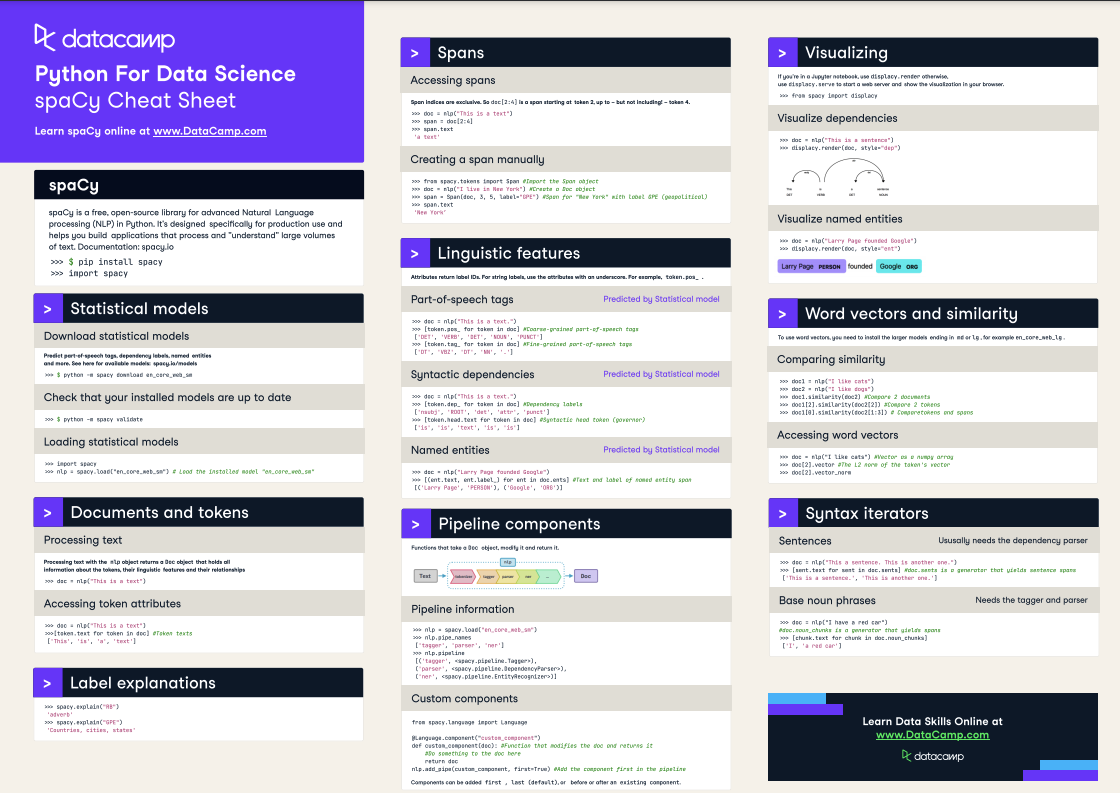
The spaCy cheat sheet shows some advanced NLP techniques
The future of Natural Language Processing is promising, with ongoing research and developments poised to further enhance its capabilities and applications. Here are some emerging trends and future developments in NLP:
The exploration of challenges provides insights into the complexities of NLP, while the glimpse into the future highlights the potential advancements and the evolving landscape of Natural Language Processing.
For those eager to delve into Natural Language Processing, DataCamp offers a range of courses and tutorials specifically designed to provide in-depth knowledge and hands-on experience in NLP. Here are some examples:
These courses, along with other tutorials available on DataCamp, can provide newcomers with the foundational knowledge and practical skills needed to explore and contribute to the field of Natural Language Processing.
Natural Language Processing is a revolutionary field in artificial intelligence, enabling computers to understand, interpret, and generate human language, thereby fostering seamless interactions between humans and machines.
This article has traversed the realms of NLP, providing insights into its definition, components, techniques, applications, challenges, and the future landscape. The applications of NLP are multifaceted, spanning across various industries and embedding into our daily technological interactions, making it a crucial aspect of modern AI.
For those intrigued by the capabilities and potential of NLP, a journey of exploration and learning awaits. DataCamp’s Natural Language Processing in Python Track is an excellent starting point to delve deeper into this transformative domain.
Start Your NLP Journey Today!
แทร็ก
บล็อก
Laiba Siddiqui
13 นาที
บล็อก
Dimitri Didmanidze
7 นาที
บล็อก
Travis Tang
15 นาที
บล็อก
Vinod Chugani
14 นาที
บทแนะนำ
DataCamp Team
13 นาที
บทแนะนำ
Moez Ali
12 นาที