

二叉搜索树中的失衡
二叉搜索树(BST)是一种遵循特定顺序组织数据的二叉树数据结构。每个节点包含一个值,并最多连接两个其他节点:其左子节点和右子节点。在 BST 中,规则是左子节点的值必须小于其父节点的值,右子节点的值必须大于其父节点的值。
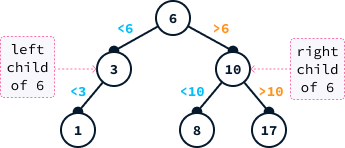
BST 在查找特定值时非常高效,因为它允许我们在搜索过程中排除树的大部分。例如,如果我们要在上图的树中查找值 1,我们可以忽略 6 右侧的所有节点。这是因为有序性保证了这些值都大于 6。
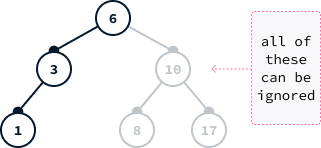
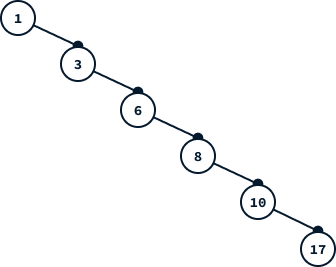
理想情况下,每个节点都应将数据一分为二,使得每向下走一步就能排除一半的值,从而实现极快的查找。然而,根据插入顺序的不同,可能会得到一个无法有效分割数据的失衡树。例如,从小到大顺序插入会得到一棵线性树,其性能不比列表更好。
什么是 AVL 树
AVL 树是在二叉搜索树基础上增加了如下性质:
对每个节点而言,其左、右子树的高度差最多为 1。
拆解这个定义:左子树包含该节点左侧的所有节点,右子树包含其右侧的所有节点。树的高度定义为从根节点(最顶层节点)到任意叶子(无子节点)之间最长路径的长度。
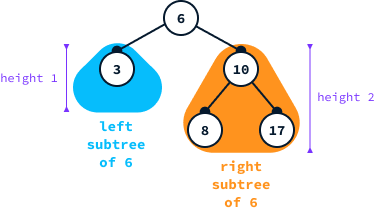
节点的平衡因子计算为其左子树与右子树的高度差:
balance(N) = height(N 的左子树) - height(N 的右子树)
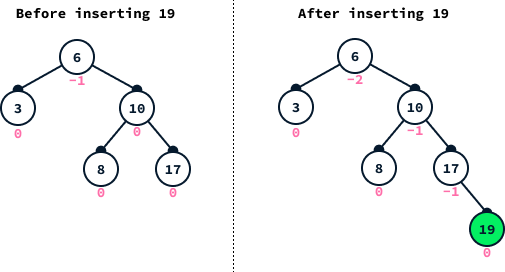
例如,balance(6) = 1 - 3 = -2。
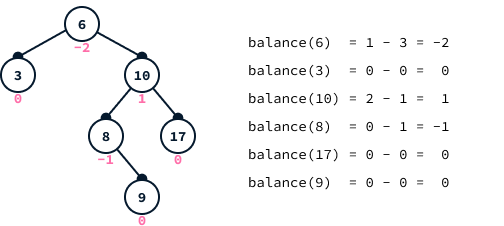
在图中,节点6的平衡因子为 -2,表明该树不符合 AVL 树的标准。要被视为 AVL 树,每个节点的平衡因子必须是 -1、0 或 1。
为何使用 AVL 树
二叉搜索树中查询的效率取决于树的高度。在最坏情况下,需要检查的节点数等于树的高度。BST 的关键问题在于树的高度可能与节点数量相当,也就是说一次查询可能需要检查每一个节点。
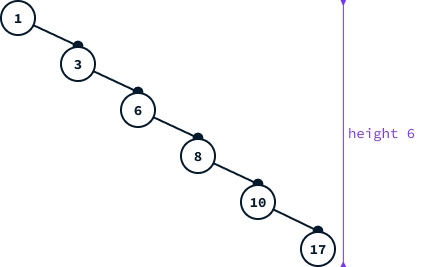
令 M(h) 表示要使二叉搜索树达到高度 h 所需的最少节点数。对简单的 BST,我们观察到 M(h) = h,即用 h 个节点即可达到高度 h。这意味着 BST 的高度会随节点数线性增长,导致查询时间与数据集规模成正比。
AVL 树具有对数高度的证明
考虑要构造一棵高度为 h 的 AVL 树所需的最少节点数 M(h)。由于是 AVL 树,需要注意每个节点的平衡因子只能是 -1、0 或 1。
然而,在我们假设为了达到高度 h 使用尽可能少的节点时,根的平衡不可能为 0。否则,我们可以从左侧或右侧移除一个节点,使其平衡变为 -1 或 1,仍然是有效的 AVL 树。
假设根的平衡为 1(若为 -1,推理是对称的)。这意味着树的结构如下:
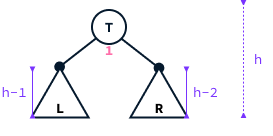
另一方面,左右子树也必须分别是高度各自最小节点数的 AVL 树(否则还可以继续移除节点)。整棵树的节点总数等于 1(根)加上左子树节点数再加上右子树节点数。
M(h) = 1 + (L 中的节点数) + (R 中的节点数) = 1 + M(h - 1) + M(h - 2)
随着高度增长,为达到该高度需要更多节点。因此:
M(h - 1) > M(h - 2)
结合两者,可得:
M(h) = 1 + M(h - 1) + M(h - 2) > 1 + 2 × M(h - 2) > 2 × M(h - 2)
我们可重复应用该不等式 h/2 次,直到达到 M(1) = 1 或 M(2) = 2:
M(h) > 2 × M(h - 2) > 2 × 2 × M(h - 4) > 2 × 2 × 2 × M(h - 6) > … > 2(h/2)
为便于理解,下图给出了 h = 7 与 h = 6 时的具体示例:
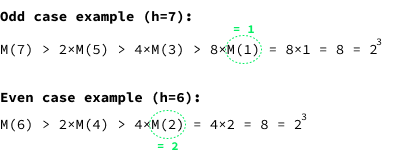
我们得出结论:高度为 h 的 AVL 树所需的最少节点数至少为2(h/2):
M(h) > 2(h/2)
两边取以 2 为底的对数,得到:
log2(M(h)) > log2(2(h/2)) = h/2
因此,两边乘以 2 可得:树高至多为节点数量的以 2 为底对数的两倍:
2 × log2(M(h)) > h
我们已经证明:
包含 N 个节点的 AVL 树的高度至多为 2 × log2(N)。
这意味着在 AVL 树中进行查询只需检查数据集中的很小一部分。比如,若有 10 亿条记录,其对数约为 30,这意味着即便有 10 亿个数据点,找到某一条记录也只需检查约 60 个数据点。与最坏情况下需要检查全部 10 亿个数据点的 BST 相比,这是一项显著提升。
如需进一步了解算法的时间复杂度,以及线性时间复杂度与对数复杂度的差异,请参阅这篇关于大 O 表示法与时间复杂度的博文。
用 AVL 树维持平衡
AVL 树通过强制每个节点的平衡因子为 -1、0 或 1 来保证快速查询。为确保每个节点的平衡得以维持,我们需要在插入新值后对树进行再平衡。
在二叉搜索树中,插入操作是从根节点沿路径向下进行。待插入值较小时向左走,否则向右走。
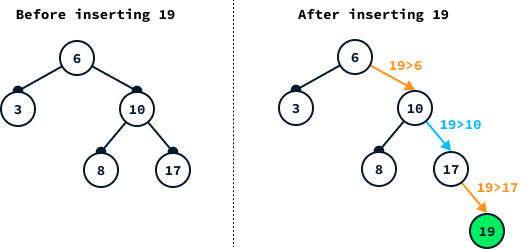
一次插入最多会使高度增加 1。因此,如果插入后不满足平衡性质,意味着原本平衡为 -1 的某个节点现在变为 -2,或原本为 1 的节点现在变为 2。上例就是第一种情况。
单旋转
为恢复平衡,我们依赖树旋转操作。对节点A 进行左旋会将A向左旋转,从而重组树,如下所示:
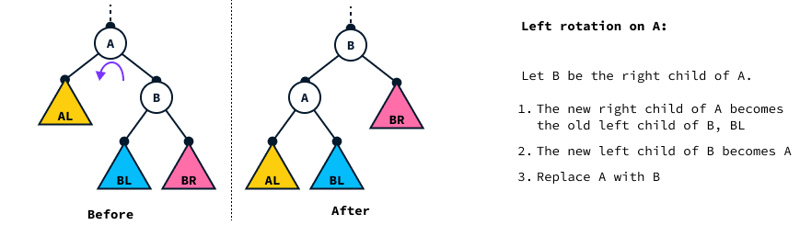
在该示意图中:
BL表示B的左子树BR表示其右子树AL表示A的左子树
注意旋转后,节点的有序性仍然成立:
- 节点
A小于B,因为B原本是它的右子节点。 - 位于
BL的节点都大于A,因为它们位于A的右侧。 - 位于
AL的节点都小于B,因为它们小于A。
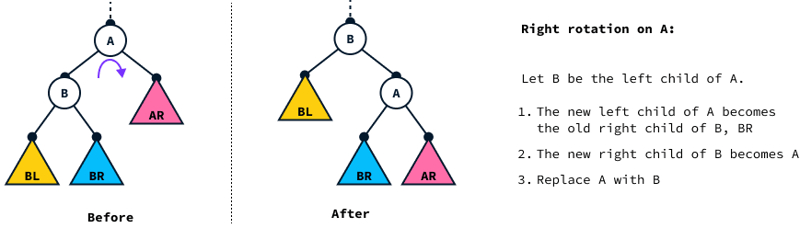
右旋与此对称,通过将A向右旋转实现。
让我们通过一个具体示例来修复插入19后出现的失衡:对节点6执行一次左旋。
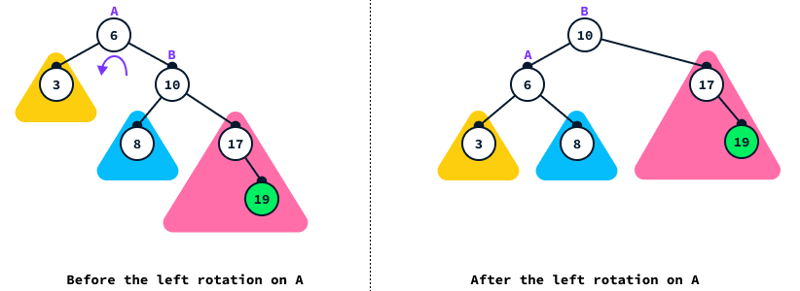
插入后,我们通过旋转平衡因子为 -2 或 2 的节点来修复失衡。本例中,节点6的平衡因子为 -2,表示树向右倾斜,因此我们进行了左旋(与失衡方向相反的方向)。若平衡因子为 2,则应使用右旋。
双旋转
在前一个示例中,整棵树完全向右倾斜,因此一次左旋即可恢复平衡。但在某些情况下,会出现“之”字形失衡:树向一侧倾斜,而其子树朝相反方向倾斜。为此,我们回到插入19之前的原始树,改为插入7:
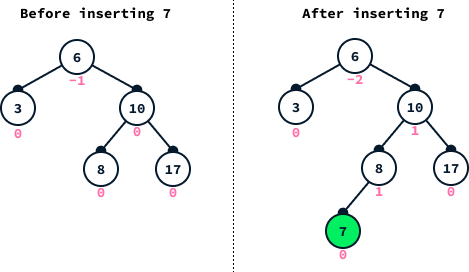
此时,整棵树仍向右倾斜,但以10为根的子树却向左倾斜。这种情况下,我们需要先将节点10右旋:
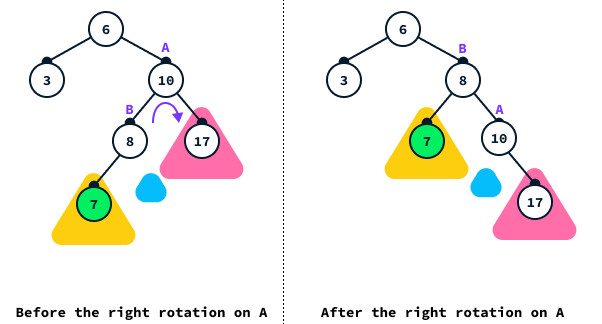
注意节点 B 没有右子节点。我们仍在图中用蓝色显示,以便于可视化。
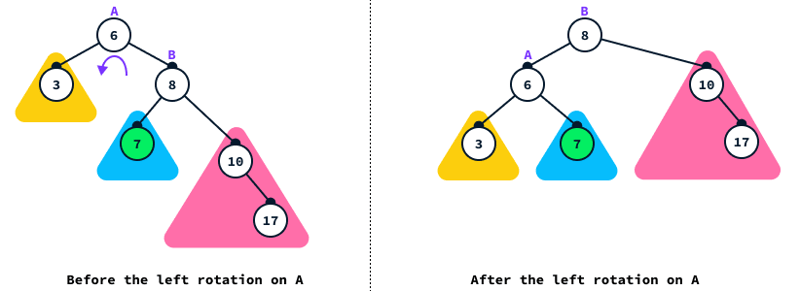
完成右旋后,回到之前的情形:对6做一次左旋即可恢复平衡:
如何在 Python 中实现 AVL 树
先从节点实现开始。
节点实现
树中的每个节点包含五个属性:
- 其存储的值(
self.value) - 父节点(
self.parent) - 左子节点(
self.left) - 右子节点(
self.right) - 以该节点为根的子树高度(
self.height)
class Node:
def __init__(self, value, parent = None):
self.value = value
self.parent = parent
self.left = None
self.right = None
self.height = 1我们用值 None 表示缺失的节点。默认 height 设为 1,因为仅包含单个节点的树高度为 1。
为方便树的实现,我们在 Node 类中引入若干方法。
# Inside the Node class
def left_height(self):
# Get the heigth of the left subtree
return 0 if self.left is None else self.left.height
def right_height(self):
# Get the height of the right subtree
return 0 if self.right is None else self.right.height
def balance_factor(self):
# Get the balance factor
return self.left_height() - self.right_height()
def update_heigth(self):
# Update the heigth of this node
self.height = 1 + max(self.left_height(),self.right_height())
def set_left(self, node):
# Set the left child
self.left = node
if node is not None:
node.parent = self
self.update_heigth()
def set_right(self, node):
# Set the right child
self.right = node
if node is not None:
node.parent = self
self.update_heigth()
def is_left_child(self):
# Check whether this node is a left child
return self.parent is not None and self.parent.left == self
def is_right_child(self):
# Check whether this node is a right child
return self.parent is not None and self.parent.right == self注意我们使用 .set_left() 与 .set_right() 方法分别设置左右子节点。之所以不直接修改 self.left 与 self.right,是因为每当变更子节点时,都需要同时更新新子节点的父节点以及当前节点的高度。
AVL 树实现
AVL 树维护一个参数:树的根,即最顶层节点。
class AVLTree:
def __init__(self):
self.root = None为维持树的平衡,我们需要实现左右旋。先回顾左旋在示意图中的呈现方式:
# Inside the AVLTree class
def rotate_left(self, a):
b = a.right
# 1. The new right child of A becomes the left child of B
a.set_right(b.left)
# 2. The new left child of B becomes A
b.set_left(a)
return b # 3. Return B to replace A with it右旋的实现是对称的:
# Inside the AVLTree class
def rotate_right(self, a):
b = a.left
a.set_left(b.right)
b.set_right(a)
return b借助旋转,我们可以对树进行再平衡。当节点的平衡因子达到 2(树左倾)或 -2(树右倾)时,需要对该节点进行再平衡。总体上有四种情形需要处理:
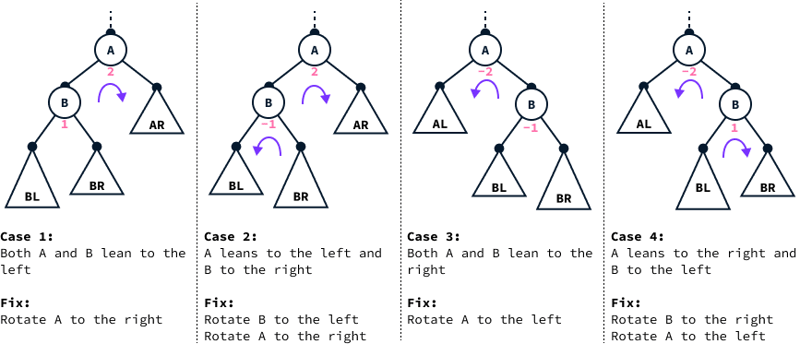
我们在 .rebalance() 方法中实现上述四种情况。
# Inside the AVLTree class
def rebalance(self, node):
if node is None:
# Empty tree, no rebalancing needed
return None
balance = node.balance_factor()
if abs(balance) <= 1:
# The node is already balanced, no rebalancing needed
return node
if balance == 2:
# Cases 1 and 2, the tree is leaning to the left
if node.left.balance_factor() == -1:
# Case 2, we first do a left rotation
node.set_left(self.rotate_left(node.left))
return self.rotate_right(node)
# Balance must be -2
# Cases 3 and 4, the tree is leaning to the left
if node.right.balance_factor() == 1:
# Case 4, we first do a right rotation
node.set_right(self.rotate_right(node.right))
return self.rotate_left(node)请注意,在每种情况下,该方法都会返回刚刚完成平衡的子树的根。稍后在再平衡过程中,将使用这个新的子树根来更新父节点的子链接。
向 AVL 树添加节点与普通 BST 类似,但在插入后多了恢复平衡的步骤。在 BST 中添加节点时,我们从根开始向下遍历,每一步将待添加值与当前节点值比较。若更小则向左,否则向右。向下遍历时,要记录父节点,以便将新节点插入为其子节点。
当到达空位置时,有两种情况:
- 父节点为None,说明树为空,则新节点成为根节点。
- 已找到父节点,则根据节点值将新节点设置为其左或右子节点。
# Inside the AVLTree class
def add(self, value):
self.size += 1
parent = None
current = self.root
while current is not None:
parent = current
if value < current.value:
# Value to insert is smaller than node value, go left
current = current.left
else:
# Value to insert is larger than node value, go right
current = current.right
# We found the parent, create the new node
new_node = Node(value, parent)
# Case 1: The parent is None so the new node is the root
if parent is None:
self.root = new_node
else:
# Case 2: Set the new node as a child of the parent
if value < parent.value:
parent.left = new_node
else:
parent.right = new_node
# After a new node is added, we need to restore balance
self.restore_balance(new_node)BST 的 .add() 方法与 AVL 树的唯一区别在最后一步:从新插入的节点开始一路回溯到根,逐个对节点调用 .rebalance() 来恢复平衡。
# Inside the AVLTree class
def restore_balance(self, node):
current = node
# Go up the tree and rebalance left and right children
while current is not None:
current.set_left(self.rebalance(current.left))
current.set_right(self.rebalance(current.right))
current.update_heigth()
current = current.parent
self.root = self.rebalance(self.root)
self.root.parent = None注意:当节点已处于平衡状态时,.rebalance() 方法不会做任何改动——它会直接返回该节点本身。因此,在向上回溯时,我们可以同时对左右子树调用它,尽管只有一侧可能失衡,另一侧的调用不会改变树。
回想我们将 .rebalance() 设计为返回(可能已经变化的)子树根节点,其目的正是为了在向上恢复平衡的过程中,更新当前节点的左右子链接。
下图展示了 .restore_balance() 在树上向上执行的步骤。
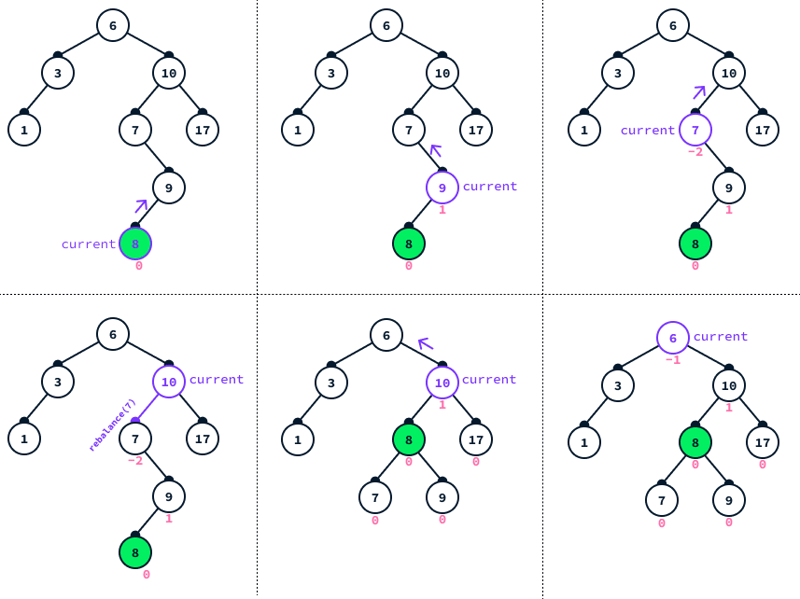
在该示例中,我们先添加节点8。随后,从该节点开始恢复平衡,并沿树向上逐一检查与再平衡每个遇到节点的左右子树,直至到达节点10。在此之前,对 .rebalance() 的调用均无效果,因为这些节点都处于平衡状态。
然而,当到达节点10时,观察到其左子节点7的平衡因子为 -2,需要进行再平衡。因此调用 .rebalance(7),从而用新的左子树根节点8替换节点10的左子节点,进而恢复树的平衡。
AVL 树的其他操作
除了在保持平衡的前提下进行插入与删除,AVL 树还支持若干其他关键操作。
最小值与最大值
由于 BST 的有序性,最小值位于树的最左侧节点,最大值位于最右侧节点。
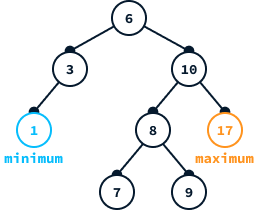
我们实现了两个辅助函数,用于从给定节点开始找到最左与最右的节点。这些函数有助于实现节点删除。
# Inside the AVLTree class
def leftmost(self, starting_node):
# Find the leftmost node from a given starting node
previous = None
current = starting_node
while current is not None:
previous = current
current = current.left
return previous
def minimum(self):
# Return the minimum value in the tree
if self.root is None:
raise Exception("Empty tree")
return self.leftmost(self.root).value# Inside the AVLTree class
def rightmost(self, starting_node):
# Find the rightmost node from a given starting node
previous = None
current = starting_node
while current is not None:
previous = current
current = current.right
return previous
def maximum(self):
# Fidn the maximum value in the tree
if self.root is None:
raise Exception("Empty tree")
return self.rightmost(self.root).value包含关系
要判断树中是否包含某个特定值,我们利用树的有序性引导搜索。从根开始,若目标值小于当前节点则向左,否则向右。若走到树的尽头仍未找到,即表明该值不存在于树中。
为便于此过程,我们实现了辅助方法 .locate_node()。它不仅适用于查找,也适用于删除等操作。此外,我们实现了 .__contains__(),从而可使用 in 运算符简化包含性检查。
# Inside the AVLTree class
def locate_node(self, value):
# Returns the node containing a given value or None if no
# such node exists
current = self.root
while current is not None:
if value == current.value:
return current
if value < current.value:
current = current.left
else:
current = current.right
return None
def __contains__(self, value):
node = self.locate_node(value)
return node is not None删除
当待删节点位于树的中间位置时,在 AVL 树中删除会尤为棘手。若该节点是叶子(无子节点),只需根据其是左子还是右子,将父节点的对应指针设为 None 即可删除。
当待删节点是树根时属于特殊情况,此时可将根设为 None 以删除该节点。
# Inside the AVLTree class
def delete_leaf(self, node):
if node.parent is None:
self.root = None
elif node.is_left_child():
node.parent.left = None
node.parent = None
else:
node.parent.right = None
node.parent = None要从 AVL 树中删除一个值,首先需使用 .locate_node() 定位包含该值的节点。若其为叶子节点,可用 .delete_leaf() 删除。若不是叶子,直接移除会破坏树的结构。此时需要寻找合适的替代节点:若待删节点有左子,则选择其左子树中的最右节点。这样可确保维持树的有序结构。
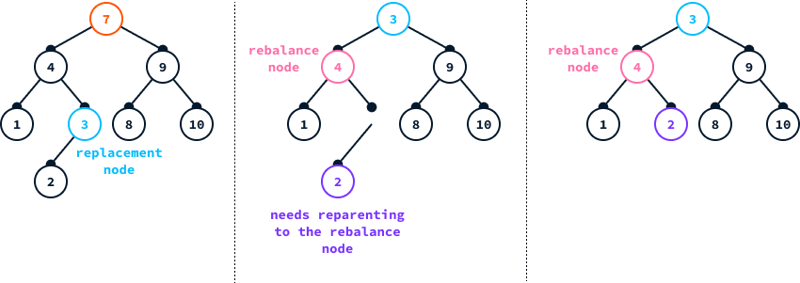
下图演示了从树中删除节点 10 的过程。由于它有左子节点,我们用左子树中的最右节点替换之。完成替换后,应从新替换节点的父节点开始对树进行再平衡。
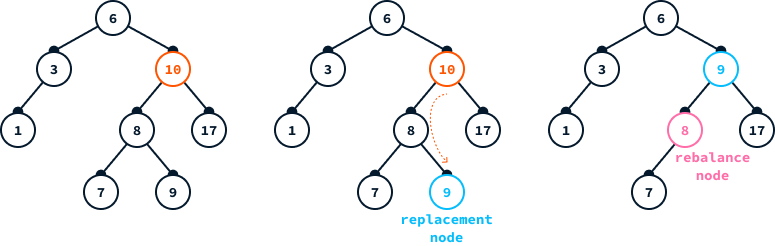
在该示例中,替代节点是叶子节点。但如果替代节点有子节点,需要将这些子节点重新挂接到替代节点的父节点上。由于替代节点是极值节点(最左或最右),它至多只有一个子节点,因此总能完成此类重新挂接。
# Inside the AVLTree class
def delete(self, value):
# Delete a value from the tree
node = self.locate_node(value)
if node is None:
raise Exception("Value not stored in tree")
replacement = None
rebalance_node = node.parent
if node.left is not None:
# There's a left child so we replace with rightmost node
replacement = self.rightmost(node.left)
# Check if reparenting is needed
if replacement.is_left_child():
replacement.parent.set_left(replacement.left)
else:
replacement.parent.set_right(replacement.left)
elif node.right is not None:
# There's a right child so we replace with the leftmost node
replacement = self.leftmost(node.right)
# Check if reparenting is needed
if replacement.is_left_child():
replacement.parent.set_left(replacement.right)
else:
replacement.parent.set_right(replacement.right)
if replacement:
# We found a replacement so replace the value
node.value = replacement.value
rebalance_node = replacement.parent
else:
# No replacement so it means the node to delete is a leaf
self.delete_leaf(node)
if rebalance_node is not None:
self.restore_balance(rebalance_node)范围查询
范围查询用于找出所有位于两个给定值之间的值。由于 AVL 树的有序性,我们可以高效地定位这些值。
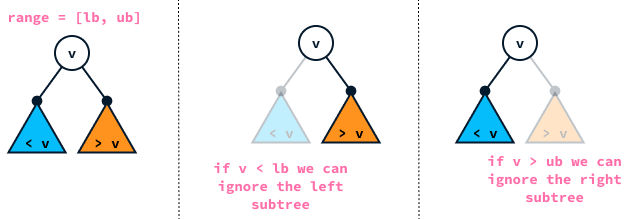
为查找下界 lb 与上界 ub 之间的所有值,我们采用递归遍历。对每个遇到的节点,若其值落在区间内,则将其加入结果;随后继续探索其左右子树。
若节点值小于下界,则忽略其左子树,因为左子树中的所有值都更小。同理,若节点值大于上界,则忽略其右子树,因为右子树中的所有值都会更大。
def search(self, node, lb, ub, results):
# Search for values between lower bound and upper bound
if node is None:
return
if lb <= node.value and node.value <= ub:
results.append(node.value)
if node.value >= lb:
self.search(node.left, lb, ub, results)
if node.value <= ub:
self.search(node.right, lb, ub, results)
def range_query(self, lb, ub):
# Search for values between lower bound and upper bound
results = []
self.search(self.root, lb, ub, results)
return results其他自平衡树
我们已经实现了一棵 AVL 树,能够执行以下操作:
- 添加一个值
- 删除一个值
- 查找一个值
- 查询最小值与最大值
- 查询位于两个值之间的所有值
avltree 包提供了具备这些能力的 Python 实现。
其他自平衡二叉搜索树(如红黑树、伸展树与 B 树)也提供类似功能。总体而言,它们在大多数应用中的性能相近,因为都能保证对数级的高度。不过,AVL 树平衡更精细,优化了查找操作,但由于需要更严格的再平衡,插入可能稍慢。
伸展树在最近访问的元素会被频繁重用的场景中尤为有效,因此非常适合用作缓存的实现。
B 树专为磁盘而非内存中的高效操作而设计,适合管理超出内存容量的大型数据集,例如用于创建数据库索引。
进一步改进
我们的实现还有多种改进空间。以下是一些练习建议,以加深您对 AVL 树的理解:
- 当前实现中,节点只存储单个值。若用作数据库索引,需要存储整行数据,因为该值对应表的一列。我们可以改进实现,使 AVL 树像字典一样,将值映射到相应的数据行。
- 我们的实现不支持重复值,不过可以修改以允许多个节点共享同一值。
- 典型的 AVL 树多采用递归实现。我们刻意回避递归,以免依赖对递归概念的深入理解。虽然递归实现通常更优雅简洁,但需要对递归有扎实把握。
结语
BST 是一种遵循特定顺序组织数据的二叉树数据结构。这样的组织能够避免在查找特定值时检查整个数据集。然而,BST 可能失衡,导致性能退化,在某些情形下甚至需要检查整个数据集。
AVL 树通过旋转强制施加额外的平衡性质,从而解决这一问题。这些性质确保树的高度相对于数据集大小保持对数级,带来显著改进。
对数时间复杂度相较线性时间复杂度是巨大的提升,使 AVL 树在查询方面极其高效。即使面对数十亿条记录,AVL 树也只需检查极少的数据点即可定位元素,效率远胜一筹。

二叉搜索树(BST)是一种强大的数据结构,用于组织信息,便于高效搜索与取值。然而,标准 BST 可能会失衡,在某些场景下导致性能下降。
AVL 树(以其发明者 Adelson-Velsky 和 Landis 命名)通过不受插入顺序影响地保持平衡来解决这一问题。即使在大型数据集上,也能确保始终快速的搜索操作。
阅读完本文,您将了解如何用 Python 实现 AVL 树,并将其用于高效的数据查找。
本文假定您对二叉搜索树(BST)已有一定了解,因为 AVL 树是在其基础上的扩展。如需快速回顾,请参阅这篇关于二叉搜索树(BST)的简介。
在深入讨论 AVL 树之前,我们先了解它要解决的问题。