Code along with us on
Code Along ↗Sloth or Pastry? Using PyTorch and Deep Learning for Image Classification
In this session, using DataCamp Workspace we'll learn all about loading custom datasets into PyTorch and using transfer learning to perform an image processing task using a mostly-pretrained model, which we'll fine-tune.

Maham Khan
Create Your Free Account
Practice and track your progress.
Continue with GoogleBy continuing, you accept our Terms of Use, our Privacy Policy and that your data is stored in the USA.Related
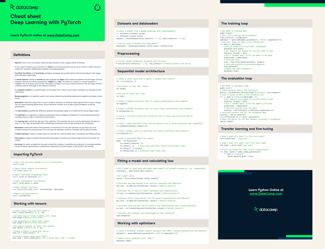
cheat sheet
Deep Learning with PyTorch Cheat Sheet
Learn everything you need to know about PyTorch in this convenient cheat sheet
 Richie Cotton · 6 min

Tutorial
Keras Tutorial: Deep Learning in Python
This Keras tutorial introduces you to deep learning in Python: learn to preprocess your data, model, evaluate and optimize neural networks.
 Karlijn Willems · 15 min

code-along
Image Classification with Hugging Face
Deep dive into open source computer vision models with Hugging Face and build an image recognition system from scratch.
 Priyanka Asnani






In the age of deep learning, data scientists and machine learning engineers seldom create and train neural networks from scratch. A big chunk of what goes into performing a machine learning task, however, is collecting, preparing, and loading data to feed into a model.
In this session, using DataLab we'll learn all about loading custom datasets into PyTorch and using transfer learning to perform an image processing task using a mostly-pretrained model, which we'll fine-tune.
We'll be using computer vision to answer the internet-popular question: is it a sloth or a pain au chocolat? This is a binary image classification task.
Key takeaways