
One week. 700+ courses for $0. No credit card needed.
Start Now

실습 문제하고 트랙하세요.
Google로 계속하기계속 진행하시면 다음 사항에 동의하는 것으로 간주됩니다: 이용약관 및 개인정보 처리방침 그리고 귀하의 데이터가 미국에 저장된다는 점에 동의하는 것으로 간주됩니다.In this section, we’ll go over cloud computing interview questions you might be asked to gauge your general knowledge.
The following table sums up the differences between IaaS, PaaS, and SaaS:
|
Service Model |
Key Features |
Examples |
|
IaaS |
Virtualized computing resources over the cloud. Users manage OS, apps, and data. |
AWS EC2, Google Compute Engine. |
|
PaaS |
Development platforms to build, test, and deploy apps. The provider manages the infrastructure. |
AWS Elastic Beanstalk, Google App Engine. |
|
SaaS |
Software delivered via the internet. Users only interact with the application interface. |
Google Workspace, Salesforce. |
Cloud bursting refers to using a public cloud to handle peak workloads when private cloud capacity is insufficient.
Benefits:
Here is a list of common threats and their mitigation strategy:
|
Threat |
Mitigation Strategy |
|
Data Breaches |
Encrypt data, use strong IAM policies, and monitor logs. |
|
Account Hijacking |
Enable MFA and monitor for unusual login attempts. |
|
Denial of Service attacks |
Deploy scalable architectures and use CDNs. |
|
Insider Threats |
Conduct regular audits and enforce role-based access. |
Public and private clouds both have their pros and cons.
|
Public Cloud |
Private Cloud | |
|
Advantages |
Cost-effective, scalable, accessible globally. |
Greater control, enhanced security, compliance-ready. |
|
Disadvantages |
Limited control, potential latency. Potentially higher long term cost. |
High upfront costs, less scalability. |
To learn more, I recommend reading this blog on private cloud vs. public cloud.
Virtualization creates virtual instances of applications in the form of virtual machines or containers. This enables multiple systems to share resources efficiently and allows applications to be deployed in different environments easily. This is one of the foundations of cloud computing and allows for dynamic allocation of resources, flexibility, and scalability.
Here’s an example of code for launching VMs in AWS:
# Using AWS CLI to launch an EC2 instance
aws ec2 run-instances \
--image-id ami-123456 \
--count 1 \
--instance-type t2.micro \
--key-name MyKeyPairThere are many components to consider when choosing a cloud provider, but the main ones include:
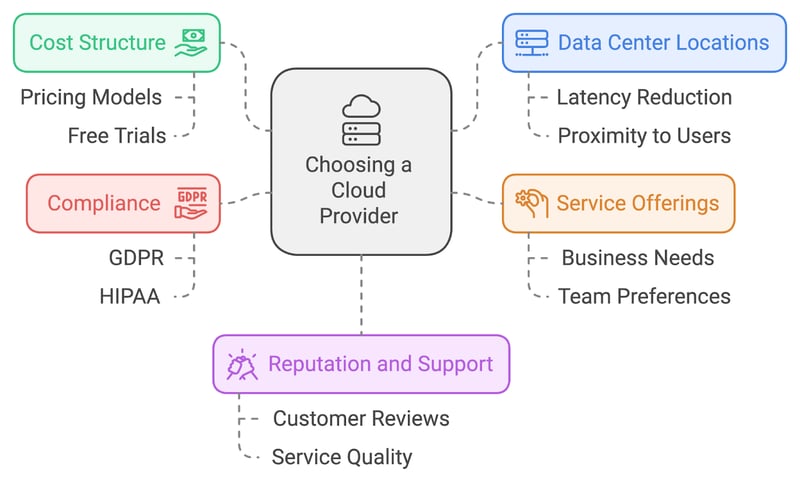
Here are some of the best practices to ensure data integrity and availability in a cloud environment:
These questions explore specific cloud technologies and best practices, testing your ability to solve more complex cloud-related problems.
Serverless computing is a cloud execution model where the cloud provider manages infrastructure, scaling, and resource allocation, allowing developers to focus solely on writing code. This eliminates the need to manage servers explicitly.
Key features of serverless computing include pay-per-use pricing models, automatic scaling, and no server maintenance.
Use cases for serverless computing include:
There are a few strategies that can be implemented to optimize cloud costs.
To learn more about cost optimization on AWS, I recommend this course on AWS Security and Cost Management.
Ensuring disaster recovery and business continuity is a multi-step process. There are a few things to put in place to approach it systematically:
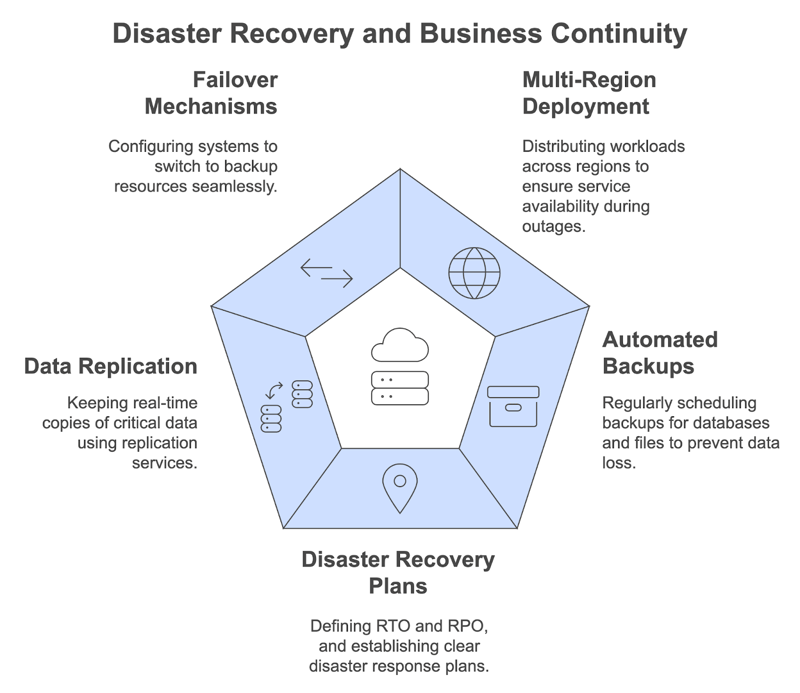
Containers are lightweight, portable environments that package applications and dependencies together.
Orchestration tools manage containerized applications at scale, handling tasks like deployment, scaling, and monitoring.
Kubernetes is the leading orchestration tool, offering features like automated scaling, self-healing, and load balancing.
Effective cloud application performance management requires a mix of proactive monitoring, insightful analysis, and automated solutions:
Securing data in the cloud involves implementing a combination of strategies to protect sensitive information and mitigate risks:
Monitoring and threat detection: Use tools like AWS GuardDuty or GCP Security Command Center to identify and respond to threats proactively.
At this level, you’ll be asked to demonstrate your expertise in advanced cloud architectures, optimization, and large-scale system design.
Cloud-native applications are built on cloud-provided services from their conception. Unlike traditional applications that are often retrofitted for the cloud, cloud-native applications use cloud-developed paradigms such as microservices architecture, containerization, and orchestration from the outset.
A typical cloud-native architecture divides an application into independent, loosely coupled services. These services communicate through APIs and can be developed, deployed, and scaled individually. This architecture ensures resilience and flexibility, as issues in one service do not bring down the entire application.
Migrating applications to the cloud introduces several challenges, but understanding these issues and addressing them proactively can ensure a smoother transition.
|
The Challenge |
Description |
Solution |
|
Legacy Compatibility |
Older systems may require significant re-engineering to function effectively in a cloud environment. |
Refactor existing systems to utilize the cloud. This can be time-consuming and require thorough testing. |
|
Data Migration |
Transferring large datasets while minimizing downtime can be complex and costly. |
Use data transfer services such as AWS Snowball. |
|
Security and Compliance |
Ensuring data is secure and meets regional compliance standards (e.g., GDPR) is critical but often challenging. |
Employ a shared responsibility model. |
|
Cost Management |
Unchecked cloud usage can lead to unexpectedly high operational costs. |
Implement cloud cost monitoring tools. Assess different providers pricing models and opt for the most cost effective for your needs. |
A hybrid cloud strategy combines private and public cloud environments, enabling organizations to enjoy the benefits of both.
Designing a hybrid strategy involves:
A well-designed hybrid cloud offers scalability, flexibility, and optimized cost.
Advanced security measures are essential for protecting cloud assets against sophisticated threats. Some strategies to maximize security include:
Automation and DevOps practices are integral to efficient cloud management. Automation reduces manual errors and accelerates deployment, while DevOps emphasizes collaboration between development and operations teams.
Together, they enable:
Continuous Integration (CI) ensures automated testing and integration of code, while Continuous Deployment (CD) automates deployment to the production environment.
Cloud-native tools for this include AWS CodePipeline and CodeBuild for AWS users, Azure DevOps for Azure-based solutions, and Google Cloud Build for GCP users. Highlight your experience with these tools.
CI/CD pipelines can be integrated into tools such as Github actions in order to automate deployment to cloud providers.
Best practices for CI/CD pipelines include implementing rollback mechanisms for faulty builds and using monitoring and alerting tools to track pipeline performance and health.
The cloud computing landscape is continuously evolving. Recent innovations include:
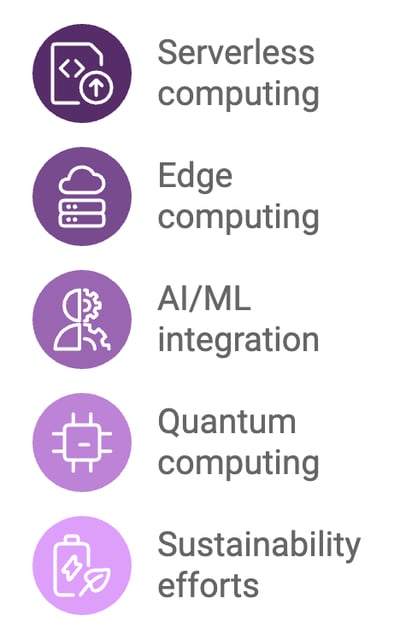
These questions focus on the technical skills and practical experience required for cloud engineering roles, including infrastructure automation, CI/CD pipelines, and cloud security.
A good approach to answering this question is to engage with the interviewer in a conversational style and talk about your experiences anecdotally. I cannot give you a straight and objective answer here, but as a general rule, you should:
Don’t worry, it’s okay if you have only worked with one provider! Here’s how you should approach the question:
To prepare for questions specific to GCP, you can read my Top 20 GCP Interview Questions article.
Walk your interviewer through your process. This can include:
You can also share some real-world examples if you have some!
Scalability in the cloud refers to the ability of a system to handle increasing loads by adding resources, while performance refers to the speed and efficiency of system operations. In cloud computing, both of these factors are important for maintaining high availability and responsiveness as demand grows.
This question tests your strategic thinking and ability to future-proof cloud architectures.
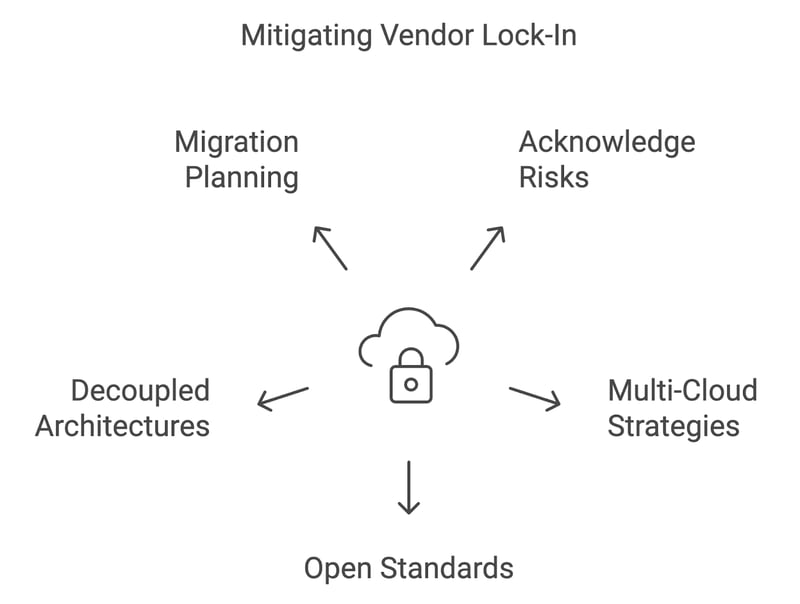
Use this question as an opportunity to demonstrate your proactive mindset, passion for cloud computing, and commitment to continuous learning. Include blogs you read, conferences you’ve attended, or certifications you have achieved. Discuss hands-on learning like side projects, open source contributions, or participation in professional networks and communities.
Cloud computing is not just a buzzword—it's the foundation of modern software development! Whether you're tackling the basics or diving into advanced concepts, each interview question is a chance to demonstrate your expertise, problem-solving skills, and dedication to learning.
If you’re preparing for interviews in data engineering or cloud roles, you may find these articles useful as well:
Use resources like mock interviews, coding platforms (e.g., DataLab), and cloud labs or sandboxes provided by cloud platforms. Additionally, review real-world case studies and implement small projects to strengthen your problem-solving skills.
Certifications like AWS Certified Solutions Architect, Microsoft Certified: Azure Solutions Architect Expert, and Google Cloud Professional Cloud Architect are highly regarded and can validate your skills in cloud computing.
Coding is essential for many cloud roles, particularly for DevOps Engineers, Cloud Engineers, and Solution Architects. Knowledge of scripting languages like Python, Bash, or PowerShell and infrastructure-as-code tools like Terraform can give you an edge.
Consider factors like market demand, your career goals, and the industries you want to work in. AWS is the most widely adopted, Azure is strong in enterprise environments, and Google Cloud is known for its machine learning and data analytics capabilities. Evaluate which aligns best with your interests and target roles. It is very likely that you will be exposed to all 3 in your career!
Certifications like AWS Certified Solutions Architect, Microsoft Certified: Azure Solutions Architect Expert, and Google Cloud Professional Cloud Architect are highly regarded and can validate your skills in cloud computing.

Author
Marie Fayard
I am a product-minded tech lead who specialises in growing early-stage startups from first prototype to product-market fit and beyond. I am endlessly curious about how people use technology, and I love working closely with founders and cross-functional teams to bring bold ideas to life. When I’m not building products, I’m chasing inspiration in new corners of the world or blowing off steam at the yoga studio.

블로그
 Thalia Barrera• 15분

블로그
 Patrick Brus• 15분

블로그
 Zoumana Keita • 15분
Learn Cloud with these courses!
실습 문제하고 트랙하세요.
Google로 계속하기계속 진행하시면 다음 사항에 동의하는 것으로 간주됩니다: 이용약관 및 개인정보 처리방침 그리고 귀하의 데이터가 미국에 저장된다는 점에 동의하는 것으로 간주됩니다.




In my career as a software engineer, I’ve seen how cloud computing has transformed the way businesses manage their infrastructure. The cloud has become a game-changer, providing services such as servers, storage, databases, and networking over the internet, eliminating the need to buy, own, and maintain physical data centers and servers.
If you are applying for a DevOps Engineer, System Administrator, or Software Developer role, you will likely encounter questions about cloud computing during your interviews.
I’ve been asked my fair share of cloud computing interview questions over the past few years, and I’ve also had the opportunity to ask them as an interviewer. In this guide, I’ll share my advice and experience to help make your interview process easier.