
Our biggest-ever sale. 60% off AI & data skills
Buy Now

Ćwicz i monitoruj swoje postępy.
Kontynuuj z GoogleKontynuując, akceptujesz nasz Warunki użytkowania, nasz Polityka prywatności i że Twoje dane są przechowywane w USA.Let’s now zoom into the specific differences between CPUs and GPUs. A major one we discussed was serial vs. parallel computation, but there are other important ones.
CPUs are built with fewer, more powerful cores optimized for single-threaded and sequential processing. These cores feature advanced control units, larger caches (L1, L2, and sometimes L3), and support for sophisticated instruction sets like x86-64 or ARM.
In contrast, GPUs have a massive array of smaller cores designed to handle parallel tasks. These cores operate under a Single Instruction, Multiple Data (SIMD) model, where the same operation is applied across multiple data points simultaneously.
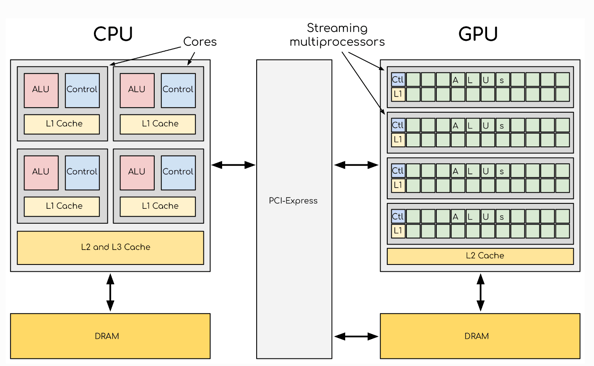
A comparison of the GPU and CPU architecture. Image source.
As you can imagine, the differences in architecture directly influence performance.
With their high clock speeds and advanced instruction handling, CPUs excel at low-latency tasks that require high precision and logical operations. Examples include operating system management, database queries, and running application threads. CPUs are also more versatile and capable of efficiently switching between diverse workloads due to their instruction decoding and branch prediction capabilities.
As mentioned, GPUs thrive in tasks where parallelism is key. Their ability to process multiple data streams simultaneously makes them indispensable for high-throughput operations, such as video encoding, scientific simulations, and neural network training. For instance, in deep learning, GPUs accelerate matrix multiplications and backpropagation, drastically reducing training times compared to CPUs.
The trade-off lies in the nature of the workload: CPUs outperform GPUs in sequential tasks, whereas GPUs dominate in data-heavy, parallel tasks.
GPUs generally consume more power due to their high core count and intensive parallel processing demands, while CPUs tend to have lower power requirements.
A high-end GPU can consume several hundred watts under load, particularly during intensive operations like training machine learning models or rendering 4K graphics. Additionally, their high memory bandwidth requirements further increase power draw.
CPU features like dynamic voltage and frequency scaling (DVFS), low-power states (C-states), and efficient cooling mechanisms allow CPUs to effectively balance performance with power consumption. This makes CPUs more suitable for devices requiring longer battery life or lower thermal output, such as laptops and mobile devices.
CPUs are widely available in consumer devices and are typically more affordable. Their broad utility and market saturation make them relatively inexpensive for consumers. Entry-level CPUs can cost under $100, while high-performance models for servers or workstations may range into the thousands.
GPUs, especially high-performance models, are more expensive and commonly found in workstations, gaming systems, and high-performance computing environments. Consumer-grade GPUs for gaming may range from $200 to $1,000, while specialized GPUs for data centers or scientific research, such as NVIDIA’s A100 or AMD’s Instinct series, can cost tens of thousands of dollars.
The following table offers a detailed comparison of CPUs vs GPUs, making it easier to see their differences at a glance:
|
CPU (Central Processing Unit) |
GPU (Graphics Processing Unit) | |
|
Primary function |
General-purpose processing for sequential tasks |
Specialized for parallel processing and data-intensive tasks |
|
Architecture |
Fewer, powerful cores optimized for single-threaded performance |
Thousands of smaller, simpler cores optimized for parallelism |
|
Processing model |
Serial execution: tasks processed one at a time |
Parallel execution: multiple tasks processed simultaneously |
|
Core count |
Typically 4–64 cores in consumer-grade CPUs |
Can have thousands of cores in high-performance GPUs |
|
Clock speed |
Higher clock speeds (up to ~5 GHz) |
Lower clock speeds (~1–2 GHz) |
|
Strengths |
Precision, sequential tasks, versatility, and logic operations |
High throughput for large-scale operations like matrix math |
|
Use cases |
Running operating systems, application logic, databases |
Graphics rendering, machine learning, scientific computing |
|
Power consumption |
Lower due to fewer cores and energy-efficient designs |
Higher due to dense cores and memory bandwidth demands |
|
Memory bandwidth |
Lower, typically optimized for latency |
Higher, optimized for throughput (e.g., GDDR6, HBM memory) |
|
Cost |
Relatively affordable and widely available |
More expensive, especially for high-performance models |
|
Applications |
Laptops, desktops, servers, mobile devices |
Gaming systems, workstations, HPC environments, AI workloads |
|
Flexibility |
Broad compatibility for diverse tasks |
Optimized for specific workloads requiring parallelism |
Let’s briefly discuss some more specific use cases for CPUs:
Let's briefly go over some GPU-specific use cases:
Both CPUs and GPUs continue to grow in power and complexity! Their futures show an increase in computational ability and widespread usage.
CPUs are increasing core counts to meet modern multitasking demands. This improves their serial computing capability and offers some parallel computing through multithreading.
Some trends in CPU development include:
GPUs are evolving to handle general-purpose tasks, making them increasingly versatile for data-heavy operations. Manufacturers like NVIDIA and AMD are investing in hardware-agnostic software ecosystems (e.g., CUDA, ROCm) to expand GPUs' applicability beyond graphics.
Many machine learning packages are now capable of using GPUs. Frameworks like TensorFlow and PyTorch now natively support GPU acceleration, dramatically reducing computation times.
The future of processing isn’t limited to just CPUs and GPUs. The rise of specialized processors, such as TPUs (Tensor Processing Units) and NPUs (Neural Processing Units), reflects a growing demand for task-specific hardware:
CPUs and GPUs each bring unique strengths to computing: CPUs excel at general-purpose and precise tasks, while GPUs shine in parallel processing and data-heavy workloads. Understanding these differences helps data scientists, gamers, and professionals make informed hardware choices.
If you’re interested in exploring how GPUs power deep learning models, check out Introduction to Deep Learning with PyTorch. For a broader understanding of AI technologies and their applications, the AI Fundamentals track provides a comprehensive overview. To dive deeper into the mechanics behind machine learning, explore the course Understanding Machine Learning.
No, GPUs are not a replacement for CPUs. While GPUs excel in parallel processing tasks, they lack the versatility and single-threaded performance that CPUs provide for general-purpose tasks.
A hybrid approach can provide optimal performance by leveraging the strengths of both processor types for tasks like video editing and neural networks.
Machine learning and AI tasks often involve processing large datasets and running numerous calculations simultaneously. GPUs, with their high core count and parallel processing capabilities, can perform these tasks much faster than CPUs.
Yes, specialized processors like TPUs (Tensor Processing Units) are designed to handle specific workloads like machine learning. TPUs combine elements of CPU and GPU architectures to optimize performance for particular types of data processing.

I am a data scientist with experience in spatial analysis, machine learning, and data pipelines. I have worked with GCP, Hadoop, Hive, Snowflake, Airflow, and other data science/engineering processes.

blog
 Kurtis Pykes • 9 min

blog
 Bhavishya Pandit• 7 min

blog
 Matt Crabtree• 10 min
Learn more about machine learning and AI with these courses!
Kurs
Przejdź na podejście MLOps, aby trenować, dokumentować, utrzymywać i skalować modele machine learning do ich pełnego potencjału.
Ścieżka
Odkryj uczenie maszynowe z Python i pracuj nad tym, by zostać naukowcem uczenia maszynowego. Poznaj uczenie nadzorowane, nienadzorowane i głębokie.
Ćwicz i monitoruj swoje postępy.
Kontynuuj z GoogleKontynuując, akceptujesz nasz Warunki użytkowania, nasz Polityka prywatności i że Twoje dane są przechowywane w USA.




We have all heard of CPUs (Central Processing Units) and GPUs (Graphics Processing Units), but do you know the differences in how they handle processing? While both are essential to modern computing, they’re designed for different purposes.
In this guide, I will break down the differences, use cases, and evolving roles of CPUs and GPUs.
What is a CPU?
The CPU, often called the computer's "brain," is the central unit that executes general-purpose computing tasks. It is optimized for managing complex, sequential instructions and involves nearly every aspect of computing, from handling applications to running the operating system. Applications include everything from your browser to chat programs and email.
CPUs are really good at tasks that demand precision and reliability, such as performing arithmetic operations, executing logic-based decisions, and controlling data flow.
Basic Von Neumann architecture. Image by Author.
Modern CPUs often feature multiple cores, allowing them to execute several tasks simultaneously (albeit at a smaller scale compared to GPUs). They also incorporate advanced technologies like hyper-threading and cache hierarchies to improve efficiency and reduce latency during task execution.
How a CPU works
CPUs process tasks sequentially, following an instruction cycle that involves fetching, decoding, executing, and storing data. This step-by-step approach enables high precision and reliability, making CPUs ideal for single-threaded tasks such as database queries, code compilation, and complex simulations.
While modern CPUs can multitask to some extent, their strength actually lies in their ability to handle complex computations where accuracy and order are essential.
CPUs also feature robust error-handling mechanisms to perform computations without data corruption or logical faults.
Characteristics of CPUs
CPUs are characterized by a few cores with high clock speeds. Each core focuses on one or a few threads at a time, making them highly efficient for tasks that require significant processing power but limited parallelism.
The core characteristics of CPUs include:
Despite their precision and versatility, CPUs are limited in their ability to handle massively parallel workloads efficiently, such as training large machine learning models or rendering high-resolution graphics. For such tasks, specialized processors like GPUs often take the lead. Let’s examine why that’s the case in the next section.
What is a GPU?
A GPU is a specialized processor optimized for tasks that involve parallel processing or processing multiple bins of information simultaneously.
GPUs were initially developed to handle image rendering for video games and visual applications but have evolved into powerful tools used in various fields, including data science, machine learning, cryptocurrency mining, and scientific simulations. Their ability to process huge amounts of data in parallel has made them critical for high-performance computing and AI development.
How a GPU works
GPUs have thousands of smaller cores that can execute simple tasks independently, making them ideal for parallel workloads.
Unlike CPUs, which focus on precision and order, GPUs divide large problems into smaller tasks, process them in parallel, and aggregate the results. This architecture allows GPUs to excel at operations where the same instructions are applied repeatedly across large datasets.
For instance, when rendering an image, a GPU assigns each pixel to a separate core for simultaneous processing, significantly speeding up the operation. In machine learning, this parallelism enables faster training by processing data batches and performing computations like matrix multiplications across many cores at once.
Modern GPUs also include features like Tensor Cores (in NVIDIA GPUs) or other specialized units designed to accelerate AI tasks, making them even more efficient for tasks like neural network training.
Characteristics of GPUs
In summary, these are the characteristics that distinguish GPUs: