Share this webinar
Close your data and AI skills gap
We're the only platform uniquely engineered to advance data and AI skills across your entire organization. Let's explore a tailored program.
Book an Enterprise DemoHow to Become an AI Agent Operator
September 2026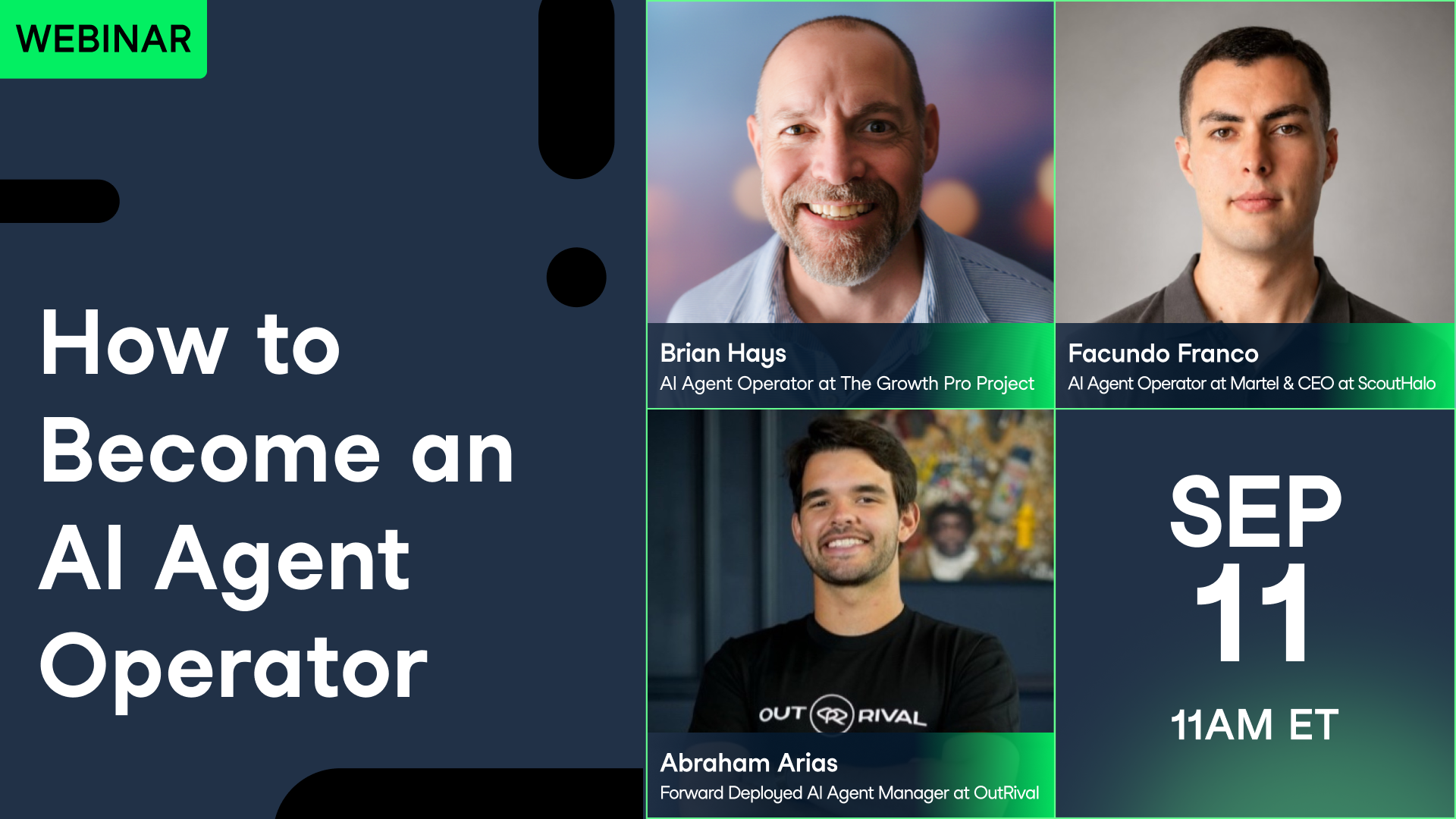
Your Presenter(s)

Brian Hays
AI Agent Operator at The Growth Pro Project
Brian Hays is an AI Agent Operator at The Growth Pro Project, where he applies over 18 years of marketing, design, and communication experience to AI-driven business growth. Specializing in healthcare brand marketing, he combines hands-on leadership with deep expertise in system development and the full marketing lifecycle. At The Growth Pro Project, he helps organizations leverage AI automation to drive personalized, measurable results and sustainable growth nationwide.

Facundo Franco
AI Agent Operator at Martel & CEO at ScoutHalo
Facundo Franco works at the intersection of AI operations and entrepreneurship, serving as an AI Agent Operator at Martel while leading ScoutHalo as CEO. He focuses on deploying and managing AI agents to drive measurable business outcomes, bringing expertise in agentic workflows and enterprise automation. Through ScoutHalo, he translates his operational experience into scalable, agent-driven solutions that help organizations adopt AI-native ways of working.
Abraham Arias
Forward Deployed AI Agent Manager at OutRival

Abraham Arias is a Forward Deployed AI Agent Manager at OutRival, where he oversees the launch, optimization, and expansion of AI digital workers across enterprise customer portfolios. A Computer Science graduate of Pomona College, he previously worked at Electronic Arts and Robert Half before joining OutRival—an AI agent company founded by the creators of Career Karma. He sits at the crossroads of customer success, prompt engineering, and technical implementation.
Summary
Three people who spend their days managing AI agents instead of writing code from scratch explained what the job actually looks like.
DataCamp's Richie Cotton hosted Brian Hays (Growth Pro Project), Facundo Franco (Scout Halo, and an AI agent operator at Martel), and Abraham Arias (Outrival) for a session on the AI agent operator role: a job that barely existed two years ago and now shows up on job boards as "AI agent operator," "forward deployed AI agent manager," or simply "AI strategist." None of the three has a computer science degree. One came from health care marketing, one from ecommerce, one from corporate recruiting. All three now spend most of a working day inside Claude Code, running between one and four agents at once, building tools that touch real money and, in one case, passenger safety on special-needs transport vehicles. The conversation covered what an AI agent operator actually builds day to day, how to tell a real agent from an automated workflow, how to measure whether the work is succeeding, and how to become an AI agent operator without a technical background. All three agreed on the path in: build something for a real problem before anyone hires you to build it.
Key Takeaways
- None of the three panelists have a computer science degree; they moved into AI agent work from health care marketing, ecommerce, and corporate recruiting.
- Claude Code is the shared daily tool across all three operators, with Facundo Franco running up to four agents at once inside it.
- Brian Hays draws a hard line between an agent that makes decisions from live data and a workflow that repeats a fixed sequence, because the distinction changes token costs by an order of magnitude.
- Loading a single agent with too many unrelated tasks raises the risk of confused output; each panelist keeps individual agents narrowly scoped to one job.
- Abraham Arias built his first automations after hours at a recruiting job, then landed his current role after six months of staying in touch with someone he met at an AI conference.
- Facundo Franco checks his own work by feeding a finished project back into Claude Code and asking it to find security and quality flaws before a client sees it.
- Success metrics differ by business model: Facundo relies on direct user feedback as a solo founder, while Abraham tracks conversion events like enrollments and bill payments alongside LLM-generated sentiment scores.
Deep Dives
What AI Agent Operators Actually Build
The clearest way to understand what an AI agent operator does is to look at what they've built. Brian Hays described a project born from a client in special-needs adult transportation: passengers, some not fully oriented to their surroundings, were occasionally left on vehicles after a route ended, with six deaths reported in that market this year alone. Hays built a platform that forces drivers to scan a QR code tied to the vehicle's plate and VIN at the end of every route, then upload a photo of the empty vehicle. An AI model compares that photo against a control image to confirm the vehicle is actually empty. "In a matter of about two and a half months, we've gone from literally a concept to a full live production site that's being used daily," Hays said, adding that state regulators have since shown interest in requiring similar safeguards across the industry.
Facundo Franco runs Scout Halo, a location-scouting tool built for filmmakers and, increasingly, social media influencers who need to find shoot-ready spots. The hard part isn't the interface, it's teaching the underlying agent what counts as a usable answer. "You need to instruct the agent what's a good answer, what is a bad answer... it's a lot of knowledge that goes on top of the agent that makes it very complex and very difficult to get to a sweet spot," Franco said. He pairs the agent with location data APIs so it can pull real information rather than guess.
Abraham Arias works on a different problem: getting students through the college application process. Outrival started with conversational AI phone calls walking students through enrollment, financial aid, and class registration. It has since added an "operator" that uses computer vision to read each screen of an application and take actions on the student's behalf, based on the conversation happening at the same time. Arias ties this to a decline in college enrollment he's watched over the past few years. "That moment where they're interested, to be able to go ahead and start taking actions on behalf of the students, is something that we're really excited about," he said.
Three different industries, three different agents, one common thread: each one automates a specific, previously manual bottleneck rather than trying to replace an entire job.
The AI Agent Operator Toolkit: Claude Code, Manus, and a Meeting Notetaker
Ask any of the three what fills their day and the same name comes up first. Franco runs Claude Code daily, currently juggling up to four agents at once: one for marketing, one that has to keep running to keep the scouting tool live, and one he moves between different parts of the application's workspace. "I started working with only one agent on Claude Code, and right now I'm using up to four agents at the same time," he said. "It seems like the computer is going to burn on fire, but I need to move fast."
Hays also builds inside Claude Code but adds Manus AI for some SaaS projects, plus Notion as what he called "my mind behind the mind" for client information, goals, and proposal templates. The tool he was most enthusiastic about was Granola, a meeting recorder and note-taker. He feeds it his calls, including sessions like this one, and pipes the output into Notion and into a custom CRM he built to track client work. "As it learns you in the way you operate, it's almost as if it completely reads your mind on exactly how you want your notes," Hays said.
Arias splits his day differently, since Outrival is a 15-person startup and his role is still being defined. He moves between engineering and sales, handling demo requests and bug reports, then interfaces directly with client institutions whose students are having live conversations with the AI system. A growing share of his time goes to a different kind of work: stepping back from daily operational tasks to look at Outrival's own internal processes and decide where AI could remove friction there too, not just for customers.
None of the three described themselves as engineers. Franco was direct about it: "I'm no software engineer, but I managed to adapt it to LLMs and using Claude Code every day." The tools have moved the bottleneck from writing code to directing it well.
How AI Agent Operators Measure Success
Success looks different depending on who's paying the bill. Hays starts every client engagement by defining the outcome before touching a process. Clients often can't articulate their own workflow, he said, so a large part of his job is translating a vague goal into a specific sequence of steps an agent can execute. "It is super important to create a clear outcome and then back that up into the actual process that is legitimately producing the outcome," he said, warning that skipping this step means "you're just shooting at an outcome and hoping for the best."
Franco, running Scout Halo alone, relies on a small circle of users who test the app and report back directly. Without a team to catch problems internally, that feedback loop is his main signal that the product is moving in the right direction. "I need that customer feedback because they know more than me what they need," he said. "So I need to build for them."
Arias tracks harder numbers: are end users enrolling, transferring, or paying bills, and are Outrival's institutional clients renewing after a pilot period. Beneath those top-line conversion metrics, his team pulls secondary signals out of the conversations themselves, using LLMs to score sentiment, detect user intent, and tag recurring themes, comparing the approach to reading momentum in a stock price rather than just watching where it sits today. Feature adoption gets tracked too, but Arias was direct about which number actually decides things: "For the most part, it's really just money conversion. Are people paying their bills? Are people paying our bills?"
The three approaches map to three different business realities: a services provider needs process discipline, a solo founder needs direct user signal, and a venture-backed startup needs conversion data it can show investors. None of them named "the AI looks impressive" as a goal.
How to Become an AI Agent Operator Without a Technical Degree
All three panelists arrived at this work sideways. Hays spent thirteen years building web-based training programs for a hospital system in Nashville, which gave him a habit of seeing every business problem as a process that could be mapped and improved. His first AI project had nothing to do with health care: his stepson worked at a Christmas tree stand still scheduling more than 75 seasonal employees by hand in a spreadsheet, so Hays built a tool that ingested the CSV files and produced schedules with one click. That small win convinced him to go all in on AI work, and he still treats learning as a daily habit. "I try to do something every single day, even if it's carving out fifteen minutes," he said.
Arias was working at recruiting firm Robert Half, frustrated by tedious manual steps in his own job, when he started building automations after hours to speed himself up. He began selling similar tools door to door to small businesses in Miami's Cuban community, then met the VP of engineering at Outrival at an AI conference. They stayed in touch for six months while Arias kept building on the side, until Outrival needed someone to handle deployment and client management after the sales and engineering work was done. His advice for anyone chasing this career path: "Just try to do it. Don't wait for permission." Networking works better, he added, once there's something real to talk about rather than a request for someone else's opportunity.
Franco's background is ecommerce, not software. He started with ordinary chatbots, and as new AI features shipped, tried building small ideas himself until one turned into a working first version of Scout Halo. "With no background, I ended up making a version one of an app that could become something important in the future," he said.
The thread across all three stories is the same: build something real, for a real problem, before waiting for a job title to authorize it.
Agent or Workflow? The AI Agent Operator Skill That Controls Your Costs
One audience question, about measuring return on investment from agentic work, drew out the most useful technical distinction of the session. Hays said much of what clients describe as an agent is actually a workflow: a fixed sequence of steps that runs the same way every time, versus a true agent that takes in new information and makes a decision or routes a task based on it. The difference matters because it changes what something should cost to run. "There's a large delineation between an AI agent where an agent's necessary and then where it's just a workflow," Hays said, noting that even when both are hosted on the same LLM platform, "the consumption of tokens... the bar is far lower than an actual agent."
That same discipline shows up in how Hays scopes individual agents. Rather than build one agent to handle an entire client process end to end, he breaks it into narrow, single-purpose pieces: one agent to qualify a lead, a separate one to build that lead into the client's system. "I really try to keep agents very targeted," he said, "because you run such a risk when you have an agent that you're trying to have one agent do so many different tasks... because you run the risk of confusion in the agent."
Data privacy gets the same treatment. Hays, who works in health care, said the platforms an operator uses need documented security standards, since clients will ask about it quickly once sensitive information is involved. He builds a review step into his own process, pulling a finished project down from a platform like Manus and feeding it into Claude Code with instructions to look for weaknesses. "We think of leveraging AI to solve a problem," he said. "But in reverse, when you solve that problem, you leverage AI to break it."
Task decomposition, cost awareness, and a built-in security check aren't the exciting parts of the job. They're the parts that separate an AI agent operator from someone who prompted a chatbot once and called it done.
Related
webinar
Reskilling for AI in the Middle of Your Career
Industry experts share how mid-career professionals can successfully transition into AI-enabled roles. Learn what skills matter most, how to stay current, and how to turn your experience into an advantage in an AI-driven workplace.webinar
Using AI To Increase Your Productivity
Industry experts share real-world examples of how professionals across these fields are using AI to get more done with less effort.webinar
AI and the Workforce: How Will AI Reshape Data and Technology Roles?
Industry experts explore how AI is reshaping the skills, responsibilities, and opportunities within the tech industry.webinar
The Hottest AI Skills in 2025
Explore the most in-demand AI skills of 2025. You’ll learn which technical and practical skills are leading the job market, how hiring flows are evolving for AI roles, and what qualities hiring managers prioritize when building their AI teams.webinar
Using AI in Robotics
In this session, you'll learn about common uses of AI in the robotics field, best practices for making use of AI in robotics, and what skills you need to make use of AI for robotics.webinar