Curs
Programare asistată de AI pentru dezvoltatori
1 ore 30 min
11.2K
Only a few hours after Google unveiled Gemini 3.8 Flash, Meta has released Muse Spark 1.3, an update to its flagship model family aimed squarely at agentic workflows and coding.
The release lands in a crowded field where OpenAI's GPT-5.6 Sol, Anthropic's Claude Opus 5, and xAI's Grok 4.6 are all fighting for the same developer mindshare.
Muse Spark 1.3 is rolling out in Muse Code and the Meta Model API, keeping a 1M token context window.
In comparisons run by Meta engineers, the model used roughly 20% fewer tool calls and 25% fewer tokens than Muse Spark 1.2, and Artificial Analysis scored the xhigh variant at Intelligence Index 61 with an output speed of 182 tokens/sec.
In this article, I'll cover everything new with Muse Spark 1.3, looking at its agentic and coding features, the benchmark picture, and pricing
To compare it against the competition, check out our guides to GPT-5.6 Terra vs Claude Sonnet 5 and Claude Opus 5 vs Claude Sonnet 5. I also recommend our guide to Meta's Muse Agent.
Muse Spark 1.3 is Meta's current flagship model, positioned as an incremental update over Muse Spark 1.2 rather than a ground-up rebuild.
It ships in two variants that appear in the research:
The changes concentrate on two main areas: sustaining longer-horizon agentic work and cleaning up coding behavior.
Meta trained the model across a range of harnesses so it generalizes to different agentic environments, and it added training on more long-horizon coding tasks. They frame the release as a step toward its stated goal of personal superintelligence.
The main takeaway I have from this launch is around efficiency; Muse Spark 1.3 completed engineering comparisons with about 20% fewer tool calls and 25% fewer tokens than 1.2.
For anyone paying per token on the Meta Model API, that is a direct cost reduction on the same workload.
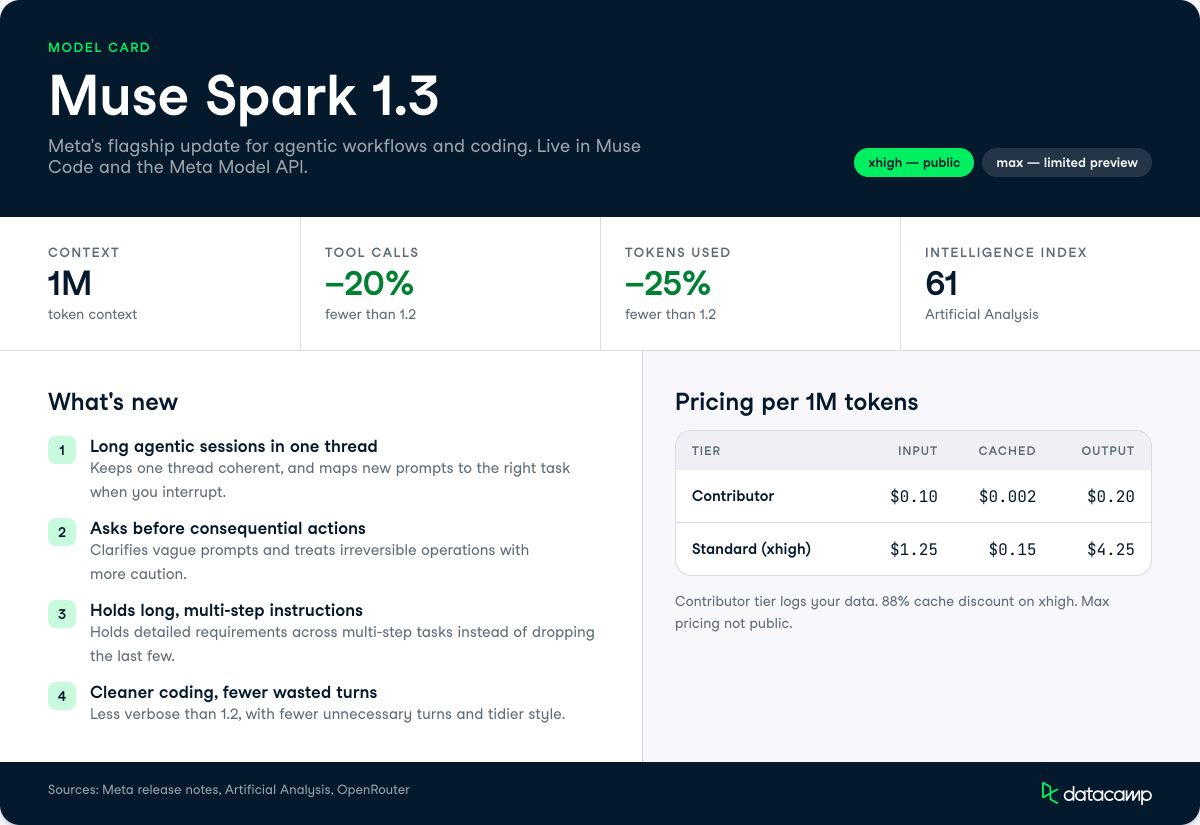
The updates in Muse Spark 1.3 center on how the model behaves during long agentic sessions and how it writes and edits code.
Here are the capabilities that stand out to me.
Muse Spark 1.3 is built to keep a single long thread coherent while juggling multiple workflows at once.
Given an open-ended objective, it uses tools to build its own context from messy and conflicting sources, corrects gaps in its plan as it goes, and tracks what it has learned to produce a final deliverable.
Meta also improved multitasking within a single-threaded context.
The model maps incoming prompts to the correct task even when you are steering an earlier request or interrupting it mid-flow, which is the failure mode that usually derails long agent sessions.
For those using Muse Spark regularly, this matters because most real agent work is not one clean instruction. It is a running conversation where you change your mind, add constraints, and pause tasks, and a model that loses track of which task a message belongs to becomes unusable fast.
Meta claim that Muse Spark 1.3 was trained to work with you rather than barrel ahead on ambiguous instructions. This means that it asks clarifying questions when a prompt is vague, pulls you in when it gets stuck, and confirms before taking consequential actions.
On long tasks, it adapts to your preference for updates. You can have it report frequently or work quietly in the background until it has a result, which is useful when you want to fire off a task and check back later.
Meta also improved the model's calibration on irreversible actions, so it treats a destructive operation more cautiously than a reversible one.
That could be a meaningful safety valve for agents that touch files, send messages, or run shell commands.
Muse Spark 1.3 follows complex, long-form instructions more reliably than earlier Muse Spark versions.
Across multi-step tasks, Meta reports it is better at preserving detailed requirements without dropping constraints or drifting from the requested workflow.
Consider a request like: draft a compliance report, pull figures from an attached spreadsheet, format the numbers into two tables, export it as a PDF, and organize it under six named headings. Earlier models tend to nail the first three requirements and quietly forget the last two.
The model also has better awareness of its own limits.
Meta trained it to recognize when it hits a wall and say so, rather than hallucinating an outcome to appear complete, though the research does not quantify how often this holds.
Muse Spark 1.3 was trained on more long-horizon coding tasks and behaves better in common engineering workflows.
Relative to Muse Spark 1.2, Meta says it takes fewer turns where they aren't needed, is less verbose, and produces a cleaner coding style.
The efficiency gains are the concrete part: in Meta engineer comparisons, Muse Spark 1.3 used approximately 20% fewer tool calls and 25% fewer tokens than 1.2.
Fewer tool calls means fewer round trips and lower latency on agentic coding tasks, and fewer tokens means lower cost per completed task.
One caveat that I've seen surfaced in community reports is that some Reddit users found the model frustrating because it does not expose its thinking process, which makes debugging its coding decisions harder than with models that show reasoning traces.
Meta published benchmark scores across three categories in the Muse Spark 1.3 release: agent tasks, long-context retrieval, and coding.
The results below compare the max variant against Muse Spark 1.2 xhigh, GPT-5.6 Sol (max), and Claude Opus 5 (max).
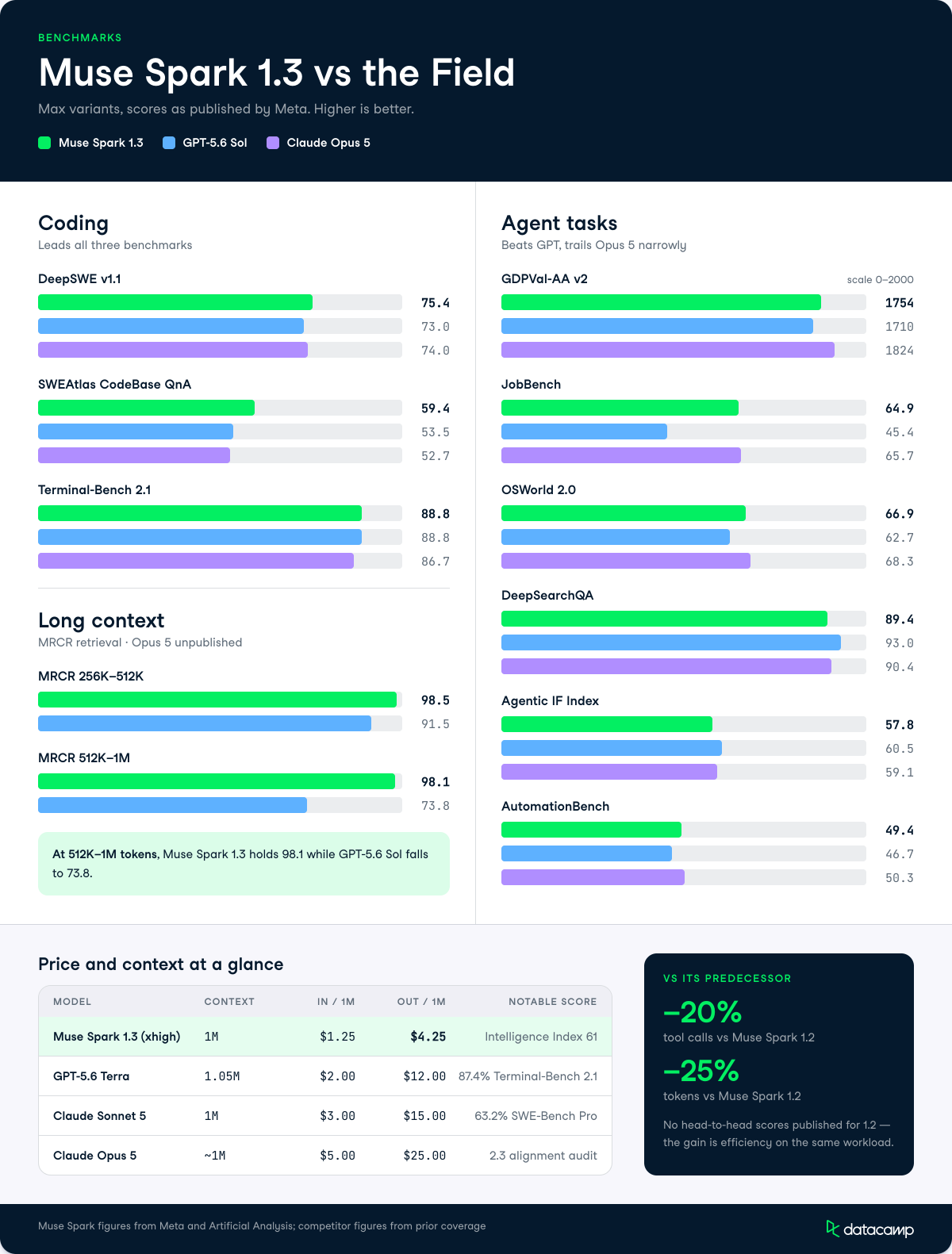
Coding is where Muse Spark 1.3 makes the strongest case. It leads all three benchmarks outright, including a tie with GPT-5.6 Sol on Terminal-Bench 2.1.
| Benchmark | Muse Spark 1.3 (max) | GPT-5.6 Sol (max) | Opus 5 (max) |
|---|---|---|---|
| DeepSWE v1.1 | 75.4 | 73.0 | 74.0 |
| SWEAtlas CodeBase QnA | 59.4 | 53.5 | 52.7 |
| Terminal-Bench 2.1 | 88.8 | 88.8 | 86.7 |
The DeepSWE v1.1 result (75.4) is the standout.
That benchmark measures long-horizon agentic coding, where the model has to complete real software engineering tasks autonomously.
Beating both Opus 5 and GPT-5.6 Sol on that eval is meaningful for anyone evaluating coding agents. T
he SWEAtlas codebase understanding score (59.4) tells a similar story: Muse Spark 1.3 reads and reasons over large codebases better than both direct rivals here.
Muse Spark 1.3 has a significant lead on long-context retrieval, particularly at the far end of the context window where most models degrade.
| Benchmark | Muse Spark 1.3 (max) | GPT-5.6 Sol (max) |
|---|---|---|
| MRCR 256K–512K | 98.5 | 91.5 |
| MRCR 512K–1M | 98.1 | 73.8 |
At 512K to 1M tokens, GPT-5.6 Sol drops to 73.8 while Muse Spark 1.3 holds at 98.1. If your work involves feeding entire codebases, long document chains, or extended agent traces into a single context, this is the category that matters most. Opus 5 scores are not published for MRCR, so a direct three-way comparison is not possible here.
On agent benchmarks, Muse Spark 1.3 sits between GPT-5.6 Sol and Opus 5.
It beats GPT on most categories but trails Opus 5 narrowly across the board.
| Benchmark | Muse Spark 1.3 (max) | GPT-5.6 Sol (max) | Opus 5 (max) |
|---|---|---|---|
| GDPVal-AA v2 | 1754 | 1710 | 1824 |
| JobBench | 64.9 | 45.4 | 65.7 |
| OSWorld 2.0 | 66.9 | 62.7 | 68.3 |
| DeepSearchQA | 89.4 | 93.0 | 90.4 |
| Agentic IF Index | 57.8 | 60.5 | 59.1 |
| AutomationBench | 49.4 | 46.7 | 50.3 |
The JobBench gap over GPT-5.6 Sol (64.9 vs 45.4) is the largest margin in the agent category and worth noting for anyone using AI in professional workflows.
DeepSearchQA is the one area where GPT-5.6 Sol leads (93.0 vs 89.4), and instruction following (Agentic IF Index) is also marginally in GPT's favor.
On computer use (OSWorld 2.0), Muse Spark 1.3 is competitive at 66.9 against Opus 5's 68.3.
The overall picture is Muse Spark 1.3 leads on coding and long-context retrieval, is competitive on agent tasks, and sits just behind Opus 5 on knowledge work and general agent orchestration.
Here is a quick reference comparing Muse Spark 1.3 against the mid-tier and flagship models we've reviewed.
Numbers for Muse Spark come from Artificial Analysis; competitor figures come from our prior coverage.
| Model | Context | Input / 1M | Output / 1M | Notable score |
|---|---|---|---|---|
| Muse Spark 1.3 (xhigh) | 1M | $1.25 | $4.25 | Intelligence Index 61 |
| GPT-5.6 Terra | 1.05M | $2.00 | $12.00 | 87.4% Terminal-Bench 2.1 |
| Claude Sonnet 5 | 1M | $3.00 | $15.00 | 63.2% SWE-Bench Pro |
| Claude Opus 5 | ~1M | $5.00 | $25.00 | 2.3 alignment audit |
The pricing gap is clear here; Muse Spark 1.3's output tokens are roughly a third of Sonnet 5's and a sixth of Opus 5's.
Muse Spark 1.3 is available today in Muse Code and the Meta Model API.
Meta for Developers noted that existing users can change the model ID and keep the same endpoints, SDKs, and pricing, which makes the upgrade path low-friction.
Pricing on the Meta Model API depends on the tier, with a contributor tier that logs your data to improve Meta's products at a lower rate and a standard tier that does not.
| Tier | Context | Input / 1M | Cached input / 1M | Output / 1M |
|---|---|---|---|---|
| Contributor (data used to improve products) | 1M | $0.10 | $0.002 | $0.20 |
| Standard (xhigh) | 1M | $1.25 | $0.15 | $4.25 |
Artificial Analysis reports an 88% cache discount on the xhigh tier, and OpenRouter mirrors the $1.25 input / $4.25 output rates while listing add-ons like web search at $2.50 per 1,000 calls.
Pricing for the max variant was not yet public at the time of the release analysis.
There are two availability caveats from the community that are worth flagging at the time of writing:
Muse Spark 1.3 is a targeted efficiency and reliability update rather than a capability leap, and Meta is honest about that framing.
The 20% fewer tool calls and 25% fewer tokens against 1.2 are the numbers that matter most for anyone running agents at volume, because they translate straight into lower cost and latency.
I think that if you are already in the Meta Model API or Muse Code, the drop-in upgrade with lower token usage is an easy yes.
If you are choosing a model fresh for production agents, I would want to see how the model performs in the wild and the max variant's pricing before committing to it over a well-documented alternative.
If you want to build the skills to evaluate and use models like this in your own workflows, I recommend starting with our AI Agent Fundamentals skill track.
Top DataCamp Courses
Curs
Curs
Traseu de învățare
articol de blog
Matt Crabtree
8 min.
articol de blog
Khalid Abdelaty
14 min.
articol de blog
Matt Crabtree
10 min.
articol de blog
Matt Crabtree
10 min.
articol de blog
Tom Farnschläder
13 min.
Tutorial
Josep Ferrer
15 min.