
Course
Working with the OpenAI API
3 hr
172.3K
If you're picking the mid-tier model to sit behind an agent that runs all day, the two obvious candidates right now are GPT-5.6 Terra and Claude Sonnet 5. Both are the default model their vendor hands to free users, both ship a roughly 1M token context window, and both land within a dollar of each other on input tokens.
In this article, I'll compare GPT-5.6 Terra and Claude Sonnet 5 across coding and terminal agents, knowledge work, cybersecurity posture, long-context behavior, API control surface, and pricing, so you can pick the one that fits your workload. For deeper coverage of each model on its own, see our guides to the GPT-5.6 family, Claude Sonnet 5, and the new GPT-6 Astra.
GPT-5.6 Terra is the middle tier of OpenAI's GPT-5.6 family, which reached general availability on July 9, 2026, alongside the flagship Sol and the cheapest tier, Luna. OpenAI describes Terra as the balanced option for everyday work and notes that it roughly corresponds to the mini tier of earlier GPT-5 families. It ships a 1,050,000 token context window, a 128,000 token output ceiling, and a February 16, 2026, knowledge cutoff.
Two things make Terra interesting rather than just cheap. It inherits Programmatic Tool Calling from the Responses API, which lets the model write and run small in-memory programs that coordinate tools, rather than round-tripping each tool response through the model. And on July 30, 2026, OpenAI cut Terra's price by 20%, taking it from $2.50/$15 at launch to $2.00/$12 per 1M tokens.
We covered the wider family in our GPT-5.6 Sol, Terra, and Luna guide, and if you want a look at what the flagship tier is being used for, our write-up of how GPT-5.6 Sol helped disprove the Maxwell conjecture is a good read. There's also a flagship-level head-to-head in our Claude Opus 5 vs GPT-5.6 Sol comparison.
Claude Sonnet 5 is Anthropic's mid-tier model, released on June 30, 2026, and pitched as the most agentic Sonnet the company has shipped. Anthropic's claim is that it plans, drives browsers and terminals, and runs autonomously at a level that previously needed Opus-class models, landing close to Opus 4.8 on reasoning, tool use, coding, and knowledge work at a lower price.
It is the default model on the Free and Pro plans, and it comes with a set of deliberate constraints: temperature, top_p, and top_k are gone, manual extended thinking returns a 400 error, and adaptive thinking is on by default. It also uses a new tokenizer that produces roughly 30% more tokens for the same text than Sonnet 4.6, which Anthropic offset with introductory pricing through August 31, 2026.
We went through the launch numbers in our Claude Sonnet 5 guide and compared it upward against Anthropic's flagship in Claude Opus 5 vs Claude Sonnet 5.
Here is the shape of the two models side by side before we get into individual capability areas.
| Feature | GPT-5.6 Terra | Claude Sonnet 5 |
|---|---|---|
| Vendor and release | OpenAI, general availability July 9, 2026 | Anthropic, June 30, 2026 |
| Positioning | Mid-tier | Mid-tier |
| Context window | 1,050,000 tokens | 1M tokens |
| Max output | 128K tokens | 128K tokens |
| Price per 1M tokens | $2.00 in / $12.00 out | $3.00 in / $15.00 out ($2.00/$10.00 through Aug 31, 2026) |
| Long-context surcharge | 2x input, 1.5x output above 272K input tokens | None published; flat to 1M |
| Signature feature | Programmatic Tool Calling in the Responses API | Adaptive thinking with selectable effort levels |
| Cyber posture | Trained for cyber; defensive capability behind Trusted Access | Not trained for cyber; safeguards on by default |
| Free tier | Default for Free and Go users in ChatGPT Work and Codex | Default for Free and Pro plans |
| API model ID | gpt-5.6-terra |
claude-sonnet-5 |
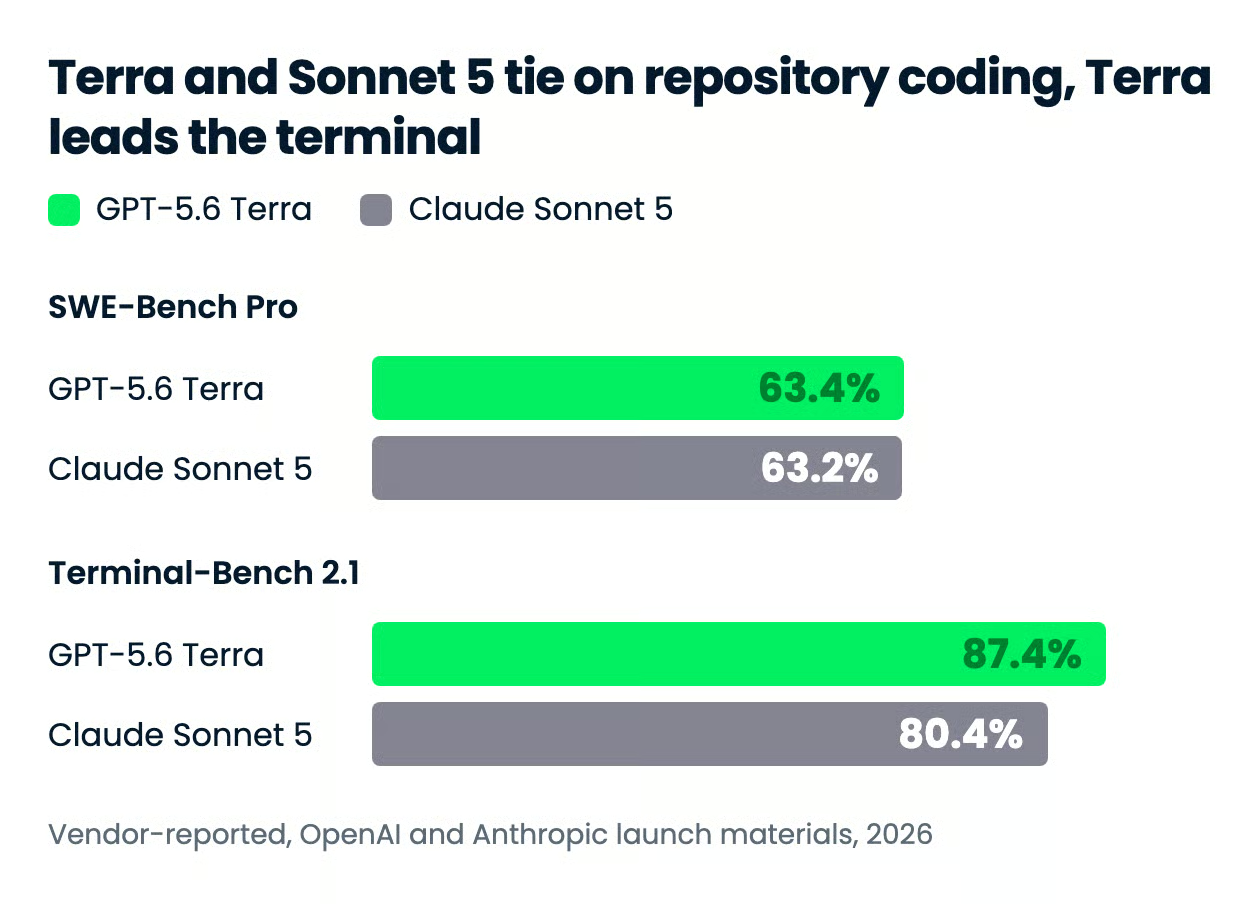
Usually, the split goes in Anthropic's favor for programming in a repository and in OpenAI's favor for terminal work.
The latter split remains: On Terminal-Bench 2.1, Terra reaches 87.4%, against 80.4% for Sonnet 5 in Anthropic's launch materials, a 7-point gap on command-line workflows. Notably, Terra also outperforms Claude Opus 4.8 (78.9%) and Claude Fable 5 (83.1%) in OpenAI's run of the same eval.
But currently, both competing mid-tier models are on par with one another for repo coding. On SWE-Bench Pro, which runs multi-step fixes against real repositories, OpenAI reports Terra at 63.4% and Anthropic reports Sonnet 5 at 63.2%.
| Benchmark | GPT-5.6 Terra | Claude Sonnet 5 | Notes |
|---|---|---|---|
| SWE-Bench Pro | 63.4% | 63.2% | Vendor-reported on separate harnesses; effectively tied |
| Terminal-Bench 2.1 | 87.4% | 80.4% | Vendor-reported; Terra's largest published coding lead |
| Artificial Analysis Coding Agent Index v1.1 | 77.4 | Not published | Independent index; Terra sits above Fable 5 at 77.2 |
Anthropic's own framing supports the split. Sonnet 5's coding story is about follow-through rather than peak score: early testers described it finishing tasks where Sonnet 4.6 stopped short and checking its own output unasked.
If your agent spends its life in a shell, Terra has the edge. If it spends its life inside a codebase reasoning about a failure, the benchmarks say you're picking between two models of the same class.
Both vendors report GDPval-AA v2, an Elo-style measure of professional output quality, and the numbers are close enough to be a wash. OpenAI puts Terra at 1,593 Elo; Anthropic puts Sonnet 5 at 1618. OpenAI scores Claude Opus 4.8 at 1600 Elo on this eval while Anthropic scores the same model at 1615, so a 25-point gap between Terra and Sonnet 5 sits inside the methodology noise.
Where Terra has an unanswered claim is Agents' Last Exam, an evaluation of long-running professional workflows across 55 fields. Terra scores 50.4%, ahead of GPT-5.5 (46.9%), Claude Opus 4.8 (45.2%), and Claude Fable 5 (40.5%). Anthropic did not report Sonnet 5 on that eval, so treat it as OpenAI's chosen ground rather than a verdict.
Computer use is the one place I'd warn you off a direct comparison entirely. OpenAI reports Terra at 50.2% on OSWorld 2.0, while Anthropic reports Sonnet 5 at 81.2% on OSWorld-Verified. Those are different evaluation sets with different scoring, and Anthropic explicitly revised how it runs OSWorld-Verified for this release, so putting the two figures side by side tells you nothing.
Terra's practical advantage in this area is token accounting. Notion reported that many agents running GPT-5.5 perform just as well on Terra at half the cost and with 16% fewer tokens, and Clio reported that Programmatic Tool Calling cut prompt tokens by 38% on multi-step document analysis with no quality loss. Those are vendor-partner claims, not independent measurements, but they're specific about what changed.
This is the widest gap in the comparison, and it is a design decision rather than a capability accident.
OpenAI trained the GPT-5.6 family for cyber work: Terra scores 91.8% on Capture-the-Flag challenges, 57.7% on SEC-Bench Pro, 52.9% on ExploitBench, and 23.2% on ExploitGym. Two of those figures beat GPT-5.5, the previous flagship, which scored 45.8% on SEC-Bench Pro and 47.9% on ExploitBench.
Anthropic went the other way. Sonnet 5 was not deliberately trained on cybersecurity tasks, and on an exploit-development eval built with Mozilla against Firefox 147 vulnerabilities, it never produced a working exploit at all, scoring 0.0%. Anthropic ships Sonnet 5 with real-time cyber safeguards enabled by default and recommends Opus 4.8 for cyber work that needs reduced guardrails.
For most readers, this is a feature of Sonnet 5, not a weakness. If you're building a product where a model attempting to generate exploits is a liability, a model that reliably declines is the safer dependency. If you do defensive security work, Terra sits inside OpenAI's Daybreak Trusted Access for Cyber program, and individual members need hardware-backed passkeys enabled by September 1 to keep access to the most cyber-capable models.
Worth flagging the friction cost on OpenAI's side, too. OpenAI says its GPT-5.6 Sol cyber safeguards block roughly 10 times as much potentially harmful activity as previous models, and it added a retry-on-a-lower-capability-model option in ChatGPT and Codex precisely because benign requests get caught. Reddit threads on the Anthropic side report the same complaint: Sonnet 5 is blocking benign security teaching content, so neither vendor has solved the overblocking issue.
Nominally, these two are the same: Terra publishes a 1,050,000 token context window with a 128,000 token output ceiling, and Sonnet 5 ships a 1M window with a 128K output ceiling. What differs is what happens when you actually fill it.
Terra has published retrieval scores across the window. On OpenAI MRCR v2 8-needle, it scores 89.6% in the 256K-512K band and 72.5% in the 512K-1M band, close to Sol's 91.5% and 73.8% and far above Luna's 41.3%. This means that you can roughly expect the model to find hidden details in 9/10 cases within a 512k document, which makes it a very reliable companion for knowledge extraction. Anthropic did not publish comparable needle-retrieval figures for Sonnet 5 at launch.
The billing behavior is the more consequential difference. Prompts over 272K input tokens on Terra are priced at 2x input and 1.5x output for the entire request, not just the overage. Sonnet 5 has no published long-context surcharge, so its rates hold across the full window. I'll put numbers on that in the pricing section, because it flips which model is cheaper.
Both models expose a reasoning-effort dial, then diverge sharply on how much else you're allowed to touch.
Sonnet 5 removed temperature, top_p, and top_k entirely, and calls that set them return a 400 error. Manual extended thinking also returns a 400; you get adaptive thinking on by default, or you disable thinking outright.
Sonnet 5 also does not support Priority Tier on the Anthropic platform, which matters if your team relies on that for latency guarantees on Opus or Sonnet 4.6 today. Anthropic raised rate limits across Chat, Cowork, Claude Code, and the Claude Platform to absorb the heavier token usage that higher effort levels produce.
Terra's surface is wider in a different direction. The features worth knowing about:
Programmatic Tool Calling in the Responses API, which runs coordinating programs in memory and is Zero Data Retention compatible.
A multi-agent beta in the Responses API, letting the model run concurrent subagents and synthesize their work in one request.
The max effort setting, toggleable by any user with GPT-5.6 access in ChatGPT Work and Codex.
Explicit cache breakpoints with a 30-minute minimum cache life, cache reads at a 90% discount, and cache writes at 1.25x the uncached input rate.
Function calling, structured outputs, hosted shell, code interpreter, and computer use on the Responses API, with fine-tuning not supported.
One asymmetry to note: OpenAI's ultra setting coordinates four agents in parallel, but every published ultra benchmark belongs to Sol, not Terra. Don't assume the mid-tier gets the same multi-agent gains until someone publishes Terra Ultra numbers.
Terra and Sonnet 5 currently sit within a dollar of each other on input, which makes the workload shape, not the headline rate, the thing that decides your bill.
| Rate | GPT-5.6 Terra | Claude Sonnet 5 |
|---|---|---|
| Input, per 1M tokens | $2.00 | $3.00 ($2.00 through Aug 31, 2026) |
| Output, per 1M tokens | $12.00 | $15.00 ($10.00 through Aug 31, 2026) |
| Long-context surcharge | 2x input, 1.5x output above 272K input tokens | None published; flat to 1M |
| Reasoning tokens | No separate rate published | Billed as output tokens |
| Free tier access | Default for Free and Go in ChatGPT Work and Codex | Default on Free and Pro plans |
Terra's $2.00/$12.00 rates reflect the 20% cut OpenAI applied on July 30, 2026, down from $2.50/$15.00 at launch. Cached input reads on Terra are $0.20 per 1M, and Anthropic supports prompt caching for Sonnet 5 without breaking out a Sonnet-specific rate in its launch materials.
Since Anthropic bills for thinking tokens at the output rate, running Sonnet 5 at extra-high effort is a direct multiplier on your most expensive line item. That is the single easiest way to blow through a budget you sized on input volume.
The formula is simple: (volume ÷ 1M) × rate, summed across input and output. I've worked three workload shapes at standard rates, chosen because each one isolates a mechanism where these two models actually differ.
| Workload | GPT-5.6 Terra | Claude Sonnet 5 | Difference |
|---|---|---|---|
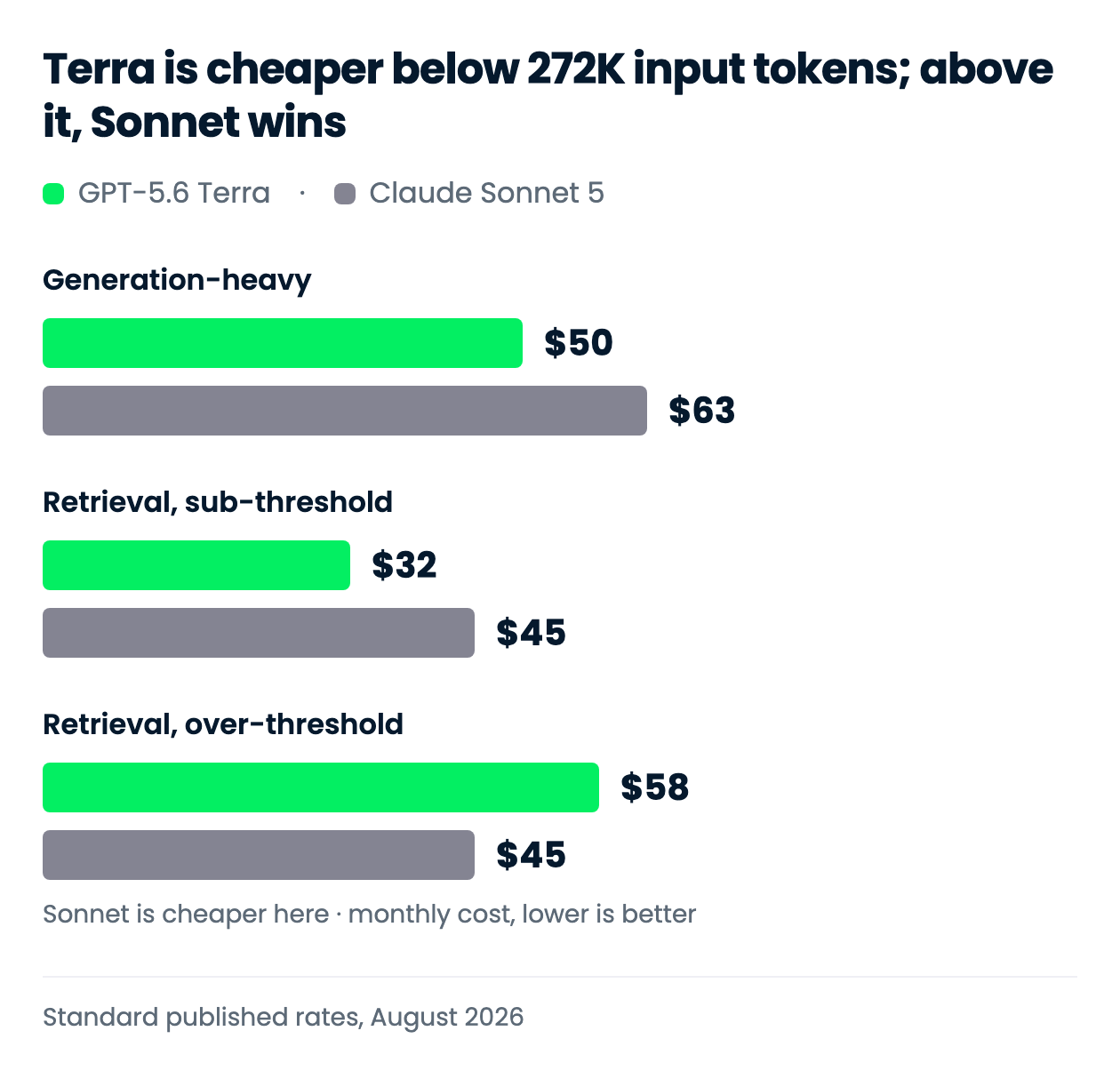
| Generation-heavy: 1M in / 4M out | $50 | $63 | Sonnet 5 +$13 (26%) |
| Retrieval, sub-threshold: 10M in / 1M out, each request under 272K | $32 | $45 | Sonnet 5 +$13 (41%) |
| Retrieval, over-threshold: 10M in / 1M out, each request above 272K | $58 | $45 | Terra +$13 (29%) |
The third row is the finding. Nothing changes about the total volume between rows two and three, only the size of each individual request, and Terra's 272K surcharge turns a 41% cost advantage into a 29% cost penalty. If you routinely stuff 300K tokens of contract text or repository context into a single call, Terra's cheaper sticker price is misleading.
The generation-heavy row also reverses if you're buying before September. At Sonnet 5's introductory $2.00/$10.00 rates, that workload costs $42 against Terra's $50, so Sonnet 5 is $8 cheaper until the standard rates kick in on September 1, 2026. Anthropic set that introductory window to make migration from Sonnet 4.6 roughly cost-neutral, which is worth remembering before you build a budget on it.
These rates only translate into a bill if both models consume the same number of tokens for the same work, and they usually don't. Terra and Sonnet 5 use different tokenizers from different vendors, so identical text yields different input token counts for each model before either model responds.
Neither vendor has published a between-subjects token count, so I can't hand you an adjusted figure. What exists are predecessor claims that don't say anything about Terra versus Sonnet 5:
My advice is to treat the table above as a rate comparison rather than a forecast, and to measure your own token counts on a representative sample before committing. The Sonnet 5 tokenizer change in particular caught teams out at launch, with Simon Willison's review and cloud consultancies both flagging it as the main migration surprise.
Here's how the decision falls out across the scenarios I'd expect most readers to be in.
| Use Case | Recommended | Why |
|---|---|---|
| Terminal and CLI coding agents | GPT-5.6 Terra | 87.4% on Terminal-Bench 2.1 against Sonnet 5's 80.4%. |
| Repository-level bug fixing | Either | 63.4% vs 63.2% on SWE-Bench Pro is a tie; pick on price and ecosystem. |
| Very large context (300K+ tokens) | Claude Sonnet 5 | No long-context surcharge, while Terra charges 2x input above 272K. |
| Tool-heavy pipelines with many calls per turn | GPT-5.6 Terra | Programmatic Tool Calling cut prompt tokens 38% in Clio's document workflows. |
| Defensive security and vulnerability triage | GPT-5.6 Terra | 91.8% on Capture-the-Flag and access via Trusted Access for Cyber. |
| Products where exploit generation is a liability | Claude Sonnet 5 | Scored 0.0% on Firefox exploit development and ships cyber safeguards on by default. |
| Generation-heavy workloads before September 2026 | Claude Sonnet 5 | Introductory $2/$10 rates undercut Terra by $8 on a 1M in / 4M out month. |
| Workloads needing custom sampling parameters | GPT-5.6 Terra | Sonnet 5 rejects temperature, top_p, and top_k with a 400 error. |
If cost is the binding constraint, the three worked workloads are the fastest way to see which side you're on: $50 versus $63 on a generation-heavy month, $32 versus $45 on sub-threshold retrieval, and $58 versus $45 once each request crosses 272K input tokens.
Both models are generally available today, and both are the models their vendors give away for free, so trying them costs nothing but time.
| Surface | GPT-5.6 Terra | Claude Sonnet 5 |
|---|---|---|
| Consumer app and tier | ChatGPT Work: default for Free and Go; selectable for Plus, Pro, Business, Enterprise | Claude apps: default on Free and Pro; available to Max, Team, Enterprise |
| First-party API | OpenAI API, via Responses and Chat Completions | Claude API on the Claude Platform |
| Cloud platforms | Amazon Bedrock (GA) and Microsoft Foundry (GA, incl. APAC Data Zone); not yet available on Google Vertex | Claude Platform on AWS and Claude in Microsoft Foundry; Google Vertex listed as coming soon |
| Coding agents | Codex: default for Free and Go, selectable on Plus and above | Claude Code |
| API model ID | gpt-5.6-terra |
claude-sonnet-5 |
These are separate SDKs, so switching between them is more than a model string. Both calls are short enough that the difference is visible at a glance.
from openai import OpenAI

client = OpenAI()
response = client.responses.create(
    model="gpt-5.6-terra",  # swap for gpt-5.6-sol or gpt-5.6-luna
    input="Refactor this pytest fixture to avoid module-level state.",
)
print(response.output_text)
from anthropic import Anthropic
client = Anthropic()
message = client.messages.create(
model="claude-sonnet-5", # no temperature/top_p/top_k on this model
max_tokens=1024,
messages=[{"role": "user", "content": "Refactor this pytest fixture to avoid module-level state."}],
)
print(message.content.text)If you're porting existing Anthropic code, remember to strip temperature, top_p, top_k, and any manual extended thinking configuration first, since Sonnet 5 returns a 400 rather than ignoring them.
For the full setup path on the Anthropic side, our complete guide to the Claude API goes deeper than makes sense here. To get started on the GPT side, our Working with the OpenAI API course is the best place to start.
The one-sentence version: Terra is the better mid-tier model for terminal agents and tool-dense pipelines, and Sonnet 5 is the better one for large prompts and teams that want a smaller surface to reason about.
What I find most interesting is that both vendors chose the mid-tier as the free default, and then made opposite bets about what a mid-tier model should refuse. OpenAI trained Terra for cyber work and put the sharpest capability behind identity verification and hardware passkeys. Anthropic trained Sonnet 5 not to do it at all, then shipped safeguards on top. Neither approach is obviously right, and both create real friction for legitimate work.
If you want to build the background to make these calls yourself rather than reading someone else's benchmark table, I recommend starting with our AI Fundamentals skill track.
Learn Using Claude and GPT with DataCamp!
Course
Course
Track
blog
Josef Waples
7 min
blog
Tom Farnschläder
11 min
blog
Tom Farnschläder
14 min
blog
Tom Farnschläder
11 min
blog
Matt Crabtree
9 min
blog
Josef Waples
8 min


