
Our biggest-ever sale. 60% off AI & data skills
Buy Now

ฝึกฝนและตรวจสอบความก้าวหน้าของคุณ
ดำเนินการต่อด้วย Googleเมื่อดำเนินการต่อ ถือว่าคุณยอมรับ ข้อกำหนดการใช้งานและ นโยบายความเป็นส่วนตัว และยอมรับว่าข้อมูลของคุณจะถูกจัดเก็บในสหรัฐอเมริกาLet’s analyze the main benefits of the adoption of AI in the workplace:
AI can be used internally to optimize the day-to-day operations of your company. By detecting bottlenecks and inefficient processes, and identifying ways to streamline operations, AI can help your company boost its performance and reduce costs.
At the same time, the automation of repetitive, time-consuming tasks will free up your employees, who will have more time to focus on higher-value work. Also, if well implemented, AI could be the cornerstone of efforts to reduce working hours and increase your employees' satisfaction.
Here are some examples of AI-powered tools to automate workflows:
AI tools can process information much faster and more accurately than humans. These technologies enable predictive analytics, pattern recognition in vast datasets, and automated decision-making, helping companies gain a competitive edge in their industries and sectors.
AI-driven decision-making can be used in many areas of the workplace:
Curious about how AI can support business decision-making? Check out our Data-Driven Decision Making for Business Course to learn all about it.
By inserting AI tools in every aspect of your business, you can better understand the behavior of your employees. With that information, you can anticipate the needs and desires of your workers to foster a better workplace and increase their satisfaction.
For example, AI can help tailor your company’s internal training programs to the needs of the departments and specific workers, thereby offering a more personalized and effective learning experience.
AI can contribute to safer workplaces by providing real-time insights, risk assessment, and behavior monitoring. By analyzing large amounts of data, AI can identify patterns, predict potential risks in business operations, and improve safety protocols. This is particularly important in sectors where serious hazards are likely to appear, like manufacturing and the energy sector.
AI is also enhancing fraud detection and prevention. By leveraging large workplace data, machine learning models can analyze millions of transactions to detect subtle patterns indicating any fraud faster and also more accurately than humans.
AI's threat detection and network monitoring capabilities are pivotal in ensuring robust cybersecurity measures.
AI significantly enhances the ability to detect and prevent cyber threats that could affect sensitive business data and employee personal data. These systems are trained on vast datasets of cybersecurity incidents, enabling them to learn and adapt to cyber attackers' new tactics, including detecting unusual access patterns, suspicious network traffic, or anomalies in user behavior that may indicate a security breach.
As Brian Murphy, CEO of ReliaQuest, claims in our podcast on How AI is Changing Cybersecurity:
AI is a useful tool to help make security possible. It helps us increase visibility, get access to data in different data types and different table fields and different tables and put like next to like so we can make accurate decisions with accurate security information.
Let’s now analyze the main benefits of challenges and concerns of using AI in the workplace:
While the benefits of AI are clear, implementing a successful AI strategy is often a long journey full of obstacles.
On the technical side, two of the main challenges are how to integrate data into optimized pipelines and how to then deploy AI models into production.
Building a successful AI strategy requires considerable effort and resources, but even companies with big pockets fail to implement AI solutions. Why? Because they lack enough skilled employees with AI literacy. According to DataCamp State of Data & AI Literacy Report 2024, although 86% of the surveyed leaders claimed data literacy is important for their teams' daily tasks, 57% acknowledged a data literacy skill gap within their organizations.
While we are still in the pioneering phase of data literacy, it’s important to start the transition as soon as possible. Check out our guide on how to learn AI to discover everything you need to know about starting your journey to data & AI literacy.
AI is rapidly reshaping the business ecosystem. However, as always occurs with emerging technologies, with power comes responsibility. As Glenn Hopper explains in this interview:
The biggest hurdles right now for the adaption of AI are data privacy and security issues, compliance, and trust in these gen AI-powered systems.
Despite the unique capabilities of AI, it’s important to consider its potential risks and regulatory concerns.
Finally, when we talk about implementing AI solutions, we need to talk about money. Advancing AI solutions requires considerable resources. While AI can lead to cost savings and efficiency gains, the initial investment and ongoing maintenance costs, as well as potential scalability issues, must be carefully considered. In this regard, evaluating the cost and ROI of implementing AI solutions is key for companies.
As Jon Reilly, Co-Founder and CEO of Akkio, summarizes in this article:
Costs can range dramatically from the affordable fees as little as $25 per month for simple AI tools like chatbots to multimillion-dollar investments in cutting-edge systems akin to those used by Netflix or OpenAI. Crucially, understanding your specific needs – be it in hardware, software, or talent – is key to making informed decisions.
If you are considering implementing AI into the day-to-day operations of your company, you should be mindful of aspects that are key to ensuring success: how to integrate AI tools and how to boost the data and AI literacy of your employees.
Integrating AI tools is a great challenge for companies. Many questions may arise during the process. When and where to use AI? What tools to use? Is it worth the cost?
Here is a list of the steps for integrating AI into your business operations:
Whatever the AI solution you want to implement in your company, you will need your employees to make that happen. That’s why, before starting the process, it’s essential to conduct an honest evaluation of your team's capabilities, needs, and existing processes.
Below, you can find a guide on how to equip your teams with essential AI skills.
The first step in launching a successful data analytics training initiative is assessing your team's current skill levels to identify gaps and determine specific training needs. Conducting a comprehensive skills assessment allows organizations to understand the proficiency levels of their employees in data analytics and related technologies.
This evaluation can be achieved through surveys, interviews, and practical assessments to gauge knowledge, expertise, and familiarity with various data analytics tools and techniques. You can also use DataCamp’s data maturity assessment to understand where your team, department, and organization are located on the data maturity spectrum.
Understanding your team’s current skill set allows you to customize training programs effectively. By focusing on areas that require improvement, you ensure that your training is relevant, targeted, and impactful. Collaboration with your data analytics academy partner, such as DataCamp For Business, can facilitate this process.
Our expert teams can help you tailor existing learning tracks or create new ones to meet your organization's specific needs and ensure that all employees stay on track with their learning goals.
Establishing clear metrics and methods to measure the success of your training program is crucial. Define key performance indicators (KPIs) and objectives that align with your business goals, such as enhanced analytical skills, increased productivity, or improved decision-making capabilities. These metrics will help you track progress and demonstrate the impact of your training efforts.
At DataCamp, we understand the complexities of building a data analytics academy and are here to support you every step of the way. We offer a wealth of data literacy resources, including blogs, webinars, and use cases specifically designed for business leaders.
Let’s analyze some case studies across industries to illustrate how companies can leverage the power of AI to improve their workplaces.
In recent years, AI has been making groundbreaking advancements in the manufacturing industry due to the significant amounts of data the industry relies upon. Below you can find some of the most illustrative use cases of AI in manufacturing.
There are many use cases of AI in finance, a sector that has historically been a pioneer in the use of new technologies to make the business safer and profitable. Agus Sudjianto explains it in this podcast:
In terms of applications for banking and finance, we are using AI in a vast number of use cases, from mundane tasks to processing information and conducting surveillance.
Here are some examples:
AI technologies are used in different combinations to solve problems across the healthcare sector. Here are a few ways AI is being applied to healthcare.
As we look towards the future, the importance of AI in the workplace is set to grow exponentially. With AI technologies evolving at a rapid pace and their applications expanding across various sectors, AI will provide a competitive edge to companies that can successfully integrate them into their daily operations.
On the one hand, the need for advancement in AI will transform businesses in unpredictable ways, helping the workplace be more efficient, productive, and safer.
On the other hand, the adoption of AI tools will reshape the way companies envision and implement business strategies and operations.
However, as shown in DataCamp’s State of Data & AI Literacy Report 2024, despite progress in previous years, AI training remains in its infancy, meaning that companies will have to make additional investments in AI literacy to harness the full potential of this technlogy.
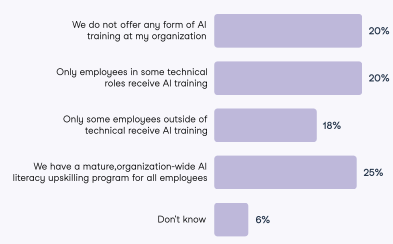
What would best describe the state of AI training at your organization? Source: DataCamp
Undoubtedly, AI is a revolutionary technology; a growing number of businesses are already adopting it to improve practices, make better decisions, and build better products.
As these systems become smarter, manufacturing practices will likely be improved in the process; therefore, companies with a solid grasp of AI fundamentals are likely to hold a significant edge over their competition.
Request a demo to see how DataCamp can guide you through the process of upskilling your entire team, building a data-positive culture, and implementing an AI workplace.
In the meantime, we highly recommend you stay tuned with AI and the technology behind it with the following DataCamp materials:
AI can optimize your workplace by increasing your productivity, improving your decision-making capabilities, ensuring the safety of your employees, and protecting your data.
Some of the main technical challenges to implementing AI are related to integration issues, and lack of skilled personnel.
Advancing AI solutions in the workplace normally requires investment. While AI can lead to cost savings and efficiency gains, the initial investment and ongoing maintenance costs, as well as potential scalability issues, must be carefully considered.
We can predict that companies of all sectors will progressively implement AI in their workplaces, making them more efficient, productive, and safer, and completely reshaping business strategies and operations.
As AI continues to permeate every facet of the workplace, a new form of literacy has emerged as a necessity - AI literacy. Check out how DataCamp can help you equip your teams with essential AI skills.

I am a freelance data analyst, collaborating with companies and organisations worldwide in data science projects. I am also a data science instructor with 2+ experience. I regularly write data-science-related articles in English and Spanish, some of which have been published on established websites such as DataCamp, Towards Data Science and Analytics Vidhya As a data scientist with a background in political science and law, my goal is to work at the interplay of public policy, law and technology, leveraging the power of ideas to advance innovative solutions and narratives that can help us address urgent challenges, namely the climate crisis. I consider myself a self-taught person, a constant learner, and a firm supporter of multidisciplinary. It is never too late to learn new things.

บล็อก
 Javier Canales Luna• 10 นาที

บล็อก
Javier Canales Luna• 9 นาที
บล็อก
 Vinod Chugani• 11 นาที


AI is rapidly revolutionizing our society. From healthcare and marketing to finance and education, nearly every sector of the economy is experiencing deep changes as a result of the adoption of AI. That includes the workplace. With the help of AI-powered tools, workplaces are becoming more productive and efficient than ever.
In this article, we will explore the impact of AI in modern companies. We will cover the benefits of adopting AI in business settings, how to manage the potential risks to ensure a safe workplace, as well as practical considerations you should think about before launching an AI strategy in your workplace.
To learn more about how AI is changing the workplace, check out our webinar, Learning in the Age of AI: How Will AI Reshape the L&D Function in 2025?