track
As the AI hype continues to explode, professionals and newcomers to the industry alike are considering AI certifications to give them an advantage in the job market. But are such certifications necessary? And what are the best AI certifications out there at the moment? In this article, I'll explore some of the options available to you and highlight some useful resources for helping you learn AI from scratch.
Earn a Top AI Certification
TL;DR - The Top AI Certifications for 2026
If you're looking for a top-level look at the artificial intelligence certification market in 2026, check out our summary below. If you're in a hurry to get started, be sure to check out our AI Fundamentals skill track.
Top AI Certifications in 2026:
- AI Fundamentals Certification – DataCamp. For beginners and professionals seeking foundational AI knowledge.
- AI Engineer for Data Scientists Associate – DataCamp. For data scientists transitioning into AI engineering; includes timed and practical exams.
- AI Engineer for Developers Associate - DataCamp. For developers transitioning into AI engineering; includes timed and practical exams.
- Certified Artificial Intelligence Scientist (CAIS) – USAII.Designed for senior leaders looking to develop AI strategy skills.
- Artificial Intelligence Certification – ARTIBA. Technical certification for CS/IT professionals pursuing AI careers.
- Azure AI Engineer Associate – Microsoft. For developers building and deploying AI solutions using Azure tools.
- Jetson AI Courses & Certifications – NVIDIA Developer. Hands-on, project-based learning in AI and Edge AI using Jetson hardware.
- Artificial Intelligence Graduate Certificate – Stanford University. Rigorous academic program with credit eligibility toward a master’s degree.
- Professional Certificate in Machine Learning & AI – MIT Professional Education. In-depth, customizable learning experience for experienced professionals.
Why Choose AI Certification?
The field of artificial intelligence is not just growing; it is exploding. The AI market size, currently valued at over $240bn, is expected to reach $738.80bn by 2030. This staggering growth translates into a soaring demand for AI-skilled professionals. Whether you are a beginner in the data science field or an experienced practitioner, AI certifications can significantly bolster your career, equipping you with the skills and knowledge to stay ahead in a highly competitive market.
Exploring The Best AI Certifications For 2026
Now that we know the benefits of getting AI certified, let’s look at some of the options you have available. These cover a range of skill levels, career pathways, and costs, but all have their pros and cons.
1. AI Fundamentals Certification | DataCamp
- Target audience: Professionals looking to validate foundational knowledge of AI, including business leaders, aspiring AI practitioners, and teams in need of a comprehensive understanding of AI basics.
- Key skills covered: Core AI concepts, machine learning fundamentals, generative AI, and ethical considerations for AI implementation.
- Career pathways: Supports career growth by establishing a foundational understanding of AI, aiding in decision-making and ethical assessment for projects involving AI.
- Experience needed: No programming experience required; suitable for all knowledge levels.
- Cost: $25 per month (included with Premium Membership), flexible timeline
2. AI Engineer for Data Scientists Associate Certification | DataCamp
- Target audience: Aspiring AI Engineers with a background in data science looking to validate core skills for pre-entry-level roles in AI development and deployment.
- Key skills covered: Data management, exploratory analysis, AI governance, application development, MLOps, and foundational AI programming in Python.
- Career pathways: Helps data professionals transition into AI engineering by certifying essential knowledge in building and managing AI systems. Builds credibility for roles in AI development, model deployment, and production systems.
- Experience needed: Suitable for learners with a data science foundation. Python experience is required, but no prior AI engineering role experience is necessary.
- Cost: $25 per month (included in DataCamp Premium Membership); certification must be completed within 30 days of registration.
3. AI Engineer for Developers Associate | DataCamp
- Target audience: Developers and professionals looking to specialize in AI and validate the foundational skills needed to become an AI Engineer with a software development focus.
- Key skills covered: AI models, prompt engineering, large language models (LLMs), building chatbots, implementing AI solutions, integrating AI into applications using APIs and open-source libraries, and common software engineering principles.
- Career pathways: Prepares individuals for entry-level AI Engineer roles, equipping them to support the development, deployment, and integration of artificial intelligence solutions within an organization.
- Experience needed: Basic programming experience (specifically in Python) and a fundamental understanding of software development are expected.
- Cost: $25 per month (included with Premium Membership), with a 30-day deadline to complete the exams once registered.
4. Certified Artificial Intelligence Scientist | CAIS
- Target audience: Senior AI professionals, including managers, directors, and CXOs, with limited technical knowledge.
- Key skills covered: Strategic AI, AI workflow, securing applications, AI for business and finance.
- Career pathways: Enhances AI strategy and solution development skills for business transformation.
- Experience needed: No mandatory programming skills required.
- Cost: $1,195, self-paced, 4-25 weeks with 8-10 hours of learning per week
5. Artificial Intelligence Certification | ARTIBA
- Target audience: Professionals with degrees in Computer Science/IT or related fields, with variable work experience requirements.
- Key skills covered: AI and ML systems and applications, data modeling, NLP, machine learning, computer vision, human-computer interactions.
- Career pathways: AI engineer and technology roles with a focus on diverse applications and solutions.
- Experience needed: Depends on educational background; programming knowledge essential for Bachelor's and Master's degree holders.
- Cost: $750, inclusive of exam and learning resources
6. Microsoft Certified: Microsoft Azure AI Fundamentals (AI-901)
- Target audience: Learners from technical backgrounds and aspiring junior developers who want to start working with AI solutions built on Azure and begin incorporating AI capabilities into applications.
- Key skills covered: Core cloud concepts (services and resource deployments), identifying AI concepts and responsibilities, deploying models/implementing single-agent solutions using Microsoft Foundry, and understanding Python code examples that consume AI models and services.
- Career pathways: Establishes a foundation for junior or entry-level developers to explore and use AI features (like language, vision, and generative AI) in software or IT solutions. It also serves as preparation for more advanced, role-based Azure AI certifications.
- Experience needed: Some foundational knowledge of Python coding syntax and programming techniques is useful, along with a basic understanding of core cloud concepts (like cloud storage, compute, and authentication).
- Cost: $99 USD (price may vary based on the country or region in which the exam is proctored).
7. AI and the Digital Ecosystem - BCS Foundation Award
- Target audience: Business leaders, senior managers, IT and transformation professionals, strategy teams, and anyone needing a clear, non-technical understanding of AI’s organizational impact and how it fits into a wider digital ecosystem.
- Key skills covered: Contextual awareness of AI adoption, AI governance and strategy, risk management, understanding big data and data architecture concepts, testing approaches for AI systems, and identifying the interdependencies between data, technology, people, and processes.
- Career pathways: Ideal for professionals involved in AI planning, procurement, or adoption. It supports career progression by enabling informed decision-making that avoids siloed approaches to AI, and it serves as a stepping stone for the broader BCS AI Certificate or BCS AI Diploma.
- Experience needed: No technical, programming, or AI background is required. There are no mandatory prerequisites, though a good level of English is recommended.
- Cost: ~$675 (one-time payment) or payment plans available. The cost includes the BCS exam fee, 12 months of course access, tutor support, the BCS AI Foundations eBook, and a 1-year BCS Associate Membership.
8. Artificial Intelligence Graduate Certificate | Stanford School of Engineering
- Target audience: Graduate-level professionals seeking advanced, academically rigorous AI training with potential credit toward a master’s degree.
- Key skills covered: Machine learning, deep learning, NLP, computer vision, robotics, reinforcement learning, and probabilistic modeling.
- Career pathways: Prepares learners for advanced technical roles, AI-focused research, or leadership in AI-driven organizations.
- Experience needed: Strong math and programming background required; Bachelor’s degree with 3.0+ GPA.
- Cost: $19,682–$24,224 total; 100% online with flexible pacing over 1–3 years.
9. Professional Certificate in Machine Learning & AI | MIT Professional Education
- Target audience: Technical professionals and managers with 3+ years of experience in fields like computer science, engineering, or statistics who want hands-on AI expertise.
- Key skills covered: Machine learning, deep learning, NLP, reinforcement learning, AI strategy, ethics, and deployment across domains like healthcare, robotics, and design.
- Career pathways: Equips professionals to lead or support AI initiatives, apply cutting-edge methods in industry, and drive digital transformation.
- Experience needed: Bachelor's degree in a technical field and relevant work experience; programming and analytical background recommended.
- Cost: Varies by course ($2,500–$4,700 each) + $325 application fee; complete 16+ days of courses within 36 months.
Top AI Certifications Compared
In the table below, we've compared the key features of each of the AI certifications we've covered:
| Certification Name | Target Audience | Experience Needed | Key Skills Covered | Cost & Timeline |
|
AI Fundamentals Certification (DataCamp) |
Business leaders, aspiring AI practitioners, teams needing foundational knowledge. | None. No programming experience required. | Core AI concepts, ML fundamentals, generative AI, ethics. |
$25/month (via Premium Membership), flexible. |
|
AI Engineer for Data Scientists Associate (DataCamp) |
Aspiring AI Engineers with a data science background. | Intermediate. Python required; data science foundation needed. | Data management, MLOps, AI governance, app development. |
$25/month (via Premium Membership), 30 days to complete. |
|
AI Engineer for Developers Associate (DataCamp) |
Software developers looking to specialize in AI engineering. | Intermediate. Basic Python and software development foundation. | Prompt engineering, LLMs, chatbots, API integration. |
$25/month (via Premium Membership), 30 days to complete. |
|
Certified Artificial Intelligence Scientist (CAIS) |
Senior professionals, managers, directors, and CXOs. | None. No mandatory programming skills. | Strategic AI, workflow, security, AI for business/finance. |
$1,195 Self-paced (4-25 weeks). |
|
Artificial Intelligence Certification (ARTIBA) |
Professionals with CS/IT or related degrees. | Advanced. Programming knowledge essential for degree holders. | AI/ML systems, data modeling, NLP, computer vision. |
$750 (Includes exam & resources). |
|
Microsoft Azure AI Fundamentals (AI-901) |
Junior developers and technical learners working with Azure. | Beginner. Basic Python and core cloud concept knowledge useful. | Cloud concepts, Microsoft Foundry model deployment. |
$99 (Varies by region). |
|
AI and the Digital Ecosystem (BCS Foundation) |
Business leaders, senior managers, transformation professionals. | None. No technical or AI background required. | AI governance, strategy, risk management, big data concepts. |
~$675 (Includes exam, 12-month access, tutor). |
|
AI Graduate Certificate (Stanford) |
Graduate-level professionals seeking academic, advanced training. | Advanced. Strong math/programming + Bachelor’s (3.0+ GPA). | Deep learning, NLP, robotics, probabilistic modeling. |
$19,682–$24,224 1–3 years. |
|
Professional Cert in ML & AI (MIT) |
Technical professionals and managers driving digital transformation. | Advanced. Bachelor’s + 3 years tech experience; analytical background. | ML/DL, NLP, reinforcement learning, AI deployment strategy. |
$2,500–$4,700/course (+ $325 app fee), up to 36 months. |
AI Certification vs Certificate
People often toss around "certificate" and "certification" like they mean the same thing, but they're actually quite different.
Certificates are simply proof of education. You get one when you finish a course or a learning track to show you put in the time to learn the material.
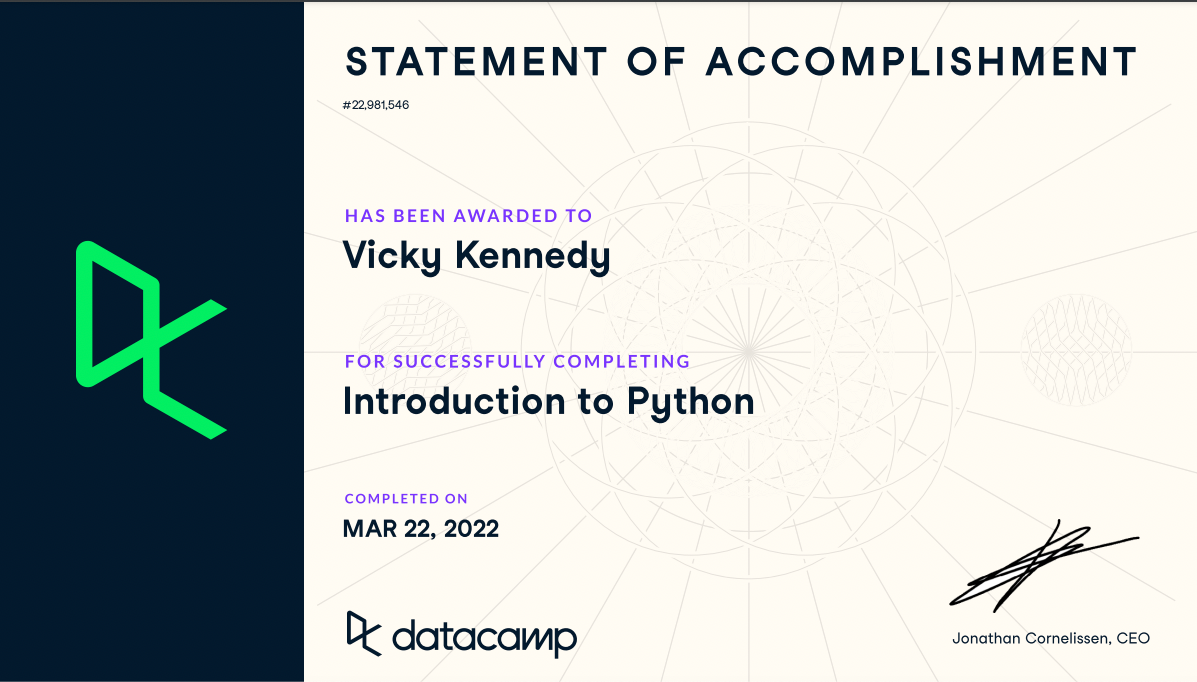
An example of a DataCamp Python certificate - different from a certification
On the other hand, AI certifications usually come from professional organizations or universities and require passing a rigorous exam (or a series of them). They act as a stamp of approval, proving you can actually do the work to a specific industry standard.
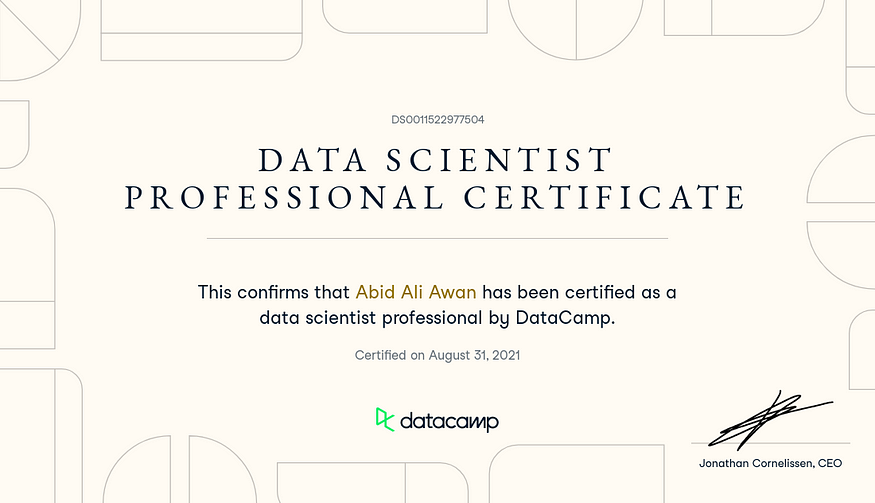
An example of DataCamp’s Python certification
Which one should you go for? It really depends on your goals. If you want to stand out to employers and prove your hard skills, go for an AI Certification. If you're just looking to learn a new skill or explore a niche without the pressure of a massive exam, an AI Certificate is the way to go.
Step-by-Step Guide to Choosing the Right AI Certification
So, how do you actually pick the right AI certification program? Keep these three things in mind before you sign up:
Identifying your career goals and skill level
Where do you want this to take you? Are you gunning for a leadership role, pivoting to data science, or just trying to specialize in a niche? Match your goals with where your skills are right now so you don't pick a program that's way over your head, or one that's too basic.
Analyzing course content and industry recognition
Don't just look at the title. Dig into the syllabus to make sure it covers what employers are actually looking for today. You want a good mix of theory and hands-on practice. Also, check the program's credibility is it an AI certification that hiring managers actually respect?
Considerations for time commitment and financial investment
Let's be practical: how many hours can you realistically dedicate to studying each week? And what's your budget? Keep in mind that a pricier certification might pay for itself if it lands you a better job. (Pro tip: always check if your employer will foot the bill!)
Preparing for AI Certification with DataCamp
Getting AI-certified takes work, but you don't have to figure it out from scratch. Here is how you can use DataCamp to prepare for exam day.
Prerequisites and foundational knowledge required
Most AI exams expect you to know your way around math and stats, especially things like linear algebra, calculus, and probability. If your math is a little rusty, we've got you covered. Check out our Demystifying Mathematical Concepts for Deep Learning tutorial or the Linear Algebra for Data Science in R course. For stats, the Statistics Fundamentals with Python Skill Track is a great place to start.
Study tips and resources for effective learning
If you’re working towards an AI certification, with DataCamp's courses and resources, you can systematically prepare for your exams, ensuring a well-rounded grasp of both the theoretical and practical aspects of AI.
- Develop programming skills: Proficiency in programming languages such as Python and R is crucial for implementing AI concepts. DataCamp's Python Programming Skill Track and R Programming Skill Track are excellent resources to build and hone these skills.
- Master data manipulation: Data manipulation skills are fundamental in AI, as they enable you to prepare and transform data for analysis. Courses like Data Manipulation with Python and Data Manipulation with R skill tracks on provide practical experience in these areas.
- Understand data science fundamentals: A strong grasp of data science concepts is vital for AI. DataCamp offers Data Scientist with Python and Data Scientist with R career tracks, which comprehensively cover the necessary skills in data science.
- Learn machine learning: As AI heavily relies on machine learning, understanding its fundamentals is key. Our Machine Learning Fundamentals with Python Skill Track and similar courses in R provide a solid foundation in machine learning concepts and techniques.
- Practice regularly: Apply what you learn in real-world scenarios and projects to reinforce your knowledge and skills. Check out our list of AI projects to help you on your way.
- Stay updated: AI is a fast-evolving field. Regularly follow AI-related news, blogs, and participate in forums to stay abreast of the latest developments.
Our machine learning cheat sheet can help as a quick reference as you revise
Final Thoughts
AI certifications are proof to employers that you actually know your stuff in an industry that's moving at lightning speed. Whether you’ve been in tech for years or you're completely new to the field, picking the right credential makes a massive difference.
The AI job market is exploding right now, and there are plenty of opportunities out there for people with the right skills. By taking the time to honestly evaluate your career goals, budget, and current experience, you can find a program that actually helps you get where you want to go.
You don't have to navigate it alone, either. DataCamp’s courses are built to give you the exact tools you need, not just to pass your exams, but to actually apply what you learn in the real world. The future of work is clearly AI-driven, and there's no better time to jump in.
Get started today with our AI Fundamentals certification track, and if you already have a base knowledge, consider the AI Engineer for Data Scientists Associate Certification.
Earn a Top AI Certification
FAQs
Are AI certifications worth it?
AI certifications can indeed be worth it if you're looking to validate your skills, gain a competitive edge in the job market, and keep pace with the rapid advancements in the field of artificial intelligence. They provide formal recognition of your expertise and can open up new career opportunities in a variety of industries increasingly reliant on AI technologies. AI skills are in incredibly high demand, and employers sought concrete evidence of candidates' expertise to de-risk the hiring process.
How much do AI certifications cost?
Costs vary widely, from free courses (like NVIDIA's Jetson AI Courses, which are technically free) to more expensive options (like the CAIS at $894). Consider how each certification matches your goals before investing both finances and time.
What key skills are covered in AI certifications?
AI certifications cover a range of skills, including AI and ML systems, data modeling, NLP, machine learning, computer vision, planning and managing AI solutions, and developing AI projects with a focus on machine learning or deep learning.
How often should I renew my AI certification?
Some certifications do not expire, while others require renewal after a certain period. For example, Microsoft certifications, including the Azure AI Engineer Associate certification, need to be renewed every 12 months.
Can I pursue AI certifications without a background in computer science or IT?
While having a background in computer science or IT can be beneficial, some AI certification programs are designed with foundational modules that enable individuals from diverse backgrounds to start learning AI, e.g. the CAIS. For other AI certifications that require programming knowledge, DataCamp is the perfect platform to develop your skills in AI concepts and programming languages such as Python.
How do AI certifications compare to traditional degrees in AI or computer science?
AI certifications are more focused and can be completed in a shorter timeframe than traditional degrees, making them ideal for upskilling quickly. While not a substitute for a degree, certifications are valuable for proving specific skills and staying current with the latest AI technologies.
What other certifications should I consider?
There are many certifications covering different topics, technologies and career paths. Check out some of our other guides for an overview: