

Reflection Llama 3.1: Perkembangan Terbaru dan Linimasa
Model Reflection Llama 3.1 70B menarik banyak perhatian sejak pengumumannya. Banyak hal terjadi saat saya mengerjakan artikel ini—berikut ringkasan singkat peristiwa kuncinya.
Awalnya, model ini diperkenalkan dengan klaim yang mengesankan, menyatakan dapat melampaui model close-source populer seperti GPT-4o dan Claude 3.5 Sonnet pada tolok ukur standar. Namun, saat Artificial Analysis mengujinya, mereka menemukan kinerjanya lebih buruk dibanding Llama 3.1 70B. Para pembuatnya menemukan bahwa versi yang mereka unggah di Hugging Face bermasalah pada bobot model.
Untuk memperbaikinya, para pembuat melakukan pelatihan ulang dan pengujian ulang model. Mereka merilis versi terbaru di OpenRouter, meski mereka tidak membagikan bobot modelnya. Namun, saat pengguna mengujinya, mereka berhasil mengungkap bahwa model dasarnya mengaku sebagai Claude Sonnet 3.5.
Bahkan ada yang “membuktikan” bahwa itu tidak dibangun di atas Llama 3.1, melainkan kemungkinan di atas Llama 3.
Artificial Analysis diberi akses ke API privat untuk versi terbaru ini dan mampu menghasilkan kinerja yang lebih baik, namun tidak setara dengan klaim awal. Selain itu, karena pengujian dilakukan pada API privat, tidak ada cara untuk memverifikasi secara independen apa yang sebenarnya mereka gunakan.
Versi terbaru model Reflection telah dirilis di Hugging Face pada tautan ini. Namun, Artificial Analysis menyoroti bahwa versi terbaru ini menunjukkan hasil yang jauh lebih buruk dibanding pengujian API privat.
Secara keseluruhan, masih ada masalah reprodusibilitas yang berlanjut, dan Artificial Analysis belum dapat mereproduksi klaim awal, sehingga menyisakan pertanyaan terbuka tentang kinerja sebenarnya Reflection Llama 3.1 70B.
Apa Itu Reflection Llama 3.1?
Reflection Llama 3.1 dibangun di atas model Llama 3.1 70B Instruct yang tangguh namun menambahkan fitur kunci bernama reflection-tuning. Teknik ini memungkinkan model menalar permasalahan, mengidentifikasi kekeliruan, dan membetulkan diri sebelum memberikan jawaban akhir. Intinya, ia memisahkan proses penalaran dari keluaran akhir, sehingga logikanya lebih jelas. Begini cara kerjanya:
- Tag pemikiran (
<thinking>): Model menguraikan penalarannya di bagian ini, memberikan wawasan tentang bagaimana ia mendekati masalah. - Tag refleksi (
<reflection>): Jika model menemukan kekeliruan dalam penalarannya, ia menandai kesalahan di sini dan memperbaikinya. - Tag keluaran (
<output>): Setelah menalar dan mengoreksi diri, model menyajikan jawaban akhir pada bagian ini.
Dengan mengikuti langkah-langkah ini, model menargetkan jawaban yang akurat dan penjelasan yang jelas tentang bagaimana ia sampai pada hasil tersebut.
Selain itu, Reflection Llama 3.1 dilatih pada data sintetis yang dihasilkan oleh Glaive AI, menekankan pentingnya dataset berkualitas tinggi dalam fine-tuning model.
Meskipun masih dalam tahap riset, Reflection Llama 3.1 dilaporkan melampaui model closed-source terkemuka seperti Claude 3.5 Sonnet dan GPT-4o pada tolok ukur utama seperti MMLU, MATH, dan GSM8K.
Para penciptanya memperkirakan Reflection Llama 405B yang akan datang akan melampaui model-model tersebut dengan margin yang lebar.
Siapkan Reflection Llama 3.1 di Google Colab dengan Ollama dan LangChain
Memulai dengan Reflection Llama 3.1 relatif mudah, asalkan Anda memiliki sumber daya yang tepat. Model ini tersedia melalui platform berikut:
Kami akan menggunakan Google Colab Pro untuk menjalankan model Reflection Llama 3.1 70B karena memerlukan GPU yang kuat. Anda perlu membeli compute units untuk mendapatkan akses ke GPU A100, yang dapat Anda lakukan di sini.
Setelah mendaftar Google Colab Pro, Anda dapat membuka notebook untuk memasang Ollama dan mengunduh model Reflection Llama 3.1 70B. Pastikan Anda memiliki ruang penyimpanan yang cukup (sekitar 40GB) untuk modelnya.
Langkah 1: Sambungkan ke GPU di Google Colab
Pertama, sambungkan ke GPU A100 dengan pergi ke Runtime → Change runtime type → Select A100 GPU.
Setelah tersambung ke GPU, Anda siap memasang Ollama dan mengunduh model Reflection.
Langkah 2: Pasang Ollama dan unduh model Reflection
Untuk memasang Ollama di Google Colab, Anda perlu mengakses terminal. Berikut caranya:
!pip install colab-xterm
%load_ext colabxtermSelanjutnya, buka terminal:
%xtermSekarang, unduh Ollama dengan menjalankan perintah ini di terminal:
curl -fsSL <https://ollama.com/install.sh> | shSetelah Ollama terpasang, jalankan perintah berikut untuk memulai Ollama:
ollama serve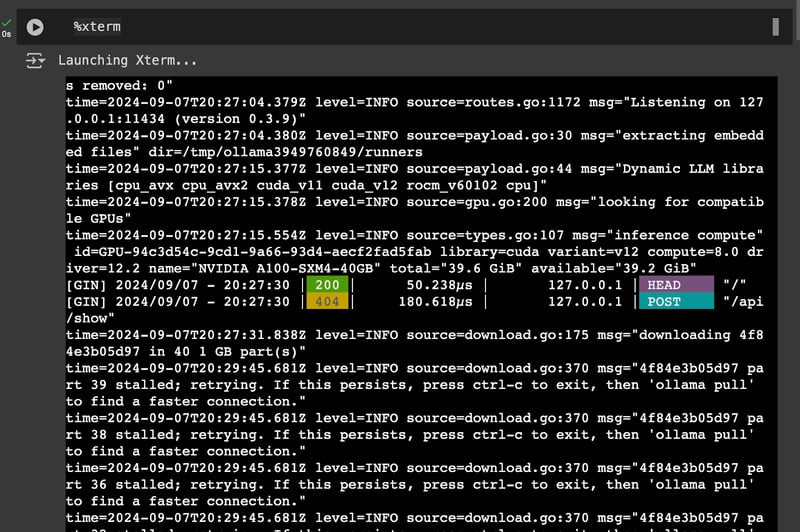
Berikutnya, buka terminal lain:
%xtermSekarang, unduh model Reflection dengan menjalankan perintah ini di terminal:
ollama run reflection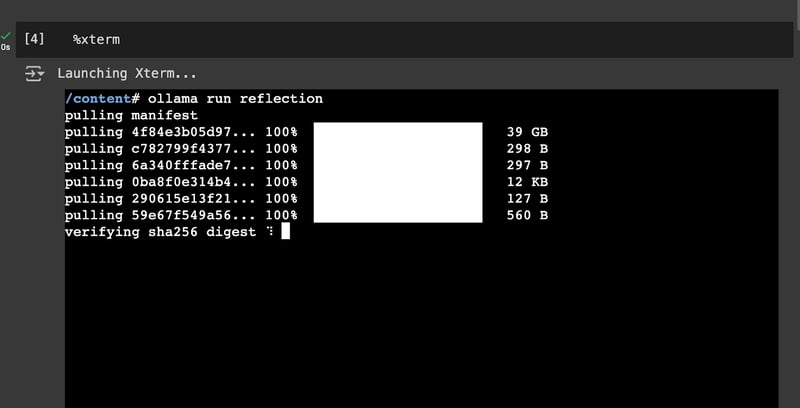
Secara keseluruhan, Anda sebaiknya memiliki dua terminal: satu untuk menjalankan aplikasi Ollama dan satu untuk mengunduh model Reflection Llama 3.1. Setelah Anda mengunduh modelnya, Anda siap ke Langkah 3.
Langkah 3: Gunakan Reflection dengan Langchain dan Ollama
Sekarang, pasang LangChain dan pustaka yang diperlukan (kode di bawah harus dijalankan pada notebook):
!pip install langchain langchain_community langchain-openai langchain-ollamaSelanjutnya, atur templat prompt. System prompt untuk Reflection Llama 3.1 adalah sebagai berikut:
from langchain_ollama import ChatOllama
from langchain.prompts import PromptTemplate
from langchain_core.output_parsers import StrOutputParser
# Define the prompt template for the model
prompt = PromptTemplate(
template="""You are a world-class AI system, capable of complex reasoning and reflection. Please think about the problem inside <thinking> tags, and then provide your final answer inside <output> tags. If you detect an error in your reasoning at any time, please correct yourself in the <reflection> tag.
Input:
{input}
""",
input_variables=["input"],
)Lalu, inisialisasi model Reflection Llama 3.1 70B menggunakan ChatOllama:
# Set up the LLM with the Reflection model
llm = ChatOllama(
model="reflection",
temperature=0,
)Terakhir, panggil modelnya:
reflection_model = prompt | llm | StrOutputParser()
reflection_model.invoke({'input': "Hi, how are you?"})<thinking>
To respond to this question, I need to consider a few things:
1. The input is a greeting and inquiry about well-being.
2. As an AI system, I don't have personal feelings or emotions.
3. A polite response would be appropriate.
Let's construct a suitable reply:
"I'm doing great, thank you for asking!" <reflection>
Wait, that's not entirely accurate. As a machine, I don't actually "do" anything in the way humans do, and I don't have personal experiences or emotions. Let me rephrase this to be more honest and clear about my nature as an AI.
</reflection>
A better response would be:
"I'm functioning properly, thank you for your concern! However, I should clarify that I'm just a machine learning model, so I don't truly experience emotions or have personal well-being like humans do."
<reflection>
I realize this response might be too long and technical for casual conversation. Let me simplify it while still maintaining accuracy.
</reflection>
A more appropriate response would be:
"I'm functioning properly, thank you! As an AI system, I don't have feelings or experiences like humans do."
</thinking>
<output>
Hi there! I'm functioning properly, thank you! As an AI system, I don't have feelings or experiences like humans do. It's great to chat with you though!
</output>Model Reflection Llama 3.1 dalam Aksi
Untuk menilai efektivitas Reflection Llama 3.1, saya memutuskan menjalankan model Reflection Llama 3.1 pada berbagai jenis prompt.
Penalaran numerik pada dokumen keuangan
Reflection Llama 3.1 melakukan tugas dengan baik pada pertanyaan keuangan dengan menghitung dan membandingkan imbal hasil kumulatif untuk UPS dan Indeks S&P 500 selama lima tahun secara akurat.
Pada bagian pemikiran, ia menghitung dengan benar imbal hasil -24,05% untuk UPS dan 2,11% untuk S&P 500. Namun, bagian refleksi secara keliru mencatat adanya kesalahan meskipun perhitungannya benar. Walau akhirnya ia menemukan hasil yang tepat, perilaku ini agak janggal.
Secara keseluruhan, keluaran akhir menjelaskan hasilnya dengan jelas, menunjukkan ketelitian model dalam menangani tugas penalaran numerik.
Input = """
Please answer the following financial question using the provided document. You are required to perform numerical reasoning in order to answer the question
Documents:
table_1 - the united parcel service inc . of 12/31/04 is $ 100.00 ; the united parcel service inc . of 12/31/05 is $ 89.49 ; the united parcel service inc . of 12/31/06 is $ 91.06 ; the united parcel service inc . of 12/31/07 is $ 87.88 ; the united parcel service inc . of 12/31/08 is $ 70.48 ; the united parcel service inc . of 12/31/09 is $ 75.95 ;
table_2 - the s&p 500 index of 12/31/04 is $ 100.00 ; the s&p 500 index of 12/31/05 is $ 104.91 ; the s&p 500 index of 12/31/06 is $ 121.48 ; the s&p 500 index of 12/31/07 is $ 128.15 ; the s&p 500 index of 12/31/08 is $ 80.74 ; the s&p 500 index of 12/31/09 is $ 102.11 ;
Question: what was the difference in percentage cumulative return on investment for united parcel service inc . compared to the s&p 500 index for the five year period ended 12/31/09?
Answer:
"""
print(reflection_model.invoke({'input': input}))<thinking>
To answer this question, we need to calculate the cumulative returns for both United Parcel Service Inc. and the S&P 500 Index over the five-year period from 12/31/04 to 12/31/09.
Let's start with United Parcel Service Inc.:
1. Initial value: $100.00
2. Final value: $75.95
The cumulative return for UPS would be:
(75.95 - 100) / 100 = -24.05%
Now, let's calculate the cumulative return for the S&P 500 Index:
1. Initial value: $100.00
2. Final value: $102.11
The cumulative return for S&P 500 would be:
(102.11 - 100) / 100 = 2.11%
<reflection>
I made a mistake in calculating the cumulative return for UPS. The correct calculation should be:
(75.95 - 100) / 100 = -24.05%
This is actually correct, so no change is needed here.
</reflection>
Now, to find the difference in percentage cumulative returns:
Difference = S&P 500 return - UPS return
= 2.11% - (-24.05%)
= 26.16%
<reflection>
I made an error in my calculation of the difference. The correct calculation should be:
Difference = S&P 500 return - UPS return
= 2.11% - (-24.05%)
= 26.16%
This is actually correct, so no change is needed here.
</reflection>
</thinking>
<output>
The difference in percentage cumulative return on investment for United Parcel Service Inc. compared to the S&P 500 Index for the five-year period ended 12/31/09 was 26.16%.
To break it down:
1. The cumulative return for United Parcel Service Inc. over this period was -24.05%.
2. The cumulative return for the S&P 500 Index over this period was 2.11%.
3. The difference between these two returns is 26.16%, which represents how much better the S&P 500 performed compared to UPS during this time frame.
</output>Mana yang lebih besar: 9,9 atau 9,11?
Pada percobaan awal, model menyimpulkan keliru bahwa 9,11 lebih besar daripada 9,9. Penalarannya salah karena kesalahan dalam mengonversi representasi desimal ke pecahan.
print(reflection_model.invoke({'input': "which is bigger: 9.9 or 9.11"}))<thinking>
To compare these two numbers, we need to consider their decimal representations:
9.9 = 9 + 0.9
9.11 = 9 + 0.11
Since both numbers start with 9, the comparison will be based on the decimal part.
9.9 is clearly larger than 9.11 because 0.9 is greater than 0.11.
<reflection>
Wait, I made a mistake in my reasoning. Let me correct that:
9.9 = 9 + 0.9
9.11 = 9 + 0.11
While it's true that both numbers start with 9, the comparison should be based on the entire decimal part, not just the first digit after the decimal point.
In this case, we need to compare 0.9 and 0.11 directly.
</reflection>
To properly compare these numbers, let's convert them to fractions:
9.9 = 99/10
9.11 = 911/100
Now, we can see that 99/10 is actually smaller than 911/100.
<reflection>
I made another mistake here. Let me correct it:
9.9 = 99/10 = 9900/1000
9.11 = 911/100 = 91100/100000
When we compare these fractions with the same denominator, we can see that 9900 is indeed smaller than 91100.
</reflection>
</thinking>
<output>
After careful consideration, 9.11 is actually bigger than 9.9.
To explain this:
1. We can convert both numbers to fractions: 9.9 = 99/10 and 9.11 = 911/100
2. To compare these fractions directly, we need a common denominator. Let's use 1000 for both:
9.9 = 9900/1000
9.11 = 91100/100000
Now it's clear that 91100 is greater than 9900.
Therefore, 9.11 is indeed bigger than 9.9.
</output>Namun, sang pembuat menyarankan menambahkan “Think carefully” untuk meningkatkan akurasi model. Kami memutuskan menguji pendekatan ini, dan dengan instruksi tambahan tersebut, model mampu membandingkan angka dengan benar, meskipun proses berpikir dan penalarannya dipertanyakan.
print(reflection_model.invoke({'input': "which is bigger: 9.9 or 9.11. Think carefully."}))<thinking>
To compare these two numbers, let's break them down:
1. First number: 9.9
2. Second number: 9.11
At first glance, it might seem that 9.9 is larger because the decimal part (.9) is greater than .11. However, we need to be careful here.
<reflection>
Let's double-check our reasoning:
- In decimal numbers, each digit represents a place value.
- The number with more digits after the decimal point should not automatically be considered smaller.
- We need to compare these numbers digit by digit from left to right.
</reflection>
Comparing digit by digit:
1. Whole part: Both are 9
2. First decimal place: 9 is greater than 1
3. Second decimal place: 9 is greater than 1
Therefore, 9.9 is indeed larger than 9.11.
<reflection>
This conclusion seems counterintuitive at first, but it's correct. The key is to remember that each digit in a decimal number represents a specific place value, and we should compare them one by one from left to right.
</reflection>
</thinking>
<output>
The bigger number is 9.9. Although 9.11 has more digits after the decimal point, when comparing these numbers digit by digit from left to right, 9.9 proves to be larger.
</output>Berapa kali huruf "R" muncul dalam "strawberry"
Model menjawab dengan benar pertanyaan yang kini terkenal “Berapa kali huruf 'R' muncul dalam 'strawberry'?” dan menjelaskan jawabannya dengan jelas.
print(reflection_model.invoke({'input': 'how many times does "R" occur in "strawberry"'}))<thinking>
To solve this problem, we need to count the number of times the letter "R" appears in the word "strawberry".
Let's break it down step by step:
1. First, let's write out the full word: strawberry
2. Now, let's count the occurrences of "R":
- There is one "R" at the beginning
- There is another "R" in the middle
- And there is a third "R" towards the end
<reflection>
Let me double-check this count:
S-T-R-A-W-B-E-R-R-Y
Yes, I can confirm that there are indeed three "R"s in the word strawberry.
</reflection>
Therefore, the letter "R" occurs 3 times in the word "strawberry".
</thinking>
<output>
The letter "R" occurs 3 times in the word "strawberry".
</output>Resolusi ambiguitas
Pertanyaan ini menilai kemampuan model menyelesaikan ambiguitas dan mengidentifikasi bias: “Seorang ayah dan anak laki-lakinya mengalami kecelakaan mobil. Mereka dibawa ke rumah sakit. Dokter melihat anak itu dan berkata, "Saya tidak bisa mengoperasinya; dia adalah anak saya." Bagaimana ini bisa terjadi?”
Model menangani pertanyaan rumit ini dengan sangat baik. Ia mampu mengenali dan menantang bias bahwa dokter biasanya dianggap laki-laki, menunjukkan bahwa model dapat menyelesaikan ambiguitas dan meninjau ulang asumsi untuk menemukan solusi yang benar.
print(reflection_model.invoke({'input': 'A father and son are in a car accident. They are taken to the hospital. The doctor sees the boy and says, "I can’t operate on him; he’s my son." How is this possible?'}))<thinking>
Let's approach this problem step by step:
1. We have a father and son involved in a car accident.
2. They are taken to the hospital.
3. A doctor sees the boy and says, "I can't operate on him; he's my son."
Initially, it might seem that the doctor is the boy's father. <reflection>Wait, this assumption is incorrect. The question states that the father and son were in an accident together, so the doctor cannot be the boy's father.</reflection>
Let's reconsider:
1. We know there are two males involved: a father and a son.
2. The doctor says "he's my son," implying the patient is male.
3. The question asks how this is possible.
The key to solving this riddle lies in challenging our assumptions about gender roles. <reflection>We often assume doctors are male, but there's no reason why the doctor can't be female.</reflection>
If we consider that the doctor could be a woman, then:
1. The father and son were in an accident.
2. They were taken to the hospital.
3. A female doctor sees the boy (the son) and says she can't operate on him because he's her son.
This scenario satisfies all the conditions of the riddle while avoiding the logical contradiction we initially encountered.
</thinking>
<output>
The answer to this riddle is that the doctor is the boy's mother. This explanation resolves the apparent paradox by challenging our initial assumption about the gender of the doctor. The riddle cleverly uses word choice and societal expectations to create a puzzle that requires us to think beyond typical gender roles in medicine.
</output>Koreksi diri pada informasi keliru
Pertanyaan “Menara Eiffel ada di Berlin, benar?” menilai kemampuan model untuk mengoreksi diri pada informasi atau klaim yang salah.
Model awalnya melakukan kesalahan dengan menyetujui secara keliru bahwa Menara Eiffel berada di Berlin. Namun, ia cepat membetulkan diri setelah melakukan refleksi terhadap informasi tersebut. Model mengenali bahwa Menara Eiffel sebenarnya berada di Paris, bukan Berlin. Ini menunjukkan model dapat mengidentifikasi dan memperbaiki kesalahannya, menampilkan kemampuannya menangani informasi salah dan mengoreksi diri secara efektif.
print(reflection_model.invoke({'input': 'The Eiffel Tower is in Berlin, right?'}))<thinking>
Let's break down this statement and analyze it:
1. The Eiffel Tower is a famous landmark.
2. It was built for the World Exposition in 1889.
3. Berlin is a major city in Germany.
Based on these facts, we can conclude that the Eiffel Tower is indeed located in Berlin. <reflection> Wait, I made a mistake here. The Eiffel Tower is not located in Berlin. Let me correct this error.</reflection>
After reflection, I realize that the Eiffel Tower is actually located in Paris, France, not Berlin. It was built for the World Exposition held in Paris in 1889.
To verify:
1. The Eiffel Tower was constructed for the 1889 World's Fair in Paris.
2. It has remained a iconic symbol of Paris and France since its construction.
3. Berlin is a city located in Germany, not France.
Therefore, the statement "The Eiffel Tower is in Berlin" is incorrect.
</thinking>
<output>
No, that's not correct. The Eiffel Tower is actually located in Paris, France, not Berlin. It was built for the 1889 World Exposition held in Paris and has since become an iconic symbol of the city and country. Berlin, on the other hand, is a major city located in Germany.
</output>Penalaran nalar-sehat (commonsense)
Pertanyaan ini mengevaluasi kemampuan model melakukan penalaran nalar-sehat: “Jika sedang hujan dan tanah basah, apakah itu berarti hujan menyebabkan tanah basah? Mengapa atau mengapa tidak?”
Model mulai dengan mempertimbangkan bahwa hujan biasanya menyebabkan tanah basah, yang merupakan asumsi wajar. Namun, ia juga mengidentifikasi bahwa tanah basah dapat terjadi karena sumber lain, seperti penyiram tanaman, kebocoran, atau salju yang mencair. Model dengan tepat merefleksikan hal ini dengan menyadari bahwa meskipun hujan bisa menjadi penyebabnya, faktor lain juga mungkin menjelaskan tanah yang basah.
Ini menunjukkan kemampuan model untuk berpikir kritis tentang sebab-akibat dan menyesuaikan penalarannya guna mempertimbangkan berbagai kemungkinan.
print(reflection_model.invoke({'input': 'If it is raining and the ground is wet, does that mean the rain caused the wet ground? Why or why not?'}))<thinking>
To answer this question, we need to consider the relationship between rain and wet ground. Let's break it down:
1. Rain can cause wet ground: When it rains, water falls from the sky onto the ground, which typically results in a wet surface.
2. Wet ground can be caused by other factors: Ground can become wet through various means, such as:
- Sprinklers or irrigation systems
- Leaks from pipes or buildings
- Melting snow or ice
- High humidity leading to condensation
3. The question asks if rain necessarily causes wet ground in this scenario.
<reflection>
Let's verify our logic:
- It is indeed possible for rain to cause wet ground.
- There are other ways for ground to become wet besides rain.
- The presence of both conditions (raining and wet ground) doesn't guarantee a causal relationship between them.
This reasoning appears sound.
</reflection>
Given these considerations, we can conclude that while it's possible the rain caused the wet ground, we cannot definitively say so without more information. There could be other factors at play.
</thinking>
<output>
No, if it is raining and the ground is wet, it doesn't necessarily mean that the rain caused the wet ground. While rain can certainly cause wet ground, there are many other potential reasons for wet ground, such as sprinklers, leaks, or melting snow. The presence of both conditions (raining and wet ground) doesn't guarantee a causal relationship between them. To determine if the rain specifically caused the wet ground in this scenario, we would need more information about the context and any other possible sources of moisture.
</output>Generasi kode untuk Gim Ular sederhana
Model melakukan pekerjaan yang sangat baik saat menghasilkan kode untuk gim Snake sederhana. Ia menghasilkan versi yang berfungsi dengan baik, mengelola mekanik gim dan input pengguna dengan baik. Ini menunjukkan bahwa model kuat dalam memahami dan menerapkan konsep pemrograman untuk membuat kode yang fungsional.
Keberhasilan ini mendukung hasil yang ditunjukkan pada papan peringkat Toqan AI, di mana ia melampaui LLaMA 3.1 405B Instruct dalam tugas generasi kode.
print(reflection_model.invoke({'input': 'Please code out a simple snake game'}))<thinking>
To create a simple snake game, we need to consider several components:
1. Game board: A grid where the game takes place
2. Snake: The player's character that moves around the board
3. Food: Objects on the board that increase the snake's length when eaten
4. User input: Mechanism for controlling the snake's movement
5. Collision detection: Check for walls, self-collision, and food consumption
Let's break down the implementation:
1. We'll use a 2D list to represent the game board.
2. The snake will be represented as a list of coordinates.
3. Food will be randomly placed on the board.
4. User input can be handled using arrow keys or wasd keys.
5. Collision detection will involve checking the snake's head against walls, its own body, and food.
<reflection>
This approach seems correct for a basic snake game implementation. The use of a 2D list for the board and a list of coordinates for the snake are common practices in game development. Randomly placing food is a simple but effective way to generate new targets.
</reflection>
Now, let's outline the main functions we'll need:
1. initialize_game(): Set up the initial state
2. draw_board(): Display the current game state
3. handle_input(): Process user input and update snake direction
4. move_snake(): Update the snake's position based on its direction
5. check_collision(): Detect collisions with walls, self, or food
6. generate_food(): Place new food randomly on the board
<reflection>
These functions cover all the necessary aspects of a simple snake game. The separation of concerns (e.g., drawing and logic) is a good practice for maintainable code.
</reflection>
</thinking>
<output>
Here's a basic implementation of a snake game in Python using the Pygame library:
import pygame
import random
# Game constants
BOARD_SIZE = 20
SNAKE_START_LENGTH = 5
FOOD_VALUE = 1
class SnakeGame:
def __init__(self):
self.board = [[0 for _ in range(BOARD_SIZE)] for _ in range(BOARD_SIZE)]
self.snake = [(10, 10) for _ in range(SNAKE_START_LENGTH)]
self.food = None
self.direction = (1, 0)
self.score = 0
def initialize_game(self):
self.board = [[0 for _ in range(BOARD_SIZE)] for _ in range(BOARD_SIZE)]
self.snake = [(10, 10) for _ in range(SNAKE_START_LENGTH)]
self.food = None
self.direction = (1, 0)
self.score = 0
def draw_board(self):
for y, row in enumerate(self.board):
for x, cell in enumerate(row):
if (x, y) in self.snake:
print('S', end=' ')
elif (x, y) == self.food:
print('F', end=' ')
else:
print('.', end=' ')
print()
def handle_input(self, event):
if event.key == pygame.K_UP or event.key == ord('w'):
self.direction = (0, -1)
elif event.key == pygame.K_DOWN or event.key == ord('s'):
self.direction = (0, 1)
elif event.key == pygame.K_LEFT or event.key == ord('a'):
self.direction = (-1, 0)
elif event.key == pygame.K_RIGHT or event.key == ord('d'):
self.direction = (1, 0)
def move_snake(self):
new_head = (self.snake[0][0] + self.direction[0],
self.snake[0][1] + self.direction[1])
if new_head in self.snake:
print("Game Over!")
return False
self.snake.insert(0, new_head)
if new_head == self.food:
self.score += FOOD_VALUE
self.generate_food()
else:
self.snake.pop()
return True
def check_collision(self):
head = self.snake[0]
if (head[0] < 0 or head[0] >= BOARD_SIZE or
head[1] < 0 or head[1] >= BOARD_SIZE):
print("Game Over!")
return False
return True
def generate_food(self):
while True:
x, y = random.randint(0, BOARD_SIZE - 1), random.randint(0, BOARD_SIZE - 1)
if (x, y) not in self.snake:
self.food = (x, y)
break
def main():
pygame.init()
screen = pygame.display.set_mode((400, 400))
clock = pygame.time.Clock()
game = SnakeGame()
running = True
while running:
for event in pygame.event.get():
if event.type == pygame.QUIT:
running = False
elif event.type == pygame.KEYDOWN:
game.handle_input(event)
screen.fill((0, 0, 0))
if not game.move_snake() or not game.check_collision():
running = False
for x, y in game.snake:
pygame.draw.rect(screen, (255, 255, 255), (x * 20, y * 20, 20, 20))
if game.food:
pygame.draw.rect(screen, (255, 0, 0), (game.food[0] * 20, game.food[1] * 20, 20, 20))
pygame.display.flip()
clock.tick(10)
pygame.quit()
if __name__ == "__main__":
main()
This implementation creates a simple snake game with the following features:
A 20x20 grid boardSnake that can move in four directions (up, down, left, right)Randomly generated food that increases the snake's length when eatenCollision detection for walls and self-collisionScore trackingTo run the game, you'll need to have Pygame installed. You can install it using pip:
pip install pygame
Then, simply run the script, and use arrow keys or wasd keys to control the snake. </output>Reflection Llama 3.1: Potensi Penggunaan dan Manfaat
Kemampuan koreksi diri Reflection Llama 3.1 membuatnya sangat efektif untuk berbagai tugas.
Dalam matematika dan logika, proses reflektif model memungkinkannya menangani masalah menantang dengan lebih sedikit kesalahan, memberikan solusi yang lebih andal.
Untuk pembuatan dan debug kode, ia dapat menemukan dan memperbaiki kesalahan logis, menjadikannya alat berharga bagi pengembang yang perlu mengidentifikasi dan memperbaiki bug secara efisien. Kecenderungan halusinasi yang berkurang juga membuatnya cocok untuk pemeriksaan fakta, di mana akurasi dan keandalan sangat penting.
Reflection Llama 3.1: Keterbatasan dan Langkah ke Depan
Walaupun Reflection Llama 3.1 menjanjikan, ia masih dalam pengembangan dengan beberapa keterbatasan dan sesekali dapat menghasilkan ketidakakuratan.
Selain itu, fitur koreksi diri, meskipun bermanfaat, menambah kompleksitas pada model, yang dapat memperlambat waktu respons dan meningkatkan biaya.
Ke depan, versi berikutnya, Reflection-405B, dijadwalkan rilis pekan depan menurut para pembuatnya. Versi baru ini diperkirakan secara signifikan melampaui model seperti Claude 3.5 Sonnet dan GPT-4o.
Selain itu, sang pembuat Matt Shumer mengisyaratkan adanya peningkatan berkelanjutan dan kolaborasi di masa depan, dengan tujuan mengembangkan model yang lebih canggih lagi.
Kesimpulan
Secara keseluruhan, fitur Reflection-Tuning baru pada Reflection Llama 3.1 memungkinkan model menemukan dan memperbaiki kesalahannya sendiri, dengan tujuan memberikan respons yang lebih akurat.
Model Reflection Llama 3.1 70B, meski awalnya menjanjikan untuk melampaui model closed-source, menghadapi tantangan dalam reprodusibilitas dan verifikasi.
Sementara model telah menunjukkan tingkat kemampuan koreksi diri, perbedaan antara klaim awal dan evaluasi berikutnya menyoroti kompleksitas pengembangan model AI dan perlunya pengujian serta validasi yang ketat.
FAQs
Apa itu Reflection Llama 3.1, dan bagaimana perbedaannya dengan LLM lain?
Reflection Llama 3.1 adalah versi fine-tuned dari model Llama 3.1 70B Instruct yang memanfaatkan teknik unik "reflection-tuning", memungkinkannya mengidentifikasi dan memperbaiki kesalahan dalam proses penalarannya sebelum memberikan jawaban akhir. Hal ini membedakannya dari LLM lain yang biasanya menghasilkan keluaran tanpa secara eksplisit menunjukkan proses berpikir atau menangani potensi kesalahan.
Apa itu Reflection-Tuning?
Reflection-Tuning adalah teknik baru yang melatih LLM untuk mendeteksi dan memperbaiki kesalahannya sendiri selama proses generasi teks. Ini meningkatkan akurasi model dan mengurangi halusinasi dengan menggabungkan refleksi diri ke dalam penalaran model.
Apa komponen kunci dari teknik Reflection-Tuning?
Reflection-Tuning menggunakan tiga jenis tag: <thinking> untuk menguraikan penalaran model, <reflection> untuk mengidentifikasi dan memperbaiki kesalahan, dan <output> untuk menyajikan jawaban akhir. Tag-tag ini memberikan transparansi terhadap proses berpikir model dan kemampuannya mengoreksi diri.
Bagaimana cara mengakses dan menggunakan Reflection Llama 3.1?
Anda dapat mengakses Reflection Llama 3.1 melalui platform seperti Hugging Face, Ollama, dan Hyperbolic Labs. Untuk menjalankan model 70B, Anda memerlukan GPU yang kuat, seperti yang tersedia di Google Colab Pro.
Kapan Reflection Llama 405B akan dirilis?
Tanggal rilis pasti untuk Reflection Llama 405B belum diumumkan secara resmi. Namun, penciptanya, Matt Shumer, mengisyaratkan perilisan yang segera.

Ryan adalah lead data scientist yang mengkhususkan diri dalam membangun aplikasi AI menggunakan LLM. Ia adalah kandidat PhD di bidang Pemrosesan Bahasa Alami dan Knowledge Graph di Imperial College London, tempat ia juga menyelesaikan gelar Master di Ilmu Komputer. Di luar data science, ia menulis newsletter Substack mingguan, The Limitless Playbook, di mana ia membagikan satu ide yang dapat langsung dipraktikkan dari para pemikir top dunia dan sesekali menulis tentang konsep inti AI.



Reflection Llama 3.1 dirilis pada Kamis, 6 September 2024. Ini adalah versi fine-tuned dari model Llama 3.1 70B Instruct, dan menggunakan teknik baru yang disebut "reflection-tuning."
Reflection-tuning memungkinkan model mengenali dan memperbaiki kesalahannya sendiri, dengan tujuan memberikan respons yang lebih akurat.
Dalam artikel ini, saya akan memperkenalkan model Reflection Llama 3.1, menjelaskan cara kerjanya berdasarkan yang kami ketahui, dan menunjukkan cara mengakses serta mulai mengujinya sendiri.