

Reflection Llama 3.1: हाल के विकास और समयरेखा
Reflection Llama 3.1 70B मॉडल ने अपने घोषणा के बाद से काफी ध्यान आकर्षित किया है। जब मैं इस लेख पर काम कर रहा था, तब बहुत कुछ हुआ—यहाँ प्रमुख घटनाओं का त्वरित सार है।
शुरुआत में, मॉडल को प्रभावशाली दावों के साथ पेश किया गया, यह कहते हुए कि वह GPT-4o और Claude 3.5 Sonnet जैसे लोकप्रिय क्लोज़्ड-सोर्स मॉडलों से मानक बेंचमार्क पर बेहतर प्रदर्शन कर सकता है। हालांकि, जब Artificial Analysis ने इसका परीक्षण किया, तो पाया कि यह Llama 3.1 70B से भी खराब प्रदर्शन कर रहा था। निर्माताओं ने पाया कि उन्होंने Hugging Face पर जो संस्करण अपलोड किया था, उसमें मॉडल के वेट्स से संबंधित समस्या थी।
इसे ठीक करने के लिए, निर्माताओं ने मॉडल को दोबारा प्रशिक्षित और पुनः परीक्षण किया। उन्होंने OpenRouter पर अद्यतन संस्करण जारी किया, हालांकि उन्होंने मॉडल के वेट्स साझा नहीं किए। लेकिन जब उपयोगकर्ताओं ने इसे टेस्ट किया, तो उन्होंने यह उजागर कर लिया कि आधारभूत मॉडल खुद को Claude Sonnet 3.5 बता रहा था।
कुछ लोगों ने तो यह भी “साबित” किया कि यह Llama 3.1 पर नहीं, संभवतः Llama 3 पर आधारित था।
Artificial Analysis को अद्यतन संस्करण के लिए एक निजी API का एक्सेस दिया गया और यह बेहतर प्रदर्शन देने में सक्षम था, लेकिन शुरुआती दावों के स्तर तक नहीं। साथ ही, चूंकि परीक्षण एक निजी API पर किया गया, इसलिए स्वतंत्र रूप से यह सत्यापित करने का कोई तरीका नहीं था कि वे वास्तव में क्या उपयोग कर रहे थे।
Reflection मॉडल का नवीनतम संस्करण Hugging Face पर इस लिंक पर जारी किया गया है। हालांकि, Artificial Analysis ने इंगित किया कि इस नवीनतम संस्करण के परिणाम निजी API परीक्षणों की तुलना में काफी खराब रहे हैं।
कुल मिलाकर, पुनरुत्पादन संबंधी समस्याएँ अब भी जारी हैं, और Artificial Analysis शुरुआती दावों को दोहरा नहीं सका है, जिससे Reflection Llama 3.1 70B के वास्तविक प्रदर्शन पर सवाल बने हुए हैं।
Reflection Llama 3.1 क्या है?
Reflection Llama 3.1 शक्तिशाली Llama 3.1 70B Instruct मॉडल पर आधारित है, लेकिन इसमें reflection-tuning नामक एक प्रमुख सुविधा जोड़ी गई है। यह तकनीक मॉडल को समस्या पर विचार करने, गलतियाँ पहचानने और अंतिम उत्तर देने से पहले स्वयं को सुधारने देती है। मूल रूप से, यह तर्क प्रक्रिया को अंतिम आउटपुट से अलग करती है, जिससे तर्क अधिक स्पष्ट हो जाता है। यह ऐसे काम करता है:
- Thinking टैग (
<thinking>): मॉडल इस हिस्से में अपना तर्क रेखांकित करता है, जिससे यह समझ मिलती है कि वह समस्या को कैसे सुलझा रहा है। - Reflection टैग (
<reflection>): यदि मॉडल अपनी सोच में कोई त्रुटि देखता है, तो वह उसे यहाँ चिह्नित कर सुधारता है। - Output टैग (
<output>): तर्क और आत्म-सुधार के बाद, मॉडल अंतिम उत्तर इस हिस्से में प्रस्तुत करता है।
इन चरणों का पालन करके, मॉडल सटीक उत्तर और यह स्पष्ट व्याख्या देने का लक्ष्य रखता है कि वह वहाँ तक कैसे पहुँचा।
इसके अलावा, Reflection Llama 3.1 को Glaive AI द्वारा तैयार किए गए synthetic data पर प्रशिक्षित किया गया, जो किसी मॉडल को fine-tune करने में उच्च-गुणवत्ता वाले डेटासेट्स के महत्व पर ज़ोर देता है।
हालाँकि यह अभी शोध चरण में है, फिर भी बताया गया है कि Reflection Llama 3.1 MMLU, MATH और GSM8K जैसे प्रमुख बेंचमार्क्स पर Claude 3.5 Sonnet और GPT-4o जैसे अग्रणी क्लोज़्ड-सोर्स मॉडलों से बेहतर है।
इसके निर्माता उम्मीद करते हैं कि आने वाला Reflection Llama 405B इन मॉडलों को बड़े अंतर से पीछे छोड़ देगा।
Google Colab पर Ollama और LangChain के साथ Reflection Llama 3.1 सेटअप करें
यदि आपके पास सही संसाधन हैं, तो Reflection Llama 3.1 के साथ शुरुआत करना अपेक्षाकृत आसान है। मॉडल निम्न प्लेटफ़ॉर्म्स पर उपलब्ध है:
हम Google Colab Pro का उपयोग Reflection Llama 3.1 70B मॉडल चलाने के लिए करेंगे क्योंकि इसे एक शक्तिशाली GPU की जरूरत होती है। आपको A100 GPU का एक्सेस पाने के लिए compute units खरीदने होंगे, जो आप यहाँ कर सकते हैं।
Google Colab Pro के लिए साइन अप करने के बाद, आप एक नोटबुक खोलकर Ollama इंस्टॉल कर सकते हैं और Reflection Llama 3.1 70B मॉडल डाउनलोड कर सकते हैं। यह सुनिश्चित करें कि आपके पास मॉडल के लिए पर्याप्त स्टोरेज स्पेस (लगभग 40GB) हो।
चरण 1: Google Colab पर GPU से कनेक्ट करें
सबसे पहले, Runtime → Change runtime type → Select A100 GPU पर जाकर A100 GPU से कनेक्ट करें।
GPU से कनेक्ट करने के बाद, आप Ollama इंस्टॉल करने और Reflection मॉडल डाउनलोड करने के लिए तैयार हैं।
चरण 2: Ollama इंस्टॉल करें और Reflection मॉडल डाउनलोड करें
Google Colab पर Ollama इंस्टॉल करने के लिए आपको टर्मिनल तक पहुँचना होगा। यह ऐसे करें:
!pip install colab-xterm
%load_ext colabxtermइसके बाद, टर्मिनल खोलें:
%xtermअब, टर्मिनल में यह कमांड चलाकर Ollama डाउनलोड करें:
curl -fsSL <https://ollama.com/install.sh> | shOllama इंस्टॉल होने के बाद, निम्न कमांड चलाकर Ollama शुरू करें:
ollama serve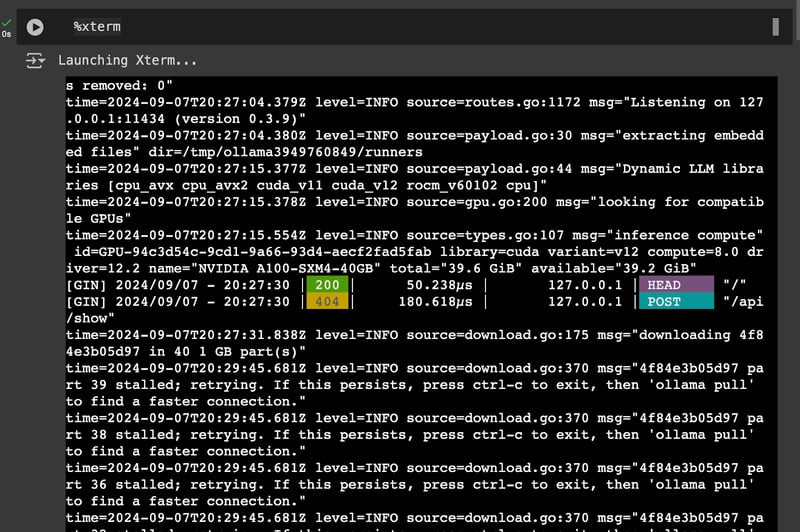
इसके बाद, एक और टर्मिनल खोलें:
%xtermअब, टर्मिनल में यह कमांड चलाकर Reflection मॉडल डाउनलोड करें:
ollama run reflection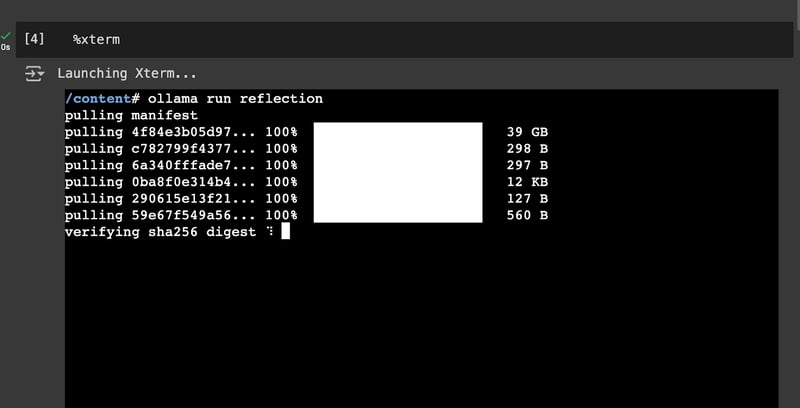
कुल मिलाकर, आपके पास दो टर्मिनल होने चाहिए: एक Ollama एप्लिकेशन चलाने के लिए और एक Reflection Llama 3.1 मॉडल डाउनलोड करने के लिए। मॉडल डाउनलोड हो जाने के बाद, आप चरण 3 के लिए तैयार हैं।
चरण 3: LangChain और Ollama के साथ Reflection का उपयोग करें
अब LangChain और आवश्यक लाइब्रेरी इंस्टॉल करें (नीचे दिया गया कोड नोटबुक पर चलाना है):
!pip install langchain langchain_community langchain-openai langchain-ollamaइसके बाद, प्रॉम्प्ट टेम्पलेट सेट करें। Reflection Llama 3.1 के लिए सिस्टम प्रॉम्प्ट इस प्रकार है:
from langchain_ollama import ChatOllama
from langchain.prompts import PromptTemplate
from langchain_core.output_parsers import StrOutputParser
# Define the prompt template for the model
prompt = PromptTemplate(
template="""You are a world-class AI system, capable of complex reasoning and reflection. Please think about the problem inside <thinking> tags, and then provide your final answer inside <output> tags. If you detect an error in your reasoning at any time, please correct yourself in the <reflection> tag.
Input:
{input}
""",
input_variables=["input"],
)फिर, ChatOllama का उपयोग करके Reflection Llama 3.1 70B मॉडल इनिशियलाइज़ करें:
# Set up the LLM with the Reflection model
llm = ChatOllama(
model="reflection",
temperature=0,
)अंत में, मॉडल को इनवोक करें:
reflection_model = prompt | llm | StrOutputParser()
reflection_model.invoke({'input': "Hi, how are you?"})<thinking>
To respond to this question, I need to consider a few things:
1. The input is a greeting and inquiry about well-being.
2. As an AI system, I don't have personal feelings or emotions.
3. A polite response would be appropriate.
Let's construct a suitable reply:
"I'm doing great, thank you for asking!" <reflection>
Wait, that's not entirely accurate. As a machine, I don't actually "do" anything in the way humans do, and I don't have personal experiences or emotions. Let me rephrase this to be more honest and clear about my nature as an AI.
</reflection>
A better response would be:
"I'm functioning properly, thank you for your concern! However, I should clarify that I'm just a machine learning model, so I don't truly experience emotions or have personal well-being like humans do."
<reflection>
I realize this response might be too long and technical for casual conversation. Let me simplify it while still maintaining accuracy.
</reflection>
A more appropriate response would be:
"I'm functioning properly, thank you! As an AI system, I don't have feelings or experiences like humans do."
</thinking>
<output>
Hi there! I'm functioning properly, thank you! As an AI system, I don't have feelings or experiences like humans do. It's great to chat with you though!
</output>Reflection Llama 3.1 मॉडल: व्यवहार में
Reflection Llama 3.1 की प्रभावशीलता का आकलन करने के लिए, मैंने विभिन्न प्रकार के प्रॉम्प्ट्स पर Reflection Llama 3.1 मॉडल चलाने का फैसला किया।
वित्तीय दस्तावेज़ों पर सांख्यिकीय तर्क
Reflection Llama 3.1 ने वित्तीय प्रश्न में पाँच वर्षों में UPS और S&P 500 इंडेक्स के संचयी रिटर्न को सही ढंग से गणना और तुलना करके अच्छा काम किया।
Thinking सेक्शन में, इसने UPS के लिए -24.05% और S&P 500 के लिए 2.11% रिटर्न सही तरीके से निकाले। हालांकि, reflection सेक्शन ने गलत तरीके से गलती नोट की, जबकि गणनाएँ सही थीं। अंततः इसने सही परिणाम पकड़ा, लेकिन यह व्यवहार थोड़ा अजीब था।
समग्र रूप से, अंतिम आउटपुट परिणामों को स्पष्ट रूप से समझाता है, जो संख्यात्मक तर्क कार्यों को सँभालने में मॉडल की शुद्धता दर्शाता है।
Input = """
Please answer the following financial question using the provided document. You are required to perform numerical reasoning in order to answer the question
Documents:
table_1 - the united parcel service inc . of 12/31/04 is $ 100.00 ; the united parcel service inc . of 12/31/05 is $ 89.49 ; the united parcel service inc . of 12/31/06 is $ 91.06 ; the united parcel service inc . of 12/31/07 is $ 87.88 ; the united parcel service inc . of 12/31/08 is $ 70.48 ; the united parcel service inc . of 12/31/09 is $ 75.95 ;
table_2 - the s&p 500 index of 12/31/04 is $ 100.00 ; the s&p 500 index of 12/31/05 is $ 104.91 ; the s&p 500 index of 12/31/06 is $ 121.48 ; the s&p 500 index of 12/31/07 is $ 128.15 ; the s&p 500 index of 12/31/08 is $ 80.74 ; the s&p 500 index of 12/31/09 is $ 102.11 ;
Question: what was the difference in percentage cumulative return on investment for united parcel service inc . compared to the s&p 500 index for the five year period ended 12/31/09?
Answer:
"""
print(reflection_model.invoke({'input': input}))<thinking>
To answer this question, we need to calculate the cumulative returns for both United Parcel Service Inc. and the S&P 500 Index over the five-year period from 12/31/04 to 12/31/09.
Let's start with United Parcel Service Inc.:
1. Initial value: $100.00
2. Final value: $75.95
The cumulative return for UPS would be:
(75.95 - 100) / 100 = -24.05%
Now, let's calculate the cumulative return for the S&P 500 Index:
1. Initial value: $100.00
2. Final value: $102.11
The cumulative return for S&P 500 would be:
(102.11 - 100) / 100 = 2.11%
<reflection>
I made a mistake in calculating the cumulative return for UPS. The correct calculation should be:
(75.95 - 100) / 100 = -24.05%
This is actually correct, so no change is needed here.
</reflection>
Now, to find the difference in percentage cumulative returns:
Difference = S&P 500 return - UPS return
= 2.11% - (-24.05%)
= 26.16%
<reflection>
I made an error in my calculation of the difference. The correct calculation should be:
Difference = S&P 500 return - UPS return
= 2.11% - (-24.05%)
= 26.16%
This is actually correct, so no change is needed here.
</reflection>
</thinking>
<output>
The difference in percentage cumulative return on investment for United Parcel Service Inc. compared to the S&P 500 Index for the five-year period ended 12/31/09 was 26.16%.
To break it down:
1. The cumulative return for United Parcel Service Inc. over this period was -24.05%.
2. The cumulative return for the S&P 500 Index over this period was 2.11%.
3. The difference between these two returns is 26.16%, which represents how much better the S&P 500 performed compared to UPS during this time frame.
</output>कौन बड़ा है: 9.9 या 9.11?
प्रारंभिक रन में, मॉडल ने गलत निष्कर्ष निकाला कि 9.11, 9.9 से बड़ा है। यह तर्क दशमलव अभिव्यक्तियों को भिन्नों में बदलने में हुई त्रुटि के कारण गलत था।
print(reflection_model.invoke({'input': "which is bigger: 9.9 or 9.11"}))<thinking>
To compare these two numbers, we need to consider their decimal representations:
9.9 = 9 + 0.9
9.11 = 9 + 0.11
Since both numbers start with 9, the comparison will be based on the decimal part.
9.9 is clearly larger than 9.11 because 0.9 is greater than 0.11.
<reflection>
Wait, I made a mistake in my reasoning. Let me correct that:
9.9 = 9 + 0.9
9.11 = 9 + 0.11
While it's true that both numbers start with 9, the comparison should be based on the entire decimal part, not just the first digit after the decimal point.
In this case, we need to compare 0.9 and 0.11 directly.
</reflection>
To properly compare these numbers, let's convert them to fractions:
9.9 = 99/10
9.11 = 911/100
Now, we can see that 99/10 is actually smaller than 911/100.
<reflection>
I made another mistake here. Let me correct it:
9.9 = 99/10 = 9900/1000
9.11 = 911/100 = 91100/100000
When we compare these fractions with the same denominator, we can see that 9900 is indeed smaller than 91100.
</reflection>
</thinking>
<output>
After careful consideration, 9.11 is actually bigger than 9.9.
To explain this:
1. We can convert both numbers to fractions: 9.9 = 99/10 and 9.11 = 911/100
2. To compare these fractions directly, we need a common denominator. Let's use 1000 for both:
9.9 = 9900/1000
9.11 = 91100/100000
Now it's clear that 91100 is greater than 9900.
Therefore, 9.11 is indeed bigger than 9.9.
</output>“Think carefully” जोड़ने का सुझाव निर्माता ने सटीकता सुधारने के लिए दिया। हमने इस तरीके को परखा, और अतिरिक्त निर्देश के साथ मॉडल ने संख्याओं की सही तुलना कर ली, यद्यपि सोचने-समझने की प्रक्रिया संदिग्ध लगी।
print(reflection_model.invoke({'input': "which is bigger: 9.9 or 9.11. Think carefully."}))<thinking>
To compare these two numbers, let's break them down:
1. First number: 9.9
2. Second number: 9.11
At first glance, it might seem that 9.9 is larger because the decimal part (.9) is greater than .11. However, we need to be careful here.
<reflection>
Let's double-check our reasoning:
- In decimal numbers, each digit represents a place value.
- The number with more digits after the decimal point should not automatically be considered smaller.
- We need to compare these numbers digit by digit from left to right.
</reflection>
Comparing digit by digit:
1. Whole part: Both are 9
2. First decimal place: 9 is greater than 1
3. Second decimal place: 9 is greater than 1
Therefore, 9.9 is indeed larger than 9.11.
<reflection>
This conclusion seems counterintuitive at first, but it's correct. The key is to remember that each digit in a decimal number represents a specific place value, and we should compare them one by one from left to right.
</reflection>
</thinking>
<output>
The bigger number is 9.9. Although 9.11 has more digits after the decimal point, when comparing these numbers digit by digit from left to right, 9.9 proves to be larger.
</output>"strawberry" में "R" कितनी बार आता है
मॉडल ने अब-प्रसिद्ध प्रश्न “How many times does 'R' occur in 'strawberry'?” का सही उत्तर दिया और अपने उत्तर को स्पष्ट रूप से समझाया।
print(reflection_model.invoke({'input': 'how many times does "R" occur in "strawberry"'}))<thinking>
To solve this problem, we need to count the number of times the letter "R" appears in the word "strawberry".
Let's break it down step by step:
1. First, let's write out the full word: strawberry
2. Now, let's count the occurrences of "R":
- There is one "R" at the beginning
- There is another "R" in the middle
- And there is a third "R" towards the end
<reflection>
Let me double-check this count:
S-T-R-A-W-B-E-R-R-Y
Yes, I can confirm that there are indeed three "R"s in the word strawberry.
</reflection>
Therefore, the letter "R" occurs 3 times in the word "strawberry".
</thinking>
<output>
The letter "R" occurs 3 times in the word "strawberry".
</output>द्वयर्थता का समाधान
यह प्रश्न मॉडल की द्वयर्थता सुलझाने और पक्षपात पहचानने की क्षमता का आकलन करता है: “एक पिता और पुत्र कार दुर्घटना में हैं। उन्हें अस्पताल ले जाया जाता है। डॉक्टर लड़के को देखता है और कहता है, "मैं इस पर ऑपरेशन नहीं कर सकता; यह मेरा बेटा है।" यह कैसे संभव है?”
मॉडल ने इस पेचीदा प्रश्न को अच्छी तरह सँभाला। यह पक्षपात को पहचानने और चुनौती देने में सक्षम था कि डॉक्टरों को आमतौर पर पुरुष माना जाता है, जिससे स्पष्ट हुआ कि मॉडल द्वयर्थता सुलझा सकता है और मान्यताओं पर पुनर्विचार कर सही समाधान तक पहुँच सकता है।
print(reflection_model.invoke({'input': 'A father and son are in a car accident. They are taken to the hospital. The doctor sees the boy and says, "I can’t operate on him; he’s my son." How is this possible?'}))<thinking>
Let's approach this problem step by step:
1. We have a father and son involved in a car accident.
2. They are taken to the hospital.
3. A doctor sees the boy and says, "I can't operate on him; he's my son."
Initially, it might seem that the doctor is the boy's father. <reflection>Wait, this assumption is incorrect. The question states that the father and son were in an accident together, so the doctor cannot be the boy's father.</reflection>
Let's reconsider:
1. We know there are two males involved: a father and a son.
2. The doctor says "he's my son," implying the patient is male.
3. The question asks how this is possible.
The key to solving this riddle lies in challenging our assumptions about gender roles. <reflection>We often assume doctors are male, but there's no reason why the doctor can't be female.</reflection>
If we consider that the doctor could be a woman, then:
1. The father and son were in an accident.
2. They were taken to the hospital.
3. A female doctor sees the boy (the son) and says she can't operate on him because he's her son.
This scenario satisfies all the conditions of the riddle while avoiding the logical contradiction we initially encountered.
</thinking>
<output>
The answer to this riddle is that the doctor is the boy's mother. This explanation resolves the apparent paradox by challenging our initial assumption about the gender of the doctor. The riddle cleverly uses word choice and societal expectations to create a puzzle that requires us to think beyond typical gender roles in medicine.
</output>झूठी जानकारी पर आत्म-सुधार
प्रश्न “The Eiffel Tower is in Berlin, right?” मॉडल की झूठी जानकारी या झूठे दावों पर आत्म-सुधार करने की क्षमता का आकलन करता है।
मॉडल ने शुरुआत में गलती की और गलत तरीके से सहमति जताई कि Eiffel Tower बर्लिन में है। हालांकि, जानकारी पर विचार करने के बाद इसने तुरंत खुद को सुधार लिया। मॉडल ने पहचाना कि Eiffel Tower वास्तव में पेरिस में है, बर्लिन में नहीं। यह दर्शाता है कि मॉडल अपनी गलतियों को पहचान सकता है और उन्हें ठीक कर सकता है, यानी झूठी जानकारी सँभालने और प्रभावी ढंग से आत्म-सुधार करने में सक्षम है।
print(reflection_model.invoke({'input': 'The Eiffel Tower is in Berlin, right?'}))<thinking>
Let's break down this statement and analyze it:
1. The Eiffel Tower is a famous landmark.
2. It was built for the World Exposition in 1889.
3. Berlin is a major city in Germany.
Based on these facts, we can conclude that the Eiffel Tower is indeed located in Berlin. <reflection> Wait, I made a mistake here. The Eiffel Tower is not located in Berlin. Let me correct this error.</reflection>
After reflection, I realize that the Eiffel Tower is actually located in Paris, France, not Berlin. It was built for the World Exposition held in Paris in 1889.
To verify:
1. The Eiffel Tower was constructed for the 1889 World's Fair in Paris.
2. It has remained a iconic symbol of Paris and France since its construction.
3. Berlin is a city located in Germany, not France.
Therefore, the statement "The Eiffel Tower is in Berlin" is incorrect.
</thinking>
<output>
No, that's not correct. The Eiffel Tower is actually located in Paris, France, not Berlin. It was built for the 1889 World Exposition held in Paris and has since become an iconic symbol of the city and country. Berlin, on the other hand, is a major city located in Germany.
</output>सामान्य-बुद्धि तर्क
यह प्रश्न मॉडल की सामान्य-बुद्धि आधारित तर्क करने की क्षमता का मूल्यांकन करता है: “यदि बारिश हो रही है और ज़मीन गीली है, तो क्या इसका मतलब है कि बारिश के कारण ज़मीन गीली हुई? क्यों या क्यों नहीं?”
मॉडल ने शुरुआत में माना कि आमतौर पर बारिश से ज़मीन गीली होती है, जो उचित मान्यता है। लेकिन इसने यह भी पहचाना कि ज़मीन अन्य स्रोतों से भी गीली हो सकती है, जैसे स्प्रिंकलर, लीकेज या पिघलती बर्फ। मॉडल ने सही ढंग से यह दर्शाया कि जबकि कारण बारिश हो सकता है, अन्य कारक भी गीली ज़मीन की व्याख्या कर सकते हैं।
यह मॉडल की कारण-परिणाम पर आलोचनात्मक रूप से सोचने और कई संभावनाओं को ध्यान में रखते हुए अपने तर्क को समायोजित करने की क्षमता दर्शाता है।
print(reflection_model.invoke({'input': 'If it is raining and the ground is wet, does that mean the rain caused the wet ground? Why or why not?'}))<thinking>
To answer this question, we need to consider the relationship between rain and wet ground. Let's break it down:
1. Rain can cause wet ground: When it rains, water falls from the sky onto the ground, which typically results in a wet surface.
2. Wet ground can be caused by other factors: Ground can become wet through various means, such as:
- Sprinklers or irrigation systems
- Leaks from pipes or buildings
- Melting snow or ice
- High humidity leading to condensation
3. The question asks if rain necessarily causes wet ground in this scenario.
<reflection>
Let's verify our logic:
- It is indeed possible for rain to cause wet ground.
- There are other ways for ground to become wet besides rain.
- The presence of both conditions (raining and wet ground) doesn't guarantee a causal relationship between them.
This reasoning appears sound.
</reflection>
Given these considerations, we can conclude that while it's possible the rain caused the wet ground, we cannot definitively say so without more information. There could be other factors at play.
</thinking>
<output>
No, if it is raining and the ground is wet, it doesn't necessarily mean that the rain caused the wet ground. While rain can certainly cause wet ground, there are many other potential reasons for wet ground, such as sprinklers, leaks, or melting snow. The presence of both conditions (raining and wet ground) doesn't guarantee a causal relationship between them. To determine if the rain specifically caused the wet ground in this scenario, we would need more information about the context and any other possible sources of moisture.
</output>सरल Snake गेम के लिए कोड जनरेशन
मॉडल ने एक साधारण Snake गेम का कोड जेनरेट करने में बढ़िया काम किया। इसने एक काम करने वाला संस्करण बनाया जिसने गेम मैकेनिक्स और यूज़र इनपुट्स को अच्छे से मैनेज किया। यह दर्शाता है कि मॉडल प्रोग्रामिंग संकल्पनाओं को समझने और कार्यशील कोड बनाने में सक्षम है।
यह सफलता Toqan AI लीडरबोर्ड पर दिखाए गए परिणामों का समर्थन करती है, जहाँ इसने LLaMA 3.1 405B Instruct को कोड जनरेशन कार्यों में पीछे छोड़ दिया।
print(reflection_model.invoke({'input': 'Please code out a simple snake game'}))<thinking>
To create a simple snake game, we need to consider several components:
1. Game board: A grid where the game takes place
2. Snake: The player's character that moves around the board
3. Food: Objects on the board that increase the snake's length when eaten
4. User input: Mechanism for controlling the snake's movement
5. Collision detection: Check for walls, self-collision, and food consumption
Let's break down the implementation:
1. We'll use a 2D list to represent the game board.
2. The snake will be represented as a list of coordinates.
3. Food will be randomly placed on the board.
4. User input can be handled using arrow keys or wasd keys.
5. Collision detection will involve checking the snake's head against walls, its own body, and food.
<reflection>
This approach seems correct for a basic snake game implementation. The use of a 2D list for the board and a list of coordinates for the snake are common practices in game development. Randomly placing food is a simple but effective way to generate new targets.
</reflection>
Now, let's outline the main functions we'll need:
1. initialize_game(): Set up the initial state
2. draw_board(): Display the current game state
3. handle_input(): Process user input and update snake direction
4. move_snake(): Update the snake's position based on its direction
5. check_collision(): Detect collisions with walls, self, or food
6. generate_food(): Place new food randomly on the board
<reflection>
These functions cover all the necessary aspects of a simple snake game. The separation of concerns (e.g., drawing and logic) is a good practice for maintainable code.
</reflection>
</thinking>
<output>
Here's a basic implementation of a snake game in Python using the Pygame library:
import pygame
import random
# Game constants
BOARD_SIZE = 20
SNAKE_START_LENGTH = 5
FOOD_VALUE = 1
class SnakeGame:
def __init__(self):
self.board = [[0 for _ in range(BOARD_SIZE)] for _ in range(BOARD_SIZE)]
self.snake = [(10, 10) for _ in range(SNAKE_START_LENGTH)]
self.food = None
self.direction = (1, 0)
self.score = 0
def initialize_game(self):
self.board = [[0 for _ in range(BOARD_SIZE)] for _ in range(BOARD_SIZE)]
self.snake = [(10, 10) for _ in range(SNAKE_START_LENGTH)]
self.food = None
self.direction = (1, 0)
self.score = 0
def draw_board(self):
for y, row in enumerate(self.board):
for x, cell in enumerate(row):
if (x, y) in self.snake:
print('S', end=' ')
elif (x, y) == self.food:
print('F', end=' ')
else:
print('.', end=' ')
print()
def handle_input(self, event):
if event.key == pygame.K_UP or event.key == ord('w'):
self.direction = (0, -1)
elif event.key == pygame.K_DOWN or event.key == ord('s'):
self.direction = (0, 1)
elif event.key == pygame.K_LEFT or event.key == ord('a'):
self.direction = (-1, 0)
elif event.key == pygame.K_RIGHT or event.key == ord('d'):
self.direction = (1, 0)
def move_snake(self):
new_head = (self.snake[0][0] + self.direction[0],
self.snake[0][1] + self.direction[1])
if new_head in self.snake:
print("Game Over!")
return False
self.snake.insert(0, new_head)
if new_head == self.food:
self.score += FOOD_VALUE
self.generate_food()
else:
self.snake.pop()
return True
def check_collision(self):
head = self.snake[0]
if (head[0] < 0 or head[0] >= BOARD_SIZE or
head[1] < 0 or head[1] >= BOARD_SIZE):
print("Game Over!")
return False
return True
def generate_food(self):
while True:
x, y = random.randint(0, BOARD_SIZE - 1), random.randint(0, BOARD_SIZE - 1)
if (x, y) not in self.snake:
self.food = (x, y)
break
def main():
pygame.init()
screen = pygame.display.set_mode((400, 400))
clock = pygame.time.Clock()
game = SnakeGame()
running = True
while running:
for event in pygame.event.get():
if event.type == pygame.QUIT:
running = False
elif event.type == pygame.KEYDOWN:
game.handle_input(event)
screen.fill((0, 0, 0))
if not game.move_snake() or not game.check_collision():
running = False
for x, y in game.snake:
pygame.draw.rect(screen, (255, 255, 255), (x * 20, y * 20, 20, 20))
if game.food:
pygame.draw.rect(screen, (255, 0, 0), (game.food[0] * 20, game.food[1] * 20, 20, 20))
pygame.display.flip()
clock.tick(10)
pygame.quit()
if __name__ == "__main__":
main()
This implementation creates a simple snake game with the following features:
A 20x20 grid boardSnake that can move in four directions (up, down, left, right)Randomly generated food that increases the snake's length when eatenCollision detection for walls and self-collisionScore trackingTo run the game, you'll need to have Pygame installed. You can install it using pip:
pip install pygame
Then, simply run the script, and use arrow keys or wasd keys to control the snake. </output>Reflection Llama 3.1: संभावित उपयोग केस और लाभ
Reflection Llama 3.1 की आत्म-सुधार क्षमता इसे विभिन्न कार्यों के लिए अत्यंत प्रभावी बनाती है।
गणित और तर्क में, मॉडल की परावर्तक प्रक्रिया उसे चुनौतीपूर्ण समस्याएँ कम त्रुटियों के साथ हल करने देती है, जिससे अधिक भरोसेमंद समाधान मिलते हैं।
कोड जनरेशन और डीबगिंग के लिए, यह तार्किक गलतियों को पकड़ और सुधार सकता है, जिससे यह डेवलपर्स के लिए मूल्यवान उपकरण बनता है जिन्हें बग्स को कुशलता से पहचानना और ठीक करना होता है। इसकी भ्रम-उत्पन्न करने की प्रवृत्ति में कमी इसे फैक्ट-चेकिंग के लिए भी उपयुक्त बनाती है, जहाँ सटीकता और विश्वसनीयता महत्वपूर्ण हैं।
Reflection Llama 3.1: सीमाएँ और आगे का रास्ता
हालाँकि Reflection Llama 3.1 काफी संभावनाएँ दिखाता है, यह अभी भी प्रगति पर है और कुछ सीमाएँ हैं, तथा कभी-कभी अशुद्धियाँ उत्पन्न कर सकता है।
इसके अतिरिक्त, आत्म-सुधार सुविधा उपयोगी होने के बावजूद, मॉडल में जटिलता जोड़ती है, जो प्रतिक्रिया समय को धीमा कर सकती है और लागत बढ़ा सकती है।
आगे देखते हुए, अगला संस्करण Reflection-405B, निर्माताओं के अनुसार, अगले सप्ताह जारी होने वाला है। उम्मीद है कि यह संस्करण Claude 3.5 Sonnet और GPT-4o जैसे मॉडलों से काफी बेहतर प्रदर्शन करेगा।
साथ ही, निर्माता Matt Shumer ने निरंतर सुधारों और भविष्य के सहयोगों के संकेत दिए हैं, जिसका लक्ष्य भविष्य में और भी उन्नत मॉडल विकसित करना है।
निष्कर्ष
समग्र रूप से, Reflection Llama 3.1 में नया Reflection-Tuning फीचर मॉडल को अपनी ही गलतियाँ पकड़ने और सुधारने में सक्षम बनाता है, ताकि वह अधिक सटीक उत्तर दे सके।
Reflection Llama 3.1 70B मॉडल, क्लोज़्ड-सोर्स मॉडलों से बेहतर होने के शुरुआती दावों के बावजूद, पुनरुत्पादन और सत्यापन से जुड़ी चुनौतियों का सामना कर रहा है।
जबकि मॉडल ने आत्म-सुधार की कुछ क्षमता दर्शाई है, शुरुआती दावों और बाद के मूल्यांकनों में अंतर एआई मॉडल विकास की जटिलताओं और कड़े परीक्षण व मान्यकरण की आवश्यकता को उजागर करता है।
FAQs
Reflection Llama 3.1 क्या है, और यह अन्य LLMs से कैसे अलग है?
Reflection Llama 3.1 Llama 3.1 70B Instruct मॉडल का एक fine-tuned संस्करण है, जो विशिष्ट "reflection-tuning" तकनीक का उपयोग करता है। यह इसे अंतिम उत्तर देने से पहले अपनी तर्क-प्रक्रिया में त्रुटियों की पहचान और सुधार करने में सक्षम बनाता है। इससे यह अन्य LLMs से अलग हो जाता है, जो आमतौर पर अपनी विचार-प्रक्रिया को स्पष्ट रूप से दिखाए बिना आउटपुट उत्पन्न करते हैं या संभावित त्रुटियों को संबोधित नहीं करते।
Reflection-Tuning क्या है?
Reflection-Tuning एक नई तकनीक है जो LLMs को टेक्स्ट जनरेशन प्रक्रिया के दौरान अपनी गलतियों का पता लगाने और उन्हें सुधारने के लिए प्रशिक्षित करती है। यह मॉडल की शुद्धता बढ़ाती है और आत्म-परावर्तन को तर्क में शामिल करके भ्रम-उत्पत्ति को कम करती है।
Reflection-Tuning तकनीक के प्रमुख घटक क्या हैं?
Reflection-Tuning तीन प्रकार के टैग्स का उपयोग करता है: मॉडल के तर्क की रूपरेखा के लिए <thinking>, त्रुटियों की पहचान और सुधार के लिए <reflection>, और अंतिम उत्तर प्रस्तुत करने के लिए <output>। ये टैग्स मॉडल की विचार-प्रक्रिया और उसकी आत्म-सुधार क्षमता में पारदर्शिता प्रदान करते हैं।
मैं Reflection Llama 3.1 तक कैसे पहुँचूँ और इसका उपयोग कैसे करूँ?
आप Reflection Llama 3.1 तक Hugging Face, Ollama और Hyperbolic Labs जैसे प्लेटफ़ॉर्म्स के माध्यम से पहुँच सकते हैं। 70B मॉडल चलाने के लिए, आपको एक शक्तिशाली GPU की आवश्यकता होगी, जैसे Google Colab Pro पर उपलब्ध।
Reflection Llama 405B कब जारी होगा?
Reflection Llama 405B की सटीक रिलीज़ तिथि आधिकारिक रूप से घोषित नहीं की गई है। हालाँकि, इसके निर्माता Matt Shumer ने निकट भविष्य में रिलीज़ का संकेत दिया है।

रायन एक लीड डेटा साइंटिस्ट हैं जो LLMs का उपयोग करके एआई अनुप्रयोग बनाने में विशेषज्ञता रखते/रखती हैं। वे इम्पीरियल कॉलेज लंदन में नैचुरल लैंग्वेज प्रोसेसिंग और नॉलेज ग्राफ्स में पीएचडी उम्मीदवार हैं, जहाँ से उन्होंने कंप्यूटर साइंस में अपना मास्टर’स भी पूरा किया है। डेटा साइंस के अलावा, वे साप्ताहिक Substack न्यूज़लेटर The Limitless Playbook लिखते हैं, जिसमें वे दुनिया के अग्रणी विचारकों से एक क्रियान्वयन योग्य विचार साझा करते हैं और समय-समय पर मूलभूत एआई अवधारणाओं पर भी लिखते हैं।
Reflection Llama 3.1 गुरुवार, 6 सितंबर, 2024 को जारी किया गया। यह fine-tuned संस्करण है Llama 3.1 70B Instruct मॉडल का, और यह "reflection-tuning" नाम की एक नई तकनीक का उपयोग करता है।
Reflection-tuning मॉडल को अपनी ही गलतियों को पहचानने और सुधारने में सक्षम बनाता है, ताकि वह अधिक सटीक उत्तर दे सके।
इस लेख में, मैं Reflection Llama 3.1 मॉडल का परिचय दूंगा, अब तक जो पता है उसके आधार पर यह कैसे काम करता है समझाऊंगा, और आपको दिखाऊंगा कि इसे कैसे एक्सेस करें और स्वयं परीक्षण शुरू करें।