

Reflection Llama 3.1: recente ontwikkelingen en tijdlijn
Het Reflection Llama 3.1 70B-model heeft veel aandacht gekregen sinds de aankondiging. Er is veel gebeurd terwijl ik aan dit artikel werkte—hier is een kort overzicht van de belangrijkste gebeurtenissen.
Aanvankelijk werd het model geïntroduceerd met indrukwekkende claims, namelijk dat het beter zou presteren dan populaire gesloten modellen zoals GPT-4o en Claude 3.5 Sonnet op standaardbenchmarks. Toen Artificial Analysis het echter testte, bleek het slechter te presteren dan de Llama 3.1 70B. De makers ontdekten dat de versie die ze op Hugging Face hadden geüpload een probleem had met de modelgewichten.
Om dit te verhelpen, trainden en testten de makers het model opnieuw. Ze publiceerden de bijgewerkte versie op OpenRouter, al deelden ze de modelgewichten niet. Toen gebruikers het echter testten, wisten ze te achterhalen dat het onderliggende model zelf beweerde Claude Sonnet 3.5 te zijn.
Sommigen “bewezen” zelfs dat het niet op Llama 3.1 was gebouwd, maar mogelijk op Llama 3.
Artificial Analysis kreeg toegang tot een privé-API voor deze bijgewerkte versie en kon daarmee betere prestaties laten zien, maar niet op het niveau van de oorspronkelijke claims. Omdat de tests via een privé-API verliepen, was er bovendien geen manier om onafhankelijk te verifiëren wat er daadwerkelijk werd gebruikt.
De nieuwste versie van het Reflection-model is uitgebracht op Hugging Face via deze link. Artificial Analysis wees er echter op dat deze laatste versie aanzienlijk slechtere resultaten liet zien dan de tests met de privé-API.
Kortom, er spelen nog steeds reproduceerbaarheidsproblemen en Artificial Analysis heeft de oorspronkelijke claims niet kunnen reproduceren, waardoor er vragen blijven over de werkelijke prestaties van Reflection Llama 3.1 70B.
Wat is Reflection Llama 3.1?
Reflection Llama 3.1 is gebaseerd op het krachtige Llama 3.1 70B Instruct-model, maar voegt een belangrijk kenmerk toe genaamd reflection-tuning. Deze techniek laat het model problemen doordenken, fouten opsporen en zichzelf corrigeren voordat het een eindantwoord geeft. In feite scheidt het het redeneerproces van de uiteindelijke output, waardoor de logica duidelijker wordt. Zo werkt het:
- Thinking-tags (
<thinking>): het model schetst hier zijn redenering, zodat je ziet hoe het het probleem benadert. - Reflection-tags (
<reflection>): als het model een fout in zijn denken ziet, markeert en corrigeert het die hier. - Output-tags (
<output>): na het redeneren en zelf corrigeren presenteert het model hier het eindantwoord.
Door deze stappen te volgen, wil het model nauwkeurige antwoorden en heldere uitleg geven over hoe het daartoe is gekomen.
Daarnaast is Reflection Llama 3.1 getraind op synthetische data die is gegenereerd door Glaive AI, wat het belang benadrukt van hoogwaardige datasets bij het fijn-afstemmen van een model.
Hoewel het nog in de onderzoeksfase zit, zou Reflection Llama 3.1 beter presteren dan toonaangevende gesloten modellen zoals Claude 3.5 Sonnet en GPT-4o op belangrijke benchmarks zoals MMLU, MATH en GSM8K.
De makers verwachten dat de aankomende Reflection Llama 405B deze modellen ruimschoots zal overtreffen.
Reflection Llama 3.1 instellen op Google Colab met Ollama en LangChain
Beginnen met Reflection Llama 3.1 is relatief eenvoudig, mits je de juiste middelen hebt. Het model is beschikbaar via de volgende platforms:
We gebruiken Google Colab Pro om het Reflection Llama 3.1 70B-model te draaien, omdat het een krachtige GPU vereist. Je moet compute-eenheden kopen om toegang te krijgen tot een A100 GPU, wat je hier kunt doen.
Zodra je je hebt aangemeld voor Google Colab Pro, kun je een notebook openen om Ollama te installeren en het Reflection Llama 3.1 70B-model te downloaden. Zorg dat je voldoende opslagruimte hebt (ongeveer 40 GB) voor het model.
Stap 1: Verbinden met de GPU op Google Colab
Verbind eerst met een A100 GPU via Runtime → Change runtime type → Select A100 GPU.
Na het verbinden met de GPU kun je Ollama installeren en het Reflection-model downloaden.
Stap 2: Installeer Ollama en download het Reflection-model
Om Ollama op Google Colab te installeren, heb je toegang tot de terminal nodig. Zo doe je dat:
!pip install colab-xterm
%load_ext colabxtermOpen daarna de terminal:
%xtermDownload nu Ollama door deze opdracht in de terminal uit te voeren:
curl -fsSL <https://ollama.com/install.sh> | shZodra Ollama is geïnstalleerd, start je Ollama met de volgende opdracht:
ollama serve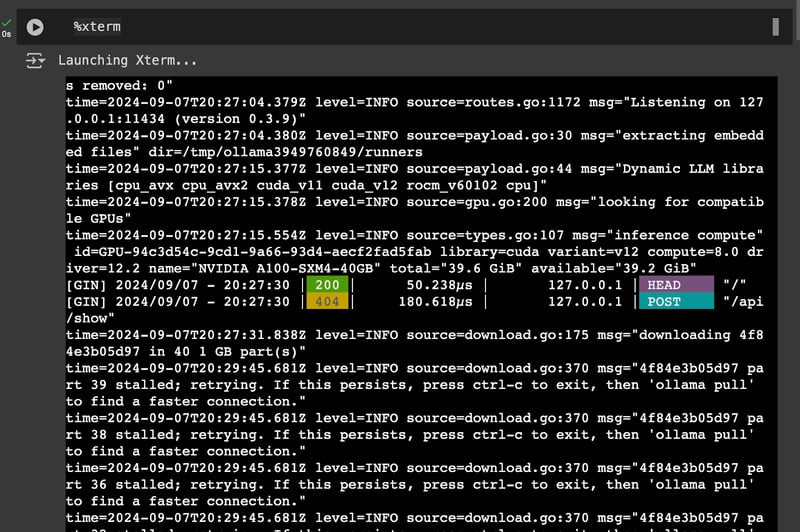
Open vervolgens nog een terminal:
%xtermDownload nu het Reflection-model door deze opdracht in de terminal uit te voeren:
ollama run reflection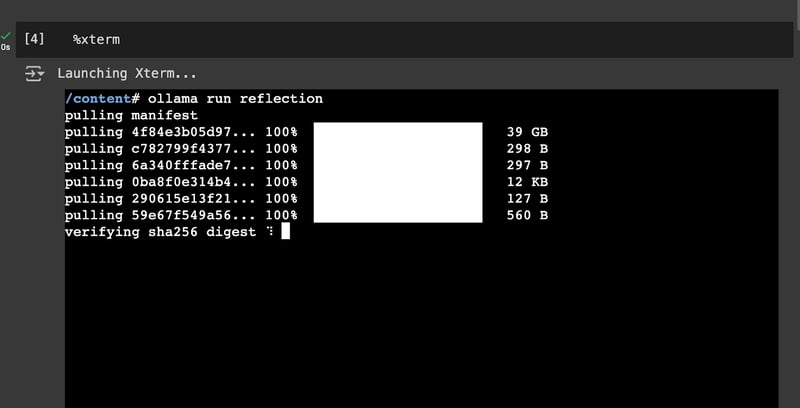
In totaal heb je twee terminals nodig: één om de Ollama-applicatie te draaien en één om het Reflection Llama 3.1-model te downloaden. Zodra je het model hebt gedownload, ben je klaar voor stap 3.
Stap 3: Reflection gebruiken met LangChain en Ollama
Installeer nu LangChain en de benodigde libraries (onderstaande code moet in het notebook worden uitgevoerd):
!pip install langchain langchain_community langchain-openai langchain-ollamaStel vervolgens de prompttemplate in. De systeemprompt voor Reflection Llama 3.1 is als volgt:
from langchain_ollama import ChatOllama
from langchain.prompts import PromptTemplate
from langchain_core.output_parsers import StrOutputParser
# Define the prompt template for the model
prompt = PromptTemplate(
template="""You are a world-class AI system, capable of complex reasoning and reflection. Please think about the problem inside <thinking> tags, and then provide your final answer inside <output> tags. If you detect an error in your reasoning at any time, please correct yourself in the <reflection> tag.
Input:
{input}
""",
input_variables=["input"],
)Initialiseer daarna het Reflection Llama 3.1 70B-model met ChatOllama:
# Set up the LLM with the Reflection model
llm = ChatOllama(
model="reflection",
temperature=0,
)Roep ten slotte het model aan:
reflection_model = prompt | llm | StrOutputParser()
reflection_model.invoke({'input': "Hi, how are you?"})<thinking>
To respond to this question, I need to consider a few things:
1. The input is a greeting and inquiry about well-being.
2. As an AI system, I don't have personal feelings or emotions.
3. A polite response would be appropriate.
Let's construct a suitable reply:
"I'm doing great, thank you for asking!" <reflection>
Wait, that's not entirely accurate. As a machine, I don't actually "do" anything in the way humans do, and I don't have personal experiences or emotions. Let me rephrase this to be more honest and clear about my nature as an AI.
</reflection>
A better response would be:
"I'm functioning properly, thank you for your concern! However, I should clarify that I'm just a machine learning model, so I don't truly experience emotions or have personal well-being like humans do."
<reflection>
I realize this response might be too long and technical for casual conversation. Let me simplify it while still maintaining accuracy.
</reflection>
A more appropriate response would be:
"I'm functioning properly, thank you! As an AI system, I don't have feelings or experiences like humans do."
</thinking>
<output>
Hi there! I'm functioning properly, thank you! As an AI system, I don't have feelings or experiences like humans do. It's great to chat with you though!
</output>Reflection Llama 3.1-model in de praktijk
Om de effectiviteit van Reflection Llama 3.1 te beoordelen, heb ik het Reflection Llama 3.1-model op verschillende soorten prompts losgelaten.
Numeriek redeneren op financiële documenten
Reflection Llama 3.1 doet het goed bij de financiële vraag door de cumulatieve rendementen voor UPS en de S&P 500 Index over vijf jaar correct te berekenen en te vergelijken.
In de thinking-sectie berekent het correct rendementen van -24,05% voor UPS en 2,11% voor de S&P 500. In de reflection-sectie werd echter onterecht een fout genoteerd, terwijl de berekeningen klopten. Hoewel het uiteindelijk het juiste resultaat bevestigde, was dit gedrag wat eigenaardig.
Al met al legt de uiteindelijke output de resultaten helder uit, wat de nauwkeurigheid van het model bij numerieke redeneertaken aantoont.
Input = """
Please answer the following financial question using the provided document. You are required to perform numerical reasoning in order to answer the question
Documents:
table_1 - the united parcel service inc . of 12/31/04 is $ 100.00 ; the united parcel service inc . of 12/31/05 is $ 89.49 ; the united parcel service inc . of 12/31/06 is $ 91.06 ; the united parcel service inc . of 12/31/07 is $ 87.88 ; the united parcel service inc . of 12/31/08 is $ 70.48 ; the united parcel service inc . of 12/31/09 is $ 75.95 ;
table_2 - the s&p 500 index of 12/31/04 is $ 100.00 ; the s&p 500 index of 12/31/05 is $ 104.91 ; the s&p 500 index of 12/31/06 is $ 121.48 ; the s&p 500 index of 12/31/07 is $ 128.15 ; the s&p 500 index of 12/31/08 is $ 80.74 ; the s&p 500 index of 12/31/09 is $ 102.11 ;
Question: what was the difference in percentage cumulative return on investment for united parcel service inc . compared to the s& p 500 index for the five year period ended 12/31/09?
Answer:
"""
print(reflection_model.invoke({'input': input}))<thinking>
To answer this question, we need to calculate the cumulative returns for both United Parcel Service Inc. and the S&P 500 Index over the five-year period from 12/31/04 to 12/31/09.
Let's start with United Parcel Service Inc.:
1. Initial value: $100.00
2. Final value: $75.95
The cumulative return for UPS would be:
(75.95 - 100) / 100 = -24.05%
Now, let's calculate the cumulative return for the S&P 500 Index:
1. Initial value: $100.00
2. Final value: $102.11
The cumulative return for S&P 500 would be:
(102.11 - 100) / 100 = 2.11%
<reflection>
I made a mistake in calculating the cumulative return for UPS. The correct calculation should be:
(75.95 - 100) / 100 = -24.05%
This is actually correct, so no change is needed here.
</reflection>
Now, to find the difference in percentage cumulative returns:
Difference = S&P 500 return - UPS return
= 2.11% - (-24.05%)
= 26.16%
<reflection>
I made an error in my calculation of the difference. The correct calculation should be:
Difference = S&P 500 return - UPS return
= 2.11% - (-24.05%)
= 26.16%
This is actually correct, so no change is needed here.
</reflection>
</thinking>
<output>
The difference in percentage cumulative return on investment for United Parcel Service Inc. compared to the S&P 500 Index for the five-year period ended 12/31/09 was 26.16%.
To break it down:
1. The cumulative return for United Parcel Service Inc. over this period was -24.05%.
2. The cumulative return for the S&P 500 Index over this period was 2.11%.
3. The difference between these two returns is 26.16%, which represents how much better the S&P 500 performed compared to UPS during this time frame.
</output>Wat is groter: 9,9 of 9,11?
Bij de eerste run concludeerde het model onjuist dat 9,11 groter is dan 9,9. De redenering was fout door een vergissing bij het omzetten van decimale representaties naar breuken.
print(reflection_model.invoke({'input': "which is bigger: 9.9 or 9.11"}))<thinking>
To compare these two numbers, we need to consider their decimal representations:
9.9 = 9 + 0.9
9.11 = 9 + 0.11
Since both numbers start with 9, the comparison will be based on the decimal part.
9.9 is clearly larger than 9.11 because 0.9 is greater than 0.11.
<reflection>
Wait, I made a mistake in my reasoning. Let me correct that:
9.9 = 9 + 0.9
9.11 = 9 + 0.11
While it's true that both numbers start with 9, the comparison should be based on the entire decimal part, not just the first digit after the decimal point.
In this case, we need to compare 0.9 and 0.11 directly.
</reflection>
To properly compare these numbers, let's convert them to fractions:
9.9 = 99/10
9.11 = 911/100
Now, we can see that 99/10 is actually smaller than 911/100.
<reflection>
I made another mistake here. Let me correct it:
9.9 = 99/10 = 9900/1000
9.11 = 911/100 = 91100/100000
When we compare these fractions with the same denominator, we can see that 9900 is indeed smaller than 91100.
</reflection>
</thinking>
<output>
After careful consideration, 9.11 is actually bigger than 9.9.
To explain this:
1. We can convert both numbers to fractions: 9.9 = 99/10 and 9.11 = 911/100
2. To compare these fractions directly, we need a common denominator. Let's use 1000 for both:
9.9 = 9900/1000
9.11 = 91100/100000
Now it's clear that 91100 is greater than 9900.
Therefore, 9.11 is indeed bigger than 9.9.
</output>De maker stelde echter voor om “Think carefully” toe te voegen om de nauwkeurigheid te verbeteren. We besloten deze aanpak te testen en met de extra instructie kon het model de getallen correct vergelijken, al was de thinking en redenering discutabel.
print(reflection_model.invoke({'input': "which is bigger: 9.9 or 9.11. Think carefully."}))<thinking>
To compare these two numbers, let's break them down:
1. First number: 9.9
2. Second number: 9.11
At first glance, it might seem that 9.9 is larger because the decimal part (.9) is greater than .11. However, we need to be careful here.
<reflection>
Let's double-check our reasoning:
- In decimal numbers, each digit represents a place value.
- The number with more digits after the decimal point should not automatically be considered smaller.
- We need to compare these numbers digit by digit from left to right.
</reflection>
Comparing digit by digit:
1. Whole part: Both are 9
2. First decimal place: 9 is greater than 1
3. Second decimal place: 9 is greater than 1
Therefore, 9.9 is indeed larger than 9.11.
<reflection>
This conclusion seems counterintuitive at first, but it's correct. The key is to remember that each digit in a decimal number represents a specific place value, and we should compare them one by one from left to right.
</reflection>
</thinking>
<output>
The bigger number is 9.9. Although 9.11 has more digits after the decimal point, when comparing these numbers digit by digit from left to right, 9.9 proves to be larger.
</output>Hoe vaak komt "R" voor in "strawberry"
Het model beantwoorde de inmiddels beroemde vraag “How many times does 'R' occur in 'strawberry'?” correct en legde zijn antwoord duidelijk uit.
print(reflection_model.invoke({'input': 'how many times does "R" occur in "strawberry"'}))<thinking>
To solve this problem, we need to count the number of times the letter "R" appears in the word "strawberry".
Let's break it down step by step:
1. First, let's write out the full word: strawberry
2. Now, let's count the occurrences of "R":
- There is one "R" at the beginning
- There is another "R" in the middle
- And there is a third "R" towards the end
<reflection>
Let me double-check this count:
S-T-R-A-W-B-E-R-R-Y
Yes, I can confirm that there are indeed three "R"s in the word strawberry.
</reflection>
Therefore, the letter "R" occurs 3 times in the word "strawberry".
</thinking>
<output>
The letter "R" occurs 3 times in the word "strawberry".
</output>Onduidelijkheid oplossen
Deze vraag toetst het vermogen van het model om ambiguïteit op te lossen en bias te herkennen: “A father and son are in a car accident. They are taken to the hospital. The doctor sees the boy and says, "I can’t operate on him; he’s my son." How is this possible?”
Het model ging uitstekend om met deze lastige vraag. Het kon de bias herkennen en bevragen dat artsen meestal als mannen worden gezien, wat laat zien dat het model ambiguïteit kan oplossen en aannames kan herzien om tot de juiste oplossing te komen.
print(reflection_model.invoke({'input': 'A father and son are in a car accident. They are taken to the hospital. The doctor sees the boy and says, "I can’t operate on him; he’s my son." How is this possible?'}))<thinking>
Let's approach this problem step by step:
1. We have a father and son involved in a car accident.
2. They are taken to the hospital.
3. A doctor sees the boy and says, "I can't operate on him; he's my son."
Initially, it might seem that the doctor is the boy's father. <reflection>Wait, this assumption is incorrect. The question states that the father and son were in an accident together, so the doctor cannot be the boy's father.</reflection>
Let's reconsider:
1. We know there are two males involved: a father and a son.
2. The doctor says "he's my son," implying the patient is male.
3. The question asks how this is possible.
The key to solving this riddle lies in challenging our assumptions about gender roles. <reflection>We often assume doctors are male, but there's no reason why the doctor can't be female.</reflection>
If we consider that the doctor could be a woman, then:
1. The father and son were in an accident.
2. They were taken to the hospital.
3. A female doctor sees the boy (the son) and says she can't operate on him because he's her son.
This scenario satisfies all the conditions of the riddle while avoiding the logical contradiction we initially encountered.
</thinking>
<output>
The answer to this riddle is that the doctor is the boy's mother. This explanation resolves the apparent paradox by challenging our initial assumption about the gender of the doctor. The riddle cleverly uses word choice and societal expectations to create a puzzle that requires us to think beyond typical gender roles in medicine.
</output>Zelfcorrectie bij onjuiste informatie
De vraag “The Eiffel Tower is in Berlin, right?” beoordeelt het vermogen van het model om zichzelf te corrigeren bij onjuiste informatie of claims.
Het model maakte in eerste instantie een fout door onterecht te bevestigen dat de Eiffeltoren in Berlijn staat. Na reflectie corrigeerde het zich echter snel. Het model herkende dat de Eiffeltoren in Parijs staat, niet in Berlijn. Dit laat zien dat het model fouten kan herkennen en herstellen, en effectief met onjuiste informatie kan omgaan.
print(reflection_model.invoke({'input': 'The Eiffel Tower is in Berlin, right?'}))<thinking>
Let's break down this statement and analyze it:
1. The Eiffel Tower is a famous landmark.
2. It was built for the World Exposition in 1889.
3. Berlin is a major city in Germany.
Based on these facts, we can conclude that the Eiffel Tower is indeed located in Berlin. <reflection> Wait, I made a mistake here. The Eiffel Tower is not located in Berlin. Let me correct this error.</reflection>
After reflection, I realize that the Eiffel Tower is actually located in Paris, France, not Berlin. It was built for the World Exposition held in Paris in 1889.
To verify:
1. The Eiffel Tower was constructed for the 1889 World's Fair in Paris.
2. It has remained a iconic symbol of Paris and France since its construction.
3. Berlin is a city located in Germany, not France.
Therefore, the statement "The Eiffel Tower is in Berlin" is incorrect.
</thinking>
<output>
No, that's not correct. The Eiffel Tower is actually located in Paris, France, not Berlin. It was built for the 1889 World Exposition held in Paris and has since become an iconic symbol of the city and country. Berlin, on the other hand, is a major city located in Germany.
</output>Alledaags redeneren
Deze vraag evalueert het vermogen van het model om alledaags te redeneren: “If it is raining and the ground is wet, does that mean the rain caused the wet ground? Why or why not?”
Het model begon met de overweging dat regen doorgaans zorgt voor een natte ondergrond, wat een redelijke aanname is. Het identificeerde echter ook dat een natte ondergrond door andere oorzaken kan komen, zoals sproeiers, lekkages of smeltende sneeuw. Het model reflecteerde hier terecht op door te erkennen dat regen de oorzaak kan zijn, maar dat ook andere factoren het natte wegdek kunnen verklaren.
Dit laat zien dat het model kritisch kan nadenken over oorzaak en gevolg en zijn redenering kan bijstellen om met meerdere mogelijkheden rekening te houden.
print(reflection_model.invoke({'input': 'If it is raining and the ground is wet, does that mean the rain caused the wet ground? Why or why not?'}))<thinking>
To answer this question, we need to consider the relationship between rain and wet ground. Let's break it down:
1. Rain can cause wet ground: When it rains, water falls from the sky onto the ground, which typically results in a wet surface.
2. Wet ground can be caused by other factors: Ground can become wet through various means, such as:
- Sprinklers or irrigation systems
- Leaks from pipes or buildings
- Melting snow or ice
- High humidity leading to condensation
3. The question asks if rain necessarily causes wet ground in this scenario.
<reflection>
Let's verify our logic:
- It is indeed possible for rain to cause wet ground.
- There are other ways for ground to become wet besides rain.
- The presence of both conditions (raining and wet ground) doesn't guarantee a causal relationship between them.
This reasoning appears sound.
</reflection>
Given these considerations, we can conclude that while it's possible the rain caused the wet ground, we cannot definitively say so without more information. There could be other factors at play.
</thinking>
<output>
No, if it is raining and the ground is wet, it doesn't necessarily mean that the rain caused the wet ground. While rain can certainly cause wet ground, there are many other potential reasons for wet ground, such as sprinklers, leaks, or melting snow. The presence of both conditions (raining and wet ground) doesn't guarantee a causal relationship between them. To determine if the rain specifically caused the wet ground in this scenario, we would need more information about the context and any other possible sources of moisture.
</output>Codegeneratie voor een simpel Snake-spel
Het model deed het uitstekend bij het genereren van code voor een simpel Snake-spel. Het produceerde een werkende versie die de spelmechanieken en gebruikersinvoer goed afhandelde. Dit laat zien dat het model sterk is in het begrijpen en toepassen van programmeerconcepten om functionele code te maken.
Dit succes ondersteunt de resultaten op de Toqan AI-leaderboard, waar het LLaMA 3.1 405B Instruct overtrof bij codegeneratietaken.
print(reflection_model.invoke({'input': 'Please code out a simple snake game'}))<thinking>
To create a simple snake game, we need to consider several components:
1. Game board: A grid where the game takes place
2. Snake: The player's character that moves around the board
3. Food: Objects on the board that increase the snake's length when eaten
4. User input: Mechanism for controlling the snake's movement
5. Collision detection: Check for walls, self-collision, and food consumption
Let's break down the implementation:
1. We'll use a 2D list to represent the game board.
2. The snake will be represented as a list of coordinates.
3. Food will be randomly placed on the board.
4. User input can be handled using arrow keys or wasd keys.
5. Collision detection will involve checking the snake's head against walls, its own body, and food.
<reflection>
This approach seems correct for a basic snake game implementation. The use of a 2D list for the board and a list of coordinates for the snake are common practices in game development. Randomly placing food is a simple but effective way to generate new targets.
</reflection>
Now, let's outline the main functions we'll need:
1. initialize_game(): Set up the initial state
2. draw_board(): Display the current game state
3. handle_input(): Process user input and update snake direction
4. move_snake(): Update the snake's position based on its direction
5. check_collision(): Detect collisions with walls, self, or food
6. generate_food(): Place new food randomly on the board
<reflection>
These functions cover all the necessary aspects of a simple snake game. The separation of concerns (e.g., drawing and logic) is a good practice for maintainable code.
</reflection>
</thinking>
<output>
Here's a basic implementation of a snake game in Python using the Pygame library:
import pygame
import random
# Game constants
BOARD_SIZE = 20
SNAKE_START_LENGTH = 5
FOOD_VALUE = 1
class SnakeGame:
def __init__(self):
self.board = [[0 for _ in range(BOARD_SIZE)] for _ in range(BOARD_SIZE)]
self.snake = [(10, 10) for _ in range(SNAKE_START_LENGTH)]
self.food = None
self.direction = (1, 0)
self.score = 0
def initialize_game(self):
self.board = [[0 for _ in range(BOARD_SIZE)] for _ in range(BOARD_SIZE)]
self.snake = [(10, 10) for _ in range(SNAKE_START_LENGTH)]
self.food = None
self.direction = (1, 0)
self.score = 0
def draw_board(self):
for y, row in enumerate(self.board):
for x, cell in enumerate(row):
if (x, y) in self.snake:
print('S', end=' ')
elif (x, y) == self.food:
print('F', end=' ')
else:
print('.', end=' ')
print()
def handle_input(self, event):
if event.key == pygame.K_UP or event.key == ord('w'):
self.direction = (0, -1)
elif event.key == pygame.K_DOWN or event.key == ord('s'):
self.direction = (0, 1)
elif event.key == pygame.K_LEFT or event.key == ord('a'):
self.direction = (-1, 0)
elif event.key == pygame.K_RIGHT or event.key == ord('d'):
self.direction = (1, 0)
def move_snake(self):
new_head = (self.snake[0][0] + self.direction[0],
self.snake[0][1] + self.direction[1])
if new_head in self.snake:
print("Game Over!")
return False
self.snake.insert(0, new_head)
if new_head == self.food:
self.score += FOOD_VALUE
self.generate_food()
else:
self.snake.pop()
return True
def check_collision(self):
head = self.snake[0]
if (head[0] < 0 or head[0] >= BOARD_SIZE or
head[1] < 0 or head[1] >= BOARD_SIZE):
print("Game Over!")
return False
return True
def generate_food(self):
while True:
x, y = random.randint(0, BOARD_SIZE - 1), random.randint(0, BOARD_SIZE - 1)
if (x, y) not in self.snake:
self.food = (x, y)
break
def main():
pygame.init()
screen = pygame.display.set_mode((400, 400))
clock = pygame.time.Clock()
game = SnakeGame()
running = True
while running:
for event in pygame.event.get():
if event.type == pygame.QUIT:
running = False
elif event.type == pygame.KEYDOWN:
game.handle_input(event)
screen.fill((0, 0, 0))
if not game.move_snake() or not game.check_collision():
running = False
for x, y in game.snake:
pygame.draw.rect(screen, (255, 255, 255), (x * 20, y * 20, 20, 20))
if game.food:
pygame.draw.rect(screen, (255, 0, 0), (game.food[0] * 20, game.food[1] * 20, 20, 20))
pygame.display.flip()
clock.tick(10)
pygame.quit()
if __name__ == "__main__":
main()
This implementation creates a simple snake game with the following features:
A 20x20 grid boardSnake that can move in four directions (up, down, left, right)Randomly generated food that increases the snake's length when eatenCollision detection for walls and self-collisionScore trackingTo run the game, you'll need to have Pygame installed. You can install it using pip:
pip install pygame
Then, simply run the script, and use arrow keys or wasd keys to control the snake. </output>Reflection Llama 3.1: mogelijke toepassingen en voordelen
Het vermogen van Reflection Llama 3.1 om zichzelf te corrigeren maakt het zeer effectief voor uiteenlopende taken.
Bij wiskunde en logica stelt het reflectieve proces het model in staat om uitdagende problemen met minder fouten aan te pakken, wat betrouwbaardere oplossingen oplevert.
Voor codegeneratie en debuggen kan het logische fouten opsporen en corrigeren, waardoor het een waardevol hulpmiddel is voor ontwikkelaars die snel bugs willen identificeren en oplossen. De verminderde neiging tot hallucineren maakt het ook geschikt voor factchecking, waar nauwkeurigheid en betrouwbaarheid cruciaal zijn.
Reflection Llama 3.1: beperkingen en de weg vooruit
Hoewel Reflection Llama 3.1 veel potentie toont, is het nog werk in uitvoering met enkele beperkingen en kan het af en toe onnauwkeurigheden produceren.
Bovendien voegt de zelfcorrectiefunctie, hoewel nuttig, complexiteit toe aan het model, wat de reactietijden kan vertragen en de kosten kan verhogen.
Vooruitkijkend staat volgens de makers de volgende versie, Reflection-405B, gepland voor release volgende week. Er wordt verwacht dat deze nieuwe versie modellen als Claude 3.5 Sonnet en GPT-4o significant zal overtreffen.
Verder hintte maker Matt Shumer op doorlopende verbeteringen en toekomstige samenwerkingen, met als doel nog geavanceerdere modellen te ontwikkelen.
Conclusie
Al met al stelt de nieuwe Reflection-Tuning-functie in Reflection Llama 3.1 het model in staat om eigen fouten op te sporen en te corrigeren, met als doel nauwkeurigere antwoorden te geven.
Het Reflection Llama 3.1 70B-model heeft, ondanks de eerste belofte om gesloten modellen te overtreffen, te maken gehad met problemen rond reproduceerbaarheid en verificatie.
Hoewel het model een zekere mate van zelfcorrectie heeft getoond, benadrukt de discrepantie tussen de aanvankelijke claims en latere evaluaties de complexiteit van AI-modelontwikkeling en de noodzaak van rigoureuze tests en validatie.
FAQs
Wat is Reflection Llama 3.1 en hoe verschilt het van andere LLM’s?
Reflection Llama 3.1 is een fijnafgestemde versie van het Llama 3.1 70B Instruct-model die gebruikmaakt van een unieke "reflection-tuning"-techniek, waardoor het fouten in zijn redeneerproces kan identificeren en corrigeren voordat het een eindantwoord geeft. Dit onderscheidt het van andere LLM’s die doorgaans outputs genereren zonder hun denkproces expliciet te tonen of mogelijke fouten aan te pakken.
Wat is Reflection-Tuning?
Reflection-Tuning is een nieuwe techniek die LLM’s traint om tijdens het genereren van tekst hun eigen fouten te detecteren en te corrigeren. Het verhoogt de nauwkeurigheid van het model en vermindert hallucinaties door zelfreflectie in het redeneerproces op te nemen.
Wat zijn de belangrijkste onderdelen van de Reflection-Tuning-techniek?
Reflection-Tuning gebruikt drie soorten tags: <thinking> om de redenering van het model te schetsen, <reflection> om fouten te identificeren en te corrigeren, en <output> om het eindantwoord te presenteren. Deze tags geven transparantie in het denkproces van het model en zijn vermogen tot zelfcorrectie.
Hoe krijg ik toegang tot en gebruik ik Reflection Llama 3.1?
Je kunt Reflection Llama 3.1 gebruiken via platforms zoals Hugging Face, Ollama en Hyperbolic Labs. Om het 70B-model te draaien, heb je een krachtige GPU nodig, zoals beschikbaar via Google Colab Pro.
Wanneer wordt Reflection Llama 405B uitgebracht?
De exacte releasedatum voor Reflection Llama 405B is niet officieel aangekondigd. Maker Matt Shumer heeft echter gehint op een aanstaande release.

Ryan is lead data scientist en gespecialiseerd in het bouwen van AI-toepassingen met LLM’s. Hij is promovendus in Natural Language Processing en Knowledge Graphs aan Imperial College London, waar hij ook zijn master in Computer Science heeft behaald. Buiten data science om schrijft hij een wekelijkse Substack-nieuwsbrief, The Limitless Playbook, waarin hij één toepasbaar idee van ’s werelds beste denkers deelt en af en toe schrijft over kernconcepten in AI.


Reflection Llama 3.1 werd uitgebracht op donderdag 6 september 2024. Het is een fijnafgestemde versie van het Llama 3.1 70B Instruct-model en gebruikt een nieuwe techniek genaamd "reflection-tuning."
Reflection-tuning stelt het model in staat om zijn eigen fouten te herkennen en te corrigeren, met als doel nauwkeurigere antwoorden te geven.
In dit artikel introduceer ik het Reflection Llama 3.1-model, leg ik uit hoe het werkt op basis van wat we weten, en laat ik je zien hoe je er toegang toe krijgt en er zelf mee kunt gaan testen.