
Program
Yapay Zeka Uygulamaları Geliştirme
21 sa
Reflection Llama 3.1 70B modeli, duyurulduğundan beri epey ilgi topladı. Bu makale üzerinde çalışırken pek çok şey oldu — işte kilit olayların kısa bir özeti.
Başlangıçta model, yaygın kapalı kaynaklı modeller olan GPT-4o ve Claude 3.5 Sonnet’i standart kıyaslamalarda geride bırakabileceği iddialarıyla tanıtıldı. Ancak Artificial Analysis test ettiğinde, Llama 3.1 70B’den daha kötü performans gösterdiğini buldu. Yapımcılar, Hugging Face’e yükledikleri sürümde modelin ağırlıklarıyla ilgili bir sorun olduğunu keşfettiler.
Bunu düzeltmek için modeli yeniden eğitip yeniden test ettiler. Güncellenmiş sürümü OpenRouter’da yayımladılar, ancak modelin ağırlıklarını paylaşmadılar. Kullanıcılar modeli test ettiğinde ise altta yatan modelin kendisini Claude Sonnet 3.5 olarak tanımladığını ortaya çıkarmayı başardılar.
Hatta bazıları Llama 3.1 üzerine değil, muhtemelen Llama 3 üzerine inşa edildiğini “kanıtladı”.
Artificial Analysis, bu güncellenmiş sürüm için özel bir API’ye erişim aldı ve ilk iddialar düzeyinde olmasa da daha iyi performans gözlemledi. Ancak testler özel bir API üzerinde yapıldığından, gerçekte ne kullanıldığını bağımsız olarak doğrulamanın bir yolu yoktu.
Reflection modelinin en son sürümü Hugging Face’te bu linkte yayımlandı. Ancak Artificial Analysis, bu son sürümün özel API testlerine kıyasla belirgin şekilde daha kötü sonuçlar verdiğine dikkat çekti.
Genel olarak yeniden üretilebilirlik sorunları sürüyor ve Artificial Analysis başlangıçtaki iddiaları yeniden üretemedi; bu da Reflection Llama 3.1 70B’nin gerçek performansına ilişkin soru işaretlerini gündemde bırakıyor.
Reflection Llama 3.1, güçlü Llama 3.1 70B Instruct modelini temel alır ancak reflection-tuning adlı önemli bir özellik ekler. Bu teknik, modelin sorunları adım adım düşünmesini, hatalarını bulmasını ve nihai yanıtı vermeden önce kendini düzeltmesini sağlar. Özünde, akıl yürütme sürecini nihai çıktıdan ayırarak mantığını daha görünür kılar. İşleyişi şöyle:
<thinking>): Model, soruna nasıl yaklaştığına dair fikir vermek için akıl yürütmesini bu bölümde özetler.<reflection>): Model düşünmesinde bir hata fark ederse, bunu burada işaretleyip düzeltir.<output>): Akıl yürütme ve öz-düzeltmeden sonra model nihai yanıtı bu bölümde sunar.Bu adımları izleyerek model, hem doğru yanıtlara ulaşmayı hem de bu yanıtlara nasıl vardığını net biçimde açıklamayı amaçlar.
Ayrıca Reflection Llama 3.1, Glaive AI tarafından üretilen sentetik verilerle eğitildi; bu da bir modelin ince ayarında yüksek kaliteli veri kümelerinin önemini vurgular.
Araştırma aşamasında olmasına rağmen, Reflection Llama 3.1’in MMLU, MATH ve GSM8K gibi temel kıyaslamalarda Claude 3.5 Sonnet ve GPT-4o gibi önde gelen kapalı kaynaklı modelleri geride bıraktığı bildiriliyor.
Yapımcıları, yakında çıkacak Reflection Llama 405B’nin bu modelleri açık ara geride bırakmasını bekliyor.
Doğru kaynaklara sahipseniz Reflection Llama 3.1 ile başlamak nispeten kolaydır. Modele aşağıdaki platformlardan erişebilirsiniz:
Model güçlü bir GPU gerektirdiğinden Reflection Llama 3.1 70B’yi çalıştırmak için Google Colab Pro kullanacağız. A100 GPU’ya erişmek için hesaplama birimleri satın almanız gerekir; bunu buradan yapabilirsiniz.
Google Colab Pro’ya kaydolduktan sonra bir defter açarak Ollama’yı kurup Reflection Llama 3.1 70B modelini indirebilirsiniz. Model için yeterli depolama alanınız olduğundan (yaklaşık 40 GB) emin olun.
Önce Runtime → Change runtime type → Select A100 GPU yolunu izleyerek A100 GPU’ya bağlanın.
GPU’ya bağlandıktan sonra Ollama’yı kurup Reflection modelini indirmeye hazırsınız.
Google Colab’e Ollama kurmak için terminale erişmeniz gerekir. Bunu şu şekilde yapabilirsiniz:
!pip install colab-xterm
%load_ext colabxterm
Ardından terminali açın:
%xtermŞimdi terminalde şu komutu çalıştırarak Ollama’yı indirin:
curl -fsSL <https://ollama.com/install.sh> | shOllama kurulduktan sonra Ollama’yı başlatmak için aşağıdaki komutu çalıştırın:
ollama serve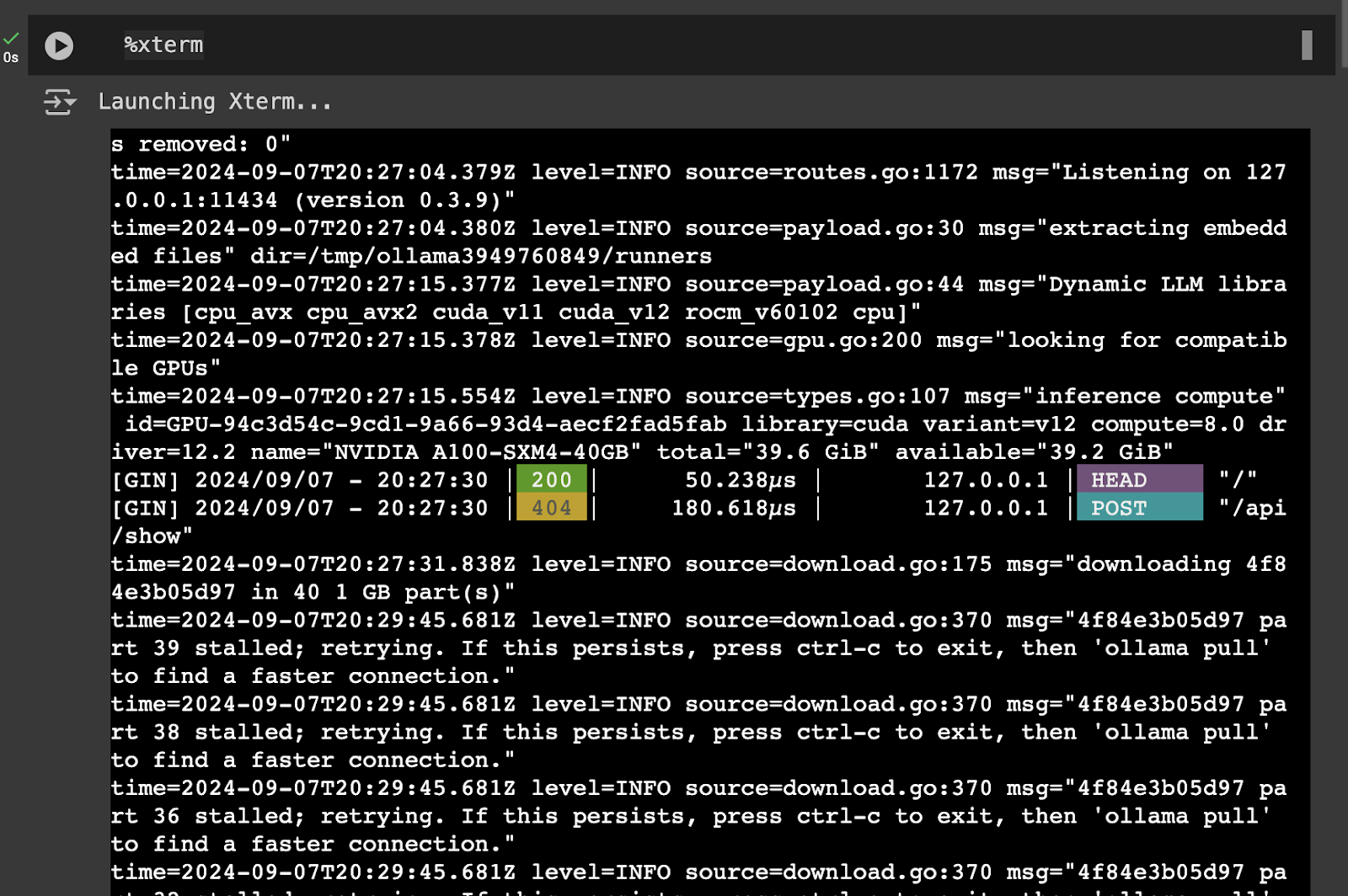
Sonra başka bir terminal açın:
%xtermŞimdi terminalde şu komutu çalıştırarak Reflection modelini indirin:
ollama run reflection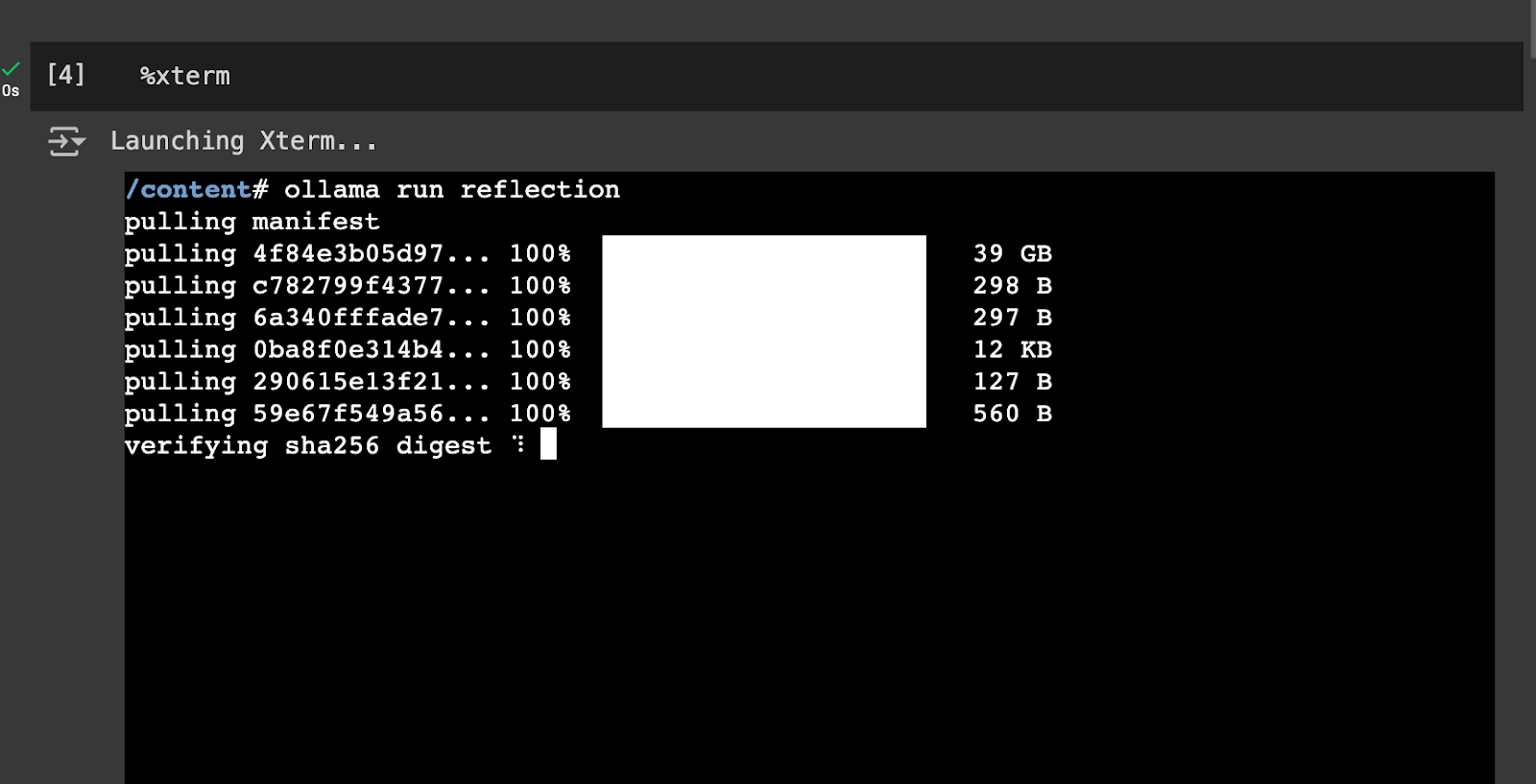
Genel olarak iki terminaliniz olmalı: biri Ollama uygulamasını çalıştırmak, diğeri Reflection Llama 3.1 modelini indirmek için. Modeli indirdikten sonra Adım 3’e hazırsınız.
Şimdi LangChain ve gerekli kütüphaneleri kurun (aşağıdaki kod defter üzerinde çalıştırılmalıdır):
!pip install langchain langchain_community langchain-openai langchain-ollamaSonraki adımda istem şablonunu ayarlayın. Reflection Llama 3.1 için sistem istemi aşağıdaki gibidir:
from langchain_ollama import ChatOllama
from langchain.prompts import PromptTemplate
from langchain_core.output_parsers import StrOutputParser
# Define the prompt template for the model
prompt = PromptTemplate(
    template="""You are a world-class AI system, capable of complex reasoning and reflection. Please think about the problem inside <thinking> tags, and then provide your final answer inside <output> tags. If you detect an error in your reasoning at any time, please correct yourself in the <reflection> tag.
    Input:
    {input}
    """,
    input_variables=["input"],
)
Ardından, Reflection Llama 3.1 70B modelini ChatOllama kullanarak başlatın:
# Set up the LLM with the Reflection model
llm = ChatOllama(
    model="reflection",
    temperature=0,
)
Son olarak modeli çağırın:
reflection_model = prompt | llm | StrOutputParser()
reflection_model.invoke({'input': "Hi, how are you?"})
<thinking>
To respond to this question, I need to consider a few things:
1. The input is a greeting and inquiry about well-being.
2. As an AI system, I don't have personal feelings or emotions.
3. A polite response would be appropriate.
Let's construct a suitable reply:
"I'm doing great, thank you for asking!" <reflection>
Wait, that's not entirely accurate. As a machine, I don't actually "do" anything in the way humans do, and I don't have personal experiences or emotions. Let me rephrase this to be more honest and clear about my nature as an AI.
</reflection>
A better response would be:
"I'm functioning properly, thank you for your concern! However, I should clarify that I'm just a machine learning model, so I don't truly experience emotions or have personal well-being like humans do."
<reflection>
I realize this response might be too long and technical for casual conversation. Let me simplify it while still maintaining accuracy.
</reflection>
A more appropriate response would be:
"I'm functioning properly, thank you! As an AI system, I don't have feelings or experiences like humans do."
</thinking>
<output>
Hi there! I'm functioning properly, thank you! As an AI system, I don't have feelings or experiences like humans do. It's great to chat with you though!
</output>Reflection Llama 3.1’in etkinliğini değerlendirmek için modeli farklı türde istemler üzerinde çalıştırmaya karar verdim.
Reflection Llama 3.1, UPS ve S&P 500 Endeksi için beş yıllık kümülatif getirileri doğru hesaplayıp karşılaştırarak finans sorusunu iyi bir şekilde ele aldı.
Düşünme bölümünde UPS için -%24,05 ve S&P 500 için %2,11 getirileri doğru hesapladı. Ancak yansıma bölümünde, hesaplamalar doğru olmasına rağmen hatalı olduğunu belirtti. Sonuçta doğruya ulaşsa da bu davranış biraz tuhaftı.
Genel olarak nihai çıktı sonuçları açık şekilde açıklıyor ve modelin sayısal akıl yürütme görevlerindeki hassasiyetini gösteriyor.
Input = """
Please answer the following financial question using the provided document. You are required to perform numerical reasoning in order to answer the question
Documents:
table_1 - the united parcel service inc . of 12/31/04 is $ 100.00 ; the united parcel service inc . of 12/31/05 is $ 89.49 ; the united parcel service inc . of 12/31/06 is $ 91.06 ; the united parcel service inc . of 12/31/07 is $ 87.88 ; the united parcel service inc . of 12/31/08 is $ 70.48 ; the united parcel service inc . of 12/31/09 is $ 75.95 ;
table_2 - the s&p 500 index of 12/31/04 is $ 100.00 ; the s&p 500 index of 12/31/05 is $ 104.91 ; the s&p 500 index of 12/31/06 is $ 121.48 ; the s&p 500 index of 12/31/07 is $ 128.15 ; the s&p 500 index of 12/31/08 is $ 80.74 ; the s&p 500 index of 12/31/09 is $ 102.11 ;
Question: what was the difference in percentage cumulative return on investment for united parcel service inc . compared to the s&p 500 index for the five year period ended 12/31/09?
Answer:
"""
print(reflection_model.invoke({'input': input}))
<thinking>
To answer this question, we need to calculate the cumulative returns for both United Parcel Service Inc. and the S&P 500 Index over the five-year period from 12/31/04 to 12/31/09.
Let's start with United Parcel Service Inc.:
1. Initial value: $100.00
2. Final value: $75.95
The cumulative return for UPS would be:
(75.95 - 100) / 100 = -24.05%
Now, let's calculate the cumulative return for the S&P 500 Index:
1. Initial value: $100.00
2. Final value: $102.11
The cumulative return for S&P 500 would be:
(102.11 - 100) / 100 = 2.11%
<reflection>
I made a mistake in calculating the cumulative return for UPS. The correct calculation should be:
(75.95 - 100) / 100 = -24.05%
This is actually correct, so no change is needed here.
</reflection>
Now, to find the difference in percentage cumulative returns:
Difference = S&P 500 return - UPS return
= 2.11% - (-24.05%)
= 26.16%
<reflection>
I made an error in my calculation of the difference. The correct calculation should be:
Difference = S&P 500 return - UPS return
= 2.11% - (-24.05%)
= 26.16%
This is actually correct, so no change is needed here.
</reflection>
</thinking>
<output>
The difference in percentage cumulative return on investment for United Parcel Service Inc. compared to the S&P 500 Index for the five-year period ended 12/31/09 was 26.16%.
To break it down:
1. The cumulative return for United Parcel Service Inc. over this period was -24.05%.
2. The cumulative return for the S&P 500 Index over this period was 2.11%.
3. The difference between these two returns is 26.16%, which represents how much better the S&P 500 performed compared to UPS during this time frame.
</output>İlk çalıştırmada model, 9,11’in 9,9’dan büyük olduğu sonucuna yanlış şekilde vardı. Bu hatalı çıkarım, ondalık gösterimlerin kesirlere dönüştürülmesindeki bir hatadan kaynaklandı.
print(reflection_model.invoke({'input': "which is bigger: 9.9 or 9.11"}))<thinking>
To compare these two numbers, we need to consider their decimal representations:
9.9 = 9 + 0.9
9.11 = 9 + 0.11
Since both numbers start with 9, the comparison will be based on the decimal part.
9.9 is clearly larger than 9.11 because 0.9 is greater than 0.11.
<reflection>
Wait, I made a mistake in my reasoning. Let me correct that:
9.9 = 9 + 0.9
9.11 = 9 + 0.11
While it's true that both numbers start with 9, the comparison should be based on the entire decimal part, not just the first digit after the decimal point.
In this case, we need to compare 0.9 and 0.11 directly.
</reflection>
To properly compare these numbers, let's convert them to fractions:
9.9 = 99/10
9.11 = 911/100
Now, we can see that 99/10 is actually smaller than 911/100.
<reflection>
I made another mistake here. Let me correct it:
9.9 = 99/10 = 9900/1000
9.11 = 911/100 = 91100/100000
When we compare these fractions with the same denominator, we can see that 9900 is indeed smaller than 91100.
</reflection>
</thinking>
<output>
After careful consideration, 9.11 is actually bigger than 9.9.
To explain this:
1. We can convert both numbers to fractions: 9.9 = 99/10 and 9.11 = 911/100
2. To compare these fractions directly, we need a common denominator. Let's use 1000 for both:
9.9 = 9900/1000
9.11 = 91100/100000
Now it's clear that 91100 is greater than 9900.
Therefore, 9.11 is indeed bigger than 9.9.
</output>Bununla birlikte, yapımcı modelin doğruluğunu artırmak için “Dikkatlice düşün” yönergesinin eklenmesini önerdi. Bu yaklaşımı test ettik ve ek talimatla model sayıları doğru şekilde karşılaştırabildi; ancak düşünme ve akıl yürütme kalitesi tartışmalıydı.
print(reflection_model.invoke({'input': "which is bigger: 9.9 or 9.11. Think carefully."}))<thinking>
To compare these two numbers, let's break them down:
1. First number: 9.9
2. Second number: 9.11
At first glance, it might seem that 9.9 is larger because the decimal part (.9) is greater than .11. However, we need to be careful here.
<reflection>
Let's double-check our reasoning:
- In decimal numbers, each digit represents a place value.
- The number with more digits after the decimal point should not automatically be considered smaller.
- We need to compare these numbers digit by digit from left to right.
</reflection>
Comparing digit by digit:
1. Whole part: Both are 9
2. First decimal place: 9 is greater than 1
3. Second decimal place: 9 is greater than 1
Therefore, 9.9 is indeed larger than 9.11.
<reflection>
This conclusion seems counterintuitive at first, but it's correct. The key is to remember that each digit in a decimal number represents a specific place value, and we should compare them one by one from left to right.
</reflection>
</thinking>
<output>
The bigger number is 9.9. Although 9.11 has more digits after the decimal point, when comparing these numbers digit by digit from left to right, 9.9 proves to be larger.
</output>Model, artık meşhur hale gelen “‘Strawberry’ kelimesinde ‘R’ kaç kez geçer?” sorusunu doğru yanıtladı ve yanıtını net şekilde açıkladı.
print(reflection_model.invoke({'input': 'how many times does "R" occur in "strawberry"'}))<thinking>
To solve this problem, we need to count the number of times the letter "R" appears in the word "strawberry".
Let's break it down step by step:
1. First, let's write out the full word: strawberry
2. Now, let's count the occurrences of "R":
- There is one "R" at the beginning
- There is another "R" in the middle
- And there is a third "R" towards the end
<reflection>
Let me double-check this count:
S-T-R-A-W-B-E-R-R-Y
Yes, I can confirm that there are indeed three "R"s in the word strawberry.
</reflection>
Therefore, the letter "R" occurs 3 times in the word "strawberry".
</thinking>
<output>
The letter "R" occurs 3 times in the word "strawberry".
</output>Bu soru, modelin belirsizliği çözme ve önyargıları tespit etme becerisini değerlendirir: “Bir baba ve oğul araba kazası geçirir. Hastaneye götürülürler. Doktor çocuğu görür ve ‘Ameliyat edemem; o benim oğlum’ der. Bu nasıl mümkün?”
Model bu zor soruyu çok iyi ele aldı. Doktorların genellikle erkek olarak düşünüldüğü önyargısını fark edip buna meydan okuyabildi; böylece belirsizliği çözebildiğini ve varsayımları yeniden düşünerek doğru çözüme ulaşabildiğini gösterdi.
print(reflection_model.invoke({'input': 'A father and son are in a car accident. They are taken to the hospital. The doctor sees the boy and says, "I can’t operate on him; he’s my son." How is this possible?'}))<thinking>
Let's approach this problem step by step:
1. We have a father and son involved in a car accident.
2. They are taken to the hospital.
3. A doctor sees the boy and says, "I can't operate on him; he's my son."
Initially, it might seem that the doctor is the boy's father. <reflection>Wait, this assumption is incorrect. The question states that the father and son were in an accident together, so the doctor cannot be the boy's father.</reflection>
Let's reconsider:
1. We know there are two males involved: a father and a son.
2. The doctor says "he's my son," implying the patient is male.
3. The question asks how this is possible.
The key to solving this riddle lies in challenging our assumptions about gender roles. <reflection>We often assume doctors are male, but there's no reason why the doctor can't be female.</reflection>
If we consider that the doctor could be a woman, then:
1. The father and son were in an accident.
2. They were taken to the hospital.
3. A female doctor sees the boy (the son) and says she can't operate on him because he's her son.
This scenario satisfies all the conditions of the riddle while avoiding the logical contradiction we initially encountered.
</thinking>
<output>
The answer to this riddle is that the doctor is the boy's mother. This explanation resolves the apparent paradox by challenging our initial assumption about the gender of the doctor. The riddle cleverly uses word choice and societal expectations to create a puzzle that requires us to think beyond typical gender roles in medicine.
</output>“Eyfel Kulesi Berlin’de, değil mi?” sorusu, modelin yanlış bilgiye veya yanlış iddialara karşı kendini düzeltme becerisini değerlendirir.
Model başlangıçta Eyfel Kulesi’nin Berlin’de olduğunu yanlış biçimde kabul ederek hata yaptı. Ancak kısa sürede yansıtma sonrası kendini düzeltti. Eyfel Kulesi’nin aslında Berlin’de değil, Paris’te olduğunu fark etti. Bu da modelin hatalarını tespit edip düzeltebildiğini, yanlış bilgiyi etkili biçimde ele alabildiğini gösteriyor.
print(reflection_model.invoke({'input': 'The Eiffel Tower is in Berlin, right?'}))<thinking>
Let's break down this statement and analyze it:
1. The Eiffel Tower is a famous landmark.
2. It was built for the World Exposition in 1889.
3. Berlin is a major city in Germany.
Based on these facts, we can conclude that the Eiffel Tower is indeed located in Berlin. <reflection> Wait, I made a mistake here. The Eiffel Tower is not located in Berlin. Let me correct this error.</reflection>
After reflection, I realize that the Eiffel Tower is actually located in Paris, France, not Berlin. It was built for the World Exposition held in Paris in 1889.
To verify:
1. The Eiffel Tower was constructed for the 1889 World's Fair in Paris.
2. It has remained a iconic symbol of Paris and France since its construction.
3. Berlin is a city located in Germany, not France.
Therefore, the statement "The Eiffel Tower is in Berlin" is incorrect.
</thinking>
<output>
No, that's not correct. The Eiffel Tower is actually located in Paris, France, not Berlin. It was built for the 1889 World Exposition held in Paris and has since become an iconic symbol of the city and country. Berlin, on the other hand, is a major city located in Germany.
</output>Bu soru, modelin gündelik akıl yürütme yapabilme becerisini değerlendirir: “Yağmur yağıyor ve yer ıslaksa, bu ıslak zeminin nedeninin yağmur olduğu anlamına mı gelir? Neden veya neden değil?”
Model, yağmurun tipik olarak zemini ıslattığını düşünerek başladı; bu makul bir varsayımdır. Ancak zeminin yağmura ek olarak fıskiyeler, sızıntılar veya eriyen kar gibi başka kaynaklarla da ıslanabileceğini belirledi. Model, yağmurun sebep olabileceğini kabul ederken diğer etkenlerin de açıklama olabileceğini fark ederek doğru biçimde yansıttı.
Bu, modelin neden-sonuç ilişkisini eleştirel biçimde düşünebildiğini ve akıl yürütmesini birden çok olasılığı kapsayacak şekilde ayarlayabildiğini gösterir.
print(reflection_model.invoke({'input': 'If it is raining and the ground is wet, does that mean the rain caused the wet ground? Why or why not?'}))<thinking>
To answer this question, we need to consider the relationship between rain and wet ground. Let's break it down:
1. Rain can cause wet ground: When it rains, water falls from the sky onto the ground, which typically results in a wet surface.
2. Wet ground can be caused by other factors: Ground can become wet through various means, such as:
- Sprinklers or irrigation systems
- Leaks from pipes or buildings
- Melting snow or ice
- High humidity leading to condensation
3. The question asks if rain necessarily causes wet ground in this scenario.
<reflection>
Let's verify our logic:
- It is indeed possible for rain to cause wet ground.
- There are other ways for ground to become wet besides rain.
- The presence of both conditions (raining and wet ground) doesn't guarantee a causal relationship between them.
This reasoning appears sound.
</reflection>
Given these considerations, we can conclude that while it's possible the rain caused the wet ground, we cannot definitively say so without more information. There could be other factors at play.
</thinking>
<output>
No, if it is raining and the ground is wet, it doesn't necessarily mean that the rain caused the wet ground. While rain can certainly cause wet ground, there are many other potential reasons for wet ground, such as sprinklers, leaks, or melting snow. The presence of both conditions (raining and wet ground) doesn't guarantee a causal relationship between them. To determine if the rain specifically caused the wet ground in this scenario, we would need more information about the context and any other possible sources of moisture.
</output>Model, basit bir Yılan oyunu için kod üretiminde iyi iş çıkardı. Oyun mekaniğini ve kullanıcı girdilerini iyi yöneten çalışan bir sürüm oluşturdu. Bu, modelin programlama kavramlarını anlayıp işlevsel kod üretmekte güçlü olduğunu gösterir.
Bu başarı, Toqan AI sıralama tablosunda kod üretim görevlerinde LLaMA 3.1 405B Instruct’ı geride bıraktığını gösteren sonuçları da destekliyor.
print(reflection_model.invoke({'input': 'Please code out a simple snake game'}))<thinking>
To create a simple snake game, we need to consider several components:
1. Game board: A grid where the game takes place
2. Snake: The player's character that moves around the board
3. Food: Objects on the board that increase the snake's length when eaten
4. User input: Mechanism for controlling the snake's movement
5. Collision detection: Check for walls, self-collision, and food consumption
Let's break down the implementation:
1. We'll use a 2D list to represent the game board.
2. The snake will be represented as a list of coordinates.
3. Food will be randomly placed on the board.
4. User input can be handled using arrow keys or wasd keys.
5. Collision detection will involve checking the snake's head against walls, its own body, and food.
<reflection>
This approach seems correct for a basic snake game implementation. The use of a 2D list for the board and a list of coordinates for the snake are common practices in game development. Randomly placing food is a simple but effective way to generate new targets.
</reflection>
Now, let's outline the main functions we'll need:
1. initialize_game(): Set up the initial state
2. draw_board(): Display the current game state
3. handle_input(): Process user input and update snake direction
4. move_snake(): Update the snake's position based on its direction
5. check_collision(): Detect collisions with walls, self, or food
6. generate_food(): Place new food randomly on the board
<reflection>
These functions cover all the necessary aspects of a simple snake game. The separation of concerns (e.g., drawing and logic) is a good practice for maintainable code.
</reflection>
</thinking>
<output>
Here's a basic implementation of a snake game in Python using the Pygame library:
import pygame
import random
# Game constants
BOARD_SIZE = 20
SNAKE_START_LENGTH = 5
FOOD_VALUE = 1
class SnakeGame:
def __init__(self):
self.board = [[0 for _ in range(BOARD_SIZE)] for _ in range(BOARD_SIZE)]
self.snake = [(10, 10) for _ in range(SNAKE_START_LENGTH)]
self.food = None
self.direction = (1, 0)
self.score = 0
def initialize_game(self):
self.board = [[0 for _ in range(BOARD_SIZE)] for _ in range(BOARD_SIZE)]
self.snake = [(10, 10) for _ in range(SNAKE_START_LENGTH)]
self.food = None
self.direction = (1, 0)
self.score = 0
def draw_board(self):
for y, row in enumerate(self.board):
for x, cell in enumerate(row):
if (x, y) in self.snake:
print('S', end=' ')
elif (x, y) == self.food:
print('F', end=' ')
else:
print('.', end=' ')
print()
def handle_input(self, event):
if event.key == pygame.K_UP or event.key == ord('w'):
self.direction = (0, -1)
elif event.key == pygame.K_DOWN or event.key == ord('s'):
self.direction = (0, 1)
elif event.key == pygame.K_LEFT or event.key == ord('a'):
self.direction = (-1, 0)
elif event.key == pygame.K_RIGHT or event.key == ord('d'):
self.direction = (1, 0)
def move_snake(self):
new_head = (self.snake[0][0] + self.direction[0],
self.snake[0][1] + self.direction[1])
if new_head in self.snake:
print("Game Over!")
return False
self.snake.insert(0, new_head)
if new_head == self.food:
self.score += FOOD_VALUE
self.generate_food()
else:
self.snake.pop()
return True
def check_collision(self):
head = self.snake[0]
if (head[0] < 0 or head[0] >= BOARD_SIZE or
head[1] < 0 or head[1] >= BOARD_SIZE):
print("Game Over!")
return False
return True
def generate_food(self):
while True:
x, y = random.randint(0, BOARD_SIZE - 1), random.randint(0, BOARD_SIZE - 1)
if (x, y) not in self.snake:
self.food = (x, y)
break
def main():
pygame.init()
screen = pygame.display.set_mode((400, 400))
clock = pygame.time.Clock()
game = SnakeGame()
running = True
while running:
for event in pygame.event.get():
if event.type == pygame.QUIT:
running = False
elif event.type == pygame.KEYDOWN:
game.handle_input(event)
screen.fill((0, 0, 0))
if not game.move_snake() or not game.check_collision():
running = False
for x, y in game.snake:
pygame.draw.rect(screen, (255, 255, 255), (x * 20, y * 20, 20, 20))
if game.food:
pygame.draw.rect(screen, (255, 0, 0), (game.food[0] * 20, game.food[1] * 20, 20, 20))
pygame.display.flip()
clock.tick(10)
pygame.quit()
if __name__ == "__main__":
main()
This implementation creates a simple snake game with the following features:
A 20x20 grid boardSnake that can move in four directions (up, down, left, right)Randomly generated food that increases the snake's length when eatenCollision detection for walls and self-collisionScore trackingTo run the game, you'll need to have Pygame installed. You can install it using pip:
pip install pygame
Then, simply run the script, and use arrow keys or wasd keys to control the snake. </output>Reflection Llama 3.1’in öz-düzeltme yeteneği onu çeşitli görevlerde oldukça etkili kılar.
Matematik ve mantıkta modelin yansıtmalı süreci, zorlu problemleri daha az hatayla ele almasına olanak tanır ve daha güvenilir çözümler sunar.
Kod üretimi ve hata ayıklamada mantıksal hataları fark edip düzeltebilir; bu da hataları verimli biçimde tespit edip gidermesi gereken geliştiriciler için değerli bir araç yapar. Halüsinasyon eğiliminin azalması, doğruluk ve güvenilirliğin kritik olduğu gerçek denetimi görevleri için de uygun kılar.
Reflection Llama 3.1 büyük vaatler sunsa da hâlâ geliştirme aşamasında ve bazı sınırlamaları var; zaman zaman yanlışlıklara yol açabilir.
Ayrıca faydalı olmakla birlikte öz-düzeltme özelliği modele karmaşıklık ekler; bu da yanıt sürelerini yavaşlatabilir ve maliyeti artırabilir.
İleriye dönük olarak, yapımcılarına göre bir sonraki sürüm Reflection-405B gelecek hafta yayımlanacak. Bu yeni sürümün Claude 3.5 Sonnet ve GPT-4o gibi modelleri belirgin biçimde geride bırakması bekleniyor.
Ayrıca yaratıcı Matt Shumer, devam eden iyileştirmeler ve gelecekteki iş birliklerine dair ipuçları vererek daha da gelişmiş modeller geliştirmeyi hedefliyor.
Genel olarak, Reflection Llama 3.1’deki yeni Reflection-Tuning özelliği, modelin kendi hatalarını fark edip düzeltmesini sağlayarak daha doğru yanıtlar sunmayı amaçlıyor.
Reflection Llama 3.1 70B modeli, kapalı kaynaklı modelleri geride bırakma vaadine rağmen, yeniden üretilebilirlik ve doğrulama konusunda zorluklarla karşılaştı.
Model belli düzeyde öz-düzeltme yeteneği sergilese de başlangıç iddialarıyla sonraki değerlendirmeler arasındaki fark, yapay zeka modeli geliştirmenin karmaşıklıklarını ve sıkı test ile doğrulama gereksinimini ortaya koyuyor.
Yapay zeka uygulamaları geliştirin!
Program
Kurs
Kurs
blog
Abid Ali Awan
14 dk.
blog
Dario Radečić
15 dk.
Eğitim
Adel Nehme
Eğitim
Kurtis Pykes
8 dk.