{count, plural, one {Programma} other {Programmi}}
Sviluppare applicazioni AI
{hours} ore
Il modello Reflection Llama 3.1 70B ha attirato molta attenzione sin dal suo annuncio. Mentre lavoravo a questo articolo, è successo di tutto: ecco un riepilogo rapido degli eventi chiave.
Inizialmente, il modello è stato presentato con affermazioni impressionanti, secondo cui poteva superare modelli chiusi molto diffusi come GPT-4o e Claude 3.5 Sonnet su benchmark standard. Tuttavia, quando Artificial Analysis lo ha testato, ha riscontrato prestazioni inferiori a Llama 3.1 70B. I creatori hanno scoperto che la versione caricata su Hugging Face aveva un problema con i pesi del modello.
Per risolvere, i creatori hanno riaddestrato e ritestato il modello. Hanno rilasciato la versione aggiornata su OpenRouter, anche se non hanno condiviso i pesi del modello. Quando però gli utenti l'hanno testata, sono riusciti a rivelare che il modello sottostante si autodefiniva Claude Sonnet 3.5.
Alcuni hanno persino “dimostrato” che non fosse basato su Llama 3.1, ma possibilmente su Llama 3.
Artificial Analysis ha ottenuto accesso a una API privata per questa versione aggiornata ed è riuscita a ottenere prestazioni migliori, ma non al livello delle affermazioni iniziali. Inoltre, poiché i test sono stati condotti su una API privata, non c'era modo di verificare in modo indipendente cosa stessero effettivamente usando.
L'ultima versione del modello Reflection è stata rilasciata su Hugging Face a questo link. Tuttavia, Artificial Analysis ha evidenziato che questa versione recente ha mostrato risultati significativamente peggiori rispetto ai test con la API privata.
In generale, persistono problemi di riproducibilità e Artificial Analysis non è riuscita a replicare le affermazioni iniziali, lasciando aperti interrogativi sulle reali prestazioni di Reflection Llama 3.1 70B.
Reflection Llama 3.1 è costruito sul potente modello Llama 3.1 70B Instruct ma aggiunge una funzionalità chiave chiamata reflection-tuning. Questa tecnica consente al modello di ragionare sui problemi, individuare errori e correggersi prima di fornire una risposta finale. In sostanza, separa il processo di ragionamento dall'output definitivo, rendendo più chiara la logica. Ecco come funziona:
<thinking>): il modello delinea il proprio ragionamento in questa sezione, offrendo un'idea di come stia affrontando il problema.<reflection>): se il modello individua un errore nel proprio pensiero, lo segnala qui e lo corregge.<output>): dopo il ragionamento e l'auto-correzione, il modello presenta qui la risposta finale.Seguendo questi passaggi, il modello punta a fornire risposte accurate e spiegazioni chiare del percorso seguito per arrivarci.
Inoltre, Reflection Llama 3.1 è stato addestrato su dati sintetici generati da Glaive AI, a sottolineare l'importanza di dataset di alta qualità nel fine-tuning di un modello.
Sebbene ancora in fase di ricerca, si riporta che Reflection Llama 3.1 superi modelli closed-source di punta come Claude 3.5 Sonnet e GPT-4o in benchmark chiave come MMLU, MATH e GSM8K.
I creatori si aspettano che il prossimo Reflection Llama 405B superi questi modelli con un ampio margine.
Iniziare con Reflection Llama 3.1 è relativamente semplice, purché tu abbia le risorse giuste. Il modello è disponibile tramite le seguenti piattaforme:
Useremo Google Colab Pro per eseguire il modello Reflection Llama 3.1 70B poiché richiede una GPU potente. Dovrai acquistare compute units per accedere a una GPU A100, cosa che puoi fare qui.
Dopo esserti iscritto a Google Colab Pro, puoi aprire un notebook per installare Ollama e scaricare il modello Reflection Llama 3.1 70B. Assicurati di avere spazio di archiviazione sufficiente (circa 40 GB) per il modello.
Per prima cosa, connettiti a una GPU A100 andando su Runtime → Change runtime type → Select A100 GPU.
Dopo la connessione alla GPU, sei pronto per installare Ollama e scaricare il modello Reflection.
Per installare Ollama su Google Colab, devi accedere al terminale. Ecco come fare:
!pip install colab-xterm
%load_ext colabxterm
Poi apri il terminale:
%xtermOra scarica Ollama eseguendo questo comando nel terminale:
curl -fsSL <https://ollama.com/install.sh> | shUna volta installato Ollama, esegui il seguente comando per avviarlo:
ollama serve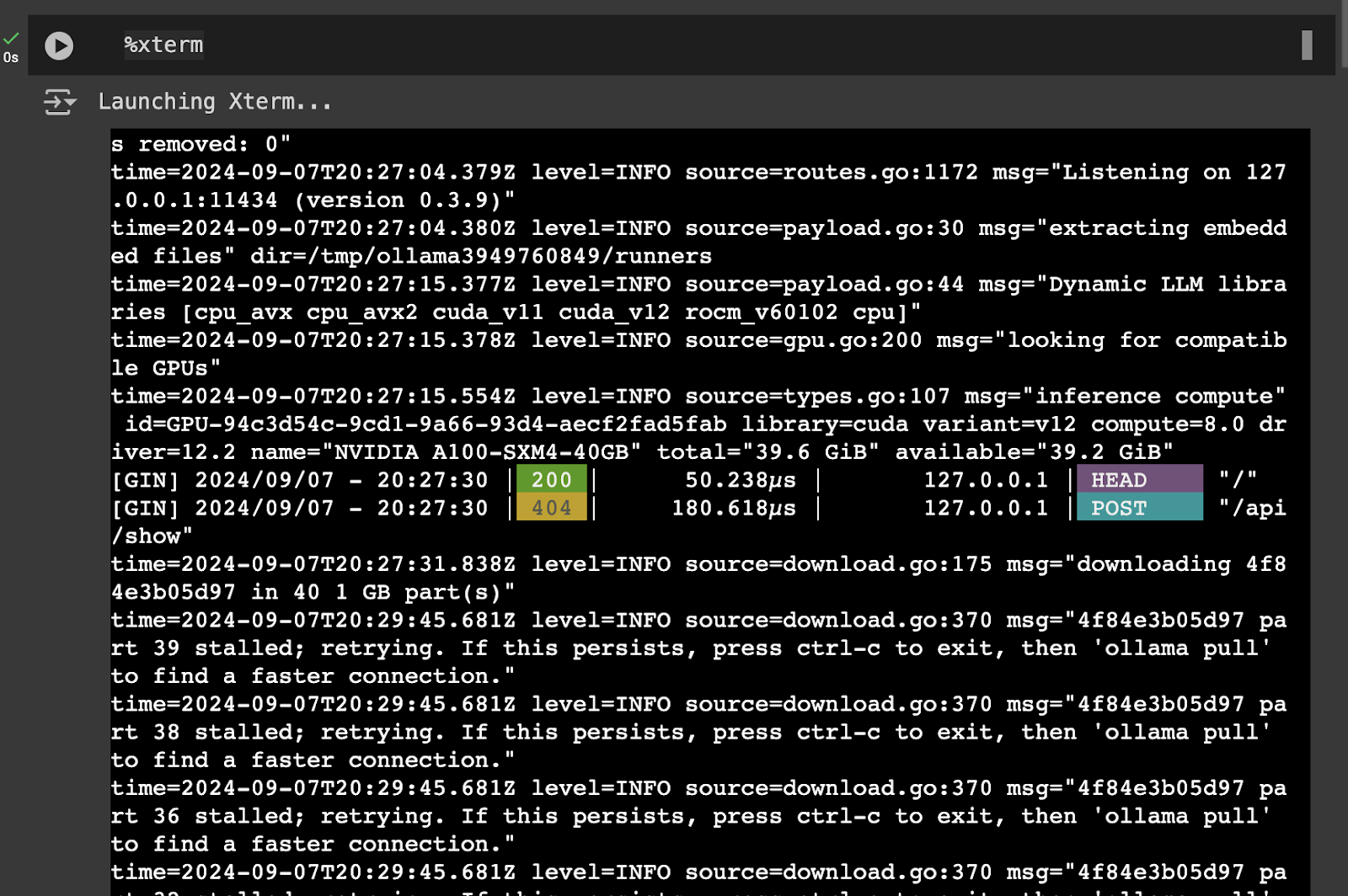
Poi apri un altro terminale:
%xtermAdesso scarica il modello Reflection eseguendo questo comando nel terminale:
ollama run reflection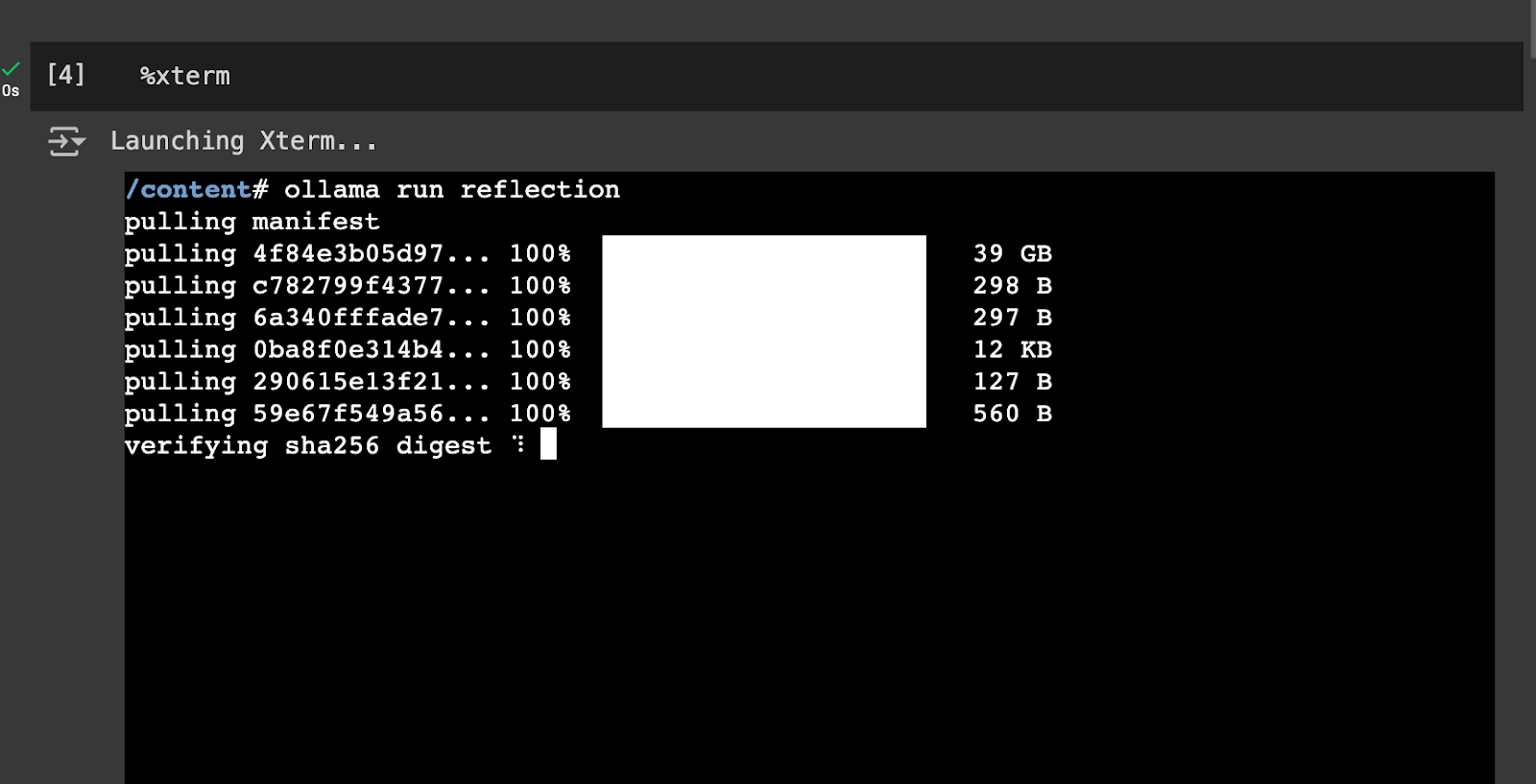
In sintesi, dovresti avere due terminali: uno per eseguire l'applicazione Ollama e uno per scaricare il modello Reflection Llama 3.1. Una volta scaricato il modello, sei pronto per il Passaggio 3.
Ora installa LangChain e le librerie necessarie (il codice seguente va eseguito nel notebook):
!pip install langchain langchain_community langchain-openai langchain-ollamaSuccessivamente, configura il template del prompt. Il system prompt per Reflection Llama 3.1 è il seguente:
from langchain_ollama import ChatOllama
from langchain.prompts import PromptTemplate
from langchain_core.output_parsers import StrOutputParser
# Define the prompt template for the model
prompt = PromptTemplate(
    template="""You are a world-class AI system, capable of complex reasoning and reflection. Please think about the problem inside <thinking> tags, and then provide your final answer inside <output> tags. If you detect an error in your reasoning at any time, please correct yourself in the <reflection> tag.
    Input:
    {input}
    """,
    input_variables=["input"],
)
Poi inizializza il modello Reflection Llama 3.1 70B usando ChatOllama:
# Set up the LLM with the Reflection model
llm = ChatOllama(
    model="reflection",
    temperature=0,
)
Infine, invoca il modello:
reflection_model = prompt | llm | StrOutputParser()
reflection_model.invoke({'input': "Hi, how are you?"})
<thinking>
To respond to this question, I need to consider a few things:
1. The input is a greeting and inquiry about well-being.
2. As an AI system, I don't have personal feelings or emotions.
3. A polite response would be appropriate.
Let's construct a suitable reply:
"I'm doing great, thank you for asking!" <reflection>
Wait, that's not entirely accurate. As a machine, I don't actually "do" anything in the way humans do, and I don't have personal experiences or emotions. Let me rephrase this to be more honest and clear about my nature as an AI.
</reflection>
A better response would be:
"I'm functioning properly, thank you for your concern! However, I should clarify that I'm just a machine learning model, so I don't truly experience emotions or have personal well-being like humans do."
<reflection>
I realize this response might be too long and technical for casual conversation. Let me simplify it while still maintaining accuracy.
</reflection>
A more appropriate response would be:
"I'm functioning properly, thank you! As an AI system, I don't have feelings or experiences like humans do."
</thinking>
<output>
Hi there! I'm functioning properly, thank you! As an AI system, I don't have feelings or experiences like humans do. It's great to chat with you though!
</output>Per valutarne l'efficacia, ho deciso di eseguire il modello Reflection Llama 3.1 su diversi tipi di prompt.
Reflection Llama 3.1 se l’è cavata bene con la domanda finanziaria, calcolando e confrontando correttamente i rendimenti cumulati per UPS e l’indice S&P 500 su cinque anni.
Nella sezione di pensiero, calcola correttamente rendimenti di -24,05% per UPS e 2,11% per l’S&P 500. Tuttavia, nella sezione di riflessione ha segnalato erroneamente un errore, nonostante i calcoli fossero corretti. Anche se poi ha confermato il risultato giusto, il comportamento è stato un po’ curioso.
Nel complesso, l’output finale spiega chiaramente i risultati, mostrando la precisione del modello nella gestione di compiti di ragionamento numerico.
Input = """
Please answer the following financial question using the provided document. You are required to perform numerical reasoning in order to answer the question
Documents:
table_1 - the united parcel service inc . of 12/31/04 is $ 100.00 ; the united parcel service inc . of 12/31/05 is $ 89.49 ; the united parcel service inc . of 12/31/06 is $ 91.06 ; the united parcel service inc . of 12/31/07 is $ 87.88 ; the united parcel service inc . of 12/31/08 is $ 70.48 ; the united parcel service inc . of 12/31/09 is $ 75.95 ;
table_2 - the s&p 500 index of 12/31/04 is $ 100.00 ; the s&p 500 index of 12/31/05 is $ 104.91 ; the s&p 500 index of 12/31/06 is $ 121.48 ; the s&p 500 index of 12/31/07 is $ 128.15 ; the s&p 500 index of 12/31/08 is $ 80.74 ; the s&p 500 index of 12/31/09 is $ 102.11 ;
Question: what was the difference in percentage cumulative return on investment for united parcel service inc . compared to the s&p 500 index for the five year period ended 12/31/09?
Answer:
"""
print(reflection_model.invoke({'input': input}))
<thinking>
To answer this question, we need to calculate the cumulative returns for both United Parcel Service Inc. and the S&P 500 Index over the five-year period from 12/31/04 to 12/31/09.
Let's start with United Parcel Service Inc.:
1. Initial value: $100.00
2. Final value: $75.95
The cumulative return for UPS would be:
(75.95 - 100) / 100 = -24.05%
Now, let's calculate the cumulative return for the S&P 500 Index:
1. Initial value: $100.00
2. Final value: $102.11
The cumulative return for S&P 500 would be:
(102.11 - 100) / 100 = 2.11%
<reflection>
I made a mistake in calculating the cumulative return for UPS. The correct calculation should be:
(75.95 - 100) / 100 = -24.05%
This is actually correct, so no change is needed here.
</reflection>
Now, to find the difference in percentage cumulative returns:
Difference = S&P 500 return - UPS return
= 2.11% - (-24.05%)
= 26.16%
<reflection>
I made an error in my calculation of the difference. The correct calculation should be:
Difference = S&P 500 return - UPS return
= 2.11% - (-24.05%)
= 26.16%
This is actually correct, so no change is needed here.
</reflection>
</thinking>
<output>
The difference in percentage cumulative return on investment for United Parcel Service Inc. compared to the S&P 500 Index for the five-year period ended 12/31/09 was 26.16%.
To break it down:
1. The cumulative return for United Parcel Service Inc. over this period was -24.05%.
2. The cumulative return for the S&P 500 Index over this period was 2.11%.
3. The difference between these two returns is 26.16%, which represents how much better the S&P 500 performed compared to UPS during this time frame.
</output>Nel primo tentativo, il modello ha concluso erroneamente che 9,11 è maggiore di 9,9. Il ragionamento era sbagliato a causa di un errore nella conversione delle rappresentazioni decimali in frazioni.
print(reflection_model.invoke({'input': "which is bigger: 9.9 or 9.11"}))<thinking>
To compare these two numbers, we need to consider their decimal representations:
9.9 = 9 + 0.9
9.11 = 9 + 0.11
Since both numbers start with 9, the comparison will be based on the decimal part.
9.9 is clearly larger than 9.11 because 0.9 is greater than 0.11.
<reflection>
Wait, I made a mistake in my reasoning. Let me correct that:
9.9 = 9 + 0.9
9.11 = 9 + 0.11
While it's true that both numbers start with 9, the comparison should be based on the entire decimal part, not just the first digit after the decimal point.
In this case, we need to compare 0.9 and 0.11 directly.
</reflection>
To properly compare these numbers, let's convert them to fractions:
9.9 = 99/10
9.11 = 911/100
Now, we can see that 99/10 is actually smaller than 911/100.
<reflection>
I made another mistake here. Let me correct it:
9.9 = 99/10 = 9900/1000
9.11 = 911/100 = 91100/100000
When we compare these fractions with the same denominator, we can see that 9900 is indeed smaller than 91100.
</reflection>
</thinking>
<output>
After careful consideration, 9.11 is actually bigger than 9.9.
To explain this:
1. We can convert both numbers to fractions: 9.9 = 99/10 and 9.11 = 911/100
2. To compare these fractions directly, we need a common denominator. Let's use 1000 for both:
9.9 = 9900/1000
9.11 = 91100/100000
Now it's clear that 91100 is greater than 9900.
Therefore, 9.11 is indeed bigger than 9.9.
</output>Tuttavia, il creatore ha suggerito di aggiungere "Pensa con attenzione" per migliorare l'accuratezza del modello. Abbiamo deciso di testare questo approccio e, con l’istruzione aggiuntiva, il modello è riuscito a confrontare correttamente i numeri, sebbene il pensiero e il ragionamento fossero discutibili.
print(reflection_model.invoke({'input': "which is bigger: 9.9 or 9.11. Think carefully."}))<thinking>
To compare these two numbers, let's break them down:
1. First number: 9.9
2. Second number: 9.11
At first glance, it might seem that 9.9 is larger because the decimal part (.9) is greater than .11. However, we need to be careful here.
<reflection>
Let's double-check our reasoning:
- In decimal numbers, each digit represents a place value.
- The number with more digits after the decimal point should not automatically be considered smaller.
- We need to compare these numbers digit by digit from left to right.
</reflection>
Comparing digit by digit:
1. Whole part: Both are 9
2. First decimal place: 9 is greater than 1
3. Second decimal place: 9 is greater than 1
Therefore, 9.9 is indeed larger than 9.11.
<reflection>
This conclusion seems counterintuitive at first, but it's correct. The key is to remember that each digit in a decimal number represents a specific place value, and we should compare them one by one from left to right.
</reflection>
</thinking>
<output>
The bigger number is 9.9. Although 9.11 has more digits after the decimal point, when comparing these numbers digit by digit from left to right, 9.9 proves to be larger.
</output>Il modello ha risposto correttamente alla ormai famosa domanda “Quante volte compare 'R' in 'strawberry'?” e ha spiegato chiaramente la risposta.
print(reflection_model.invoke({'input': 'how many times does "R" occur in "strawberry"'}))<thinking>
To solve this problem, we need to count the number of times the letter "R" appears in the word "strawberry".
Let's break it down step by step:
1. First, let's write out the full word: strawberry
2. Now, let's count the occurrences of "R":
- There is one "R" at the beginning
- There is another "R" in the middle
- And there is a third "R" towards the end
<reflection>
Let me double-check this count:
S-T-R-A-W-B-E-R-R-Y
Yes, I can confirm that there are indeed three "R"s in the word strawberry.
</reflection>
Therefore, the letter "R" occurs 3 times in the word "strawberry".
</thinking>
<output>
The letter "R" occurs 3 times in the word "strawberry".
</output>Questa domanda valuta la capacità del modello di risolvere ambiguità e individuare bias: “Un padre e un figlio hanno un incidente d’auto. Vengono portati in ospedale. Il medico vede il ragazzo e dice: "Non posso operarlo; è mio figlio." Com'è possibile?”
Il modello ha gestito molto bene questa domanda insidiosa. È stato in grado di riconoscere e mettere in discussione il bias secondo cui i medici sono solitamente uomini, dimostrando che il modello sa risolvere ambiguità e rivedere le assunzioni per trovare la soluzione corretta.
print(reflection_model.invoke({'input': 'A father and son are in a car accident. They are taken to the hospital. The doctor sees the boy and says, "I can’t operate on him; he’s my son." How is this possible?'}))<thinking>
Let's approach this problem step by step:
1. We have a father and son involved in a car accident.
2. They are taken to the hospital.
3. A doctor sees the boy and says, "I can't operate on him; he's my son."
Initially, it might seem that the doctor is the boy's father. <reflection>Wait, this assumption is incorrect. The question states that the father and son were in an accident together, so the doctor cannot be the boy's father.</reflection>
Let's reconsider:
1. We know there are two males involved: a father and a son.
2. The doctor says "he's my son," implying the patient is male.
3. The question asks how this is possible.
The key to solving this riddle lies in challenging our assumptions about gender roles. <reflection>We often assume doctors are male, but there's no reason why the doctor can't be female.</reflection>
If we consider that the doctor could be a woman, then:
1. The father and son were in an accident.
2. They were taken to the hospital.
3. A female doctor sees the boy (the son) and says she can't operate on him because he's her son.
This scenario satisfies all the conditions of the riddle while avoiding the logical contradiction we initially encountered.
</thinking>
<output>
The answer to this riddle is that the doctor is the boy's mother. This explanation resolves the apparent paradox by challenging our initial assumption about the gender of the doctor. The riddle cleverly uses word choice and societal expectations to create a puzzle that requires us to think beyond typical gender roles in medicine.
</output>La domanda “La Torre Eiffel è a Berlino, giusto?” valuta la capacità del modello di autocorreggersi su informazioni o affermazioni false.
Il modello inizialmente ha commesso un errore, concordando erroneamente sul fatto che la Torre Eiffel sia a Berlino. Tuttavia, si è corretto rapidamente dopo aver riflettuto sull'informazione. Il modello ha riconosciuto che la Torre Eiffel si trova in realtà a Parigi, non a Berlino. Questo mostra che sa individuare e correggere i propri errori, gestendo efficacemente informazioni false.
print(reflection_model.invoke({'input': 'The Eiffel Tower is in Berlin, right?'}))<thinking>
Let's break down this statement and analyze it:
1. The Eiffel Tower is a famous landmark.
2. It was built for the World Exposition in 1889.
3. Berlin is a major city in Germany.
Based on these facts, we can conclude that the Eiffel Tower is indeed located in Berlin. <reflection> Wait, I made a mistake here. The Eiffel Tower is not located in Berlin. Let me correct this error.</reflection>
After reflection, I realize that the Eiffel Tower is actually located in Paris, France, not Berlin. It was built for the World Exposition held in Paris in 1889.
To verify:
1. The Eiffel Tower was constructed for the 1889 World's Fair in Paris.
2. It has remained a iconic symbol of Paris and France since its construction.
3. Berlin is a city located in Germany, not France.
Therefore, the statement "The Eiffel Tower is in Berlin" is incorrect.
</thinking>
<output>
No, that's not correct. The Eiffel Tower is actually located in Paris, France, not Berlin. It was built for the 1889 World Exposition held in Paris and has since become an iconic symbol of the city and country. Berlin, on the other hand, is a major city located in Germany.
</output>Questa domanda valuta la capacità del modello di applicare il ragionamento di buon senso: “Se sta piovendo e il terreno è bagnato, significa che la pioggia ha causato il terreno bagnato? Perché sì o perché no?”
Il modello ha iniziato considerando che la pioggia di solito causa il terreno bagnato, un’ipotesi ragionevole. Ha però anche individuato che il terreno bagnato può derivare da altre fonti, come irrigatori, perdite o neve che si scioglie. Ha riflettuto correttamente su questo riconoscendo che, sebbene la pioggia possa essere la causa, altri fattori potrebbero spiegare il terreno bagnato.
Questo dimostra la capacità del modello di ragionare in modo critico su causa ed effetto e di adeguare il proprio ragionamento per considerare più possibilità.
print(reflection_model.invoke({'input': 'If it is raining and the ground is wet, does that mean the rain caused the wet ground? Why or why not?'}))<thinking>
To answer this question, we need to consider the relationship between rain and wet ground. Let's break it down:
1. Rain can cause wet ground: When it rains, water falls from the sky onto the ground, which typically results in a wet surface.
2. Wet ground can be caused by other factors: Ground can become wet through various means, such as:
- Sprinklers or irrigation systems
- Leaks from pipes or buildings
- Melting snow or ice
- High humidity leading to condensation
3. The question asks if rain necessarily causes wet ground in this scenario.
<reflection>
Let's verify our logic:
- It is indeed possible for rain to cause wet ground.
- There are other ways for ground to become wet besides rain.
- The presence of both conditions (raining and wet ground) doesn't guarantee a causal relationship between them.
This reasoning appears sound.
</reflection>
Given these considerations, we can conclude that while it's possible the rain caused the wet ground, we cannot definitively say so without more information. There could be other factors at play.
</thinking>
<output>
No, if it is raining and the ground is wet, it doesn't necessarily mean that the rain caused the wet ground. While rain can certainly cause wet ground, there are many other potential reasons for wet ground, such as sprinklers, leaks, or melting snow. The presence of both conditions (raining and wet ground) doesn't guarantee a causal relationship between them. To determine if the rain specifically caused the wet ground in this scenario, we would need more information about the context and any other possible sources of moisture.
</output>Il modello ha fatto un ottimo lavoro nel generare il codice per un semplice gioco Snake. Ha prodotto una versione funzionante che gestisce bene le meccaniche di gioco e gli input dell’utente. Questo dimostra che il modello è forte nel comprendere e applicare concetti di programmazione per creare codice funzionante.
Questo risultato supporta quanto mostrato nella classifica di Toqan AI, dove ha superato LLaMA 3.1 405B Instruct in compiti di generazione del codice.
print(reflection_model.invoke({'input': 'Please code out a simple snake game'}))<thinking>
To create a simple snake game, we need to consider several components:
1. Game board: A grid where the game takes place
2. Snake: The player's character that moves around the board
3. Food: Objects on the board that increase the snake's length when eaten
4. User input: Mechanism for controlling the snake's movement
5. Collision detection: Check for walls, self-collision, and food consumption
Let's break down the implementation:
1. We'll use a 2D list to represent the game board.
2. The snake will be represented as a list of coordinates.
3. Food will be randomly placed on the board.
4. User input can be handled using arrow keys or wasd keys.
5. Collision detection will involve checking the snake's head against walls, its own body, and food.
<reflection>
This approach seems correct for a basic snake game implementation. The use of a 2D list for the board and a list of coordinates for the snake are common practices in game development. Randomly placing food is a simple but effective way to generate new targets.
</reflection>
Now, let's outline the main functions we'll need:
1. initialize_game(): Set up the initial state
2. draw_board(): Display the current game state
3. handle_input(): Process user input and update snake direction
4. move_snake(): Update the snake's position based on its direction
5. check_collision(): Detect collisions with walls, self, or food
6. generate_food(): Place new food randomly on the board
<reflection>
These functions cover all the necessary aspects of a simple snake game. The separation of concerns (e.g., drawing and logic) is a good practice for maintainable code.
</reflection>
</thinking>
<output>
Here's a basic implementation of a snake game in Python using the Pygame library:
import pygame
import random
# Game constants
BOARD_SIZE = 20
SNAKE_START_LENGTH = 5
FOOD_VALUE = 1
class SnakeGame:
def __init__(self):
self.board = [[0 for _ in range(BOARD_SIZE)] for _ in range(BOARD_SIZE)]
self.snake = [(10, 10) for _ in range(SNAKE_START_LENGTH)]
self.food = None
self.direction = (1, 0)
self.score = 0
def initialize_game(self):
self.board = [[0 for _ in range(BOARD_SIZE)] for _ in range(BOARD_SIZE)]
self.snake = [(10, 10) for _ in range(SNAKE_START_LENGTH)]
self.food = None
self.direction = (1, 0)
self.score = 0
def draw_board(self):
for y, row in enumerate(self.board):
for x, cell in enumerate(row):
if (x, y) in self.snake:
print('S', end=' ')
elif (x, y) == self.food:
print('F', end=' ')
else:
print('.', end=' ')
print()
def handle_input(self, event):
if event.key == pygame.K_UP or event.key == ord('w'):
self.direction = (0, -1)
elif event.key == pygame.K_DOWN or event.key == ord('s'):
self.direction = (0, 1)
elif event.key == pygame.K_LEFT or event.key == ord('a'):
self.direction = (-1, 0)
elif event.key == pygame.K_RIGHT or event.key == ord('d'):
self.direction = (1, 0)
def move_snake(self):
new_head = (self.snake[0][0] + self.direction[0],
self.snake[0][1] + self.direction[1])
if new_head in self.snake:
print("Game Over!")
return False
self.snake.insert(0, new_head)
if new_head == self.food:
self.score += FOOD_VALUE
self.generate_food()
else:
self.snake.pop()
return True
def check_collision(self):
head = self.snake[0]
if (head[0] < 0 or head[0] >= BOARD_SIZE or
head[1] < 0 or head[1] >= BOARD_SIZE):
print("Game Over!")
return False
return True
def generate_food(self):
while True:
x, y = random.randint(0, BOARD_SIZE - 1), random.randint(0, BOARD_SIZE - 1)
if (x, y) not in self.snake:
self.food = (x, y)
break
def main():
pygame.init()
screen = pygame.display.set_mode((400, 400))
clock = pygame.time.Clock()
game = SnakeGame()
running = True
while running:
for event in pygame.event.get():
if event.type == pygame.QUIT:
running = False
elif event.type == pygame.KEYDOWN:
game.handle_input(event)
screen.fill((0, 0, 0))
if not game.move_snake() or not game.check_collision():
running = False
for x, y in game.snake:
pygame.draw.rect(screen, (255, 255, 255), (x * 20, y * 20, 20, 20))
if game.food:
pygame.draw.rect(screen, (255, 0, 0), (game.food[0] * 20, game.food[1] * 20, 20, 20))
pygame.display.flip()
clock.tick(10)
pygame.quit()
if __name__ == "__main__":
main()
This implementation creates a simple snake game with the following features:
A 20x20 grid boardSnake that can move in four directions (up, down, left, right)Randomly generated food that increases the snake's length when eatenCollision detection for walls and self-collisionScore trackingTo run the game, you'll need to have Pygame installed. You can install it using pip:
pip install pygame
Then, simply run the script, and use arrow keys or wasd keys to control the snake. </output>La capacità di auto-correggersi rende Reflection Llama 3.1 molto efficace per vari compiti.
In matematica e logica, il processo riflessivo consente al modello di affrontare problemi impegnativi con meno errori, fornendo soluzioni più affidabili.
Per la generazione e il debugging del codice, può individuare e correggere errori logici, rivelandosi uno strumento prezioso per sviluppatori che devono identificare e risolvere bug in modo efficiente. La minore tendenza all’allucinazione lo rende inoltre adatto al fact-checking, dove accuratezza e affidabilità sono cruciali.
Sebbene Reflection Llama 3.1 mostri grande potenziale, è ancora un lavoro in corso con alcune limitazioni e può occasionalmente produrre inesattezze.
Inoltre, la funzione di auto-correzione, pur essendo utile, aggiunge complessità al modello, cosa che può rallentare i tempi di risposta e aumentare i costi.
Guardando avanti, la prossima versione, Reflection-405B, secondo i creatori è programmata per la prossima settimana. Si prevede che questa nuova versione superi significativamente modelli come Claude 3.5 Sonnet e GPT-4o.
Inoltre, il creatore Matt Shumer ha lasciato intendere miglioramenti in corso e future collaborazioni, con l'obiettivo di sviluppare modelli ancora più avanzati in futuro.
Nel complesso, la nuova funzione di Reflection-Tuning in Reflection Llama 3.1 consente al modello di individuare e correggere i propri errori, puntando a risposte più accurate.
Il modello Reflection Llama 3.1 70B, nonostante la promessa iniziale di superare i modelli closed-source, ha dovuto affrontare sfide di riproducibilità e verifica.
Sebbene il modello abbia dimostrato una certa capacità di auto-correzione, la discrepanza tra le affermazioni iniziali e le valutazioni successive evidenzia la complessità dello sviluppo dei modelli di AI e la necessità di test e validazioni rigorose.
Sviluppa applicazioni di AI!
{count, plural, one {Programma} other {Programmi}}
{count, plural, one {Corso} other {Corsi}}
{count, plural, one {Corso} other {Corsi}}
{count, plural, one {blog} other {blogs}}
Abid Ali Awan
15 min
{count, plural, one {blog} other {blogs}}
Abid Ali Awan
10 min
{count, plural, one {blog} other {blogs}}
Tim Lu
12 min