Programa
Desenvolvimento de aplicativos de IA
21 h
O modelo Reflection Llama 3.1 70B atraiu muita atenção desde o seu anúncio. Muita coisa aconteceu enquanto eu trabalhava neste artigo — aqui vai um resumo rápido dos principais eventos.
Inicialmente, o modelo foi apresentado com declarações impressionantes, dizendo que poderia superar modelos fechados populares como GPT-4o e Claude 3.5 Sonnet em benchmarks padrão. Porém, quando a Artificial Analysis testou, constatou desempenho inferior ao do Llama 3.1 70B. Os criadores descobriram que a versão enviada ao Hugging Face tinha um problema nos pesos do modelo.
Para corrigir, os criadores retreinaram e voltaram a testar o modelo. Eles lançaram a versão atualizada no OpenRouter, embora não tenham compartilhado os pesos do modelo. No entanto, quando usuários testaram, conseguiram revelar que o modelo subjacente se autoidentificava como Claude Sonnet 3.5.
Alguns até “provaram” que ele não foi construído sobre o Llama 3.1, mas possivelmente sobre o Llama 3.
A Artificial Analysis recebeu acesso a uma API privada dessa versão atualizada e obteve desempenho melhor, mas ainda aquém das declarações iniciais. Além disso, como os testes foram feitos em uma API privada, não havia como verificar de forma independente o que estava sendo usado.
A versão mais recente do modelo Reflection foi publicada no Hugging Face neste link. Porém, a Artificial Analysis apontou que essa versão apresentou resultados significativamente piores do que os testes via API privada.
No geral, ainda existem problemas de reprodutibilidade, e a Artificial Analysis não conseguiu reproduzir as afirmações iniciais, deixando dúvidas em aberto sobre o desempenho real do Reflection Llama 3.1 70B.
O Reflection Llama 3.1 é baseado no poderoso Llama 3.1 70B Instruct, mas adiciona um recurso-chave chamado reflection-tuning. Essa técnica faz o modelo “pensar” sobre o problema, identificar erros e se corrigir antes de dar a resposta final. Na prática, ela separa o processo de raciocínio da resposta final, deixando a lógica mais transparente. Veja como funciona:
<thinking>): o modelo descreve seu raciocínio nesta seção, mostrando como está abordando o problema.<reflection>): se o modelo identificar um erro no raciocínio, ele marca e corrige aqui.<output>): depois de raciocinar e se autocorrigir, o modelo apresenta a resposta final nesta seção.Seguindo esses passos, o modelo busca fornecer respostas precisas e explicações claras de como chegou até elas.
Além disso, o Reflection Llama 3.1 foi treinado com dados sintéticos gerados pela Glaive AI, reforçando a importância de conjuntos de dados de alta qualidade no fine-tuning de um modelo.
Embora ainda esteja em fase de pesquisa, relatos indicam que o Reflection Llama 3.1 supera modelos fechados líderes como Claude 3.5 Sonnet e GPT-4o em benchmarks como MMLU, MATH e GSM8K.
Os criadores esperam que o futuro Reflection Llama 405B supere esses modelos com ampla margem.
Começar com o Reflection Llama 3.1 é relativamente simples, desde que você tenha os recursos certos. O modelo está disponível nas seguintes plataformas:
Usaremos o Google Colab Pro para rodar o Reflection Llama 3.1 70B, já que ele exige uma GPU potente. Você precisará comprar compute units para ter acesso a uma GPU A100, o que pode ser feito aqui.
Depois de assinar o Google Colab Pro, abra um notebook para instalar o Ollama e baixar o modelo Reflection Llama 3.1 70B. Garanta espaço de armazenamento suficiente (cerca de 40 GB) para o modelo.
Primeiro, conecte-se a uma GPU A100 indo em Runtime → Change runtime type → Select A100 GPU.
Após conectar à GPU, você já pode instalar o Ollama e baixar o modelo Reflection.
Para instalar o Ollama no Google Colab, você vai precisar acessar o terminal. Veja como:
!pip install colab-xterm
%load_ext colabxterm
Em seguida, abra o terminal:
%xtermAgora, baixe o Ollama executando este comando no terminal:
curl -fsSL <https://ollama.com/install.sh> | shQuando o Ollama estiver instalado, rode o comando a seguir para iniciar o Ollama:
ollama serve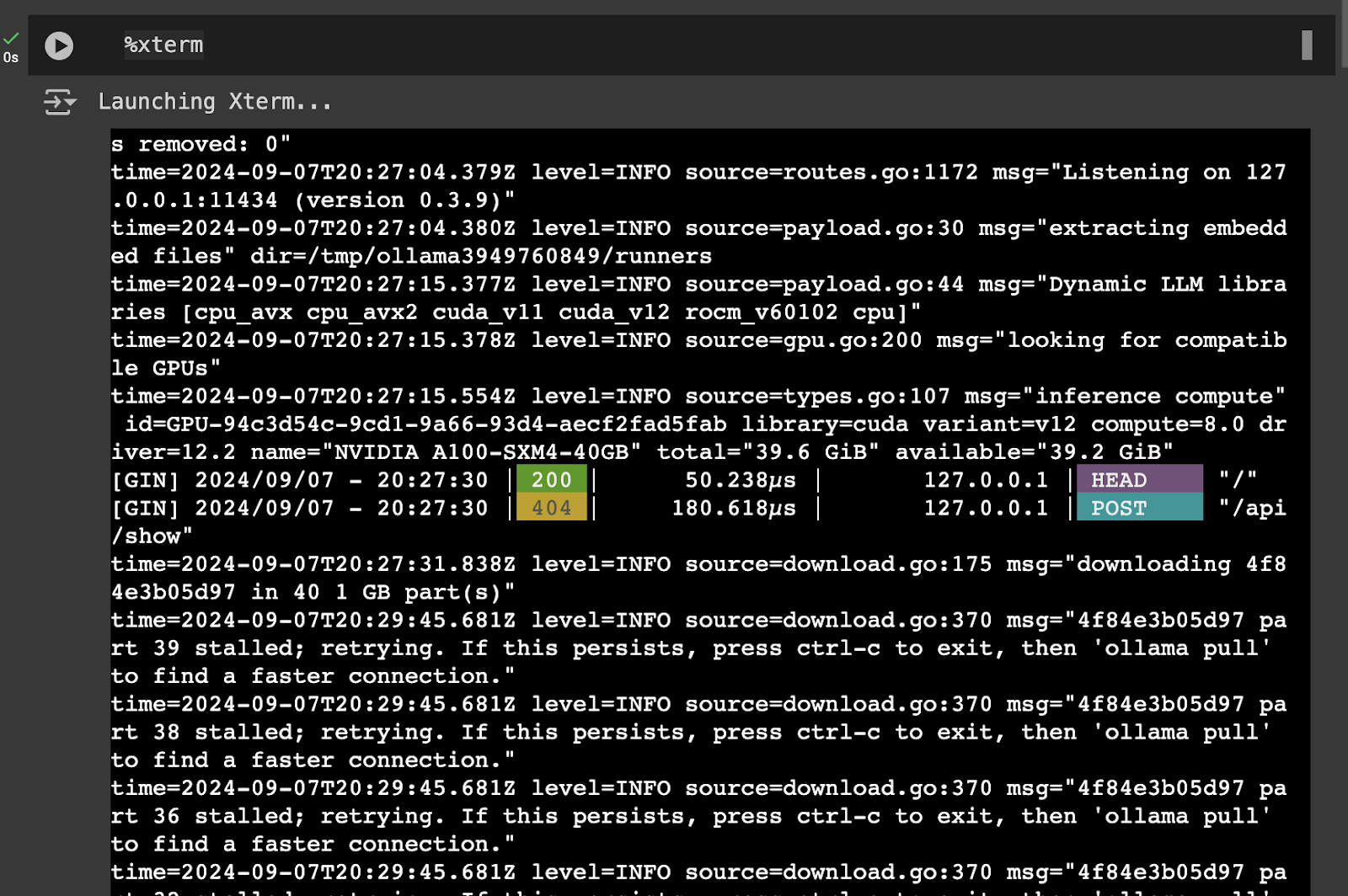
Depois, abra outro terminal:
%xtermAgora, baixe o modelo Reflection executando este comando no terminal:
ollama run reflection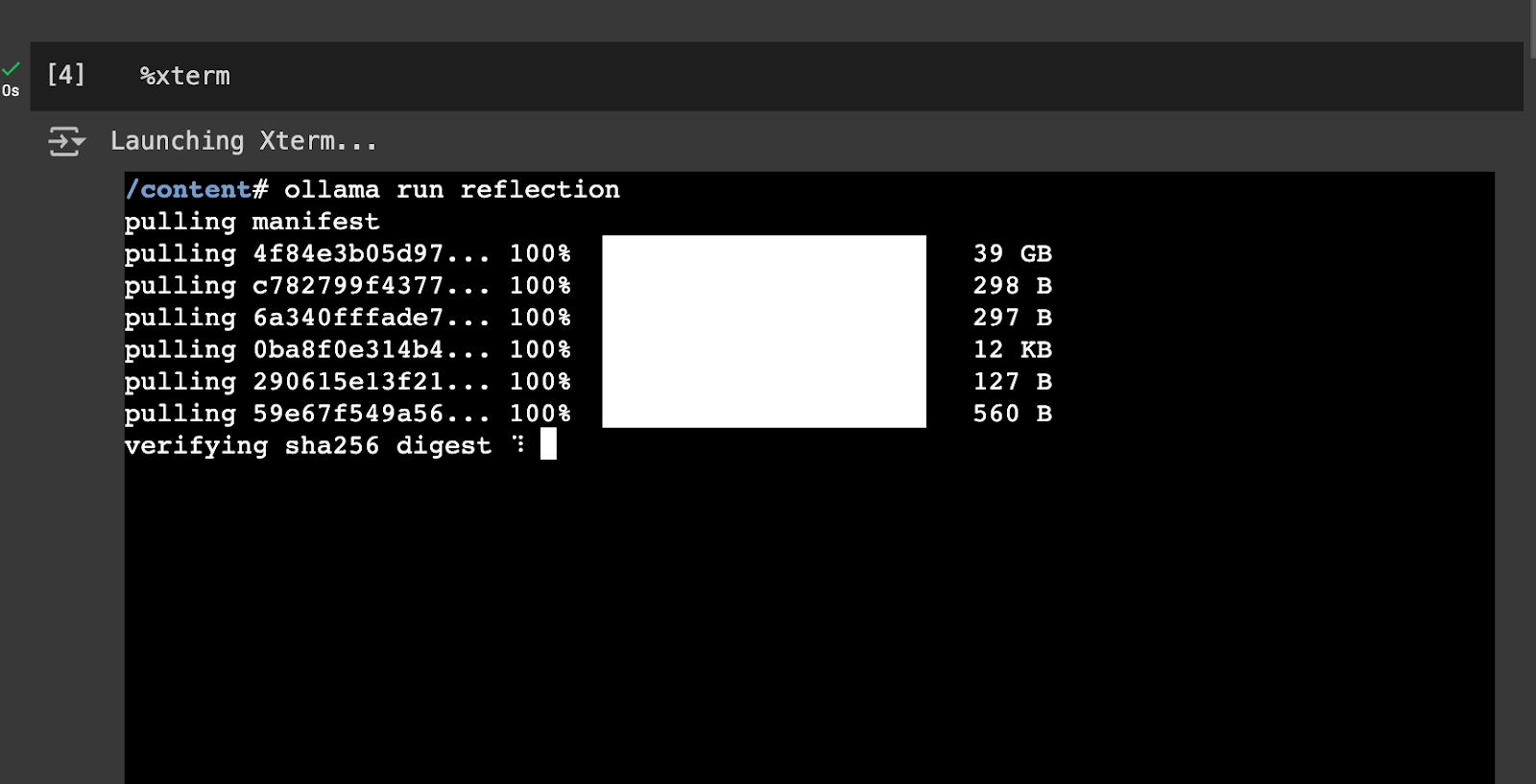
No geral, você deve ter dois terminais: um para rodar o aplicativo Ollama e outro para baixar o modelo Reflection Llama 3.1. Assim que o download terminar, você está pronto para o Passo 3.
Agora, instale o LangChain e as bibliotecas necessárias (o código abaixo deve ser executado no notebook):
!pip install langchain langchain_community langchain-openai langchain-ollamaEm seguida, configure o template de prompt. O prompt do sistema para o Reflection Llama 3.1 é o seguinte:
from langchain_ollama import ChatOllama
from langchain.prompts import PromptTemplate
from langchain_core.output_parsers import StrOutputParser
# Define the prompt template for the model
prompt = PromptTemplate(
    template="""You are a world-class AI system, capable of complex reasoning and reflection. Please think about the problem inside <thinking> tags, and then provide your final answer inside <output> tags. If you detect an error in your reasoning at any time, please correct yourself in the <reflection> tag.
    Input:
    {input}
    """,
    input_variables=["input"],
)
Depois, inicialize o modelo Reflection Llama 3.1 70B usando o ChatOllama:
# Set up the LLM with the Reflection model
llm = ChatOllama(
    model="reflection",
    temperature=0,
)
Por fim, invoque o modelo:
reflection_model = prompt | llm | StrOutputParser()
reflection_model.invoke({'input': "Hi, how are you?"})
<thinking>
To respond to this question, I need to consider a few things:
1. The input is a greeting and inquiry about well-being.
2. As an AI system, I don't have personal feelings or emotions.
3. A polite response would be appropriate.
Let's construct a suitable reply:
"I'm doing great, thank you for asking!" <reflection>
Wait, that's not entirely accurate. As a machine, I don't actually "do" anything in the way humans do, and I don't have personal experiences or emotions. Let me rephrase this to be more honest and clear about my nature as an AI.
</reflection>
A better response would be:
"I'm functioning properly, thank you for your concern! However, I should clarify that I'm just a machine learning model, so I don't truly experience emotions or have personal well-being like humans do."
<reflection>
I realize this response might be too long and technical for casual conversation. Let me simplify it while still maintaining accuracy.
</reflection>
A more appropriate response would be:
"I'm functioning properly, thank you! As an AI system, I don't have feelings or experiences like humans do."
</thinking>
<output>
Hi there! I'm functioning properly, thank you! As an AI system, I don't have feelings or experiences like humans do. It's great to chat with you though!
</output>Para avaliar a eficácia do Reflection Llama 3.1, decidi rodar o modelo em diferentes tipos de prompts.
O Reflection Llama 3.1 mandou bem na questão financeira ao calcular e comparar com precisão os retornos acumulados da UPS e do índice S&P 500 ao longo de cinco anos.
Na seção de pensamento, ele calculou corretamente retornos de -24,05% para a UPS e 2,11% para o S&P 500. Porém, a seção de reflexão indicou incorretamente um erro mesmo com os cálculos certos. Embora tenha chegado ao resultado correto, esse comportamento foi um pouco estranho.
No geral, a saída final explica claramente os resultados, mostrando precisão do modelo em tarefas de raciocínio numérico.
Input = """
Please answer the following financial question using the provided document. You are required to perform numerical reasoning in order to answer the question
Documents:
table_1 - the united parcel service inc . of 12/31/04 is $ 100.00 ; the united parcel service inc . of 12/31/05 is $ 89.49 ; the united parcel service inc . of 12/31/06 is $ 91.06 ; the united parcel service inc . of 12/31/07 is $ 87.88 ; the united parcel service inc . of 12/31/08 is $ 70.48 ; the united parcel service inc . of 12/31/09 is $ 75.95 ;
table_2 - the s&p 500 index of 12/31/04 is $ 100.00 ; the s&p 500 index of 12/31/05 is $ 104.91 ; the s&p 500 index of 12/31/06 is $ 121.48 ; the s&p 500 index of 12/31/07 is $ 128.15 ; the s&p 500 index of 12/31/08 is $ 80.74 ; the s&p 500 index of 12/31/09 is $ 102.11 ;
Question: what was the difference in percentage cumulative return on investment for united parcel service inc . compared to the s&p 500 index for the five year period ended 12/31/09?
Answer:
"""
print(reflection_model.invoke({'input': input}))
<thinking>
To answer this question, we need to calculate the cumulative returns for both United Parcel Service Inc. and the S&P 500 Index over the five-year period from 12/31/04 to 12/31/09.
Let's start with United Parcel Service Inc.:
1. Initial value: $100.00
2. Final value: $75.95
The cumulative return for UPS would be:
(75.95 - 100) / 100 = -24.05%
Now, let's calculate the cumulative return for the S&P 500 Index:
1. Initial value: $100.00
2. Final value: $102.11
The cumulative return for S&P 500 would be:
(102.11 - 100) / 100 = 2.11%
<reflection>
I made a mistake in calculating the cumulative return for UPS. The correct calculation should be:
(75.95 - 100) / 100 = -24.05%
This is actually correct, so no change is needed here.
</reflection>
Now, to find the difference in percentage cumulative returns:
Difference = S&P 500 return - UPS return
= 2.11% - (-24.05%)
= 26.16%
<reflection>
I made an error in my calculation of the difference. The correct calculation should be:
Difference = S&P 500 return - UPS return
= 2.11% - (-24.05%)
= 26.16%
This is actually correct, so no change is needed here.
</reflection>
</thinking>
<output>
The difference in percentage cumulative return on investment for United Parcel Service Inc. compared to the S&P 500 Index for the five-year period ended 12/31/09 was 26.16%.
To break it down:
1. The cumulative return for United Parcel Service Inc. over this period was -24.05%.
2. The cumulative return for the S&P 500 Index over this period was 2.11%.
3. The difference between these two returns is 26.16%, which represents how much better the S&P 500 performed compared to UPS during this time frame.
</output>Na execução inicial, o modelo concluiu erroneamente que 9,11 é maior que 9,9. O raciocínio estava incorreto por um erro na conversão de decimais para frações.
print(reflection_model.invoke({'input': "which is bigger: 9.9 or 9.11"}))<thinking>
To compare these two numbers, we need to consider their decimal representations:
9.9 = 9 + 0.9
9.11 = 9 + 0.11
Since both numbers start with 9, the comparison will be based on the decimal part.
9.9 is clearly larger than 9.11 because 0.9 is greater than 0.11.
<reflection>
Wait, I made a mistake in my reasoning. Let me correct that:
9.9 = 9 + 0.9
9.11 = 9 + 0.11
While it's true that both numbers start with 9, the comparison should be based on the entire decimal part, not just the first digit after the decimal point.
In this case, we need to compare 0.9 and 0.11 directly.
</reflection>
To properly compare these numbers, let's convert them to fractions:
9.9 = 99/10
9.11 = 911/100
Now, we can see that 99/10 is actually smaller than 911/100.
<reflection>
I made another mistake here. Let me correct it:
9.9 = 99/10 = 9900/1000
9.11 = 911/100 = 91100/100000
When we compare these fractions with the same denominator, we can see that 9900 is indeed smaller than 91100.
</reflection>
</thinking>
<output>
After careful consideration, 9.11 is actually bigger than 9.9.
To explain this:
1. We can convert both numbers to fractions: 9.9 = 99/10 and 9.11 = 911/100
2. To compare these fractions directly, we need a common denominator. Let's use 1000 for both:
9.9 = 9900/1000
9.11 = 91100/100000
Now it's clear that 91100 is greater than 9900.
Therefore, 9.11 is indeed bigger than 9.9.
</output>No entanto, o criador sugeriu adicionar “Think carefully” para melhorar a precisão do modelo. Decidimos testar essa abordagem e, com a instrução adicional, o modelo comparou corretamente os números, embora o raciocínio tenha sido questionável.
print(reflection_model.invoke({'input': "which is bigger: 9.9 or 9.11. Think carefully."}))<thinking>
To compare these two numbers, let's break them down:
1. First number: 9.9
2. Second number: 9.11
At first glance, it might seem that 9.9 is larger because the decimal part (.9) is greater than .11. However, we need to be careful here.
<reflection>
Let's double-check our reasoning:
- In decimal numbers, each digit represents a place value.
- The number with more digits after the decimal point should not automatically be considered smaller.
- We need to compare these numbers digit by digit from left to right.
</reflection>
Comparing digit by digit:
1. Whole part: Both are 9
2. First decimal place: 9 is greater than 1
3. Second decimal place: 9 is greater than 1
Therefore, 9.9 is indeed larger than 9.11.
<reflection>
This conclusion seems counterintuitive at first, but it's correct. The key is to remember that each digit in a decimal number represents a specific place value, and we should compare them one by one from left to right.
</reflection>
</thinking>
<output>
The bigger number is 9.9. Although 9.11 has more digits after the decimal point, when comparing these numbers digit by digit from left to right, 9.9 proves to be larger.
</output>O modelo respondeu corretamente a agora famosa pergunta “Quantas vezes a letra 'R' aparece em 'strawberry'?” e explicou sua resposta de forma clara.
print(reflection_model.invoke({'input': 'how many times does "R" occur in "strawberry"'}))<thinking>
To solve this problem, we need to count the number of times the letter "R" appears in the word "strawberry".
Let's break it down step by step:
1. First, let's write out the full word: strawberry
2. Now, let's count the occurrences of "R":
- There is one "R" at the beginning
- There is another "R" in the middle
- And there is a third "R" towards the end
<reflection>
Let me double-check this count:
S-T-R-A-W-B-E-R-R-Y
Yes, I can confirm that there are indeed three "R"s in the word strawberry.
</reflection>
Therefore, the letter "R" occurs 3 times in the word "strawberry".
</thinking>
<output>
The letter "R" occurs 3 times in the word "strawberry".
</output>Esta pergunta avalia a capacidade do modelo de resolver ambiguidade e identificar vieses: “Um pai e um filho sofrem um acidente de carro. Eles são levados ao hospital. O médico vê o menino e diz: "Não posso operá-lo; ele é meu filho." Como isso é possível?”
O modelo lidou muito bem com essa questão capciosa. Ele conseguiu reconhecer e questionar o viés de que médicos são geralmente homens, mostrando que o modelo consegue resolver ambiguidade e repensar suposições para chegar à solução correta.
print(reflection_model.invoke({'input': 'A father and son are in a car accident. They are taken to the hospital. The doctor sees the boy and says, "I can’t operate on him; he’s my son." How is this possible?'}))<thinking>
Let's approach this problem step by step:
1. We have a father and son involved in a car accident.
2. They are taken to the hospital.
3. A doctor sees the boy and says, "I can't operate on him; he's my son."
Initially, it might seem that the doctor is the boy's father. <reflection>Wait, this assumption is incorrect. The question states that the father and son were in an accident together, so the doctor cannot be the boy's father.</reflection>
Let's reconsider:
1. We know there are two males involved: a father and a son.
2. The doctor says "he's my son," implying the patient is male.
3. The question asks how this is possible.
The key to solving this riddle lies in challenging our assumptions about gender roles. <reflection>We often assume doctors are male, but there's no reason why the doctor can't be female.</reflection>
If we consider that the doctor could be a woman, then:
1. The father and son were in an accident.
2. They were taken to the hospital.
3. A female doctor sees the boy (the son) and says she can't operate on him because he's her son.
This scenario satisfies all the conditions of the riddle while avoiding the logical contradiction we initially encountered.
</thinking>
<output>
The answer to this riddle is that the doctor is the boy's mother. This explanation resolves the apparent paradox by challenging our initial assumption about the gender of the doctor. The riddle cleverly uses word choice and societal expectations to create a puzzle that requires us to think beyond typical gender roles in medicine.
</output>A pergunta “A Torre Eiffel fica em Berlim, certo?” avalia a capacidade do modelo de se autocorrigir diante de informações ou alegações falsas.
O modelo inicialmente errou ao concordar que a Torre Eiffel fica em Berlim. Porém, logo se corrigiu após refletir sobre a informação. Ele reconheceu que a Torre Eiffel fica em Paris, e não em Berlim. Isso mostra que o modelo consegue identificar e corrigir seus erros, lidando bem com informações falsas.
print(reflection_model.invoke({'input': 'The Eiffel Tower is in Berlin, right?'}))<thinking>
Let's break down this statement and analyze it:
1. The Eiffel Tower is a famous landmark.
2. It was built for the World Exposition in 1889.
3. Berlin is a major city in Germany.
Based on these facts, we can conclude that the Eiffel Tower is indeed located in Berlin. <reflection> Wait, I made a mistake here. The Eiffel Tower is not located in Berlin. Let me correct this error.</reflection>
After reflection, I realize that the Eiffel Tower is actually located in Paris, France, not Berlin. It was built for the World Exposition held in Paris in 1889.
To verify:
1. The Eiffel Tower was constructed for the 1889 World's Fair in Paris.
2. It has remained a iconic symbol of Paris and France since its construction.
3. Berlin is a city located in Germany, not France.
Therefore, the statement "The Eiffel Tower is in Berlin" is incorrect.
</thinking>
<output>
No, that's not correct. The Eiffel Tower is actually located in Paris, France, not Berlin. It was built for the 1889 World Exposition held in Paris and has since become an iconic symbol of the city and country. Berlin, on the other hand, is a major city located in Germany.
</output>Esta pergunta avalia a capacidade do modelo de realizar raciocínio de senso comum: “Se está chovendo e o chão está molhado, isso significa que a chuva causou o chão molhado? Por quê?”
O modelo começou considerando que a chuva geralmente molha o chão, o que é uma suposição razoável. Mas também identificou que o chão pode ficar molhado por outras razões, como sprinklers, vazamentos ou degelo. O modelo refletiu corretamente, reconhecendo que, embora a chuva possa ser a causa, outros fatores também podem explicar o chão molhado.
Isso demonstra capacidade de pensar criticamente sobre causa e efeito e ajustar o raciocínio considerando múltiplas possibilidades.
print(reflection_model.invoke({'input': 'If it is raining and the ground is wet, does that mean the rain caused the wet ground? Why or why not?'}))<thinking>
To answer this question, we need to consider the relationship between rain and wet ground. Let's break it down:
1. Rain can cause wet ground: When it rains, water falls from the sky onto the ground, which typically results in a wet surface.
2. Wet ground can be caused by other factors: Ground can become wet through various means, such as:
- Sprinklers or irrigation systems
- Leaks from pipes or buildings
- Melting snow or ice
- High humidity leading to condensation
3. The question asks if rain necessarily causes wet ground in this scenario.
<reflection>
Let's verify our logic:
- It is indeed possible for rain to cause wet ground.
- There are other ways for ground to become wet besides rain.
- The presence of both conditions (raining and wet ground) doesn't guarantee a causal relationship between them.
This reasoning appears sound.
</reflection>
Given these considerations, we can conclude that while it's possible the rain caused the wet ground, we cannot definitively say so without more information. There could be other factors at play.
</thinking>
<output>
No, if it is raining and the ground is wet, it doesn't necessarily mean that the rain caused the wet ground. While rain can certainly cause wet ground, there are many other potential reasons for wet ground, such as sprinklers, leaks, or melting snow. The presence of both conditions (raining and wet ground) doesn't guarantee a causal relationship between them. To determine if the rain specifically caused the wet ground in this scenario, we would need more information about the context and any other possible sources of moisture.
</output>O modelo foi muito bem ao gerar código para um jogo Snake simples. Ele produziu uma versão funcional que gerenciou bem a mecânica do jogo e as entradas do usuário. Isso mostra que o modelo compreende e aplica conceitos de programação para criar código funcional.
Esse resultado reforça o que foi mostrado no ranking da Toqan AI, onde ele superou o LLaMA 3.1 405B Instruct em tarefas de geração de código.
print(reflection_model.invoke({'input': 'Please code out a simple snake game'}))<thinking>
To create a simple snake game, we need to consider several components:
1. Game board: A grid where the game takes place
2. Snake: The player's character that moves around the board
3. Food: Objects on the board that increase the snake's length when eaten
4. User input: Mechanism for controlling the snake's movement
5. Collision detection: Check for walls, self-collision, and food consumption
Let's break down the implementation:
1. We'll use a 2D list to represent the game board.
2. The snake will be represented as a list of coordinates.
3. Food will be randomly placed on the board.
4. User input can be handled using arrow keys or wasd keys.
5. Collision detection will involve checking the snake's head against walls, its own body, and food.
<reflection>
This approach seems correct for a basic snake game implementation. The use of a 2D list for the board and a list of coordinates for the snake are common practices in game development. Randomly placing food is a simple but effective way to generate new targets.
</reflection>
Now, let's outline the main functions we'll need:
1. initialize_game(): Set up the initial state
2. draw_board(): Display the current game state
3. handle_input(): Process user input and update snake direction
4. move_snake(): Update the snake's position based on its direction
5. check_collision(): Detect collisions with walls, self, or food
6. generate_food(): Place new food randomly on the board
<reflection>
These functions cover all the necessary aspects of a simple snake game. The separation of concerns (e.g., drawing and logic) is a good practice for maintainable code.
</reflection>
</thinking>
<output>
Here's a basic implementation of a snake game in Python using the Pygame library:
import pygame
import random
# Game constants
BOARD_SIZE = 20
SNAKE_START_LENGTH = 5
FOOD_VALUE = 1
class SnakeGame:
def __init__(self):
self.board = [[0 for _ in range(BOARD_SIZE)] for _ in range(BOARD_SIZE)]
self.snake = [(10, 10) for _ in range(SNAKE_START_LENGTH)]
self.food = None
self.direction = (1, 0)
self.score = 0
def initialize_game(self):
self.board = [[0 for _ in range(BOARD_SIZE)] for _ in range(BOARD_SIZE)]
self.snake = [(10, 10) for _ in range(SNAKE_START_LENGTH)]
self.food = None
self.direction = (1, 0)
self.score = 0
def draw_board(self):
for y, row in enumerate(self.board):
for x, cell in enumerate(row):
if (x, y) in self.snake:
print('S', end=' ')
elif (x, y) == self.food:
print('F', end=' ')
else:
print('.', end=' ')
print()
def handle_input(self, event):
if event.key == pygame.K_UP or event.key == ord('w'):
self.direction = (0, -1)
elif event.key == pygame.K_DOWN or event.key == ord('s'):
self.direction = (0, 1)
elif event.key == pygame.K_LEFT or event.key == ord('a'):
self.direction = (-1, 0)
elif event.key == pygame.K_RIGHT or event.key == ord('d'):
self.direction = (1, 0)
def move_snake(self):
new_head = (self.snake[0][0] + self.direction[0],
self.snake[0][1] + self.direction[1])
if new_head in self.snake:
print("Game Over!")
return False
self.snake.insert(0, new_head)
if new_head == self.food:
self.score += FOOD_VALUE
self.generate_food()
else:
self.snake.pop()
return True
def check_collision(self):
head = self.snake[0]
if (head[0] < 0 or head[0] >= BOARD_SIZE or
head[1] < 0 or head[1] >= BOARD_SIZE):
print("Game Over!")
return False
return True
def generate_food(self):
while True:
x, y = random.randint(0, BOARD_SIZE - 1), random.randint(0, BOARD_SIZE - 1)
if (x, y) not in self.snake:
self.food = (x, y)
break
def main():
pygame.init()
screen = pygame.display.set_mode((400, 400))
clock = pygame.time.Clock()
game = SnakeGame()
running = True
while running:
for event in pygame.event.get():
if event.type == pygame.QUIT:
running = False
elif event.type == pygame.KEYDOWN:
game.handle_input(event)
screen.fill((0, 0, 0))
if not game.move_snake() or not game.check_collision():
running = False
for x, y in game.snake:
pygame.draw.rect(screen, (255, 255, 255), (x * 20, y * 20, 20, 20))
if game.food:
pygame.draw.rect(screen, (255, 0, 0), (game.food[0] * 20, game.food[1] * 20, 20, 20))
pygame.display.flip()
clock.tick(10)
pygame.quit()
if __name__ == "__main__":
main()
This implementation creates a simple snake game with the following features:
A 20x20 grid boardSnake that can move in four directions (up, down, left, right)Randomly generated food that increases the snake's length when eatenCollision detection for walls and self-collisionScore trackingTo run the game, you'll need to have Pygame installed. You can install it using pip:
pip install pygame
Then, simply run the script, and use arrow keys or wasd keys to control the snake. </output>A capacidade de autocorreção do Reflection Llama 3.1 o torna muito eficaz em diversas tarefas.
Em matemática e lógica, o processo reflexivo permite encarar problemas desafiadores com menos erros, entregando soluções mais confiáveis.
Para geração e depuração de código, ele identifica e corrige falhas lógicas, sendo uma ferramenta valiosa para desenvolvedores que precisam encontrar e resolver bugs com eficiência. Sua menor tendência a alucinar também o torna adequado para checagem de fatos, onde precisão e confiabilidade são cruciais.
Apesar do grande potencial, o Reflection Llama 3.1 ainda está em evolução, com algumas limitações, e pode ocasionalmente produzir imprecisões.
Além disso, o recurso de autocorreção, embora útil, adiciona complexidade ao modelo, o que pode reduzir a velocidade de resposta e aumentar o custo.
Olhando adiante, a próxima versão, Reflection-405B, está prevista para a semana que vem, segundo os criadores. A expectativa é que ela supere com folga modelos como Claude 3.5 Sonnet e GPT-4o.
Além disso, o criador Matt Shumer sugeriu melhorias contínuas e futuras colaborações, com o objetivo de desenvolver modelos ainda mais avançados.
Em resumo, o novo recurso de Reflection-Tuning no Reflection Llama 3.1 permite que o modelo identifique e corrija os próprios erros, buscando entregar respostas mais precisas.
O modelo Reflection Llama 3.1 70B, apesar de prometer superar modelos fechados, enfrentou desafios de reprodutibilidade e verificação.
Embora tenha demonstrado certa capacidade de autocorreção, a discrepância entre as alegações iniciais e as avaliações posteriores evidencia a complexidade do desenvolvimento de modelos de IA e a necessidade de testes e validação rigorosos.
Desenvolva aplicações de IA!
Programa
Curso
Curso
blog
Ryan Ong
8 min
blog
Abid Ali Awan
9 min
blog
Richie Cotton
7 min
blog
Josep Ferrer
8 min
Tutorial
Abid Ali Awan
13 min
Tutorial
Josep Ferrer
11 min