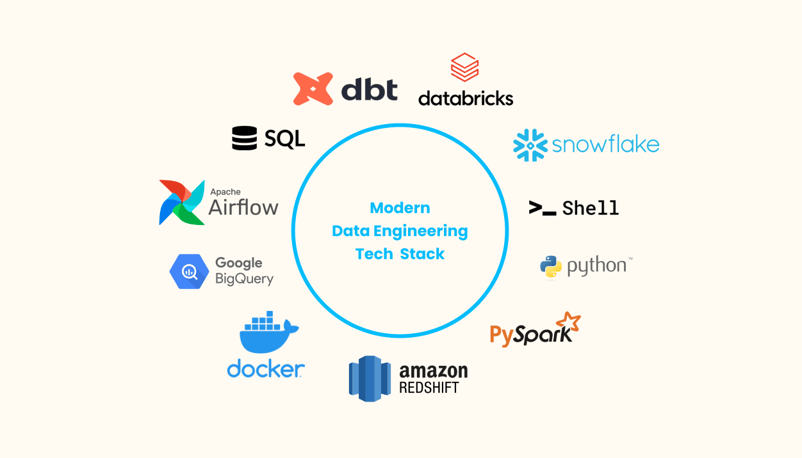
The modern data engineering tech stack is continuously growing along with the size and complexity of organizational datasets.
With the rise of big data, companies are looking for professionals who can not only collect and process data, but also store and manage it efficiently in the cloud data warehouses. Specifically, Google BigQuery, Snowflake, and Amazon Redshift.
Although possessing Python and SQL knowledge is essential, a data engineer should also have hands-on experience with cloud data warehouse intricacies, such as SQL dialect, data types, scaling options, and more.
On top of the Data Engineer with Python career track, which already offers a comprehensive path to gaining foundational data engineering skills, we are happy to announce the new Exploring London’s Travel Network Project available to practice Snowflake, Google BigQuery, and Amazon Redshift skills.
Inside Exploring London’s Travel Network Project
Over 1.5 million daily journeys are made across the extensive Transport for London (TFL) network.
With such a high volume of commuters, tourists, and residents on the move each day—how do most Londoners get around?
In this introductory Exploring London’s Travel Network Project, you will write SQL queries to find the most popular transport methods, examine peak hours, and identify rare periods when the Underground (known as "the tube" to locals) was less busy. Plus, you can interact directly with the modern cloud data warehouses–choose between Snowflake, BigQuery, or Redshift or complete all three project variations.

If you completed other DataCamp projects before, you should be familiar with DataLab, DataCamp's our modern data science notebook in the cloud.
DataLab provides seamless integrations with the most popular SQL databases and cloud warehouses and saves you hours on configurations and setup. Furthermore, you can accelerate your learning with DataLab AI Assistant, which could suggest best practices for writing SQL code and help fix errors.
If you want to explore working with cloud warehouses beyond the project's scope, head over to DataLab and practice your skills with preconfigured sample data integrations.









The modern data engineering tech stack is continuously growing along with the size and complexity of organizational datasets.
With the rise of big data, companies are looking for professionals who can not only collect and process data, but also store and manage it efficiently in the cloud data warehouses. Specifically, Google BigQuery, Snowflake, and Amazon Redshift.
Although possessing Python and SQL knowledge is essential, a data engineer should also have hands-on experience with cloud data warehouse intricacies, such as SQL dialect, data types, scaling options, and more.
On top of the Data Engineer with Python career track, which already offers a comprehensive path to gaining foundational data engineering skills, we are happy to announce the new Exploring London’s Travel Network Project available to practice Snowflake, Google BigQuery, and Amazon Redshift skills.
Inside Exploring London’s Travel Network Project
Over 1.5 million daily journeys are made across the extensive Transport for London (TFL) network.
With such a high volume of commuters, tourists, and residents on the move each day—how do most Londoners get around?
In this introductory Exploring London’s Travel Network Project, you will write SQL queries to find the most popular transport methods, examine peak hours, and identify rare periods when the Underground (known as "the tube" to locals) was less busy. Plus, you can interact directly with the modern cloud data warehouses–choose between Snowflake, BigQuery, or Redshift or complete all three project variations.
If you completed other DataCamp projects before, you should be familiar with DataLab, DataCamp's our modern data science notebook in the cloud.
DataLab provides seamless integrations with the most popular SQL databases and cloud warehouses and saves you hours on configurations and setup. Furthermore, you can accelerate your learning with DataLab AI Assistant, which could suggest best practices for writing SQL code and help fix errors.
If you want to explore working with cloud warehouses beyond the project's scope, head over to DataLab and practice your skills with preconfigured sample data integrations.