ข้ามไปยังเนื้อหาหลัก

Invertible Matrix: Definition, Properties, and Examples

Learn what an invertible matrix is, how to determine if a matrix is invertible, and why matrix inverses matter in linear algebra and data science.
11 ส.ค. 2569  · 5 นาที อ่าน

สำรวจด้วย AI

ChatGPTClaudePerplexity

Some matrices behave like numbers that can be divided, as the transformation can be “undone” by multiplication with another matrix. Thus, an invertible matrix is a square matrix that has an inverse matrix, called its inverse.

This property is fundamental in solving systems of linear equations, for example, where the inverse allows for a direct computation of the unknown variables of that system.

In the following sections, I will be presenting the precise definitions, the conditions of invertibility, the main properties, the computational methods, and, of course, many concrete examples.

What Is an Invertible Matrix?

A square matrix A of dimensions n×n is invertible if there exists another n×n matrix B such that 

A B = B A = I

Where I is the identity matrix of the same size (n×n). The matrix B is denoted A-1 (almost like A to the power of -1) and is called the inverse of A. 

It is very important to note that only square matrices can be invertible and that non-square matrices have no inverse. This originates from the fact of bijectivity in linear algebra. But for the sake of the intuitiveness of this article, we will stay satisfied with this simple rule.

What Is the Identity Matrix?

The identity matrix I is the square matrix that acts as the multiplicative identity in matrix algebra. Thus, multiplying any compatible matrix by I leaves it unchanged. You can think of it as a neutral transformation, or more rigorously speaking, an identity transformation.

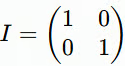
For the 2x2 case, it is:

$   I = \begin{pmatrix} 1 & 0 \\ 0 & 1 \end{pmatrix}.   $

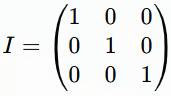
A 3x3 example is

$   I = \begin{pmatrix} 1 & 0 & 0 \\ 0 & 1 & 0 \\ 0 & 0 & 1 \end{pmatrix}.   $

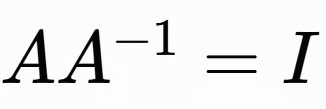
The defining relation is 

$  A A^{-1} = I  $

This shows that multiplying A by its inverse returns the system to this neutral starting point. Although matrix multiplication is not commutative in general, in this particular case the order doesn't matter: AA−1 = A−1A , because A and A⁻¹ are defined as inverses of one another.

Conditions for a Matrix to Be Invertible

A square matrix A is invertible precisely when it satisfies three equivalent conditions:

  • Its determinant is nonzero. That is, det(A)≠0
  • Its rows or columns are linearly independent, so no column/row vector is colinear with another column/row vector.
  • It has a full rank equal to its dimension n.

If any of these fails, no inverse exists.

Determinant and Invertibility

The determinant provides a direct numerical test. Therefore, if det(A)=0, then the rank of A is strictly less than the number of dimensions, thus the transformation described by A collapses in at least one dimension, which alone makes it impossible to retrieve the inverse transformation of A, which formally means that A has no inverse.

If det(A) is non-zero, then an inverse exists and can be computed. This equivalence holds for every square matrix and requires no further derivation for practical purposes. Intuitively, you can think of the determinant as a scalar that represents how A scales the volume of the space.

Therefore, a magnitude |det(A)| > 1 means that A expands the space, a negative determinant means that A reverses the orientation of the space, for |det(A)| < 1, A contracts the space, and naturally, a null determinant means that the transformation described by A reduces the dimensionality of that space (like collapsing two axes together).

Invertible vs. Non-Invertible (Singular) Matrices

A matrix that possesses an inverse is called invertible (or nonsingular). A matrix with no inverse is called singular.

Property

Invertible Matrix

Singular Matrix

Determinant

det(A) ≠ 0

det(A)=0

Rank

rank(A)=n

Rank(A)<n

Rows/columns

Linearly independent

At least one linear dependence

Solution to Ax=b

Exactly one solution

No solution or infinitely many

How to Find the Inverse of a Matrix

Two standard manual methods exist, plus a direct computation in software.

2×2 Matrix Formula

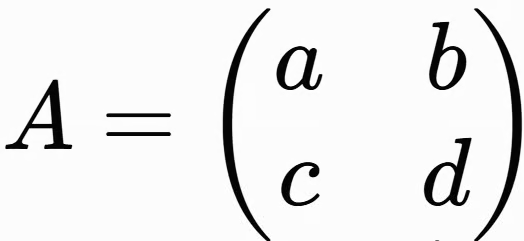
For

$  A = \begin{pmatrix} a & b \\ c & d \end{pmatrix}  $

With det(A)=ad-bc≠0,

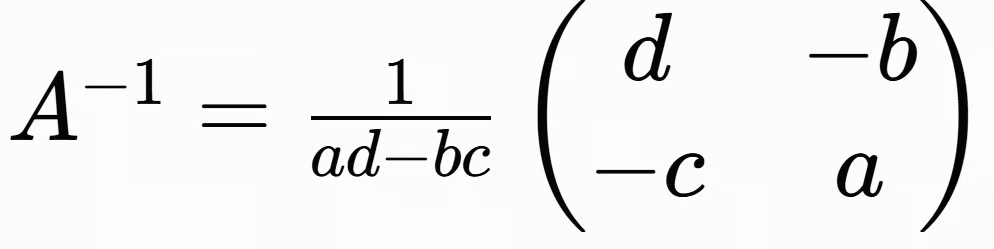
$   A^{-1} = \frac{1}{ad-bc} \begin{pmatrix} d & -b \\ -c & a \end{pmatrix}.   $

Row Reduction (Gauss-Jordan)

Form the augmented matrix [A| I] and apply elementary row operations until the left half becomes I. The right half then contains A-1.

Using Software (Python, etc.)

In Python with NumPy, the inverse is obtained by numpy.linalg.inv(A) after confirming that det(A) ≠ 0.

Example of an Invertible Matrix

Consider the 2x2 matrix:

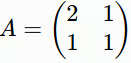
$   A = \begin{pmatrix} 2 & 1 \\ 1 & 1 \end{pmatrix}.   $

First, compute the determinant:

$   \det(A) = 2 \cdot 1 - 1 \cdot 1 = 1 \neq 0.   $

Thus, A is invertible. Applying the 2x2 formula gives us:

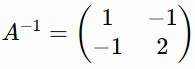
$   A^{-1} = \begin{pmatrix} 1 & -1 \\ -1 & 2 \end{pmatrix}.   $

Let’s verify our obtained results now:

$   A A^{-1} = \begin{pmatrix} 2 & 1 \\ 1 & 1 \end{pmatrix} \begin{pmatrix} 1 & -1 \\ -1 & 2 \end{pmatrix} = \begin{pmatrix} 1 & 0 \\ 0 & 1 \end{pmatrix} = I.   $

The same holds for A-1A.

Why Invertible Matrices Matter

Invertible matrices are required whenever a linear transformation must be reversed exactly. In linear systems, they guarantee a unique solution. In machine learning, they appear in the normal equations of ordinary least squares, like when the design matrix has a full column rank.

Another example would be in computer graphics, as they represent reversible transformations such as rotations, scalings, and translations that must be undone for rendering or animation. They also appear in physics for solving a system of ordinary differential equations, for example, and they have many, many other day-to-day use cases.

Invertible Matrices and Linear Systems

A system of linear equations can be written compactly as Ax=b, where A is called the coefficient matrix, x the vector of unknowns, and b the constant vector. If A is invertible, the unique solution is obtained directly by

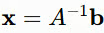
$   \mathbf{x} = A^{-1} \mathbf{b}.   $

No other solution, in this case, satisfies the equation.

Common Mistakes with Invertible Matrices

These are one of the most frequent mistakes people stumble upon:

  • Assuming every square matrix is invertible.
  • Neglecting to check the determinant before attempting inversion.
  • Confusing the inverse with the transpose (they coincide only for certain orthogonal matrices).
  • Treating a singular matrix as invertible and obtaining meaningless or unstable results in numerical computations.

Key Properties of Invertible Matrices

These are the main properties of invertible matrices within the scope of this article:

Let A and B be invertible n×n matrices. Then:

The inverse is unique.

The product AB is invertible and 

$  (AB)^{-1} = B^{-1} A^{-1}  $

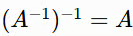
The inverse of the inverse is the original matrix:

$  (A^{-1})^{-1} = A  $

The determinant of the inverse is the reciprocal: 

$  \det(A^{-1}) = 1 / \det(A)  $

The transpose of the inverse equals the inverse of the transpose: 

$  (A^{-1})^T = (A^T)^{-1}  $

Conclusion

An invertible matrix is a square matrix that has a unique inverse that satisfies A.A-1 = I.

The decisive tests are a nonzero determinant and linear independence of the rows or columns. These properties are the sole indicators that the linear system has exactly one solution and that the linear transformation can be reversed exactly.

If you master invertible matrices, solving systems of linear equations would be extremely handy. Not only that, but you will be able to build reliable models in data science or perform exact computations in any field that relies on linear algebra.


Iheb Gafsi's photo
Author
Iheb Gafsi
LinkedIn

I work on accelerated AI systems enabling edge intelligence with federated ML pipelines on decentralized data and distributed workloads.  My work focuses on Large Models, Speech Processing, Computer Vision, Reinforcement Learning, and advanced ML Topologies.

Invertible Matrix FAQs

What is an invertible matrix?

An invertible matrix is a square matrix that has another matrix called its inverse. Multiplying the original matrix by its inverse produces the identity matrix, which acts like the number 1 in ordinary arithmetic.An invertible matrix is a square matrix that has another matrix called its inverse. Multiplying the original matrix by its inverse produces the identity matrix, which acts like the number 1 in ordinary arithmetic.

How do I know if a matrix is invertible?

A square matrix is invertible only if its determinant is not zero and its rows or columns are linearly independent. These two tests are equivalent and confirm that the matrix has full rank.

What is a singular matrix?

A singular matrix is a square matrix with no inverse. Its determinant equals zero, and at least one row or column is a linear combination of the others, so it cannot be undone by multiplication.

Why are invertible matrices important?

They guarantee a unique solution when solving systems of linear equations and are essential in data science for tasks like linear regression, in computer graphics for reversible transformations, and in any field that requires exact reversal of linear operations.

Can non-square matrices be invertible?

Only square matrices can have an inverse. Non-square matrices lack the matching dimensions needed for the product to equal the identity matrix.

หัวข้อ

Learn with Datacamp

Courses

การอนุมานสำหรับการถดถอยเชิงเส้นใน R

4 ชม.
16.1K
เรียนรู้การทำ inference ด้วย linear models ในหลักสูตรนี้
ดูรายละเอียดRight Arrow
เริ่มหลักสูตร

Courses

พีชคณิตเชิงเส้นสำหรับ Data Science ใน R

4 ชม.
21.3K
หลักสูตรนี้เป็นบทนำสู่พีชคณิตเชิงเส้น หนึ่งในหัวข้อคณิตศาสตร์ที่สำคัญที่สุดซึ่งเป็นพื้นฐานของวิทยาการข้อมูล
ดูเพิ่มเติมRight Arrow
ที่เกี่ยวข้อง

Tutorials

Singular Matrix: Key Concepts and Examples in Data Science

Learn about singular matrices, their properties, detection methods, and critical implications for machine learning and numerical computing.
Arunn Thevapalan's photo

Arunn Thevapalan

Tutorials

Orthogonal Matrix: An Explanation with Examples and Code

Learn about orthogonal matrices with practical examples and real-world applications in linear algebra and data science.
Arunn Thevapalan's photo

Arunn Thevapalan

Tutorials

Matrix Diagonalization: A Comprehensive Guide

Understand when and how matrices can be diagonalized, and why it matters for data science and computational linear algebra.
Arunn Thevapalan's photo

Arunn Thevapalan

Tutorials

Characteristic Equation: Everything You Need to Know for Data Science

Understand how to derive the characteristic equation of a matrix and explore its core properties. Discover how eigenvalues and eigenvectors reveal patterns in data science applications. Build a solid foundation in linear algebra for machine learning.
Vahab Khademi's photo

Vahab Khademi

Tutorials

Affine Transformation Explained: Properties and Applications

Learn about the definition, formula, key properties, homogeneous coordinates, and applications of affine transformations in graphics, computer vision, robotics, and data preprocessing.
Vikash Singh's photo

Vikash Singh

Tutorials

What Is a Linear Function? A Guide with Examples

Get formal and intuitive definitions of linear functions. Understand how to spot them with real-world scenarios.
Iheb Gafsi's photo

Iheb Gafsi

ดูเพิ่มเติมดูเพิ่มเติม