
Khóa học
AI thực chiến với Google Gemini và NotebookLM
2 giờ
10.1K
Lưu ý: Gần đây Google đã công bố Gemini 3.8 Flash và 3.8 Flash Cyber. Xem bản demo trong hướng dẫn API Gemini 3.8 Flash của chúng tôi.
Hôm nay Google phát hành ba mô hình Gemini với cùng một mục tiêu: làm được nhiều hơn với ít token hơn:
3.6 Flash là bản nâng cấp đa dụng. Flash-Lite đánh đổi chất lượng lấy tốc độ và giá. Cyber là công cụ bảo mật chuyên biệt mà đa số người dùng sẽ không được truy cập.
Bên dưới: từng mô hình thực sự làm gì, các điểm chuẩn có đứng vững không, và Gemini 3.5 Pro nằm ở đâu trong bức tranh này.
Mỗi mô hình nằm ở một điểm khác nhau trên đường cong chi phí - năng lực. Nếu bạn chọn dựa theo kết quả điểm chuẩn, hãy kéo xuống; phần điểm chuẩn ở bên dưới.
Gemini 3.6 Flash là tâm điểm của đợt phát hành. Đây là mô hình Google muốn bạn mặc định dùng cho lập trình, công việc tri thức và mọi thứ đa phương tiện.
Theo Artificial Analysis Index, 3.6 Flash cắt giảm 17% lượng token đầu ra so với 3.5 Flash, và Google báo cáo mức giảm lên tới 65% ở một số bài đánh giá riêng lẻ như DeepSWE. Một phần là do mô hình thông minh hơn nên nói ít hơn. Phần còn lại đến từ việc đi đến kết luận qua ít bước suy luận và lời gọi công cụ hơn — một kiểu hiệu quả khác và khó “giả” hơn.
3.6 Flash nhận đầu vào văn bản, hình ảnh, video, âm thanh và PDF, chạy cửa sổ ngữ cảnh 1 triệu token với trần đầu ra 64k. Khả năng dùng máy tính nay đã tích hợp trong cả Gemini API và Gemini Enterprise, cùng với gọi hàm, đầu ra có cấu trúc và tìm kiếm như một công cụ. (Dù có lẽ đây không còn là điểm riêng của 3.6 Flash nữa; hầu hết các phòng thí nghiệm tiên phong hiện đều cung cấp biến thể nào đó của “dùng máy tính”.)
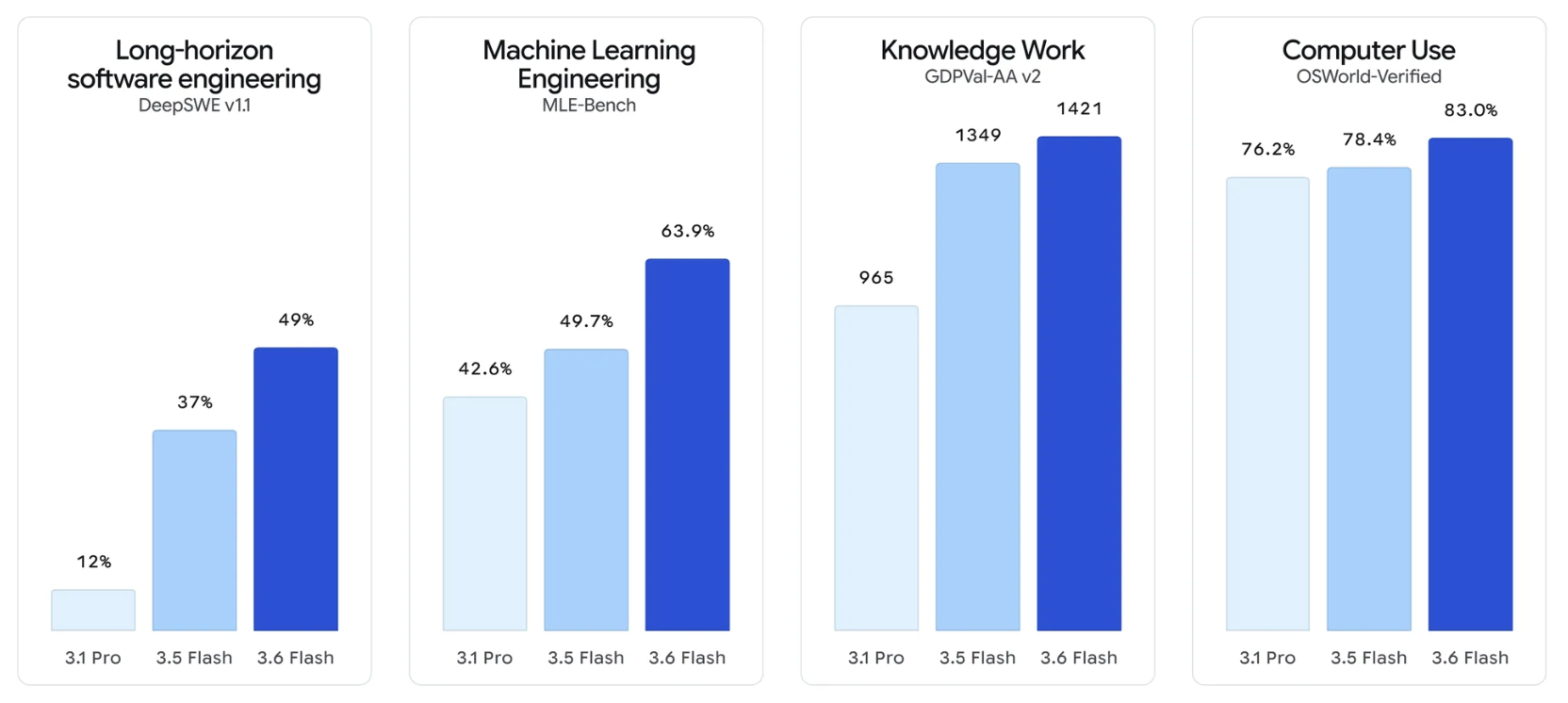
So với phiên bản tiền nhiệm, mức nhảy vọt là thật ở gần như mọi nơi: DeepSWE gần như tăng gấp đôi, MLE-Bench từ 49,7% lên 63,9%, hiệu năng ngữ cảnh dài trên GDM-MRCR v2 cải thiện hai chữ số.
3.5 Flash-Lite không cố trở thành mô hình thông minh nhất trong dàn. Đây là mô hình nhanh nhất, ở mức 350 token đầu ra mỗi giây, và rẻ nhất, ở mức $0,30 mỗi triệu token đầu vào và $2,50 mỗi triệu token đầu ra.
Nếu khối lượng công việc của bạn lớn và nhạy trễ — như tìm kiếm dạng tác tử, xử lý tài liệu hàng loạt, hay bất kỳ thứ gì chạy hàng nghìn lần mỗi ngày — thì khoảng cách chất lượng mà các mô hình khác mang lại có lẽ không xứng với chi phí để san bằng nó. Đó chính là “cửa cược” của Flash-Lite.
Nhà phát triển có thể điều chỉnh mức độ “suy nghĩ” theo từng tác vụ: tối thiểu hoặc thấp cho thực thi rẻ, nhanh, lưu lượng cao; hoặc cao hơn cho công việc đa bước kiểu phân tác tử phụ thực sự cần suy luận.
So với người tiền nhiệm 3.1 Flash-Lite, chênh lệch là rất lớn: Terminal-Bench 2.1 từ 31% lên 54%, GDM-MRCR v2 từ 60,1% lên 72,2%, GDPVal-AA v2 từ 642 lên 1140.
| Điểm chuẩn | Gemini 3.5 Flash-Lite | Gemini 3.1 Flash-Lite |
|---|---|---|
| Terminal-Bench 2.1 | 54% | 31% |
| GDM-MRCR v2 (ngữ cảnh dài) | 72,2% | 60,1% |
| GDPVal-AA v2 (Elo) | 1140 | 642 |
Thực ra, so sánh thú vị hơn là theo hướng đi lên. Ở vài bài đánh giá về tác tử và lập trình, 3.5 Flash-Lite nay vượt hẳn Gemini 3 Flash cũ, lớn hơn — SWE-Bench Pro (54,2% so với 49,6%), OSWorld-Verified (74,0% so với 65,1%). Nếu điều đó đúng với khối lượng công việc của bạn, đây là cách cắt giảm chi phí thẳng thắn mà không đánh đổi chất lượng.
Cuối cùng là Cyber, thứ mà đa số người đọc bài này sẽ không bao giờ chạm tay vào. Đây là 3.5 Flash được tinh chỉnh đặc biệt để tìm và vá lỗ hổng bảo mật, triển khai trong hệ thống CodeMender của Google, nơi nhiều tác tử mô hình Cyber phối hợp và trả về một báo cáo tổng hợp.
Google nói mô hình này có tính cạnh tranh với các mô hình quy mô tiền tuyến trên CyberGym, một bộ điểm chuẩn an ninh mạng được dùng rộng rãi, dù kích thước nhỏ hơn — nếu đúng như vậy, đây có lẽ là câu chuyện hiệu suất đáng chú ý nhất trong cả đợt phát hành.
Quyền truy cập bị giới hạn cho chính phủ và đối tác tin cậy thông qua chương trình thử nghiệm của CodeMender. Chưa công bố giá, chưa có ngày phát hành chung.
Dưới đây là tóm tắt kết quả điểm chuẩn. Tôi cũng đưa vào thông tin giá — yếu tố quan trọng khi lựa chọn.
| Điểm chuẩn | Gemini 3.6 Flash | Gemini 3.5 Flash | Gemini 3.1 Pro | GPT-5.6 Luna | Grok 4.5 | Claude Sonnet 5 |
|---|---|---|---|---|---|---|
| Giá đầu vào ($/1M) | $1.50 | $1.50 | $2.00 | $1.00 | $2.00 | $3.00 |
| Giá đầu ra ($/1M) | $7.50 | $9.00 | $12.00 | $6.00 | $6.00 | $15.00 |
| SWE-Bench Pro | 58,7% | 55,1% | 54,2% | 62,7% | 64,7% | 63,2% |
| DeepSWE v1.1 | 49% | 37% | 12% | 67% | 54% | 54% |
| Terminal-Bench 2.1 | 78,0% | 76,2% | 73,8% | 84,7% | 83,3% | 80,4% |
| MLE-Bench | 63,9% | 49,7% | 42,6% | 47,6% | 43,2% | 66,9% |
| OSWorld-Verified | 83,0% | 78,4% | 76,2% | 72,6% | — | 81,2% |
| GDPVal-AA v2 (Elo) | 1421 | 1349 | 965 | 1584 | 1535 | 1607 |
| CharXiv Reasoning (không công cụ) | 85,2% | 84,2% | 83,3% | 82,7% | 81,6% | 77,0% |
| GDM-MRCR v2, 128k | 91,8% | 77,3% | 84,9% | 74,8% | 81,4% | 71,6% |
So với đối thủ bên ngoài, kết quả là “hòa có phân”. GPT-5.6 Luna và Grok 4.5 dẫn đầu ở các điểm chuẩn nặng về lập trình — SWE-Bench Pro, DeepSWE — và đó là khoảng cách thực sự nếu khối lượng công việc của bạn thực sự nặng về lập trình chứ không chỉ cận kề lập trình.
Claude Sonnet 5 dẫn đầu ở công việc tri thức và MLE-Bench.
Nơi 3.6 Flash thực sự thắng là truy xuất ngữ cảnh dài và suy luận dựa trên biểu đồ, với biên độ đủ lớn để không còn sát nút, và mức giá đầu ra thấp hơn mọi mô hình trong danh sách trừ GPT-5.6 Luna và Grok 4.5.
3.6 Flash và 3.5 Flash-Lite đã khả dụng — Gemini API, Google AI Studio, Android Studio, và riêng 3.6 Flash còn có trong Google Antigravity. Khách hàng doanh nghiệp có cả hai qua Gemini Enterprise Agent Platform, với 3.6 Flash cũng có trong ứng dụng Gemini Enterprise. Về phía người dùng, cả hai đều có trong ứng dụng Gemini, và Flash-Lite bắt đầu xuất hiện trong Chế độ AI của Google Tìm kiếm.
Giá, nếu bạn kéo xuống để xem:
3.6 Flash đi kèm những gì Google gọi là biện pháp an toàn Frontier tăng cường quanh việc lạm dụng CBRN và tấn công mạng — ngôn ngữ tiêu chuẩn cho “chúng tôi cố làm cho jailbreak khó hơn mà không khiến mô hình gây khó chịu khi dùng”, một cân bằng mà phòng lab nào cũng nói là đạt được nhưng bình luận trên X thì thường kể câu chuyện khác.
Việc triển khai hạn chế của Cyber thực chất là cùng bản năng nhưng áp dụng khác: thay vì cố tinh chỉnh an toàn một mô hình săn lỗ hổng để phát hành rộng rãi, Google đơn giản là không phát hành rộng rãi.
3.5 Pro vẫn đang thử nghiệm với đối tác, Google nói sẽ khả dụng rộng rãi khi sẵn sàng.
Đáng chú ý hơn, Google xác nhận đã bắt đầu tiền huấn luyện Gemini 4, gọi đây là lần tiền huấn luyện tham vọng nhất từ trước đến nay. Để cập nhật tin tức AI mới nhất, hãy đăng ký nhận bản tin The Median của chúng tôi; chúng tôi sẽ thông báo cho bạn về những lần ra mắt mô hình quan trọng như thế này.
Không mô hình nào trong ba mô hình này cố đứng đầu mọi bảng xếp hạng, và có lẽ đó là lựa chọn đúng. 3.6 Flash nhường chỗ cho GPT-5.6 Luna và Grok 4.5 ở các điểm chuẩn lập trình, và cho Claude Sonnet 5 ở công việc tri thức, để đổi lấy cú nhảy hiệu suất thực sự so với người tiền nhiệm và lợi thế rõ rệt ở truy xuất ngữ cảnh dài.
3.5 Flash-Lite thậm chí không cố cạnh tranh về chất lượng. Mô hình đặt cược rằng với một phần lớn khối lượng công việc theo kiểu tác tử, chất lượng vượt quá một ngưỡng nào đó sẽ không còn quan trọng bằng tốc độ và chi phí. Có lẽ điều đó đúng. Nhưng cũng là kiểu cược trông hiển nhiên đúng — cho đến khi một tác tử đưa ra quyết định sai mà một mô hình thông minh hơn đã không mắc phải.
Cyber thì chẳng nằm trên bảng xếp hạng nào. Đây là công cụ hẹp phục vụ một nhiệm vụ, chỉ mở cho những người Google tin tưởng sẽ dùng có trách nhiệm — điều này nói lên mức độ nghiêm túc của Google với rủi ro phát hiện lỗ hổng không kém gì phần an toàn ở trên.
Gộp lại, điều này giống Google đang tinh chỉnh toàn bộ tầng Flash cho các khối lượng công việc tác tử ở quy mô, trong khi giữ các mô hình thực sự tham vọng — 3.5 Pro, Gemini 4 — dự phòng cho đến khi sẵn sàng.
Học với DataCamp
Khóa học
Khóa học
Khóa học
blog
Matt Crabtree
10 phút
