Chuyển đến nội dung chính

Introducing the State of Data & AI Literacy Report 2025

Learn how 500+ business leaders are adapting their workforce's skills to generative AI.
9 thg 4, 2025  · 5 phút đọc

Download the State of Data & AI Literacy Report 2026

Based on a YouGov survey of 500+ enterprise leaders, find out how organizations are building data and AI skills—and why workforce readiness is emerging as a defining competitive advantage.

Download the Report

Explore the key takeaways from the 2025 edition of the State of Data & AI Literacy report, based on a survey of 500+ global leaders and expert insights from organizations like Colgate, BP, Rolls Royce, JPMorgan Chase, and more.

For the past two years, the State of Data Literacy Report has been a staple resource for understanding how data and AI literacy impact workforce readiness. This year is no different—except now, the conversation has grown in urgency. As AI moves from research labs into daily workflows, leaders are grappling with a new question: Is my team ready for the AI era?

In this year’s State of Data & AI Literacy Report, we surveyed 500+ leaders across the US and UK and drew insights from top thinkers in the industry and DataCamp for Business customers to explore the evolving data and AI skills landscape.

Below, you’ll find a summary of key insights from the report. But for the full picture—including deep dives, best practices, and expert commentary—we highly recommend downloading the full report.

Is AI Literacy Outpacing Data Literacy?

One of the biggest trends uncovered this year is the accelerating importance of AI literacy. While 86% of leaders still rank data literacy as essential for day-to-day work, a growing 69% say the same for AI literacy—a significant 7-point increase from last year.

In fact, when asked to identify the fastest-growing skills needed on their teams, AI literacy now matches business intelligence at the top of the list, surpassing data science and data literacy year-over-year. For executives, the emphasis on AI is even more pronounced.

But while AI is gaining momentum, it would be shortsighted to think of it in isolation. Data and AI literacy are deeply intertwined. Without a strong foundation in data—governance, interpretation, and analytical thinking—AI adoption risks becoming a surface-level trend. The report shows that organizations investing in both areas are better positioned to extract real value, avoid bias, and accelerate innovation.

The State of AI Adoption

Enterprise AI adoption is quickly shifting from early experimentation to real-world deployment. Only 9% of leaders report that no one in their organization uses AI—meaning, for the vast majority, AI is already integrated into workflows.

Tools like ChatGPT and Google Gemini dominate usage, while copilots and even custom-built AI solutions are gaining traction. AI is being used regularly: 82% of teams use AI at least once a week, and 39% use it daily.

Technical teams like IT, analytics, and R&D are leading adoption, but there remains a significant gap among business functions—including marketing, operations, sales, and finance. These are areas where AI has enormous potential to boost productivity, enhance decision-making, and personalize customer engagement.

While leaders report measurable gains in productivity, concerns remain around hallucinations, bias, and low-quality outputs. The message is clear: AI adoption is here, but responsible, effective usage depends on skills.

Download the State of Data & AI Literacy Report 2025

Learn how 500+ business leaders are adapting their workforce's skills to generative AI.

Download the Report

The Data and AI Skills Agenda

Over the past two years, the enterprise skills agenda has matured. Organizations have moved from ad-hoc initiatives to structured programs that reflect a growing urgency to close the data and AI skills gap.

The numbers tell a clear story. 46% of leaders now report having a mature, organization-wide data literacy program, up from 35% last year. AI training has seen even greater growth—43% of organizations now offer mature AI upskilling, nearly doubling from 25% in 2024. Meanwhile, the number of organizations offering no training at all continues to decline. 

However, challenges remain. Budget constraints, employee resistance, lack of executive support, and difficulty measuring ROI continue to stall progress. Many leaders also cite a lack of interactivity and personalization in existing training resources, making it harder to drive real engagement and skill retention. The report highlights that while the infrastructure for upskilling is improving, the need for more tailored, outcome-oriented approaches is greater than ever.

Five Lessons for Building Effective Data & AI Literacy

In the previous section, we uncovered the biggest challenges to scaling skills across the enterprise—from budget limitations to lack of ownership and employee resistance. To better understand how organizations can overcome these challenges, we turned to the experience of DataCamp for Business customers—those leading the way in workforce upskilling.

Here are five key lessons drawn from their success:

  1. Align Learning with Business Objectives: Rather than focusing solely on tools or technologies, organizations must link learning outcomes to tangible business goals—like automating reporting or accelerating product development. This outcome-based approach helps justify investment and ensures training drives impact.
  2. Treat Upskilling as a Change Management Initiative: Resistance to AI and data training often stems from uncertainty. The most successful programs treat communication like a product launch—using champions, internal events, and storytelling to build trust and engagement from day one.
  3. Make Learning Interactive and Practical: Passive video-based learning is not enough. The report shows that active, hands-on experiences—especially ones that mirror real business tasks—drive better retention and application of skills across technical and non-technical teams.
  4. Connect Data & AI Literacy as One Continuum: Rather than treat data and AI skills as separate programs, organizations should embrace their interdependence. The most mature teams integrate both into a single roadmap, recognizing that AI fluency builds on a solid foundation in data.

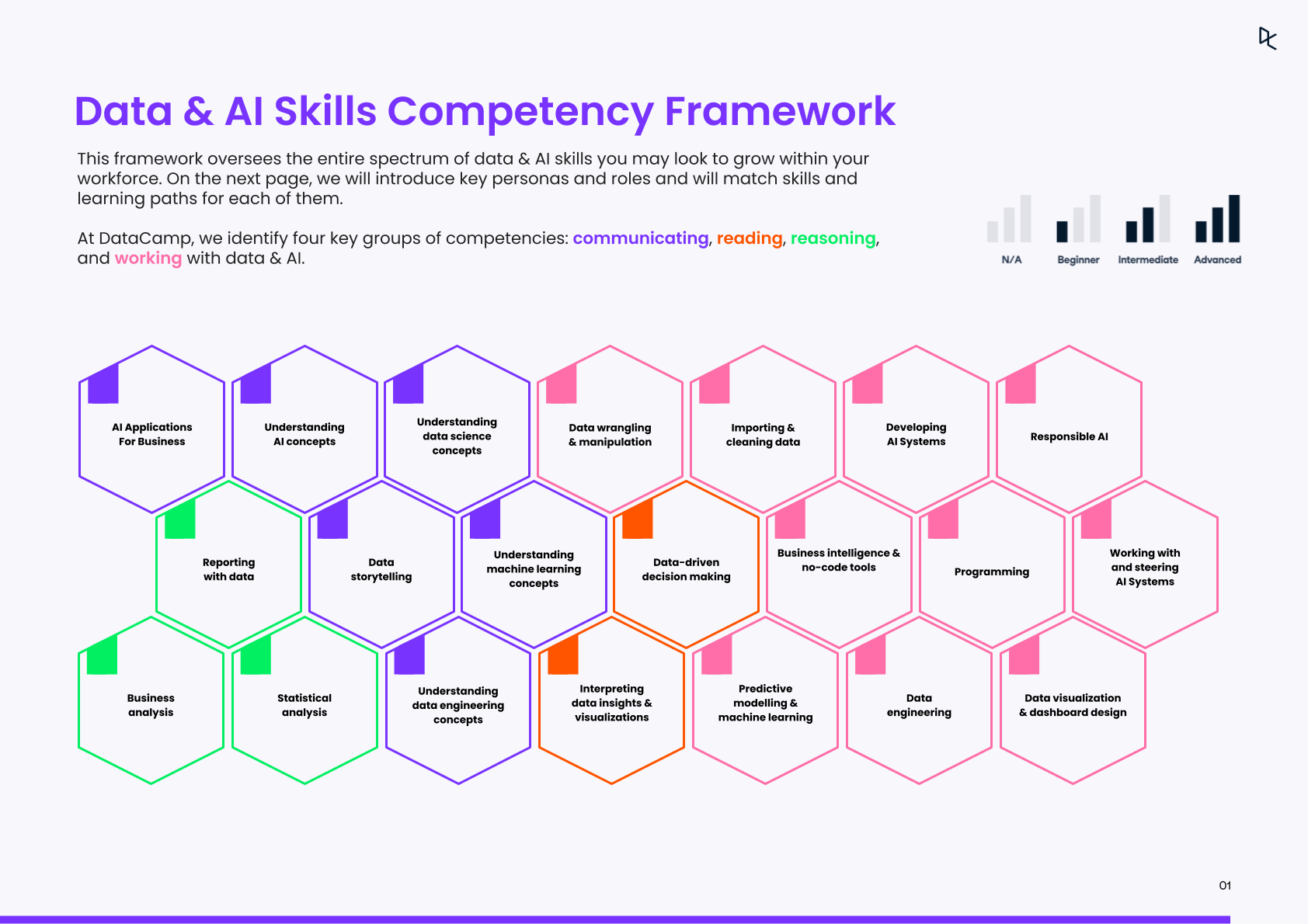
Personalize Learning at Scale: Roles and responsibilities vary widely. A one-size-fits-all approach doesn’t work. The report recommends creating learning personas across departments to tailor content and ensure relevance—from marketing to finance to engineering. We also recommend checking out our data and AI competency framework, updated for 2025.

A free, editable version of our data competency framework is included in the report

A free, editable version of our data competency framework is included in the report 

What’s Next?

The State of Data & AI Literacy Report 2025 is a clear call to action: in a world increasingly shaped by artificial intelligence, skills are the greatest differentiator. Organizations that invest in data and AI literacy today are better equipped to innovate, compete, and grow responsibly.

We’ve only scratched the surface here. Download the full report to explore the data, frameworks, and strategies shaping the future of the AI-powered workforce.

Download the State of Data & AI Literacy Report 2025

Learn how 500+ business leaders are adapting their workforce's skills to generative AI.

Chủ đề

Continue your Data and AI skills journey today

Tracks

Lãnh đạo trong lĩnh vực Trí tuệ Nhân tạo (AI)

6 giờ
Nâng cao kỹ năng lãnh đạo trong lĩnh vực Trí tuệ Nhân tạo (AI) thông qua chương trình này: Tối ưu hóa doanh thu từ AI, xây dựng niềm tin thông qua AI có trách nhiệm và có thể giải thích được, và bảo vệ các sáng tạo của bạn. Hãy dẫn dắt với sự tự tin!
Xem chi tiếtRight Arrow
Bắt đầu khóa học
Xem thêmRight Arrow
Có liên quan

blogs

Introducing The State of Data & AI Literacy Report 2024

Explore the key takeaways from the 2024 State of Data & AI Literacy report, including key statistics and opinions from data & AI thought leaders
DataCamp Team's photo

DataCamp Team

3 phút

blogs

The State of Data and AI Literacy in 2026: Definitions, Statistics, and the AI Skills Gap

88% of enterprise leaders say basic data literacy is essential for day-to-day work. 72% say the same for AI literacy. Yet nearly 60% report a skills gap in their organization.
Lynn Heidmann's photo

Lynn Heidmann

5 phút

blogs

Introducing The State of Data Literacy Report 2023

Explore the key takeaways from our State of Data Literacy report, including essential stats, insights, and opinions from business leaders.
Matt Crabtree's photo

Matt Crabtree

5 phút

blogs

The Role of AI in Technology: How Artificial Intelligence is Transforming Industries

Discover the power of AI in technology, from software development to healthcare. Learn how businesses are using AI and why upskilling in AI literacy is crucial.
Javier Canales Luna's photo

Javier Canales Luna

10 phút

blogs

What is Data Literacy? A 2026 Guide for Data & Analytics Leaders

Discover the importance of data literacy in today's data-driven world.
Matt Crabtree's photo

Matt Crabtree

15 phút

blogs

AI Talent Shortages: How to Build AI Literacy in Your Business

Discover innovative strategies to enhance AI literacy for your teams to bridge the AI talent gap.
Javier Canales Luna's photo

Javier Canales Luna

13 phút

Xem thêmXem thêm