学习路径
开发 AI 应用程序
21 小时
LLM 功能强大,但在需要速度的场景中,它们往往有些慢,这并不理想。推测解码是一种在不牺牲质量的前提下,加快 LLM 生成响应速度的技术。
本质上,它是在文本生成过程中进行“超前猜测”,提前预测可能出现的下一个词,同时仍然保证我们对 LLM 的准确性和深度预期。
在本文中,我将解释什么是推测解码、它如何工作,以及如何在 Gemma 2 模型上实现它。
推测解码通过引入一个更小、更快的模型来生成初步预测,从而加速 LLM。这个较小的模型通常被称为“草稿”模型,会一次性生成一批 token,供主要、更强大的 LLM 确认或修正。草稿模型相当于第一遍生成,产生多个 token,以加速生成过程。
与其让主 LLM 逐个顺序生成 token,不如由草稿模型提供一组可能的候选,主模型并行评估它们。这种方法将初始预测的计算负载转移到主 LLM 之外,使其只需专注于纠正或验证。
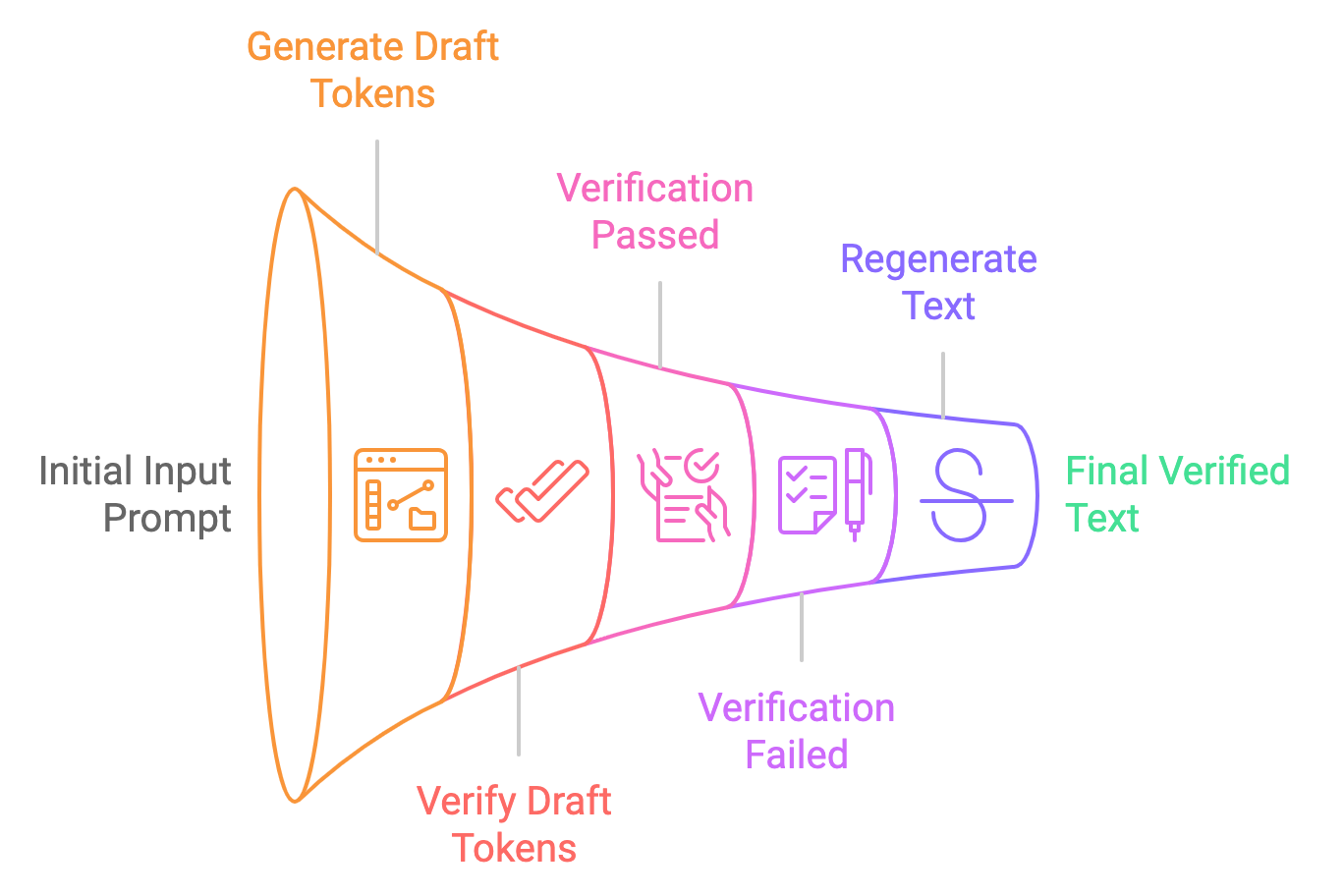
可以把它想象成作家与编辑的配合。主 LLM 就像作家,能产出高质量文本,但速度较慢。更小、更快的“草稿”模型像编辑,能迅速给出可能的续写建议。主 LLM 随后评估这些建议,采纳准确的部分,舍弃其余。这样 LLM 就能并行处理多个 token,从而加快文本生成。
我们把推测解码流程拆解为几个简单步骤:
传统解码逐个处理 token,延迟较高;推测解码则先由小模型批量生成 token,再由大模型验证。这可以将响应时间降低 30–40%,把延迟从 25–30 秒缩短至约 15–18 秒。
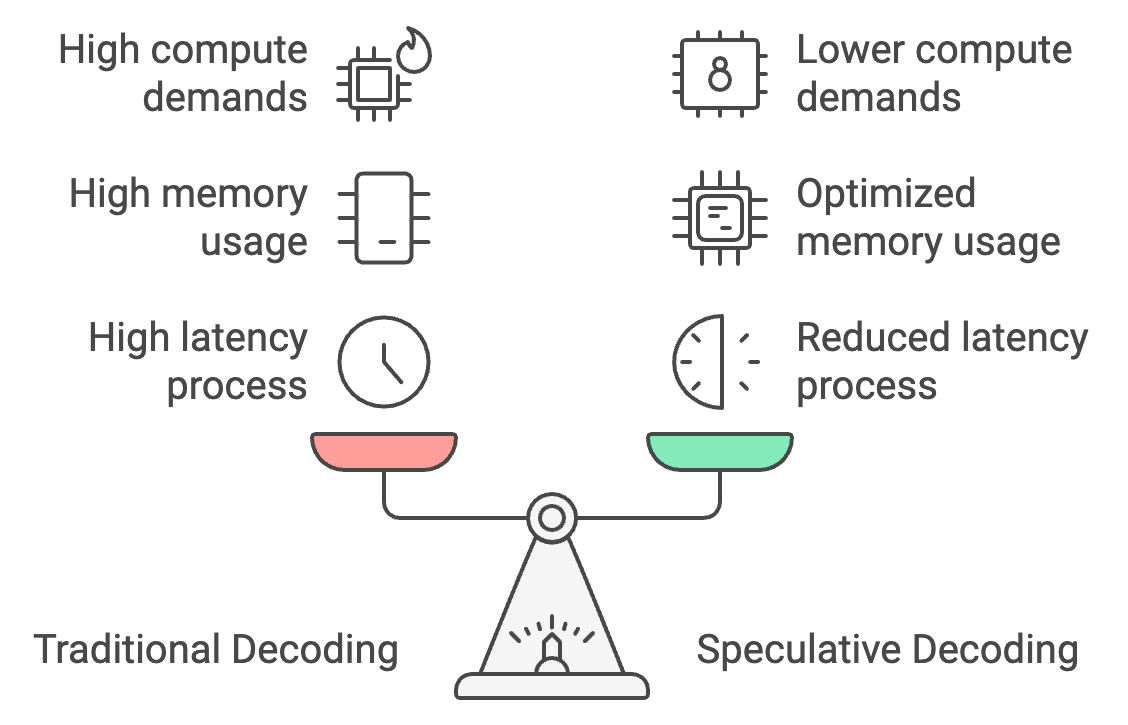
此外,推测解码通过将大部分 token 生成转移给小模型来优化内存使用,将内存需求从 26 GB 降至约 14 GB,使端侧推理更易实现。
最后,它可将算力需求降低 50%,因为大模型只需验证而非生成 token,从而在算力受限的移动设备上也能更流畅地运行,并避免过热。
下面用 Gemma2 模型实现一个推测解码的动手示例。我们将从延迟和性能两方面比较推测解码与标准推理。
首先,导入依赖并设置随机种子。
接着,检查您所使用的机器是否可用 GPU。对于 Gemma 2-9B-it 或 LLama2-13B 等大模型,这一点尤为重要。
最后,加载大小两个模型及其分词器。此处我们使用 Gemma2-2b-it(instruct)作为草稿模型,Gemma2-9b-it 作为验证模型。
也有其他可替代的组合,例如:
import torch
from transformers import AutoTokenizer, AutoModelForCausalLM, set_seed

# Set Seed
set_seed(42)

# Check if GPU is available
device = "cuda" if torch.cuda.is_available() else "cpu"

# Load the smaller Gemma2 model (draft generation)
small_tokenizer = AutoTokenizer.from_pretrained("google/gemma-2-2b-it", device_map="auto")
small_model = AutoModelForCausalLM.from_pretrained("google/gemma-2-2b-it", device_map="auto", torch_dtype=torch.bfloat16)

# Load the larger Gemma2 model (verification)
big_tokenizer = AutoTokenizer.from_pretrained("google/gemma-2-9b-it", device_map="auto")
big_model = AutoModelForCausalLM.from_pretrained("google/gemma-2-9b-it", device_map="auto", torch_dtype=torch.bfloat16)首先,仅在大模型(Gemma2-9b-it)上进行推理并生成输出。先分词输入提示,并将 token 移动到正确的设备(若可用则为 GPU)。generate 方法会生成模型输出,最多生成 max_new_tokens。然后将 token ID 解码回可读文本。
def normal_inference(big_model, big_tokenizer, prompt, max_new_tokens=50):
    inputs = big_tokenizer(prompt, return_tensors='pt').to(device)
    outputs = big_model.generate(inputs['input_ids'], max_new_tokens=max_new_tokens)
return big_tokenizer.decode(outputs[0], skip_special_tokens=True)接下来尝试推测解码方法,步骤如下:
def speculative_decoding(small_model, big_model, small_tokenizer, big_tokenizer, prompt, max_new_tokens=50):
    # Step 1: Use the small model to generate the draft
    inputs = small_tokenizer(prompt, return_tensors='pt').to(device)
    small_outputs = small_model.generate(inputs['input_ids'], max_new_tokens=max_new_tokens)
    draft = small_tokenizer.decode(small_outputs[0], skip_special_tokens=True)

    # Step 2: Verify the draft with the big model
    big_inputs = big_tokenizer(draft, return_tensors='pt').to(device)

    # Step 3: Calculate log-likelihood of the draft tokens under the large model
    with torch.no_grad():
        outputs = big_model(big_inputs['input_ids'])
        log_probs = torch.log_softmax(outputs.logits, dim=-1)

    draft_token_ids = big_inputs['input_ids']
    log_likelihood = 0
    for i in range(draft_token_ids.size(1) - 1):
        token_id = draft_token_ids[0, i + 1]
        log_likelihood += log_probs[0, i, token_id].item()

    avg_log_likelihood = log_likelihood / (draft_token_ids.size(1) - 1)

    # Return the draft and its log-likelihood score
    return draft, avg_log_likelihood
说明:对数似然是模型为特定 token 序列分配概率的对数。这里它反映了模型对该 token 序列(生成文本)在既有上下文下的可信度或“信心”。
在实现两种技术后,我们即可测量各自的延迟。对于推测解码,我们通过查看对数似然值来评估表现。对数似然接近 0(尤其是负值区间内接近 0)通常说明生成文本较为准确。
def measure_latency(small_model, big_model, small_tokenizer, big_tokenizer, prompt, max_new_tokens=50):
    # Measure latency for normal inference (big model only)
    start_time = time.time()
    normal_output = normal_inference(big_model, big_tokenizer, prompt, max_new_tokens)
    normal_inference_latency = time.time() - start_time
    print(f"Normal Inference Output: {normal_output}")
    print(f"Normal Inference Latency: {normal_inference_latency:.4f} seconds")
    print("\n\n")

    # Measure latency for speculative decoding
    start_time = time.time()
    speculative_output, log_likelihood = speculative_decoding(
        small_model, big_model, small_tokenizer, big_tokenizer, prompt, max_new_tokens
    )
    speculative_decoding_latency = time.time() - start_time
    print(f"Speculative Decoding Output: {speculative_output}")
    print(f"Speculative Decoding Latency: {speculative_decoding_latency:.4f} seconds")
    print(f"Log Likelihood (Verification Score): {log_likelihood:.4f}")

    return normal_inference_latency, speculative_decoding_latency
返回结果如下:
更低的延迟得益于小模型生成文本所需时间更少,而大模型仅负责验证所需时间也更短。
我们用以下五个提示,比较推测解码与自回归推理:
# List of 5 prompts
prompts = [
    "The future of artificial intelligence is ",
    "Machine learning is transforming the world by ",
    "Natural language processing enables computers to understand ",
    "Generative models like GPT-3 can create ",
    "AI ethics and fairness are important considerations for "
]

# Inference settings
max_new_tokens = 200

# Initialize accumulators for latency, memory, and tokens per second
total_tokens_per_sec_normal = 0
total_tokens_per_sec_speculative = 0
total_normal_latency = 0
total_speculative_latency = 0

# Perform inference on each prompt and accumulate the results
for prompt in prompts:
    normal_latency, speculative_latency, _, _, tokens_per_sec_normal, tokens_per_sec_speculative = measure_latency_and_memory(
        small_model, big_model, small_tokenizer, big_tokenizer, prompt, max_new_tokens
    )
    total_tokens_per_sec_normal += tokens_per_sec_normal
    total_tokens_per_sec_speculative += tokens_per_sec_speculative
    total_normal_latency += normal_latency
    total_speculative_latency += speculative_latency

# Calculate averages
average_tokens_per_sec_normal = total_tokens_per_sec_normal / len(prompts)
average_tokens_per_sec_speculative = total_tokens_per_sec_speculative / len(prompts)
average_normal_latency = total_normal_latency / len(prompts)
average_speculative_latency = total_speculative_latency / len(prompts)

# Output the averages
print(f"Average Normal Inference Latency: {average_normal_latency:.4f} seconds")
print(f"Average Speculative Decoding Latency: {average_speculative_latency:.4f} seconds")
print(f"Average Normal Inference Tokens per second: {average_tokens_per_sec_normal:.2f} tokens/second")
print(f"Average Speculative Decoding Tokens per second: {average_tokens_per_sec_speculative:.2f} tokens/second")
Average Normal Inference Latency: 25.0876 seconds
Average Speculative Decoding Latency: 15.7802 seconds
Average Normal Inference Tokens per second: 7.97 tokens/second
Average Speculative Decoding Tokens per second: 12.68 tokens/second可见推测解码更高效,单位时间生成的 token 数量多于常规推理。提升的原因在于小模型承担了大部分文本生成工作,而大模型的职责主要是验证,从而在延迟与内存方面都降低了整体计算开销。
在这样的内存需求下,我们可以轻松在边缘设备上部署推测解码技术,并在端侧应用(如聊天机器人、翻译器、游戏等)中获得加速效果。
上述方法虽高效,但在端侧推理时,延迟与内存优化之间存在取舍。为此,我们对大小模型都应用量化。您也可以只对大模型进行量化试验,因为小模型本身占用空间已经较小。
我们使用 Hugging Face transformers 库中的 BitsAndBytesConfig 配置对大小模型进行量化。量化通过将模型权重转换为更紧凑的形式,显著降低内存占用,并在很多情况下提升推理速度。
将以下代码片段加入上述代码中,即可观察量化带来的效果。
bnb_config = BitsAndBytesConfig(
    load_in_4bit=True,  # Enables 4-bit quantization
    bnb_4bit_quant_type="nf4",  # Specifies the quantization type (nf4)
    bnb_4bit_compute_dtype=torch.bfloat16,  # Uses bfloat16 for computation
    bnb_4bit_use_double_quant=False,  # Disables double quantization to avoid additional overhead
)

# Load the smaller and larger Gemma2 models with quantization applied
small_model = AutoModelForCausalLM.from_pretrained("google/gemma-2-2b-it", device_map="auto", quantization_config=bnb_config)
big_model = AutoModelForCausalLM.from_pretrained("google/gemma-2-9b-it", device_map="auto", quantization_config=bnb_config)
下面对比一下启用与未启用量化时,推测解码的输出差异:
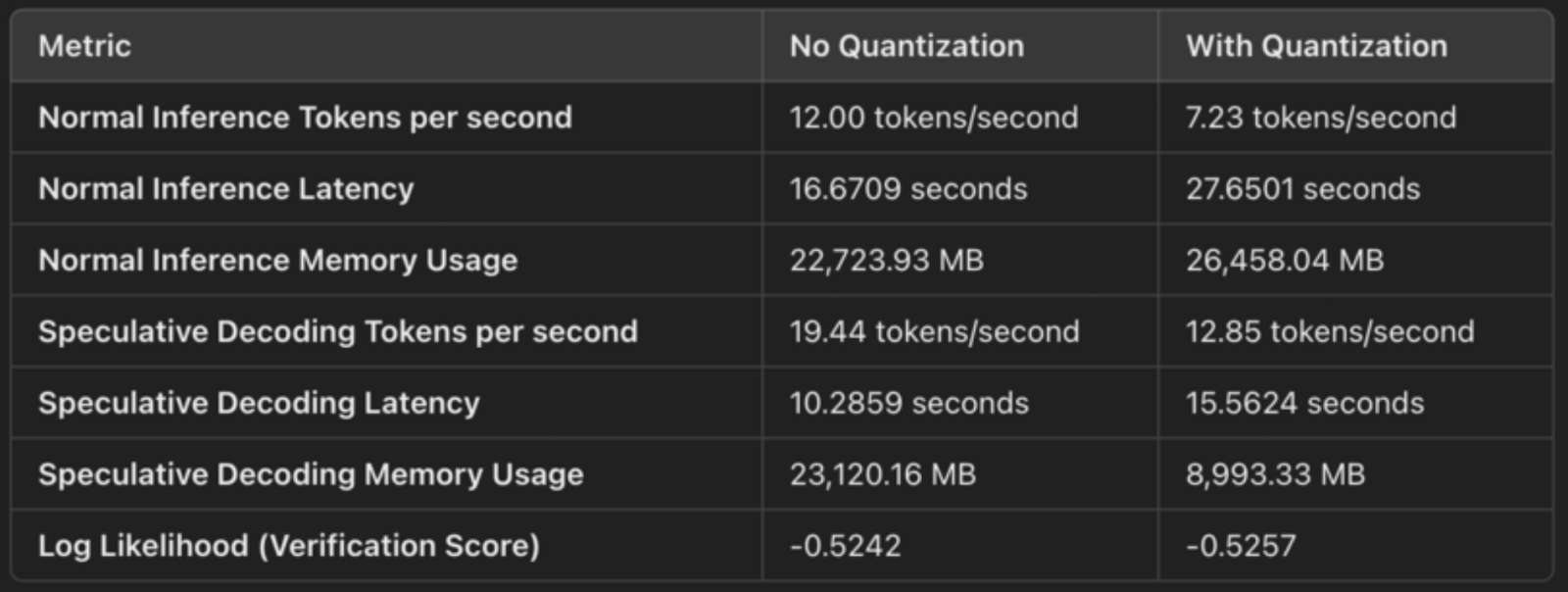
配置中设置了 load_in_4bit=True,即将模型权重从原始的 32 位或 16 位浮点格式量化为 4 位整数,以降低模型内存占用。量化会压缩模型权重,使其存储与运算更高效。具体内存节省如下:
配置 bnb_4bit_compute_dtype=torch.bfloat16 指定使用 bfloat16(BF16)进行计算,这是一种更高效的浮点格式。BF16 的动态范围比 FP16 更广,同时相较 FP32 占用一半内存,在精度与性能之间实现良好平衡。
在 NVIDIA GPU(如 A100)上使用 BF16 可充分利用针对 BF16 运算优化的 Tensor Core,从而在推理中实现更快的矩阵乘法与其他计算。
对于推测解码,我们观察到延迟下降:
更小的内存占用意味着更快的内存访问与更高效的 GPU 资源利用,从而带来更快的生成速度。
选项 bnb_4bit_quant_type="nf4" 指定了Norm-Four 量化(NF4),其针对神经网络进行了优化。NF4 在仅用 4 位表示权重的同时,尽量保留模型关键部分的精度,与简单的 4 位量化相比,可最大限度降低性能劣化。
NF4 在 4 位量化的紧凑性与模型预测准确性之间取得平衡,使性能尽可能接近原始模型,同时大幅降低内存使用。
双重量化(bnb_4bit_use_double_quant=False)是在 4 位权重之上再添加一层量化,可进一步降低内存占用,但会带来额外计算开销。此处将其禁用,以避免推理变慢。
推测解码潜在应用广泛而令人期待。示例如下:
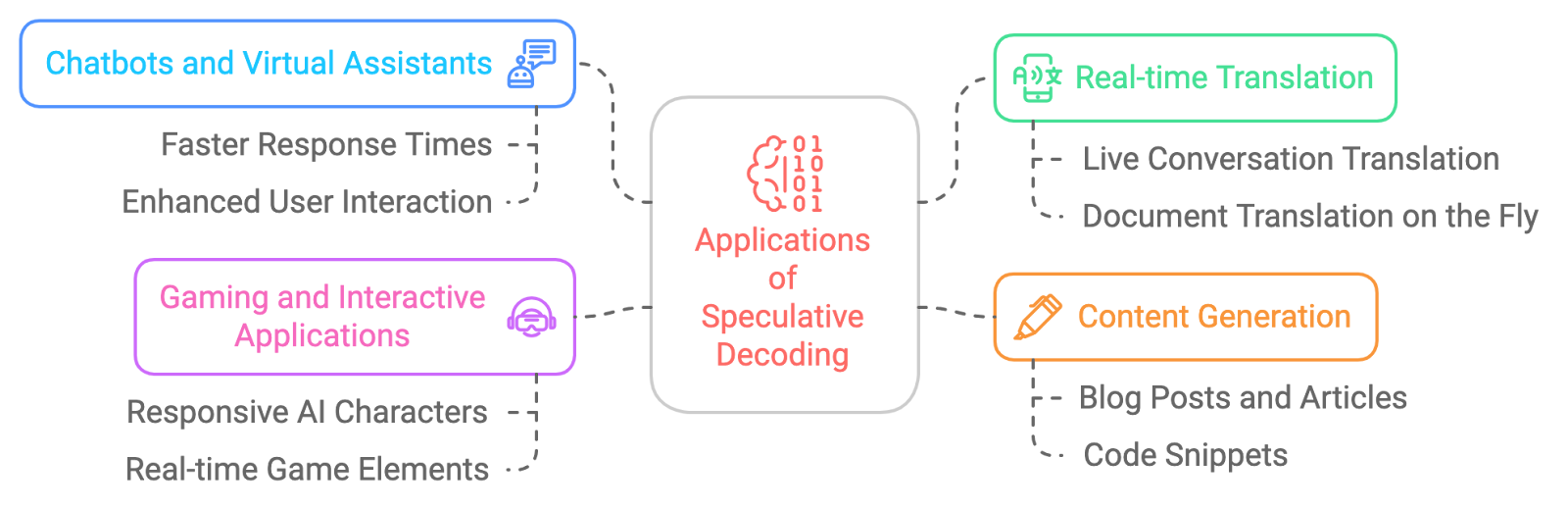
尽管推测解码前景广阔,但也并非没有挑战:
推测解码是一项强大的技术,能够在不牺牲生成文本质量的情况下,大幅加速大语言模型的推理。尽管仍有挑战需要解决,但其优势不容置疑。预计未来几年其采用率将持续提升,推动新一代更快速、更灵敏、且更高效的 AI 应用。
通过这些课程学习 AI!
学习路径
课程
课程