Cours
Concepts des grands modèles de langage (LLM)
2 h
110.3K
Choisir un assistant IA ne consiste pas à trouver le « meilleur » modèle. Il s'agit de sélectionner l'outil le mieux adapté à votre flux de travail. Un développeur qui procède au débogage d'un code complexe à 2 heures du matin a besoin de fonctionnalités différentes de celles d'un chercheur qui synthétise des articles universitaires ou d'un analyste commercial qui rédige des rapports trimestriels.
Dans cet article, je vais comparer Claude 4.5 et Gemini 3 Pro, les derniers modèles d'Anthropic et de Google. Vous constaterez les différences entre ces modèles en termes de profondeur de raisonnement, d'intégration dans l'écosystème, de tarification de l' et de performances. Si vous découvrez la technologie sous-jacente à ces assistants, nous vous recommandons de commencer par notre cours Concepts d'IA générative afin de vous familiariser rapidement avec le sujet.
Claude est l'assistant IA d'Anthropic, conçu autour de ce que l'entreprise appelle l'IA constitutionnelle. Trois principes guident toutes nos actions : l'utilité (réponses claires et utiles), l'innocuité (éviter les résultats dangereux ou trompeurs) et l'honnêteté (reconnaître l'incertitude plutôt que de générer des informations erronées qui semblent fiables).
Anthropic positionne Claude comme l'assistant IA des personnes réfléchies. Au lieu de se précipiter pour ajouter toutes les fonctionnalités possibles, ils se concentrent sur la qualité du raisonnement soutenu, en particulier pour les tâches complexes nécessitant un contexte long ou des conversations prolongées. Cela se manifeste dans la manière dont Claude traite les questions ambiguës. Il est préférable de demander des précisions plutôt que de deviner ce que vous avez voulu dire.
La gamme actuelle comprend trois niveaux : Claude Opus (le plus performant en matière de raisonnement et de codage), Claude Sonnet (équilibre entre performances et coût) et Claude Haiku (léger et rapide). Claude Opus 4.5 représente l'offre la plus performante d'Anthropic, avec des améliorations significatives en matière de benchmarks de codage et de compréhension de contextes longs.
Gemini est le système d'IA multimodal de Google DeepMind, conçu dès le départ pour traiter le texte, les images, le code, l'audio et la vidéo comme des entrées natives. Contrairement aux modèles qui ont ajouté des capacités visuelles par la suite, Gemini a été formé pour raisonner simultanément à travers plusieurs modalités, ce qui se reflète dans la manière naturelle dont il traite des tâches telles que l'analyse de graphiques ou l'extraction de données à partir de captures d'écran.
L'objectif de Google avec Gemini va au-delà de la création d'un assistant autonome. Le modèle sert de couche d'intelligence artificielle intégrée à la recherche, à Google Workspace (Gmail, Docs, Sheets, Slides), à Android et à Google Cloud. Grâce à cette intégration, Gemini peut extraire des informations en temps réel de Google Search, accéder à votre calendrier ou rédiger des e-mails en fonction du contexte de votre boîte de réception, le tout dans la même conversation.
Le modèle Gemini 3 Pro offre ce que Google appelle des capacités de « réflexion » : des chaînes de raisonnement internes qui décomposent les problèmes complexes avant de générer des réponses. Le mode « Deep Think » à venir ira encore plus loin, en permettant des chemins de raisonnement encore plus longs pour les tâches particulièrement difficiles.
Claude et Gemini représentent des philosophies différentes quant à ce que devraient être les assistants IA et comment ils devraient s'intégrer dans votre flux de travail.
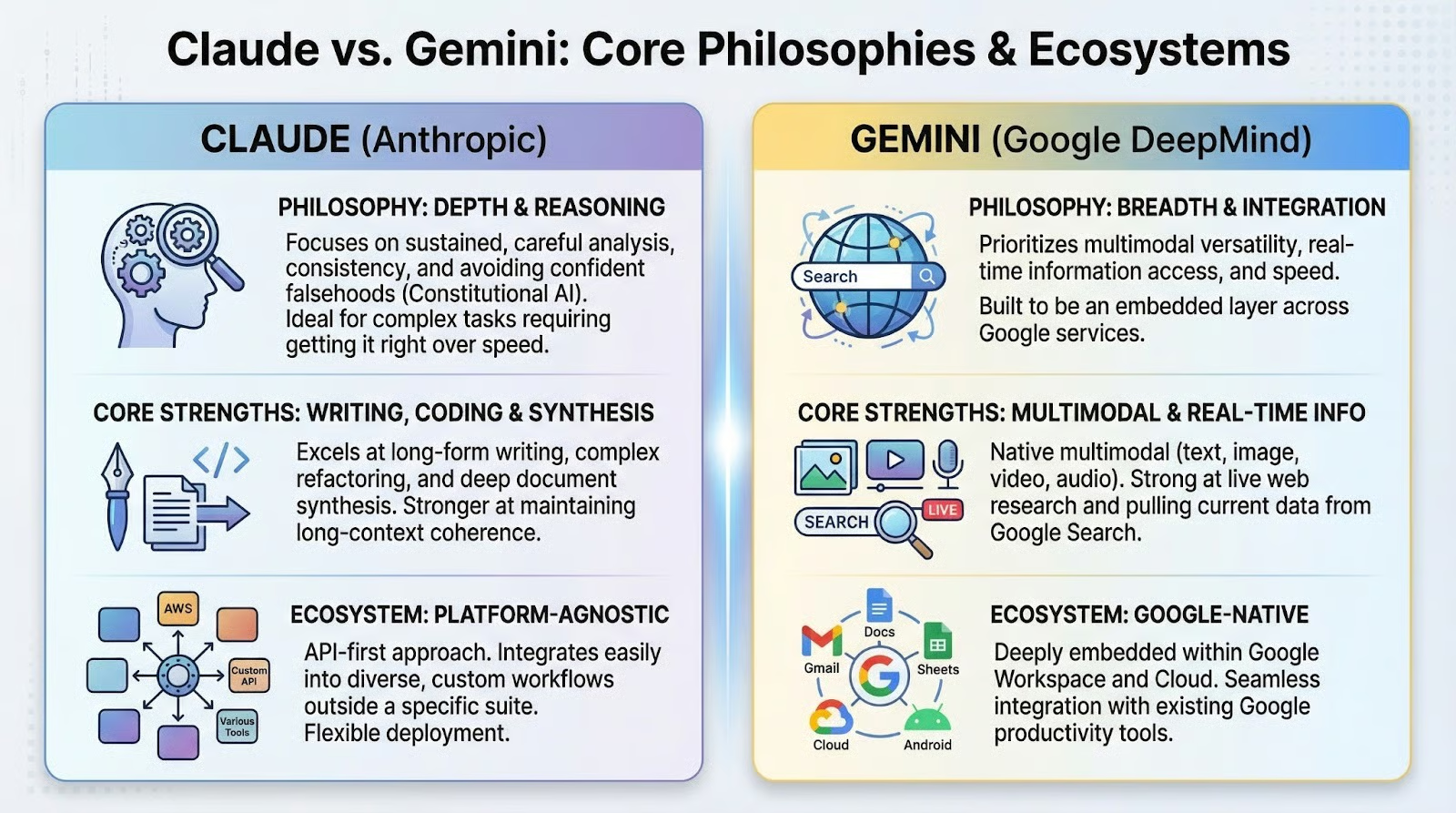
Comparaison côte à côte des philosophies fondamentales et des écosystèmes. Image fournie par l'auteur.
Claude met l'accent sur un raisonnement minutieux et soutenu. Il est conçu pour les tâches où il est plus important d'obtenir la bonne réponse que de l'obtenir rapidement, comme la refonte d'un code complexe ou l'analyse d'un article de recherche nuancé. L'approche d'Anthropic, qui privilégie la sécurité, implique que Claude est plus susceptible de reconnaître l'incertitude ou de poser des questions de clarification plutôt que de faire des suppositions avec assurance.
Gemini privilégie la polyvalence multimodale et l'accès à l'information en temps réel. Il est conçu pour les utilisateurs qui ont besoin d'une IA capable de passer de l'analyse d'une image à la recherche de données actuelles sur le Web et à la génération d'un concept vidéo, le tout au cours d'une seule conversation. Grâce à l'intégration de l'écosystème Google, Gemini a connaissance de votre calendrier, peut accéder à vos fichiers Drive et fonctionne avec les outils de productivité que vous utilisez déjà.
Claude adopte une approche axée sur les API et indépendante de la plateforme. Il s'intègre facilement dans les flux de travail personnalisés, fonctionne sur AWS ou via l'API d'Anthropic, et ne présuppose pas l'utilisation d'une suite d'outils particulière. Cette flexibilité est particulièrement intéressante pour les entreprises disposant d'infrastructures technologiques complexes ou les développeurs qui créent des applications personnalisées.
Gemini est intégré à l'écosystème de Google. Si vous utilisez déjà Gmail, Google Docs et Google Cloud, Gemini s'intègre naturellement. Cependant, si vous ne le faites pas, vous passerez à côté de certaines de ses fonctionnalités les plus utiles.
Claude excelle dans les domaines suivants : qualité et cohérence rédactionnelles, assistance au codage (en particulier pour les refactorisations complexes), raisonnement dans un contexte étendu et pensée analytique structurée. Gemini excelle dans les domaines suivants : recherche d'informations en temps réel, tâches multimodales (images, vidéo, audio), agrégation de recherches provenant de plusieurs sources et intégration de la productivité dans les outils Google.
Claude produit systématiquement des textes longs, bien structurés et cohérents. Il conserve le ton sur des milliers de mots, ce qui le rend idéal pour la documentation, les rapports techniques ou les contenus éducatifs. Le modèle perd rarement le fil des explications complexes.
Gemini est particulièrement performant pour les contenus courts, les résumés et les réponses qui bénéficient d'informations en temps réel. Cependant, il peut être moins cohérent dans le maintien de la voix et de la structure dans les récits très longs.
Claude Opus 4.5 est actuellement en tête des benchmarks de codage, avec un score de 74,4 % sur SWE-Bench (un benchmark exigeant en matière d'ingénierie logicielle). Il est particulièrement performant pour les tâches nécessitant un raisonnement soutenu sur plusieurs fichiers, comme la refonte de code existant ou le débogage d'erreurs logiques subtiles. Les développeurs indiquent souvent que Claude « comprend mieux l'intention » lorsqu'on lui fournit des spécifications vagues.
Gemini 3 Pro est performant pour la génération et l'explication de code, obtenant un score d'environ 74,2 % sur SWE-Bench avec des approches d'agent spécialisées. Il fonctionne efficacement lorsqu'il est associé aux outils Google Cloud, mais reste en retrait par rapport à Claude dans les tâches d'ingénierie logicielle à long terme qui nécessitentde maintenir le contexte à travers de nombreuses modifications du code.
L'intégration native de la fonction de recherche de Gemini lui confère un avantage certain pour les actualités, les études de marché et la recherche d'informations. Lorsque vous vous renseignez sur l'actualité brûlante ou que vous avez besoin de données de la semaine écoulée, Gemini peut extraire des informations vérifiées directement à partir des résultats de recherche Google.
Claude s'appuie sur ses données d'entraînement (avec une date limite de connaissances fixée à janvier 2025) et sur des outils de navigation optionnels via son API. Cependant, il excelle dans la synthèse des informations issues des documents que vous fournissez, analysant les PDF volumineux ou les documents techniques avec plus de profondeur que Gemini ne le fait habituellement.
En matière de rédaction analytique, de raisonnement structuré et d'explications techniques détaillées, la cohérence et la profondeur de Claude lui confèrent un avantage certain. Il est plus efficace pour maintenir des arguments logiques complexes dans des réponses longues.
En matière de créativité multimodale (génération de concepts d'images, raisonnement à partir d'informations visuelles ou planification de contenus vidéo), la formation multimodale native de Gemini le rend plus performant. Il est capable d'analyser des graphiques, d'extraire des données à partir de captures d'écran et de comprendre le contexte visuel de manière plus naturelle.
L'approche constitutionnelle de Claude en matière d'IA permet une gestion plus transparente de l'incertitude. Lorsqu'il ne connaît pas la réponse, il est plus susceptible de le dire explicitement plutôt que de formuler une hypothèse qui semble plausible. Cela permet de réduire les hallucinations dans les domaines à haut risque.
Gemini est plus souple et flexible, ce qui peut faciliter les tâches créatives, mais peut nécessiter une surveillance accrue dans les applications sensibles où la précision est essentielle.
Claude prend en charge des documents de très grande taille (200 000 tokens en standard, avec des options d'entreprise dépassant le million) et maintient la cohérence sur des sessions prolongées. Si vous analysez un manuel technique de 500 pages ou un référentiel GitHub complet, Claude s'en charge naturellement.
Gemini 3 Pro offre jusqu'à 1 million de jetons, ce qui le rend très compétitif pour les cas d'utilisation à long terme. Associé à ses processus de recherche et à l'utilisation d'outils, il est capable de traiter des documents volumineux, bien que les utilisateurs indiquent que Claude offre une meilleure cohérence dans les tâches analytiques de longue durée.
Les deux plateformes proposent des offres gratuites pour permettre aux utilisateurs de les tester, ainsi que des formules payantes pour les utilisateurs expérimentés, mais leurs stratégies tarifaires diffèrent considérablement.
|
Caractéristique |
Claude |
Gemini |
|
Niveau gratuit |
Chat de base, utilisation restreinte |
Gemini 3 Flash, accès Pro limité |
|
Plan Pro |
20 $ par mois |
19,99 $ par mois (Google AI Pro) |
|
Plan haut de gamme |
Environ 100 $ par mois (Claude Max) |
249,99 $ par mois (Google AI Ultra) |
|
Accès à l'API |
Paiement par jeton via Anthropic/AWS |
Paiement à l'utilisation via Vertex AI |
|
Plans Entreprise |
Tarification personnalisée, authentification unique, administration |
Tarification personnalisée, Intégration à l'espace de travail |
L'offre gratuite de Claude fournit un accès conversationnel de base avec des limites d'utilisation modérées. Claude Pro (20 $/mois) offre des limites plus élevées, un mode de réflexion prolongé, des artefacts et un accès prioritaire. La valeur clé : vous bénéficiez de toutes les fonctionnalités du modèle Opus, avec des limites de messages plus élevées.
L'offre gratuite de Gemini comprend un accès limité à Gemini 3 Pro ainsi qu'un accès complet au modèle 3 Flash, plus rapide. Gemini Pro (19,99 $/mois) supprime les limites et ajoute l'intégration Workspace, une meilleure génération d'images (1 000 crédits mensuels) et la priorité pour les nouvelles fonctionnalités.
Claude Max (environ 100 $/mois) offre aux utilisateurs individuels expérimentés des limites d'utilisation 5 à 20 fois supérieures à celles de la version Pro. Pour les équipes, les forfaits commencent à 25 $ par utilisateur et par mois, avec des options pour des postes de développeur premium à 150 $ par utilisateur et par mois, qui incluent Claude Code.
Le niveau Ultra de Gemini (249,99 $/mois) s'adresse aux utilisateurs qui ont besoin de fonctionnalités de pointe : Mode Deep Think, Gemini Agent pour l'exécution autonome de tâches et plus de 25 000 crédits mensuels pour la génération d'images et de vidéos.
Pour l'utilisation de l'API, Claude facture environ 5 dollars par million de jetons d'entrée et 25 dollars par million de jetons de sortie pour Opus 4.5 (les modèles plus petits comme Sonnet sont moins onéreux). La tarification de Gemini via Vertex AI est basée sur l'utilisation, généralement autour de 1,25 $ par million de jetons d'entrée et 10 à 15 $ par million de jetons de sortie, bien que Google utilise un système de crédits qui peut rendre la comparaison directe difficile.
Les tests de performance ne reflètent pas tous les aspects, mais ils fournissentdes aperçus objectifsdes capacités des modèles dans le cadre de tâches standardisées.
|
Référence |
Claude Opus 4.5 |
Gemini 3 Pro |
Ce qu'il évalue |
|
SWE-Bench (codage) |
~74.4% |
~74.2% |
Tâches concrètes en génie logiciel, correction de bogues |
|
GPQA (raisonnement scientifique) |
Très performant |
En tête |
Questions de niveau universitaire en physique, chimie et biologie |
|
MMLU (connaissances générales) |
Plus de 80 % |
Comparable |
Questions d'examen académique multidomaine |
|
Raisonnement à long terme |
Excellent |
Excellent |
Maintenir la précision pour plus de 100 000 entrées de jetons |
Claude est actuellement en tête des classements en matière de codage intensif, en particulier pour les tâches nécessitant un raisonnement soutenu sur plusieurs étapes ou fichiers. Son score SWE-Bench de 74,4 % représente l'une des meilleures performances mesurées dans le cadre de défis réels en matière d'ingénierie logicielle.
Gemini 3 Pro affiche de bonnes performances dans les tâches de raisonnement général et se distingue dans certains tests de référence scientifiques de niveau universitaire, tels que le GPQA. Il a obtenu 18,8 % au « dernier examen de l'humanité » (un test de raisonnement délibérément difficile), soit le score le plus élevé parmi les modèles n'ayant pas accès à des outils au moment du test.
Les deux modèles excellent dans la compréhension de contextes longs, conservant avec précision les informations à travers d'énormes quantités de données. Ils sont à égalité sur le test MMLU (connaissances générales), obtenant tous deux un score supérieur à 80 et se rapprochant des performances d'un expert humain.
Veuillez noter que ces tests de performance évaluent des capacités spécifiques dans des conditions contrôlées. Les performances réelles dépendent fortement de votre cas d'utilisation et de la manière dont vous interagissez avec le modèle.
Voici un aperçu desprincipaux avantages et limites de chaqueplateforme.
|
Plateforme |
Pros |
Cons |
|
Claude |
|
Pas d'accès Web en temps réel natif |
|
Gemini |
Intégration en temps réel de la recherche Google |
Moins cohérent pour les très longs textes analytiques |
Le choix du meilleur assistant IA dépend de ce que vous souhaitez accomplir.
Nous vous recommandons de choisir Claude si vous travaillez sur des projets de codage complexes, si vous refactorisez des systèmes existants ou si vous déboguez des problèmes logiques subtils. Son score SWE-Bench élevé reflète sa capacité réelle à comprendre l'intention du code dans plusieurs fichiers. Le mode de réflexion approfondie facilite les décisions architecturales qui nécessitent une analyse minutieuse.
Gemini est une solution pertinente si vous utilisez déjà Google Cloud Platform et souhaitez intégrer une assistance IA à votre infrastructure cloud. Il est fiable pour la génération de code et s'intègre parfaitement aux outils de développement de Google.
Claude est le choix le plus judicieux pour la rédaction technique longue, la documentation, le contenu éducatif ou tout autre projet nécessitant une voix cohérente sur plusieurs milliers de mots. Il est rare qu'il « s'égare » au milieu d'explications complexes.
Gemini est particulièrement adapté aux contenus courts qui tirent parti des informations en temps réel (par exemple, les articles de blog sur l'actualité) et excelle lorsque vous avez besoin de créer des contenus multimodaux, en générant des images ou des concepts vidéo en plus du texte.
Si vous utilisez déjà Google Workspace, l'intégration native de Gemini dans Gmail, Docs et Sheets peut améliorer votre productivité de manière immédiate. Les études menées par Google auprès des entreprises indiquent un gain de temps d'environ 105 minutes par semaine, principalement grâce à cette intégration.
Claude offre une plus grande flexibilité de plateforme pour les flux de travail personnalisés et les environnements réglementés où un contrôle précis du traitement des données est nécessaire. De nombreuses entreprises utilisent Claude via AWS Bedrock pour cette raison.
La conception axée sur la sécurité, la gestion transparente des incertitudes et la flexibilité de déploiement (y compris la disponibilité dans AWS GovCloud) de Claude en font une solution privilégiée pour les secteurs de la santé, de la finance, des administrations publiques et d'autres secteurs fortement réglementés.
Gemini peut fonctionner dans ces contextes, mais nécessite une configuration minutieuse, en particulier si vous devez isoler les données des systèmes plus larges de Google.
Gemini excelle dans la recherche en temps réel sur plusieurs sources Web. Son mode Deep Research peut synthétiser automatiquement les informations provenant de dizaines d'articles actuels. Si vous suivez des sujets qui évoluent rapidement ou si vous avez besoin de données de marché en temps réel, cet outil est d'une valeur inestimable.
Claude excelle dans la synthèse approfondie des documents dont vous disposez déjà. Veuillez lui fournir une série d'articles de recherche ou de rapports techniques, et il vous fournira une analyse plus cohérente et plus approfondie que celle généralement proposée par Gemini.
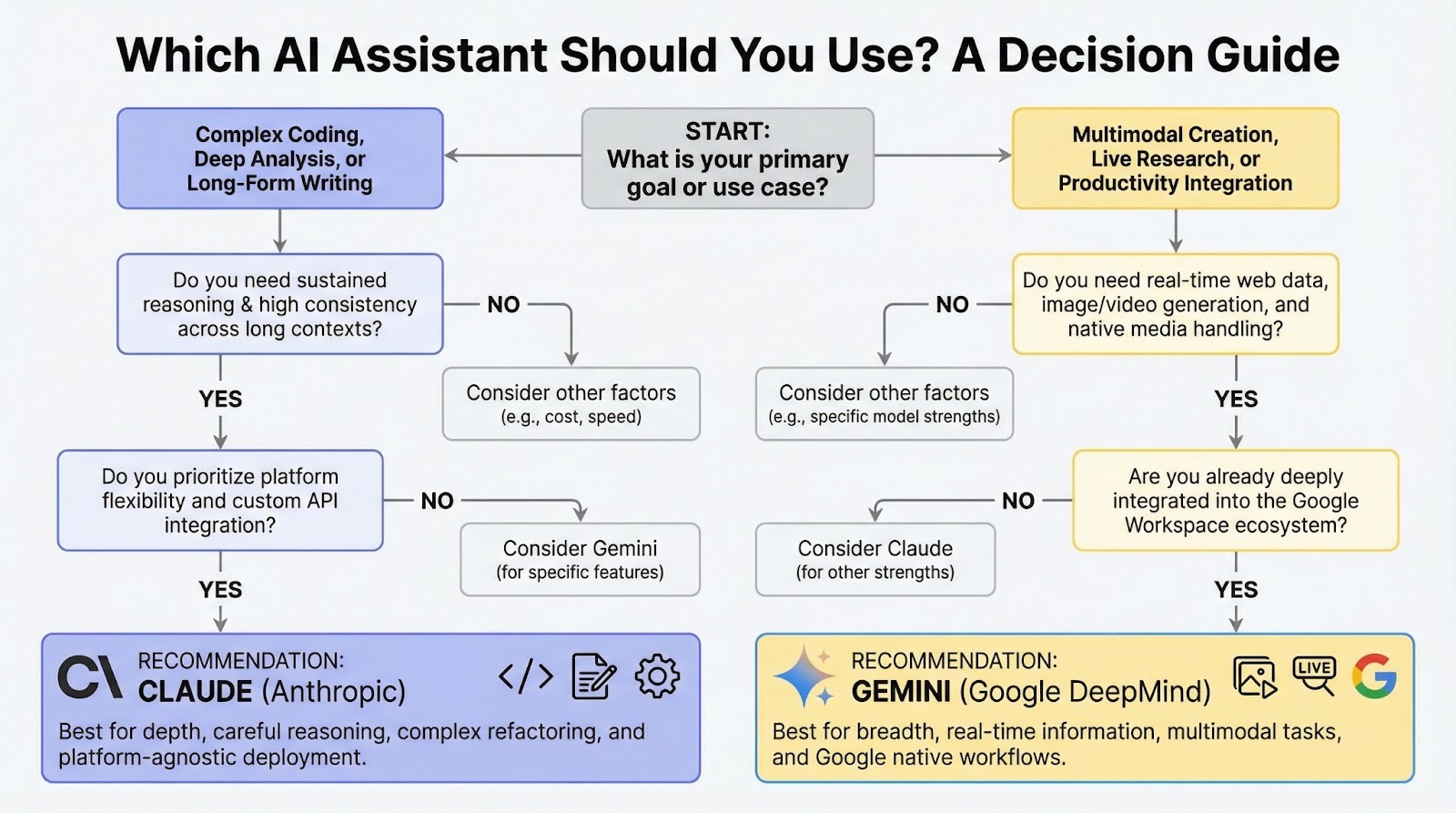
Un guide rapide pour choisir entre Claude et Gemini. Image fournie par l'auteur.
Claude et Gemini représentent deux philosophies distinctes en matière d'assistance par IA. Claude privilégie la profondeur, le raisonnement rigoureux et la qualité constante, et s'adresse aux utilisateurs qui ont besoin d'une IA fiable pour effectuer des tâches analytiques complexes. Gemini met l'accent sur l'étendue, l'accès à l'information en temps réel et la polyvalence multimodale. Il est conçu pour les utilisateurs qui souhaitent intégrer l'IA dans leurs flux de travail Google existants.
Aucun des deux n'est objectivement « meilleur » dans tous les domaines. Le choix dépend de vos priorités : privilégiez-vous la profondeur du raisonnement plutôt que l'étendue des informations, l'indépendance de la plateforme plutôt que la commodité de l'écosystème, et l'excellence du codage plutôt que la créativité multimodale ?
Pour aller au-delà de la simple utilisation de ces assistants et commencer à créer vos propres applications basées sur l'IA, nous vous invitons à suivre notre cours « Développer des applications LLM avec LangChain ». Si vous envisagez de mettre en œuvre ces outils au sein de votre organisation, notre cours « Generative AI for Business » (IA générative pour les entreprises) constitue une autre excellente option.
Apprenez avec DataCamp
Cours
Cours
Cours
blog
Kurtis Pykes
9 min
blog
blog
Lynn Heidmann
blog
Matt Crabtree
14 min
Tutoriel
Tutoriel
Samuel Shaibu
9 min