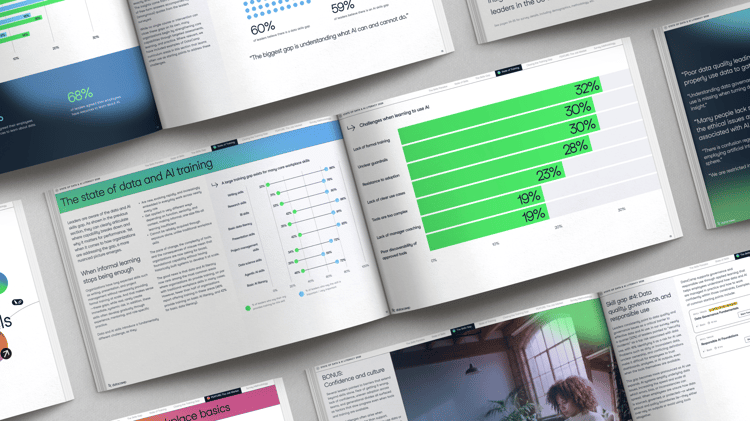
Malgré l’adoption massive de l’IA et les efforts de formation, la plupart des entreprises peinent encore à développer de réelles capacités au sein de leurs équipes. Dans notre enquête 2026 menée avec YouGov auprès de plus de 500 dirigeants aux États‑Unis et au Royaume‑Uni, une majorité déclare que leur organisation ne dispose pas des compétences en IA nécessaires pour l’appliquer avec assurance et efficacité au quotidien.
Le problème n’est pas l’accès aux outils d’IA, mais la capacité des collaborateurs à bien les utiliser.
L’écart de compétences en IA n’existe pas isolément. Il s’inscrit dans un décalage plus large entre la hausse des attentes en matière de culture de l’IA et les systèmes que les organisations utilisent pour la développer. Nous analysons ce phénomène plus global — définitions, référentiels et tendances à l’échelle de l’entreprise — dans notre panorama 2026 de la culture des données et de l’IA.
Qu’est-ce que l’écart de compétences en IA ?
L’écart de compétences en IA désigne le décalage entre les capacités en IA attendues par les organisations et l’aptitude réelle des collaborateurs à appliquer l’IA efficacement dans leurs fonctions.
Il ne s’agit pas principalement d’expertise d’ingénierie IA avancée. Il se manifeste surtout sur des fondamentaux tels que :
- Évaluer si les sorties de l’IA sont fiables ou trompeuses
- Appliquer des outils d’IA à des workflows précis
- Traduire des insights générés par l’IA en décisions
- Comprendre la gouvernance, les risques et un usage responsable de l’IA
Autrement dit, l’enjeu porte sur la culture de l’IA appliquée au sens large dans l’entreprise, et pas uniquement sur le recrutement de spécialistes techniques.
Le paradoxe de la formation à l’IA
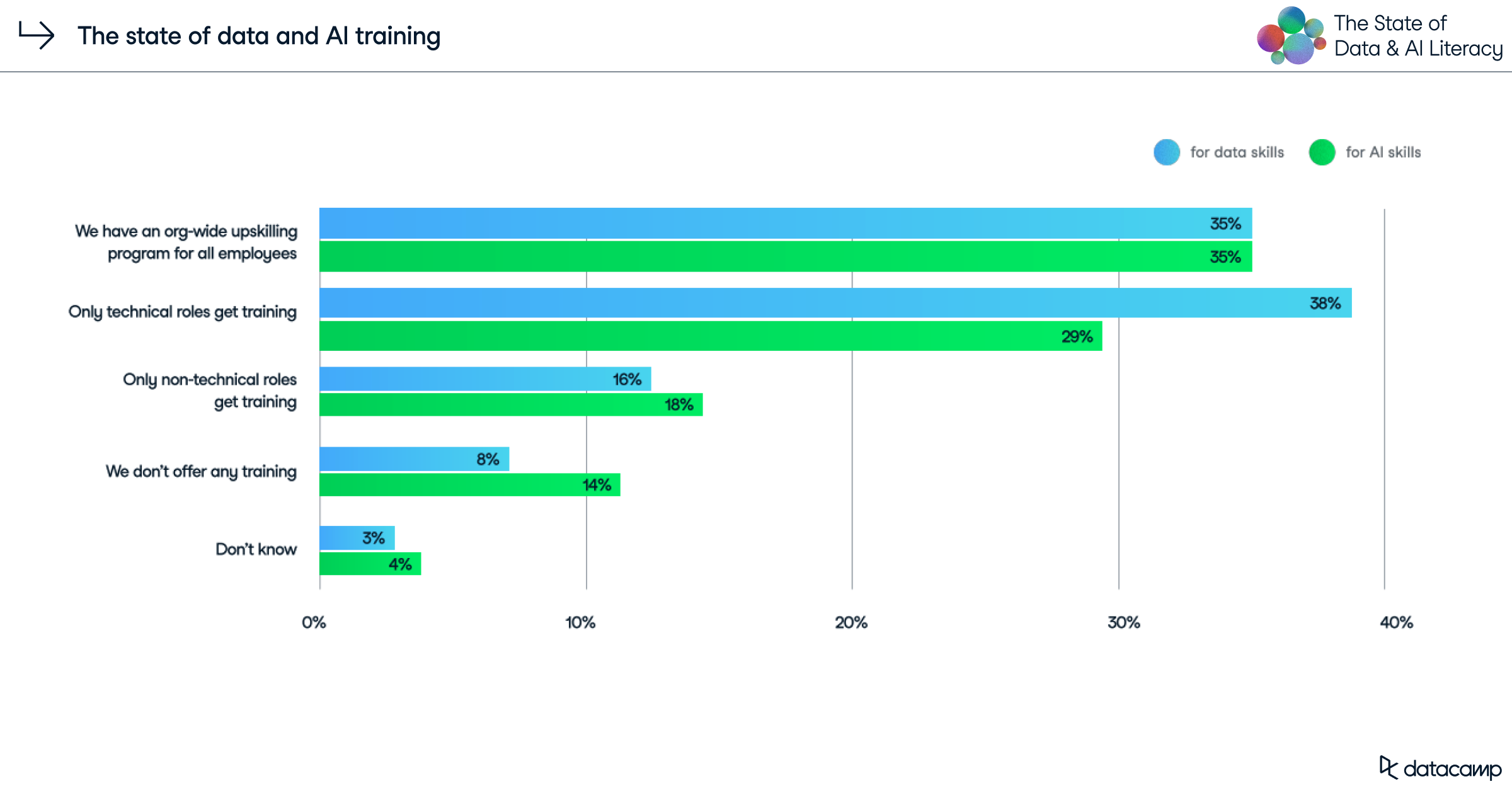
La plupart des organisations ne négligent pas totalement la formation à l’IA. Même si seulement 35 % des dirigeants déclarent disposer d’un programme de montée en compétences en IA mature et à l’échelle de l’entreprise :
- 82 % proposent une forme de formation à l’IA
- 68 % indiquent que les employés ont accès à des ressources d’apprentissage en IA
- 46 % dispensent une formation de base à la culture de l’IA
Pourquoi l’écart de compétences perdure‑t‑il ? Parce que l’accès à la formation ne se traduit pas automatiquement par des capacités opérationnelles.
Pourquoi la formation à l’IA ne se traduit pas en capacités opérationnelles
La plupart des organisations n’échouent pas à proposer des formations à l’IA ; elles échouent à les concevoir pour le monde de l’IA. Dans notre enquête 2026 auprès de plus de 500 dirigeants, plusieurs problèmes structurels ressortent.
1. L’apprentissage passif domine
Les formats les plus courants sont les cours vidéo et les sessions hybrides en ligne (40 %). Mais les dirigeants constatent les limites de ces approches :
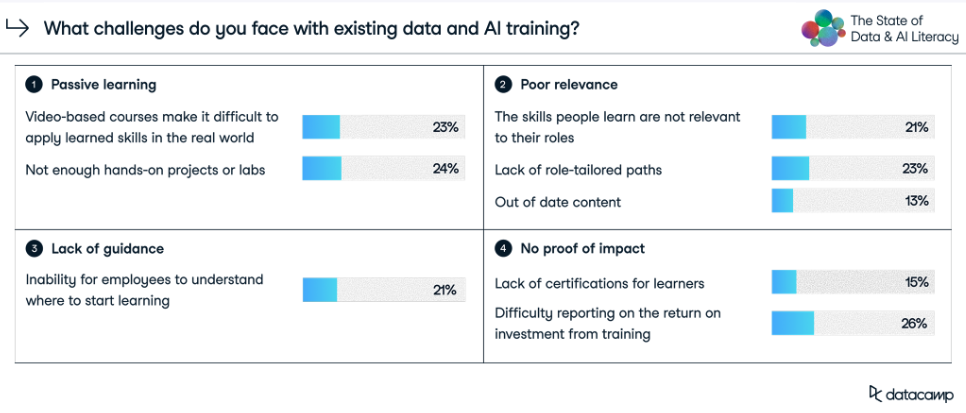
- 23 % indiquent que les cours vidéo rendent difficile l’application des compétences sur le terrain
- 24 % pointent le manque de projets ou de labs pratiques
Regarder une explication de l’IA n’a rien à voir avec l’utiliser efficacement. Sans pratique appliquée, les collaborateurs peinent à transférer les acquis dans leurs workflows quotidiens.
Résultat : de la sensibilisation sans confiance, et de l’adoption sans discernement.
2. La formation n’est pas adaptée aux rôles
Environ trois dirigeants sur cinq signalent des difficultés avec les prestataires de formation en ligne tiers pour les données et l’IA :
- 23 % estiment que les parcours ne sont pas adaptés à des rôles spécifiques
- 21 % indiquent que les employés ne savent pas par où commencer
Les sessions génériques de culture de l’IA se connectent rarement à la réalité du travail. Les collaborateurs comprennent parfois les concepts en théorie mais peinent à :
- Identifier des cas d’usage concrets dans leur fonction
- Intégrer des outils d’IA dans les processus existants
- Mesurer l’impact sur la performance
Quand la formation à l’IA n’est pas alignée sur les rôles, l’adoption devient inégale.
3. Pas de progression claire ni de renforcement
Beaucoup d’organisations fournissent des ressources d’apprentissage en IA sans parcours structurés qui développent les capacités dans la durée. Sans surprise, 26 % des dirigeants peinent à rendre compte du ROI de la formation.
De plus, seuls 35 % des dirigeants déclarent disposer d’un programme de montée en compétences en IA mature et à l’échelle de l’entreprise.
La culture de l’IA n’est pas une compétence ponctuelle. Elle exige répétition, feedback et ancrage contextuel. Faute de structure et de mesure, la formation reste fragmentée — et l’écart de compétences perdure.
L’écart de compétences en IA et le ROI de l’IA
Les conséquences de l’écart de compétences en IA sont mesurables. Globalement :
- 21 % des dirigeants rapportent un ROI significatif de leurs investissements en IA
- 17 % ne constatent aucun ROI positif
Cependant, parmi les organisations dotées d’un programme mature de montée en compétences à l’échelle des équipes pour la culture de l’IA :
- Les signalements d’un ROI IA significatif doublent presque, à 42 %
- Les cas d’absence de ROI tombent à 11 %
Cela suggère un lien clair entre une construction structurée des capacités et le retour sur investissement en IA.
Le détail complet de ces résultats est disponible dans le 2026 State of Data & AI Literacy Report.
Là où l’écart de compétences en IA est le plus visible
L’écart de compétences en IA se voit surtout sur les capacités fondamentales :
- Transformer des sorties générées par l’IA en décisions solides
- Distinguer les insights fiables des hallucinations
- Appliquer l’IA à de vrais enjeux métier
- Naviguer entre gouvernance et usage responsable de l’IA
- Communiquer clairement des insights issus de l’IA
Il s’agit de compétences de jugement et d’application, pas uniquement techniques.
C’est pourquoi résorber l’écart de compétences en IA exige une culture de l’IA à l’échelle de l’entreprise, et pas seulement des recrutements techniques.
Combler l’écart de compétences en IA en 2026
Les organisations qui avancent partagent des caractéristiques communes. Les programmes efficaces de montée en compétences en IA sont :
- Scalables, au‑delà des équipes techniques
- Adaptés aux rôles et ancrés dans les workflows quotidiens
- Pratiques, centrés sur l’application
- Renforcés dans le temps, pas des sessions isolées
- Mesurables et reliés aux résultats de performance
Combler l’écart de compétences en IA ne tient pas à « plus de contenu », mais à un meilleur design pédagogique. C’est pourquoi les organisations leaders basculent vers des systèmes d’apprentissage structurés et appliqués, qui intègrent la culture de l’IA directement dans le travail au quotidien plutôt que de s’appuyer uniquement sur des cours passifs ou des formations ponctuelles.
DataCamp for Business s’appuie sur ce modèle, en combinant des parcours d’apprentissage par rôle, des projets pratiques, une personnalisation propulsée par l’IA et des référentiels de compétences mesurables pour aider les organisations à développer des capacités en IA à grande échelle.
À quoi cela ressemble concrètement
Les grandes organisations mondiales amorcent le passage d’une formation à l’IA éclatée à des programmes structurés et pertinents par rôle.
Par exemple, Bayer a créé une Data Academy à trois niveaux pour diffuser la culture des données et de l’IA à l’échelle de l’entreprise : de la culture de l’IA générative pour tous aux parcours avancés pour spécialistes techniques. Résultat : plus de 90 % des apprenants déclarent avoir développé des idées, processus ou solutions innovants après la formation.