Data and AI literacy are no longer specialized capabilities. They are now baseline workplace expectations. Unfortunately, most enterprises are not workforce-ready.
To understand how organizations are navigating this shift, DataCamp worked with YouGov to survey 500+ enterprise leaders across the United States and United Kingdom for the 2026 State of Data & AI Literacy Report.
The findings reveal a clear pattern:
- Expectations for data and AI literacy are rising rapidly
- Workforce capability has not kept pace
- Organizations that invest in structured upskilling are nearly twice as likely to report significant AI ROI
Here’s what data and AI literacy mean in 2026 and what the latest data literacy statistics reveal about the growing AI skills gap.
What Is data literacy?
Data literacy is the ability to read, interpret, analyze, and communicate data in order to inform decisions. In the workplace, data literacy goes beyond technical data analysis skills. It includes:
- Understanding how data is collected and structured
- Interpreting dashboards and visualizations
- Evaluating the quality and reliability of data
- Translating insights into business decisions
- Communicating findings clearly to stakeholders
Data literacy in the workplace is no longer confined to analysts. Leaders increasingly expect HR teams, finance professionals, marketers, operations managers, and executives to confidently work with data.
Data literacy statistics (2026)
According to our survey of 500+ enterprise leaders:
- 88% say basic data literacy is important for day-to-day work
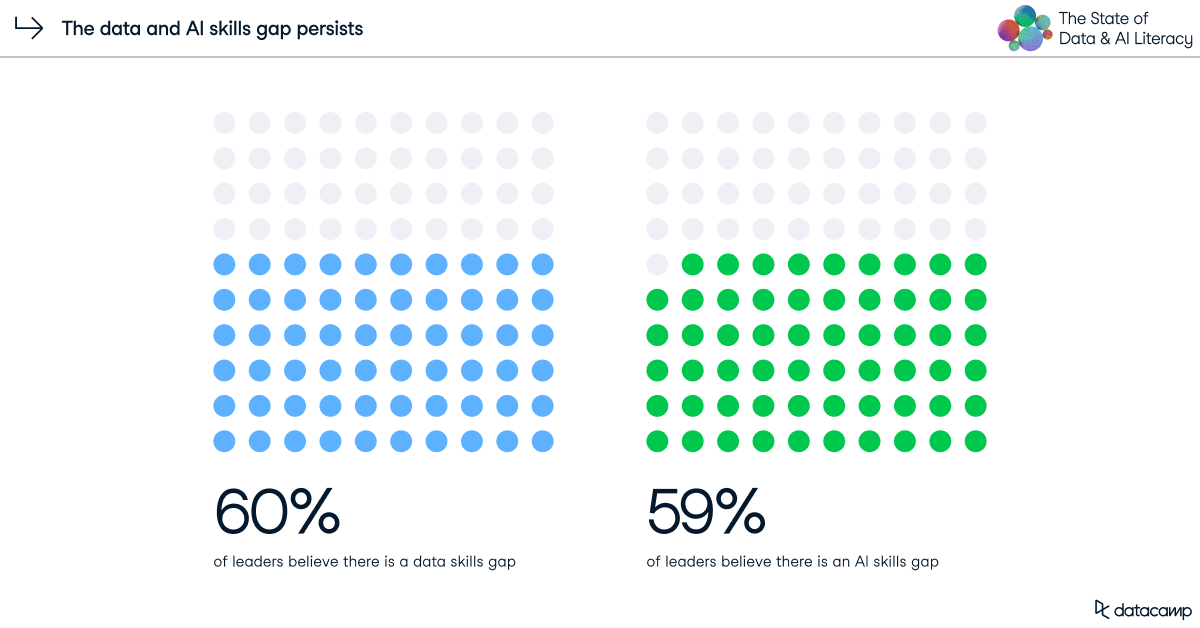
- 60% report a data skills gap in their organization
- Only 42% provide foundational data literacy training at scale
- 74% are willing to pay higher salaries for strong data literacy skills
These data literacy statistics show that demand is high, but enterprise-wide capability remains uneven.
What is AI literacy?
AI literacy is the ability to understand, evaluate, and responsibly apply artificial intelligence tools in real-world work contexts. AI literacy does not mean building machine learning models. Instead, it includes:
- Understanding basic AI concepts
- Evaluating AI-generated outputs critically
- Applying AI tools to business workflows
- Recognizing limitations, risks, and bias
- Using AI responsibly within governance guidelines
AI literacy in the workplace is rapidly becoming a foundational skill, particularly as generative AI tools and AI copilots become embedded in daily workflows.
AI literacy statistics (2026)
Our research shows:
- 72% of leaders say AI literacy is important for day-to-day work
- 57% say AI literacy has grown in importance over the past year
- 59% report an AI skills gap
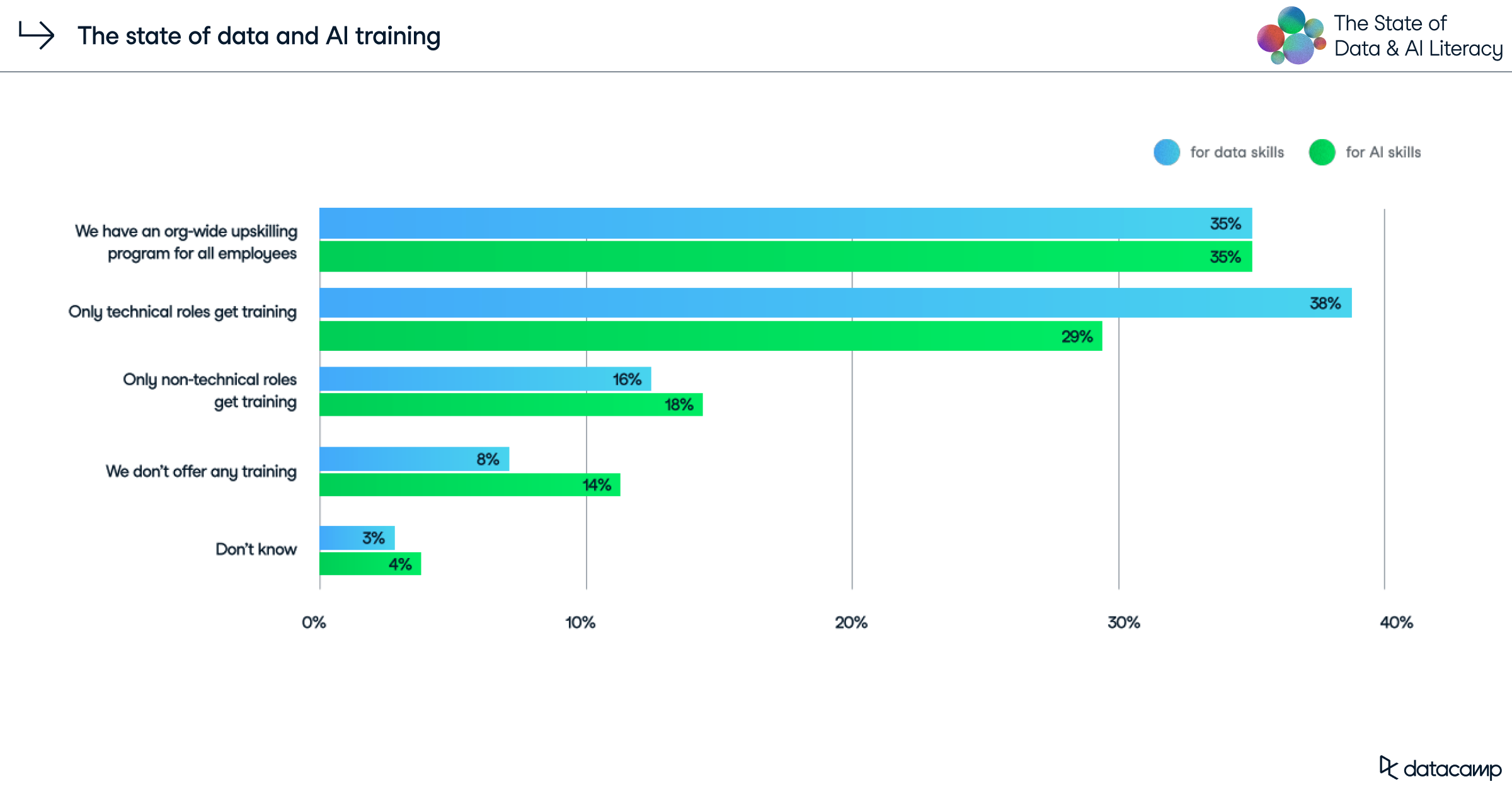
- Only 35% have a mature, organization-wide AI literacy program
- 69% are willing to pay salary premiums for strong AI literacy skills
AI literacy expectations are rising faster than training systems are evolving to support them.
The data and AI skills gap: Why it persists
Despite high expectations, nearly two in three leaders report a data or AI skills gap within their organization. Importantly, the AI skills gap is not primarily about advanced engineering expertise.
Leaders identify the biggest capability breakdowns in:
- Turning information into sound decisions
- Interpreting dashboards and AI outputs
- Communicating insights clearly (data storytelling)
- Applying AI tools practically to everyday workflows
- Managing data quality, governance, and responsible AI use
This suggests the real challenge is foundational AI literacy in the workplace, not specialized development skills.
In other words, most organizations don’t lack AI tools; they lack applied workforce fluency.
AI ROI and workforce capability: The critical link
One of the most important findings in the 2026 report concerns the return on AI investments.
Overall:
- 21% of leaders report seeing significant positive ROI from AI investments
- 17% report seeing no positive ROI at all
However, the picture changes dramatically for organizations with a mature, organization-wide data literacy or AI literacy upskilling program:
- The share reporting significant AI ROI jumps to 42%
- The share reporting no positive ROI drops to 11%
That means organizations pairing AI investment with structured workforce capability building are nearly twice as likely to see strong returns. AI tools alone do not create impact, but workforce capability does.
Why most data and AI training isn’t working
Most organizations report offering some form of data or AI training.
- 77% offer some kind of AI training
- 76% say employees have access to data learning resources
Yet only 35% report having a mature, workforce-wide upskilling program.
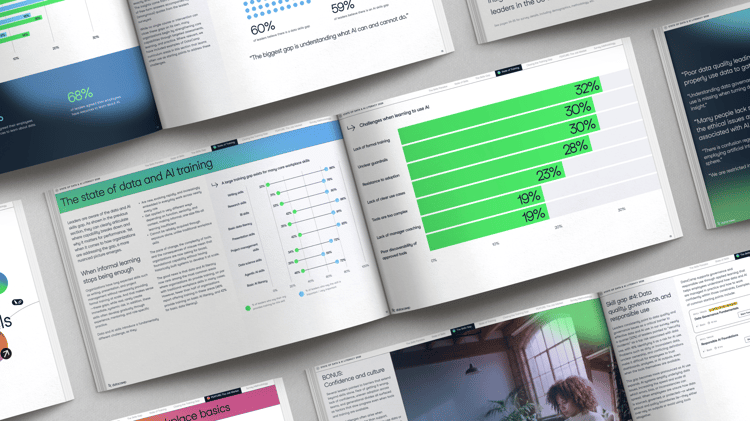
Leaders cite consistent challenges with corporate AI training programs:
- Passive, video-based learning
- Lack of hands-on projects and labs
- Poor role relevance
- Difficulty measuring ROI from training
- Lack of structured learning paths
The issue is not awareness or intent, but rather learning design. Traditional training models were built for slower-moving, specialized skills, not for fast-evolving, cross-functional capabilities like AI literacy.
The most important data and AI skills in 2026
The most valued skills are not necessarily deeply technical. Leaders prioritize:
Foundational decision-making and interpretation skills
- Data-driven decision making
- Interpreting dashboards and visualizations
- Data analysis and manipulation
Foundational AI fluency
- Understanding AI concepts
- Responsible AI use
- Applying AI tools in business contexts
- Using AI copilots
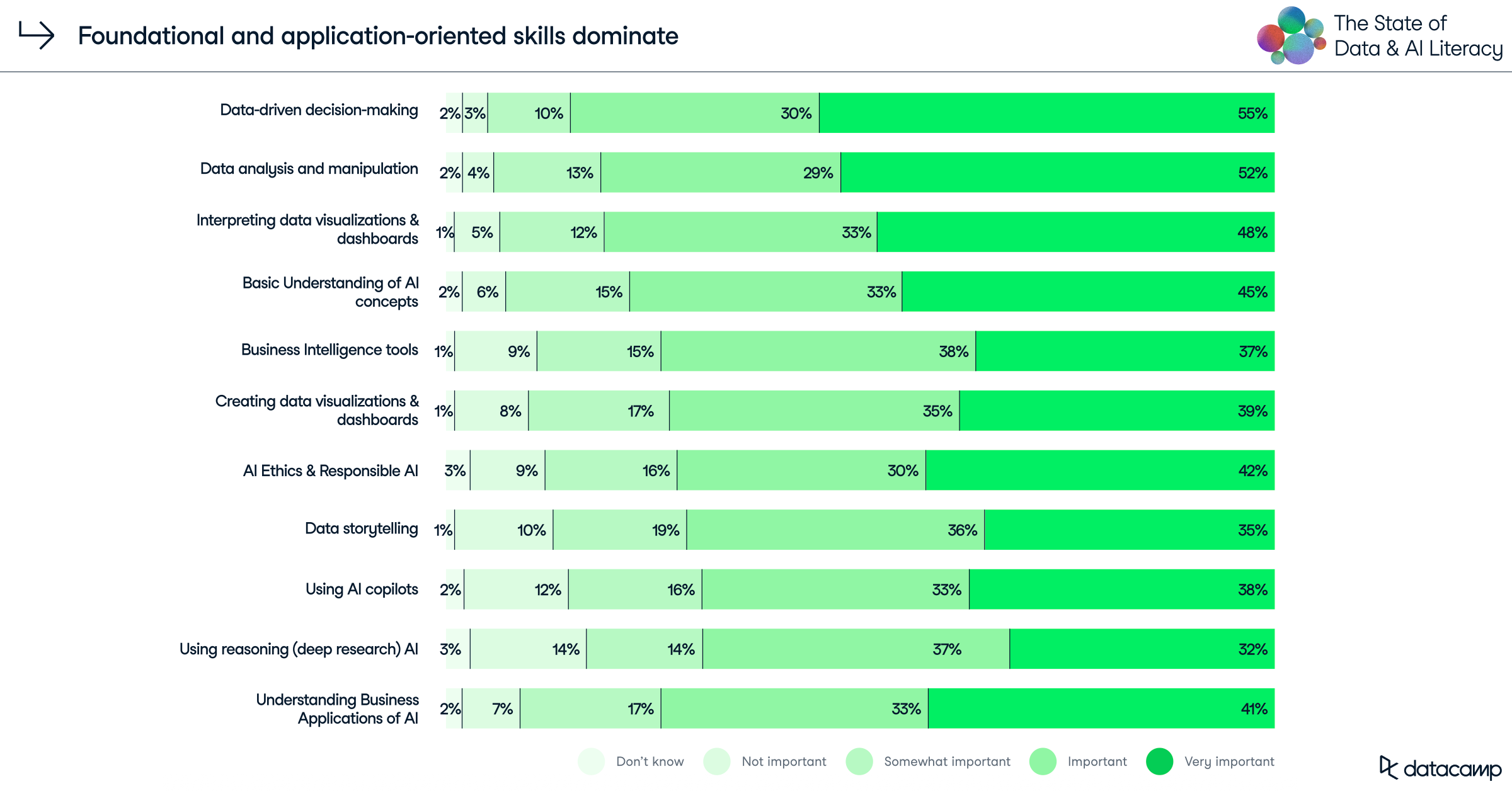
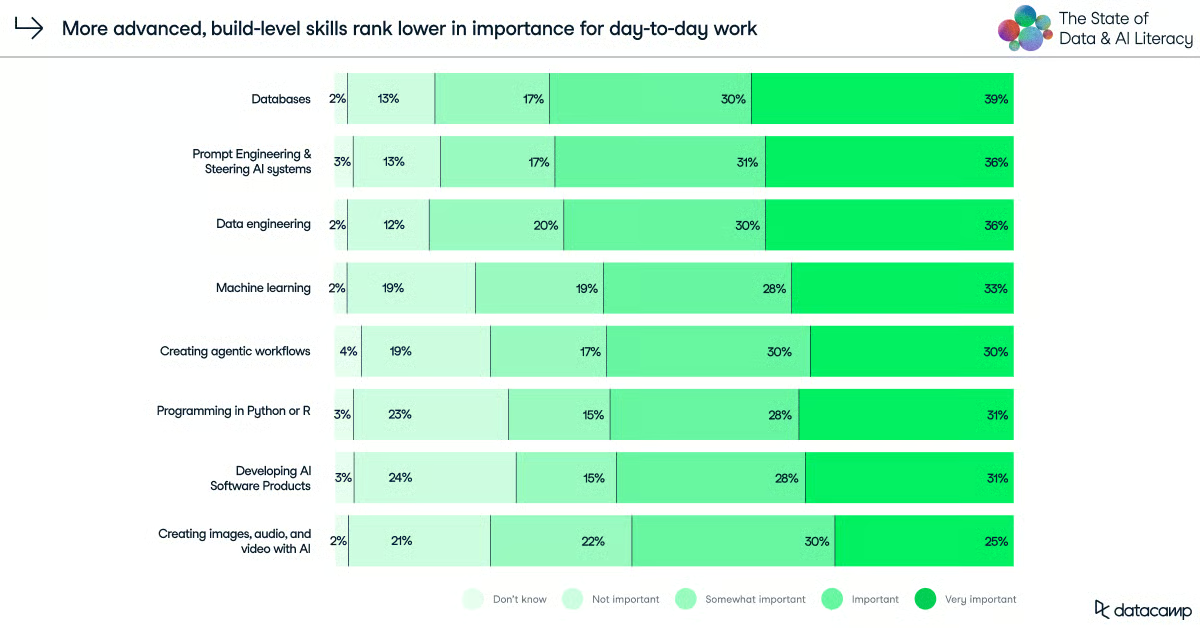
Advanced development skills, such as machine learning engineering or AI engineering, remain critical for specific roles. But enterprise-wide competitiveness depends on foundational data and AI literacy at scale.
The core paradox: High expectations, low readiness
The 2026 State of Data & AI Literacy Report reveals a persistent paradox: Leaders expect AI-human collaboration across every function. They anticipate double-digit productivity improvements. They recognize data and AI literacy as foundational skills.
Yet structured, workforce-wide capability programs remain rare.
Closing this gap requires a shift from content delivery to capability building:
- From passive learning to applied practice
- From one-size-fits-all training to role-relevant pathways
- From one-off interventions to reinforced, embedded learning
Organizations that make this shift are significantly more likely to see measurable AI ROI.
Download the full 2026 State of Data and AI Literacy Report
This overview summarizes key definitions, data literacy statistics, and insights into the AI skills gap.
The full 2026 report includes:
- Detailed breakdowns of enterprise AI skills gaps
- Expanded AI ROI analysis
- Training effectiveness benchmarks
- Case studies from global organizations
- Job market and salary premium insights
Download the full 2026 State of Data & AI Literacy Report to see how your organization compares and what it will take to build lasting workforce capability.