
Last chance! 50% off DataCamp Premium
Sale ends in
Buy Now

ฝึกฝนและตรวจสอบความก้าวหน้าของคุณ
ดำเนินการต่อด้วย Googleเมื่อดำเนินการต่อ ถือว่าคุณยอมรับ ข้อกำหนดการใช้งานและ นโยบายความเป็นส่วนตัว และยอมรับว่าข้อมูลของคุณจะถูกจัดเก็บในสหรัฐอเมริกาArtificial Intelligence (AI) is a broad term that encompasses various technologies and techniques used to enable machines to perform tasks that would typically require human intelligence. AI in accounting is the application of these technologies and techniques in the field of accounting to automate processes, perform data analysis, and help make informed financial decisions.
AI can be implemented in various areas of accounting such as auditing, tax preparation, risk assessment, fraud detection, and financial reporting. Here are a few examples:
Overall, AI in accounting aims to streamline processes, reduce costs, and improve accuracy and efficiency.
AI in accounting is becoming increasingly essential for the industry's competitiveness and survival.
In fact, according to The State of AI in Accounting Report 2024 by Karbon Magazine, 71% of respondents believe that AI will bring about a big change to their operations.
To explore the potential prospects of AI, let's look at some benefits it may provide to your organization.
AI technology is excellent at anything that requires repetition.
Therefore, AI can automate time-consuming accounting tasks such as data entry, invoice processing, and account reconciliation.
According to a report by McKinsey, many functions within finance and accounting can be automated.
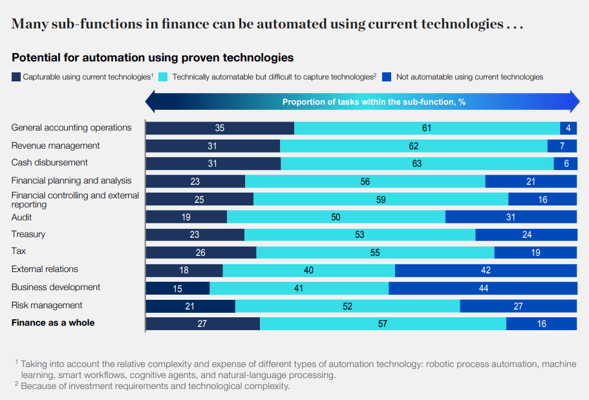
As you can see from the image above, the general accounting operations sub-function has the highest proportion of tasks capturable by current AI technologies.
Companies adopting AI for automation purposes can free up accountants' time to focus on high-impact, strategic activities like financial analysis.
For example, AI-driven systems can automatically categorize transactions, reconcile accounts, and even generate financial statements, significantly reducing the manual effort required. A software company, Accountancy Cloud, has developed AI solutions to automate language or text-based tasks for their clients.
One of the significant advantages of AI in accounting is its ability to reduce human error. Tasks like bookkeeping and financial reporting can be error-prone when managed manually.
AI minimizes these risks by ensuring consistent data accuracy, which enhances the reliability of financial reports. This precision is crucial for businesses that rely on accurate financial data to make critical decisions.
AI empowers businesses with real-time financial data analysis, allowing them to make quicker, informed decisions based on up-to-the-minute financial metrics.
Traditional accounting processes often delay reporting, but AI-driven platforms analyze data continuously, giving organizations immediate insights into cash flow, expenditures, and profitability.
According to J.P. Morgan, AI has the potential to revolutionize cash flow forecasting with AI through the analysis of enterprise data platforms, online media, and regulatory changes.
Adopting AI can lead to considerable cost savings as well. Time and resources spent doing extensive manual work can be saved, allowing organizations to operate with leaner accounting teams.
AI systems can handle massive datasets efficiently, enabling companies to scale their financial operations without a proportional increase in resources.
For example, an Artificial Intelligence Central Europe CFO Survey 2019 by Deloitte found a 40% improvement in effectiveness and 46% in cost reduction in companies that implemented AI for accounting.
The use of AI is relatively new to accounting, but the applications are already making an impact on the industry.
Here are some real-life examples of AI in accounting:
AI plays a crucial role in detecting fraud by analyzing vast volumes of financial data to identify anomalies and suspicious transactions.
Advanced AI algorithms can:
These help to mitigate fraud within an organization.
For example, a bank partnered with Cognizant to create an AI neural network to identify fraudulent checks, saving $20M in fraud losses.
AI also has the potential to transform the audit process. Traditionally labor-intensive tasks can be streamlined through the use of AI.
This is done by analyzing large datasets, reducing the need for manual sample testing, and identifying trends and anomalies that might go unnoticed by human auditors.
This allows auditors to focus on areas requiring professional judgment, thus enhancing the quality of audits.
However, this doesn’t mean the auditor is not involved in the process. According to KPMG, 64% of survey respondents expect auditors to conduct a more detailed review of the control environment in relation to their use of AI. This means that auditors are still required to govern and manage their use of AI in audits.
AI-driven predictive analytics enable accountants to forecast future financial performance and trends with greater accuracy.
Analysis of historical data and external factors can enable AI models to project revenue, cash flow, and other financial metrics, aiding in budgeting and strategic planning.
Generative AI tools, such as language models, simplify the process of drafting financial reports and performing competitor analysis.
These tools can analyze vast amounts of information, generate summaries, and create automated communications, enabling accountants to produce high-quality reports efficiently.
For example, AI can be used for invoice processing, where it can automatically extract and categorize data from invoices, eliminating the manual effort required.
AI is currently being explored and implemented in various areas in both the ‘Big Four’ and beyond. Let’s look at them below:
Leading accounting firms from the big four have also implemented AI in their operations.
Here are some examples:
In KPMG, innovations in AI are being implemented through the KPMG Ignite AI platform. This platform uses machine learning, deep learning and computer vision for various applications in accounting
Ernst & Young Global Limited (EY) is also another competitor of the big four that has begun using AI in their services.
Here are some of their service offerings:
PwC, also known as PricewaterhouseCoopers, is collaborating with OpenAI to be a reseller of ChatGPT Enterprise, a key product focused on B2B.
The company also has plans to roll out the ChatGPT Enterprise license to its 75,000 U.S. employees and 26,000 U.K. employees.
PwC has also developed an internal chatbot, ChatPwC, based on OpenAI’s GPT-4 model. The ChatPwC tool has seen a 20% to 40% increase in productivity among employees.
Deloitte is also taking steps to establish AI as a key part of its audit services. For example, their Digital Audit Technology, Deloitte Omnia, has incorporated AI capabilities through an internal chatbot, DARTbot.
DARTbot is an application of generative AI to create a simplified helpdesk chatbot for audit and assurance professionals to use as a reference and assistant.
Smaller accounting firms also benefit from AI, particularly in automating bookkeeping and tax preparation tasks.
AI tools designed for small businesses can have the following applications:
For example, Xero’s new GenAI-powered smart business companion, Just Ask Xero (JAX), enables small businesses to query any accounting-related matters using a conversational interface. Their customers will not be required to know any AI skills to gain deep insight into their financial data.
Beyond just regular AI, generative AI has been put in the spotlight in recent years for its ability to create new and unique content.
Generative AI is a type of AI that can create new content and ideas, such as text, images, videos, music, and audio. It works by learning from existing data and then generating new data with similar characteristics.
Generative AI is now being applied across various uses, with the most used application being AI chatbots for internal reference.
For example, Deloitte has launched a ‘DARTbot’ internal chatbot to assist audit and assurance professionals to quickly research complex accounting questions
These capabilities allow accounting teams to handle large volumes of routine tasks, increasing their capacity to focus on strategic functions and advising.
With generative AI handling repetitive research and reporting, accounting professionals can dedicate more time to strategic and analytical roles.
This shift allows accountants to better support business objectives, contribute insights, and engage in forward-looking planning rather than routine transactional work.
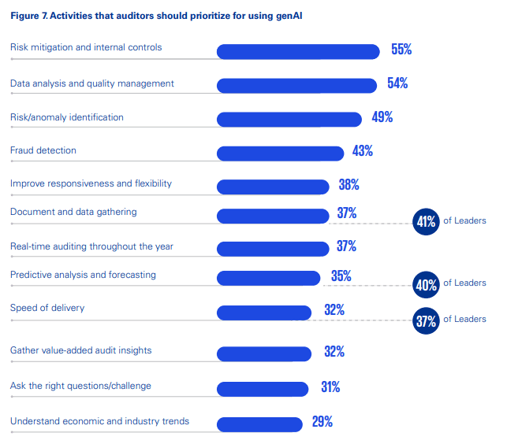
In a report by KPMG, most survey respondents felt that auditors should prioritize using GenAI for risk mitigation and internal controls, and data analysis and quality management, among others.
Having AI in your organization is highly beneficial but ensuring that it is implemented correctly comes with some challenges.
Here are some to take into consideration:
For accounting teams to leverage AI effectively, they require training in data management and AI tools.
This is where DataCamp For Business comes in.
DataCamp For Business delivers enterprise-level solutions to equip your professionals with the skills they need to understand and utilize AI in accounting workflows. With scalable and customizable options, as well as bespoke reporting, your teams can get started with foundational courses like Introduction to ChatGPT and AI Fundamentals and work their way up to expert-level courses.
Make the most of AI technology today, get started here, or Request a Demo.
Working with AI comes with the challenge of ensuring data security and privacy. Financial data is highly sensitive, and organizations must implement robust security measures to prevent breaches.
To tackle this challenge, accounting teams should work with IT departments to establish data protection protocols and monitor systems for potential security vulnerabilities.
AI’s growing role in accounting raises ethical questions as well.
Like most use cases of AI, there are issues that need to be addressed such as:
For example, a study found that AI was found not completely effective in tax accounting, due to the possible tax implications that may give rise from incorrect information.
Organizations need to adopt AI responsibly, ensuring that its application aligns with AI regulatory standards and industry best practices.
Some regulatory standards to keep in mind are:
AI is reshaping the accounting profession, automating routine tasks, enhancing accuracy, and enabling real-time financial insights. With its potential to improve efficiency and reduce costs, AI offers significant benefits for accounting firms of all sizes.
However, to fully harness AI’s capabilities, firms must address challenges related to training, data security, and ethical use. If your organization is looking to explore areas for AI implementation and requires necessary training, get started with DataCamp for Business today.
AI is used in accounting to automate manual tasks, analyze large amounts of data, and provide insights for decision-making.
No, AI is not meant to replace accountants but rather help them in their work. It can automate repetitive tasks and provide insights for more informed decision-making.
Some benefits include increased efficiency, reduced human error, improved data analysis, and cost savings.
Yes, some potential risks include privacy concerns, bias in algorithms, and job displacement for certain roles within accounting.
Companies can start by identifying areas where AI could be beneficial and then implementing a plan to train employees on essential AI skills. Alternatively, they can also have a team of external experts create an AI solution.

I'm Austin, a blogger and tech writer with years of experience both as a data scientist and a data analyst in healthcare. Starting my tech journey with a background in biology, I now help others make the same transition through my tech blog. My passion for technology has led me to my writing contributions to dozens of SaaS companies, inspiring others and sharing my experiences.

บล็อก
 Austin Chia• 12 นาที

บล็อก
 Tom Farnschläder• 8 นาที

บล็อก
 Javier Canales Luna• 10 นาที
Top DataCamp Courses
แทร็ก
ก้าวหน้าในเส้นทาง AI ได้รวดเร็วยิ่งขึ้น เพิ่มประสิทธิภาพการทำงานด้วยเครื่องมือ AI และพัฒนากลยุทธ์ AI ที่ครอบคลุม
คอร์ส
เรียนรู้บทบาทที่ปัญญาประดิษฐ์เชิงกำเนิดมีในปัจจุบันและจะมีในอนาคตในสภาพแวดล้อมทางธุรกิจ
ฝึกฝนและตรวจสอบความก้าวหน้าของคุณ
ดำเนินการต่อด้วย Googleเมื่อดำเนินการต่อ ถือว่าคุณยอมรับ ข้อกำหนดการใช้งานและ นโยบายความเป็นส่วนตัว และยอมรับว่าข้อมูลของคุณจะถูกจัดเก็บในสหรัฐอเมริกา


Many accountants are leaving the profession, with the number of accountants in the U.S. falling by 15.9% since 2019. With such alarming statistics, leaders in the industry are likely to be searching for new ways to bolster their operations or attract talent and keep their businesses relevant. One solution that is gaining popularity is the use of artificial intelligence (AI) in accounting.
In this article, we'll explore the importance of AI in accounting, some real-life examples of AI implementations, and some possible challenges.