
Tracks
Artificial intelligence and machine learning are transforming industries, making certifications one of the clearest ways for professionals to validate their skills and stand out. These credentials signal expertise to employers and confirm holders are current with today's ML tools, frameworks, and methodologies.
This guide covers the top machine learning certifications for 2026, from cloud credentials issued by AWS, Google Cloud, Microsoft, and Databricks, to the eCornell academic certificate, and DataCamp's own AI Engineer for Data Scientists Associate and AI Engineer for Developers Associate certifications. For each option, I cover prerequisites, cost, exam format, and who it is best suited for.
Get certified in your dream data role
Our certification programs help you stand out and prove your skills are job-ready to potential employers.

TL;DR
- Machine learning certifications validate your ML skills and open doors to roles like ML engineer, data scientist, and AI engineer
- Top cloud credentials: AWS Certified Machine Learning Engineer – Associate ($150, 130 min), Google Cloud Professional ML Engineer ($200), and Microsoft Azure Data Scientist Associate ($165)
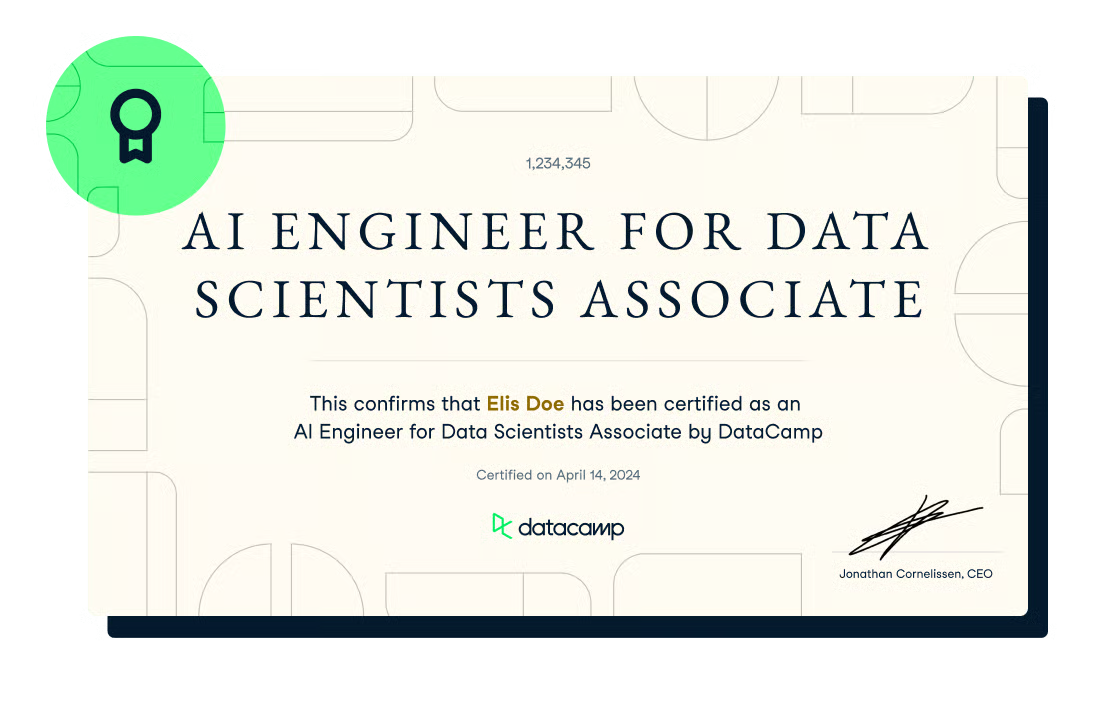
- DataCamp's AI Engineer for Data Scientists Associate and AI Engineer for Developers Associate certifications are both included with a Premium subscription and assessed through practical, scenario-based coding exams
- Cloud certifications from AWS, Google, and Azure carry strong employer recognition for platform-specific ML roles
- Choose based on your situation: cloud-platform certs for engineers already working in AWS/GCP/Azure; DataCamp AI Engineer certs for those building ML and AI skills from scratch or moving into AI engineering roles
What is Machine Learning Certification?
A machine learning certification is a formal credential that validates an individual’s expertise in machine learning (ML) concepts, techniques, and applications. Offered by educational institutions, technology companies, and professional organizations, it demonstrates the holder's ability to design, implement, and manage ML projects.
Key aspects of machine learning certification include:
- Skill Validation: Certifies proficiency in tackling ML tasks like data preprocessing, model selection, deployment, and optimization.
- Industry Recognition: Signals expertise to employers and peers, enhancing professional credibility and job market appeal.
- Structured Learning: Provides a clear learning pathway, ensuring comprehensive knowledge of core ML topics.
- Career Growth: Opens doors to new opportunities, higher salaries, and influential roles in the data science field.
- Continuous Development: Encourages ongoing learning to stay updated with advancements in ML technologies and methodologies.
In short, a machine learning certification is a direct signal to employers that you can design, implement, and manage ML systems — not just describe how they work.
The Top Machine Learning Certifications For 2026
Now that we know the value of a machine learning certification, let’s look at some of the top options out there. These are offered by some of the biggest names in the industry, potentially giving you the edge over the competition in the job market.
1. AWS Certified Machine Learning Engineer – Associate
The AWS Certified Machine Learning Engineer – Associate is the primary AWS credential for practitioners building and operationalizing ML workloads in production. It focuses on Amazon SageMaker, MLOps workflows, and deploying models at scale — a more accessible entry point than the advanced Specialty exam, requiring around 1 year of experience rather than 2.
- Who it's for: Backend developers, data engineers, MLOps engineers, and data scientists working with AWS ML services.
- Prerequisites: At least 1 year of hands-on experience with Amazon SageMaker and related AWS services.
- Duration: 130 minutes, 65 questions.
- Cost: $150.
Practitioners with 2+ years of AWS ML experience may prefer the AWS Certified Machine Learning – Specialty ($300, 180 minutes), which covers data engineering, modeling, and ML implementation across the full AWS stack in greater depth.
2. Google Cloud Certified - Machine Learning Engineer
This certification is designed for professionals who build and maintain models in Google Cloud. It emphasizes integrating ML models into applications and managing model performance. The certification is ideal for those who are familiar with Google Cloud products and solutions.
- Who it's for: Individuals who build and maintain machine learning models on Google Cloud.
- Prerequisites: None officially, although 3 years of industry experience is recommended, with 1 or more years of designing and managing solutions using Google Cloud.
- Duration: Two-hour exam, 50-60 multiple choice and multiple select questions.
- Cost: $200.
3. Microsoft Certified: Azure Data Scientist Associate
Microsoft's certification is for professionals who apply Azure's ML and AI services in their workflow. It tests skills in data science and machine learning, emphasizing the integration of Azure services. This certification is suitable for those who are looking to demonstrate their proficiency in cloud-based ML solutions.
- Who it's for: Professionals specializing in applying data science and ML on Azure, including designing environments for data science workloads, training models, and deploying scalable solutions.
- Prerequisites: Experience in Azure Machine Learning and MLflow, with a focus on practical application in data science.
- Duration: Specific duration not provided for the certification, but it includes an exam.
- Cost: $165.
4. Databricks Certified Machine Learning Professional
Databricks' certification focuses on applied ML skills, especially in big data environments. It assesses the ability to build, tune, and deploy ML models using the Databricks platform. This certification is particularly valuable for those who work with big data and are looking to implement scalable ML solutions.
- Who it's for: Individuals capable of performing advanced ML tasks using Databricks Machine Learning, including experiment tracking, model lifecycle management, deployment, and monitoring for data drift.
- Prerequisites: No specific prerequisites stated, but related training and hands-on experience with the relevant ML tasks are highly recommended.
- Duration: 120 minutes for the exam.
- Cost: $200.
5. eCornell Machine Learning Certificate
The eCornell certificate offers an academic approach to machine learning. It is designed to provide a strong theoretical foundation as well as practical skills in ML. This program is ideal for those who prefer a more structured, educational approach to learning ML.
- Who it's for: Programmers, developers, data analysts, statisticians, data scientists, software engineers.
- Prerequisites: Prior experience in math, familiarity with Python, probability theory, statistics, multivariate calculus, and linear algebra recommended.
- Duration: Approximately 3.5 months, with an estimated effort of 6-9 hours per week.
- Cost: $3,750.
Machine learning certifications compared
The table below compares all certifications covered in this guide, including DataCamp's AI Engineer certifications and the main cloud provider credentials:
| Certification | Target Audience | Prerequisites | Duration | Cost |
|---|---|---|---|---|
| DataCamp AI Engineer for Data Scientists Associate | Data scientists and ML practitioners validating AI engineering skills | Python proficiency; foundational ML knowledge recommended | 2 timed exams (2 hrs each) + practical exam (4 hrs); 30-day window | Included with Premium |
| DataCamp AI Engineer for Developers Associate | Software developers building AI-powered applications | Programming experience; no ML background required | 1 timed exam (2 hrs) + practical exam (4 hrs); 30-day window | Included with Premium |
| AWS Certified Machine Learning Engineer – Associate | MLOps engineers, data engineers, developers working with AWS ML services | 1+ year hands-on experience with Amazon SageMaker | 130 minutes, 65 questions | $150 |
| Google Cloud Certified – Professional ML Engineer | Professionals building and maintaining ML models on Google Cloud | 3 years industry experience recommended; 1+ years with Google Cloud | 2-hour exam, 50-60 questions | $200 |
| Microsoft Certified: Azure Data Scientist Associate | Professionals applying data science and ML on Azure | Experience in Azure Machine Learning and MLflow | Exam (duration not published) | $165 |
| Databricks Certified Machine Learning Professional | Advanced ML practitioners using Databricks | Hands-on experience with Databricks ML recommended | 120 minutes | $200 |
| eCornell Machine Learning Certificate | Programmers, analysts, data scientists, engineers | Python, math, probability theory, statistics, and linear algebra recommended | ~3.5 months, 6–9 hrs/week | $3,750 |
| AWS Certified Machine Learning – Specialty | Experienced ML practitioners and architects with 2+ years on AWS | 2 years hands-on AWS ML/deep learning experience | 180 minutes | $300 |
Getting Machine Learning Certified With DataCamp
DataCamp supports certification in two ways: as a preparation platform for cloud provider credentials (AWS, Google Cloud, Azure), and as a certification provider in its own right. Our AI Engineer for Data Scientists Associate and AI Engineer for Developers Associate certifications are both included with a Premium subscription and assessed through practical, scenario-based coding exams in Python. Here's how our platform supports both paths:
1. Comprehensive course offerings
DataCamp provides a variety of machine learning courses tailored for different skill levels, from beginners to advanced practitioners. Our Machine Learning Fundamentals with Python skill track is designed to build foundational knowledge, whereas more specialized courses such as Developing Machine Learning Models for Production and Feature Engineering for Machine Learning in Python focus on practical applications and advanced concepts in machine learning.
2. Hands-on learning experience
Our platform emphasizes a hands-on, interactive approach to learning. This method is particularly beneficial for grasping complex machine learning concepts and applying them in real-world scenarios.
With courses like Practicing Machine Learning Interview Questions in Python and Introduction to Deep Learning with Keras, learners can sharpen their skills through practical exercises and projects.
3. Access to diverse learning materials
DataCamp offers a wealth of tutorials, webinars, and blog posts that complement their course offerings. These additional resources provide in-depth insights into various machine learning topics and the latest industry trends.
Resources such as What is a Confusion Matrix in Machine Learning? and A Comprehensive Introduction to Anomaly Detection are great for expanding your understanding beyond the structured course content.
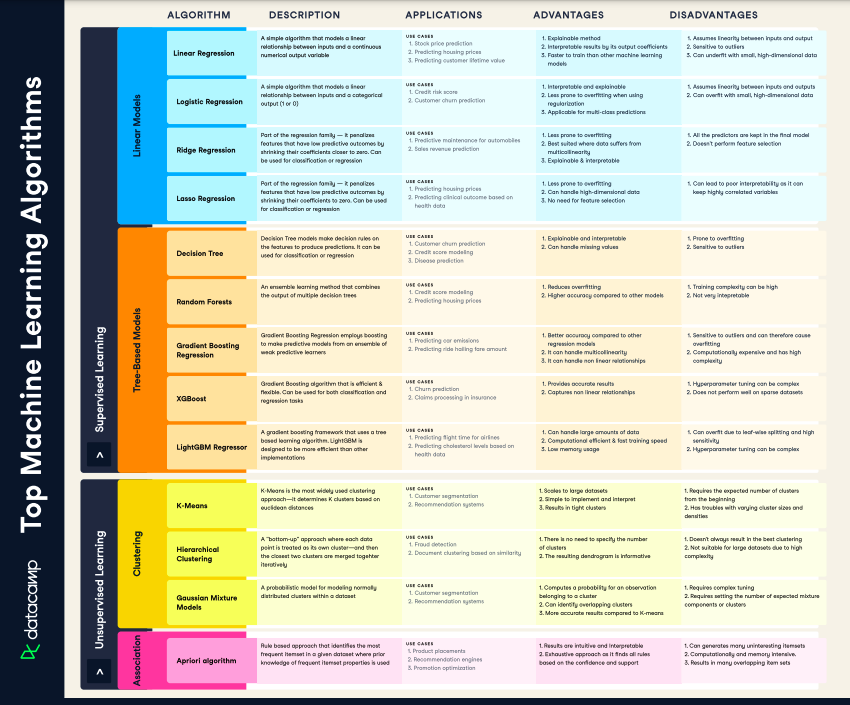
Our Machine Learning cheat sheet can help you prepare for certification
4. Project-based learning
Applying your skills to real-world projects is critical for understanding the practical aspects of machine learning. DataCamp provides project-based learning opportunities where you can work on real datasets and solve actual machine learning problems.
Our list of the top machine learning projects for all levels allows you to apply what you’ve learned in a practical, hands-on manner.
5. Preparation for machine learning interviews
If you’re aiming to secure a job in machine learning, DataCamp’s courses can help you prepare for technical interviews. The platform offers resources specifically designed to help you practice common machine learning interview questions.
Using our course library, hands-on exercises, and supporting resources, you can build the practical skills needed to pass external ML certifications or earn one of DataCamp's own AI Engineer credentials.
Role-Specific Certifications with DataCamp
DataCamp offers role-based certifications assessed through a combination of timed exams and practical Python coding tasks. All certifications are included with a Premium subscription and valid for 2 years. The two most relevant for machine learning and AI practitioners are the AI Engineer certifications, listed first below:
1. AI Engineer for Data Scientists Associate
- Target audience: Data scientists and ML practitioners who want to validate their skills in building, fine-tuning, and deploying AI solutions — including working with LLMs like Llama 3 in production environments.
- Key learning areas: Data management, exploratory analysis, AI governance, Python programming for AI, model development, and production system deployment.
- Structure and assessment: 2 timed exams (2 hours each) covering statistical experimentation, exploratory analysis, governance, and application development, plus a 4-hour practical exam based on a real-world scenario in Python. 30-day window from registration to complete all requirements.
- Preparation track: Associate AI Engineer for Data Scientists (40 hours, 43K+ learners) — included with Premium.
2. AI Engineer for Developers Associate
- Target audience: Software developers and engineers who want to integrate AI into applications using APIs and open-source libraries — including building chatbots, recommendation engines, and semantic search tools with LLMs and vector databases.
- Key learning areas: AI governance, model usage, prompt engineering, programming for AI, and developing AI-powered applications.
- Structure and assessment: 1 timed exam (2 hours) plus a 4-hour practical exam with 3 real-world tasks completed in Python. 30-day window from registration.
- Preparation track: Associate AI Engineer for Developers (29 hours, 5.9K learners) — included with Premium.
3. Data Analyst Certification
- Target audience: Ideal for professionals who want to excel in data analysis using tools like Python, R, SQL, and Tableau.
- Key learning areas: The certification covers data manipulation, data visualization, and statistical analysis, equipping learners with the skills to derive actionable insights from data.
- Structure and content: The program includes a blend of courses, hands-on exercises, and projects, ensuring a comprehensive understanding of data analysis concepts.
4. Data Scientist Certification
- Target audience: Suitable for individuals aiming to become data scientists, focusing on skills like statistical analysis, machine learning, and data manipulation.
- Key learning areas: This certification covers a wide range of topics from exploratory data analysis to machine learning, deep learning, and even advanced subjects like NLP.
- Structure and content: It provides an in-depth understanding of data science methodologies and tools, including practical applications and project work.
5. Data Engineer Certification
- Target audience: Designed for professionals interested in data engineering, focusing on building scalable data infrastructure and pipelines.
- Key learning areas: The certification encompasses big data processing, data engineering tools (like Spark), and working with databases.
- Structure and content: It combines theoretical knowledge with practical skills, enabling learners to build efficient data storage and retrieval systems.
What Jobs Can You Get with Machine Learning Certification?
Machine learning certification opens the door to a wide range of career opportunities in the tech industry, as it validates your expertise in one of the most sought-after fields. Here are some of the key roles that candidates with machine learning certification can pursue:
1. Machine Learning Engineer
- Role: Design and implement machine learning models to solve business problems, optimizing algorithms for performance and scalability.
- Skills: Proficiency in programming languages like Python or R, knowledge of ML frameworks (e.g., TensorFlow, PyTorch), and experience with cloud computing platforms.
Check out our full guide on how to become a machine learning engineer to find out more.
2. Data Scientist
- Role: Analyze and interpret complex data to help organizations make informed decisions. Use machine learning techniques to predict future trends and patterns.
- Skills: Strong analytical skills, experience with statistical tools and software, and the ability to communicate findings effectively.
Find out more about how to become a data scientist in our eight-step guide.
3. NLP (Natural Language Processing) Engineer
- Role: Work on systems that enable computers to understand, interpret, and generate human language. Applications include chatbots, translation services, and sentiment analysis.
- Skills: Knowledge of linguistics, experience with NLP libraries and frameworks, and programming skills.
Our Natural Language Processing With Python skill track can help you master the fundamentals you'll need to pursue this career.
4. Data Analyst
- Role: Extract and analyze data to identify trends, patterns, and insights. Often involves the use of machine learning techniques to enhance data analysis.
- Skills: Strong statistical background, proficiency in data visualization tools, and experience with SQL and programming languages.
Read more about how to become a data analyst and what the role entails in our separate guide.
5. Business Intelligence Developer
- Role: Develop, deploy, and maintain BI interfaces, such as query tools, data visualization dashboards, and data modeling tools, incorporating machine learning models for predictive analytics.
- Skills: Experience with BI tools, knowledge of database management, and understanding of machine learning applications in business.
Our guide on how to become a Power BI developer can help you move into this field.
Machine Learning Certification vs Machine Learning Certificate
Machine learning certifications and certificates serve distinct roles in professional development:
- Certifications: Formal endorsements from reputable organizations, demonstrating mastery of machine learning. These credentials often require passing rigorous exams and are highly valued for advanced roles in the industry.
- Certificates: Awarded upon completing specific courses or programs, focusing on particular skills or knowledge areas. They typically involve course completion and project work, rather than standardized exams. While certificates show a commitment to learning, they carry less weight in validating expertise compared to certifications.
Both pathways can enhance your professional profile, but certifications are more suitable for showcasing comprehensive proficiency, while certificates are ideal for targeted skill development.
Why Pursue a Machine Learning Certification?
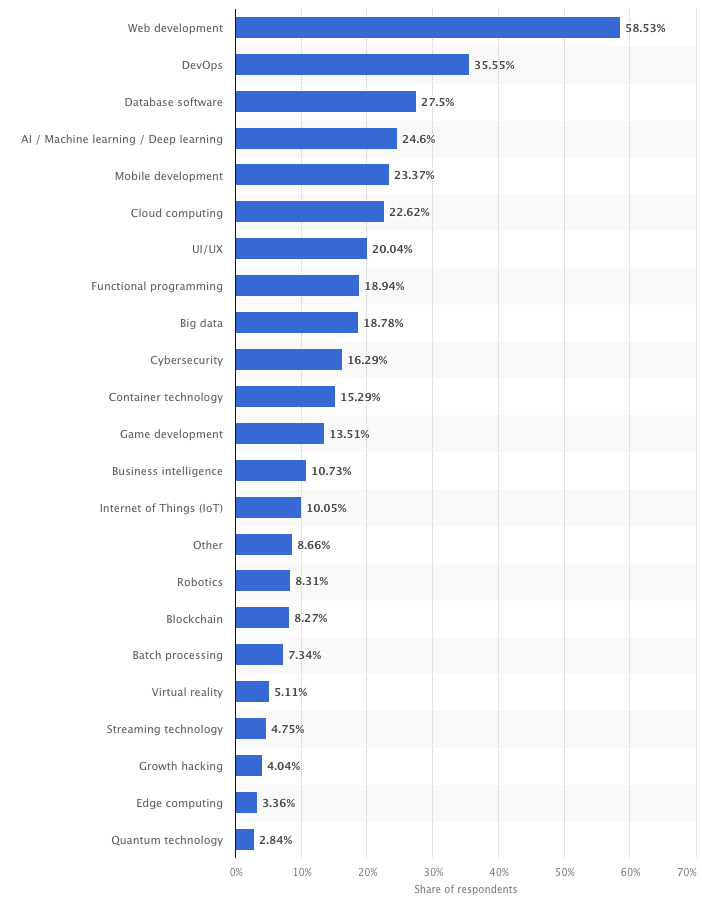
The World Economic Forum predicts a significant increase in demand for AI and ML specialists, expecting a growth of 40% between 2023 and 2027. Similarly, Statista suggests that AI and machine learning are some of the most in-demand tech skills. As such, machine learning certifications are more than just educational accomplishments; they are gateways to new career opportunities and pathways for professional advancement.
For professionals looking to transition into ML roles or those seeking to solidify their expertise in the field, a certification acts as a powerful tool. It signals to employers a commitment to the field, a readiness to tackle complex ML challenges, and a dedication to staying abreast of the latest developments.
Moreover, as the demand for skilled ML practitioners continues to grow, certifications can be the differentiator that sets candidates apart in a crowded job market. They offer tangible proof of skills, often aligning with industry standards and requirements, thus making certified individuals highly attractive to potential employers.

Machine learning is one of the most in-demand tech skills - source
Choosing the Right Certification for You
With a variety of machine learning certifications available, selecting the one that best aligns with your career aspirations and skill level is crucial. Here are some key considerations to help you make the right choice:
Assess your current skill level and career goals
Begin by evaluating your current expertise in machine learning. Are you a beginner looking to gain foundational knowledge, or are you an experienced practitioner seeking advanced skills? Also, consider your long-term career goals. For instance, if you're interested in cloud-based ML solutions, certifications from AWS, Google Cloud, or Microsoft Azure might be more relevant.
Consider the certification's focus and curriculum
Each certification has a unique focus. For example, AWS and Azure certifications are more aligned with cloud services, whereas the eCornell certificate provides a broader, academic approach. Review the curriculum and learning outcomes of each certification to ensure they match your learning needs and the specific skills you want to acquire.
Explore the prerequisites and commitment required
Consider the prerequisites for each certification. Some may require prior experience or familiarity with specific tools and languages. Additionally, assess the time and financial commitment required for each certification. Balancing these factors with your personal and professional commitments is essential.
Consider the industry recognition and career advancement opportunities
Research how different certifications are perceived in the industry. Look for testimonials or case studies of professionals who have completed the certifications. This can provide insights into how these certifications have impacted their careers and how they might influence yours.
Final Thoughts
The right certification depends on where you are in your career. For engineers working in AWS, Google Cloud, or Azure environments, a cloud provider credential signals platform-specific competency to hiring managers in those ecosystems.
For those building ML and AI skills from scratch, or moving into AI engineering roles, DataCamp's AI Engineer for Data Scientists Associate or AI Engineer for Developers Associate are practical starting points: scenario-based, included with Premium, and requiring no prior cloud platform experience.
Start with our Machine Learning Fundamentals with Python skill track to build the foundational knowledge needed for any of the certifications in this guide — or go directly to the Associate AI Engineer for Data Scientists track (40 hours) if you're ready to pursue DataCamp certification.
Get certified in your dream data role
Our certification programs help you stand out and prove your skills are job-ready to potential employers.

A senior editor in the AI and edtech space. Committed to exploring data and AI trends.
Machine Learning Certification FAQs
Who should consider getting a machine learning certification?
Anyone looking to validate their skills in machine learning, advance their career in data science or AI, or transition into a role requiring ML expertise. This includes data scientists, software engineers, and professionals in related fields.
Do I need to have a background in programming to pursue machine learning certification?
Yes, a fundamental understanding of programming, typically in Python or R, is essential for most machine learning certifications. Some programs may require more advanced programming skills.
Are there any prerequisites for machine learning certifications?
Prerequisites vary. Some certifications require years of relevant experience or knowledge of specific technologies and platforms. It's important to review the prerequisites of each certification to ensure you meet them before applying.
Can machine learning certification help me get a job?
Yes, certifications can significantly enhance your resume by demonstrating your expertise and commitment to the field. They are often valued by employers when hiring for roles that require machine learning skills.
Is machine learning certification worth it?
For many professionals, the answer is yes. Certifications can open up new career opportunities, lead to higher salaries, and help you stay competitive in a fast-evolving field.
Are there any other types of certifications that will benefit my career?
If you're looking to prove your expertise in machine learning, a Tensorflow certification, AI certification, prompt engineering certification or Python certification may also be of interest to you.
Does DataCamp have a machine learning certification?
Yes. DataCamp offers two AI Engineer certifications directly relevant to machine learning: the AI Engineer for Data Scientists Associate, which tests data management, exploratory analysis, AI governance, and production ML deployment, and the AI Engineer for Developers Associate, which focuses on building AI-powered applications using APIs and open-source libraries. Both are included with a DataCamp Premium subscription and use practical, scenario-based Python coding exams.