Kurs
Python ile DeepSeek Kullanımı
3 sa
1.3K
DeepSeek serves V4.1 Flash through the API under the model ID deepseek-flash. It accepts image input, supports thinking and non-thinking modes, has a 1M-token context window, and can return up to 384K tokens through Chat Completions and the Responses API.
Our DeepSeek V4.1 Flash overview covers the launch, architecture, and benchmarks.
DeepSeek describes V4.1 Flash as a 552B-parameter MoE backbone, while Hugging Face reports 763B parameters for the published checkpoint. The gap is mostly the 196B-parameter Engram conditional memory, plus the vision encoder and projector, all components that ship in the checkpoint but sit outside the MoE backbone.
Its Causal Encoder-Decoder design reuses cached encoder states, with 8B active parameters per token during input processing and 16B during output.
V4.1 Flash is the first model in the new V4.1 architecture family, with image understanding built in natively. Visual and text embeddings are trained jointly from the start of pre-training, rather than added afterward as in the experimental V4-Flash-Vision-Exp.
The Responses API predates V4.1 Flash; DeepSeek added native support during the earlier V4 rollout. The retired model names deepseek-v4-flash and deepseek-v4-flash-vision-exp now route to V4.1 Flash.
DeepSeek's pricing is based on peak hours, with off-peak rates set at 50% of peak. When I ran the agent, cached input cost $0.003 per million tokens off-peak and $0.006 peak, uncached input cost $0.15 off-peak and $0.30 peak, and output cost $0.60 off-peak and $1.20 peak, per DeepSeek's pricing page.
Peak hours run 01:00 to 04:00 and 06:00 to 10:00 UTC, Monday through Friday, excluding Chinese public holidays. Every other hour is off-peak, and Chinese public holidays are off-peak in full.
Nimbus Analytics Launch Metrics is a Flask dashboard for total visitors, signups, conversion rate, revenue, and daily signups. I placed three bugs across three files and did not tell the agent what they were. The code and the broken dashboard are in this GitHub repository.
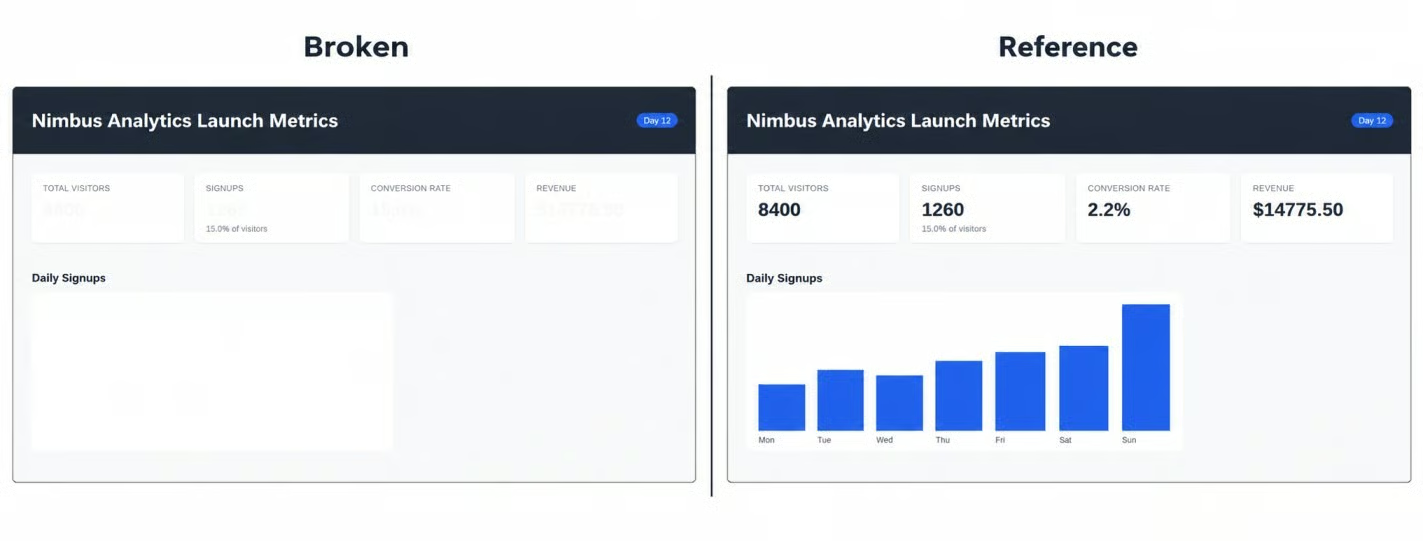
Broken dashboard next to the reference design. Image by Author.
The three bugs need different evidence. One appears in the screenshot, one affects browser behavior, and one fails pytest. The agent receives no bug list.
Before handing this to the agent, I define what "fixed" means: the pytest suite must pass, and a fresh screenshot must visually match a reference image. The model's opinion alone is not enough, so the runner checks both forms of evidence.
The loop alternates between a model request and local tool execution. V4.1 Flash returns reasoning, a message, or tool calls; Python runs the requested tools and adds the results to history. The loop stops when the model answers without another tool call or reaches the limit of fourteen turns.
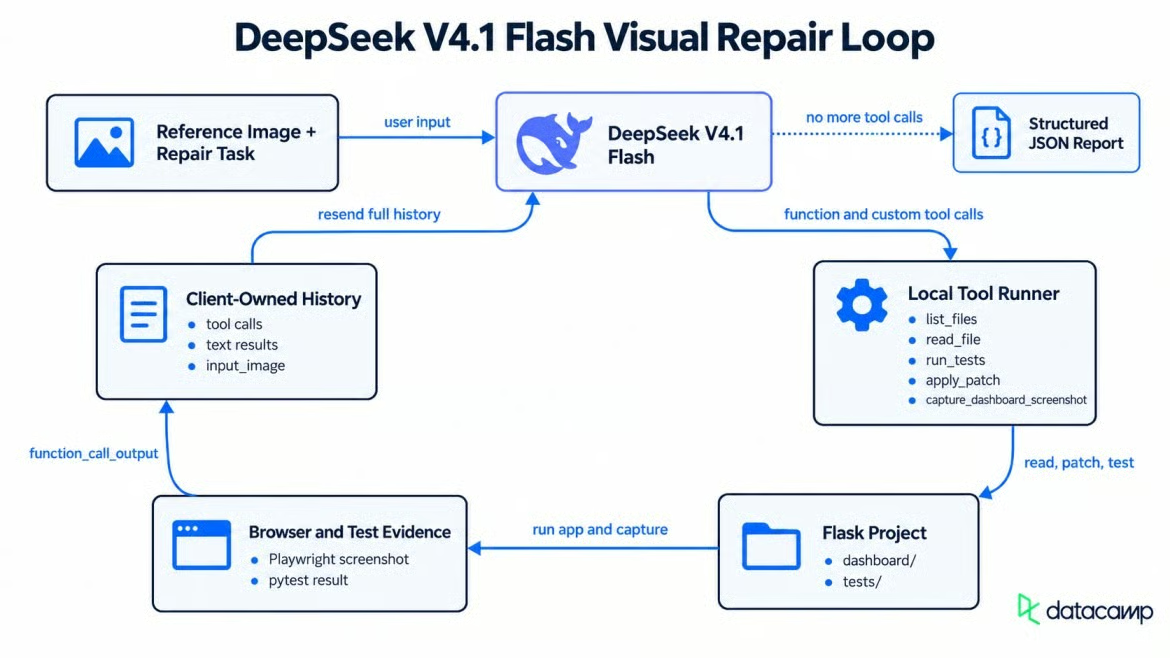
Repair loop connecting model, tools, and browser. Image by Author.
You'll need Python 3.10 or newer and a DeepSeek API key with credit. DeepSeek's API follows the OpenAI request format, so this project uses the openai Python package with base_url set to DeepSeek.
Create a virtual environment and install what the project needs.
python3 -m venv .venv
source .venv/bin/activate
pip install openai flask playwright pytest python-dotenv requests streamlit
playwright install chromium
I tested this with openai 3.14.1, flask 3.1.3, and playwright 1.63.0. Save the key in a .env file at the project root as DEEPSEEK_API_KEY=sk-... and load it with python-dotenv. If your key already works with the Responses API, skip the next code block; otherwise, the request checks the key and base URL.
from openai import OpenAI
import os
from dotenv import load_dotenv

load_dotenv()
client = OpenAI(api_key=os.environ["DEEPSEEK_API_KEY"], base_url="https://api.deepseek.com")

response = client.responses.create(model="deepseek-flash", input="Say hi in five words.")
print(response.output_text)
If that prints a short greeting, the key and base URL work.
The agent's first input contains a reference screenshot, a short task, and the live URL. This is the only image sent in a user message. Every later screenshot comes from a tool.
The runner sends the reference image as a base64 data URL with every request. DeepSeek recommends the Files API when an image is reused. A file_id avoids sending the same image data each time.
In the attached image, I asked what the model would check first, but there were no tools. This let me inspect its plan before it could edit anything. The response proposed listing the project files, tracing CSS variables, and taking a screenshot; I used reasoning: {"effort": "high"}, DeepSeek's default thinking level.
The agent gets four function tools and one custom tool.
list_files and read_file inspect the project, both restricted to dashboard/ and tests/.
run_tests runs pytest.
capture_dashboard_screenshot launches headless Chromium through Playwright.
The custom tool is apply_patch, declared as {"type": "custom", "name": "apply_patch"} and accepted "for Codex compatibility." Any other custom tool name returns a 400 error, while built-in types like web search and computer use are silently ignored.
Function arguments arrive as JSON text and are checked before Python runs them. apply_patch arrives as a custom tool input, so the code handles it separately and checks the patch before writing files. Tool errors are returned to the model instead of stopping the loop.
When capture_dashboard_screenshot runs, its result is not saved to disk. Python returns it as an input_image part inside function_call_output. DeepSeek then reads the screenshot as an image rather than a text description.
history.append({
    "type": "function_call_output",
    "call_id": item.call_id,
    "output": [{"type": "input_image", "image_url": f"data:image/png;base64,{png_b64}"}],
})
The agent can patch the CSS, take another screenshot, and check whether the numbers are readable.
History lives in a Python list because the API does not support previous_response_id or server-side conversations. Thinking mode also requires every reasoning item from earlier tool turns.
Important: If the tool output is inserted between two calls from the same turn, the next request returns a 400 error. Append every item from response.output in order, then run the tools and append their results.
The runner limits the agent to fourteen turns and the dashboard/ and tests/ directories. It provides no shell access, checks tool arguments, and uses pytest for verification.
Yes, via the Responses API, DeepSeek V4.1 Flash accepts a JSON Schema through text.format. The Chat Completions response_format supports JSON mode but not schemas. After the loop stops, the final request records the bugs, fixes, test results, screenshot results, and verification method.
The project also includes a Streamlit app in app_streamlit.py. The same agent runs as a generator with stream=True, so the page shows reasoning text and tool calls as they arrive. The sidebar changes the reasoning effort and image detail.
Streamlit UI streams the agent run. Video by Author.
The run looked finished after one patch, but the live page disagreed.
The agent used its first two turns to look before touching anything: turn one listed the files and took a baseline screenshot, turn two read app.py, index.html, style.css, and the test file.
Turn three ran pytest, then turn four applied one patch that corrected the conversion formula, changed the metric color, and matched the JavaScript lookup to the canvas ID.
-    conversion_rate = data["conversions"] / data["signups"] * 100
+    conversion_rate = data["conversions"] / data["total_visitors"] * 100
Running the tests on turn five showed all five passing. This is where the run stopped being tidy. Every new screenshot still showed a 15% conversion rate and a blank chart.
The agent confirmed that the files on disk contained the fixes, retried the screenshot, and probed whether the server was loading the changed Python and template files. Two temporary freshness checks also failed to appear in the live page.
By turn fourteen, the loop had reached its budget and identified the cause: run_tests checks code on disk, while the screenshot checks a running process with a stale state. Flask started with debug=False, so no reloader loaded the changed Python module, and template auto-reload was not enabled.
The CSS change appeared while the Python-derived value and template-backed chart remained stale. Pytest imported app.py from disk, so green tests did not guarantee a fresh page.
After I restarted Flask, the dashboard matched the reference image. The missing piece was a restart_server tool, not another code patch.
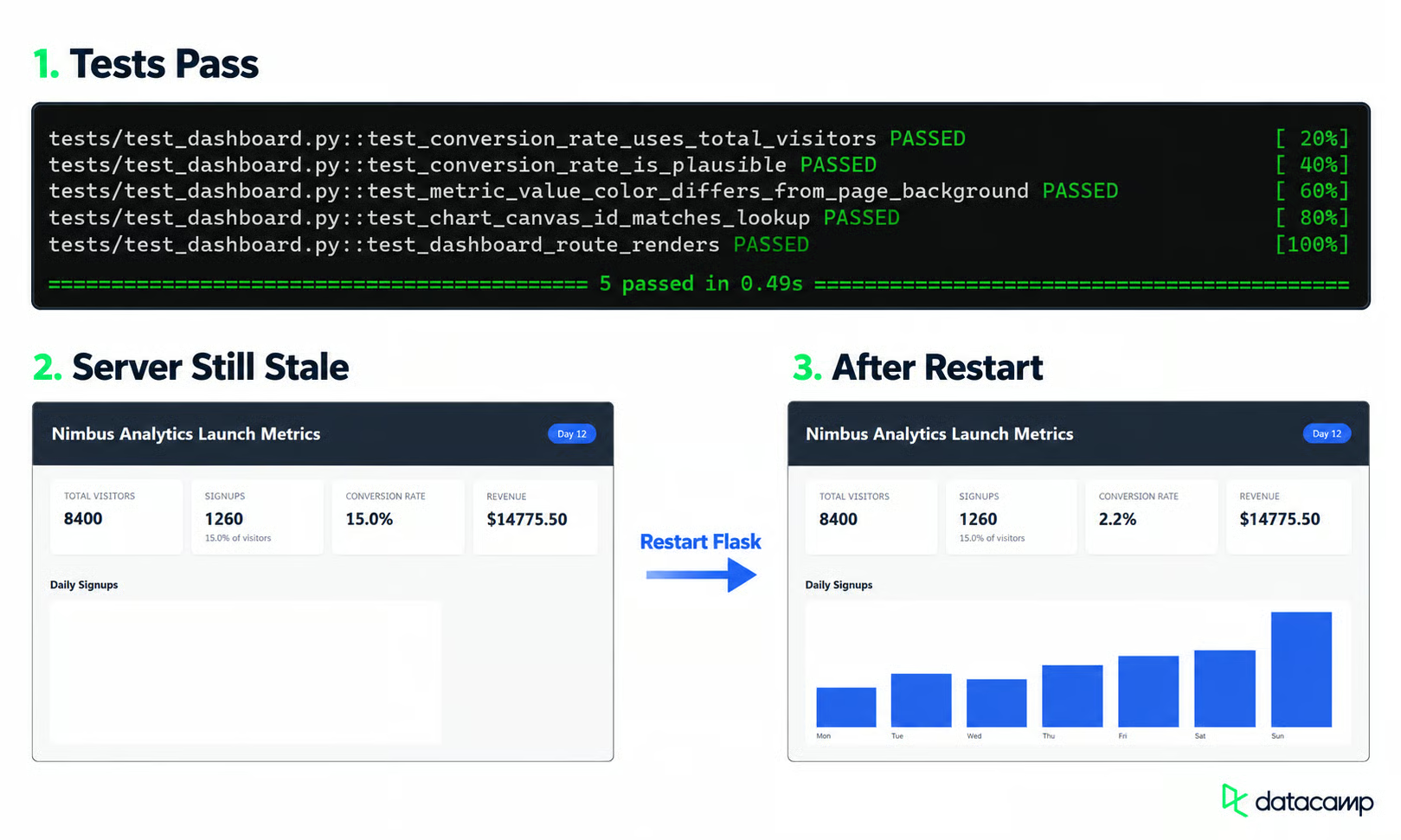
Restart makes patched dashboard changes visible. Image by Author.
Yes, the agent fixed the dashboard on disk. It changed only the three faulty files, and pytest went from four failures to five passing tests. The live page showed every fix after Flask restarted.
Because the agent resends its history, later requests repeat much of the input from earlier turns. DeepSeek checks this repeated prefix against its automatic cache. The cache operates on a best-effort basis, so these figures apply only to this run.
Across fourteen repair turns and the final JSON report request, the API reported 156,724 input tokens, including 137,088 cached tokens, an 87% hit rate. Output came to 11,497 tokens, including 9,362 reasoning tokens. The run fell during off-peak hours, so all fifteen requests cost only roughly $0.0103.
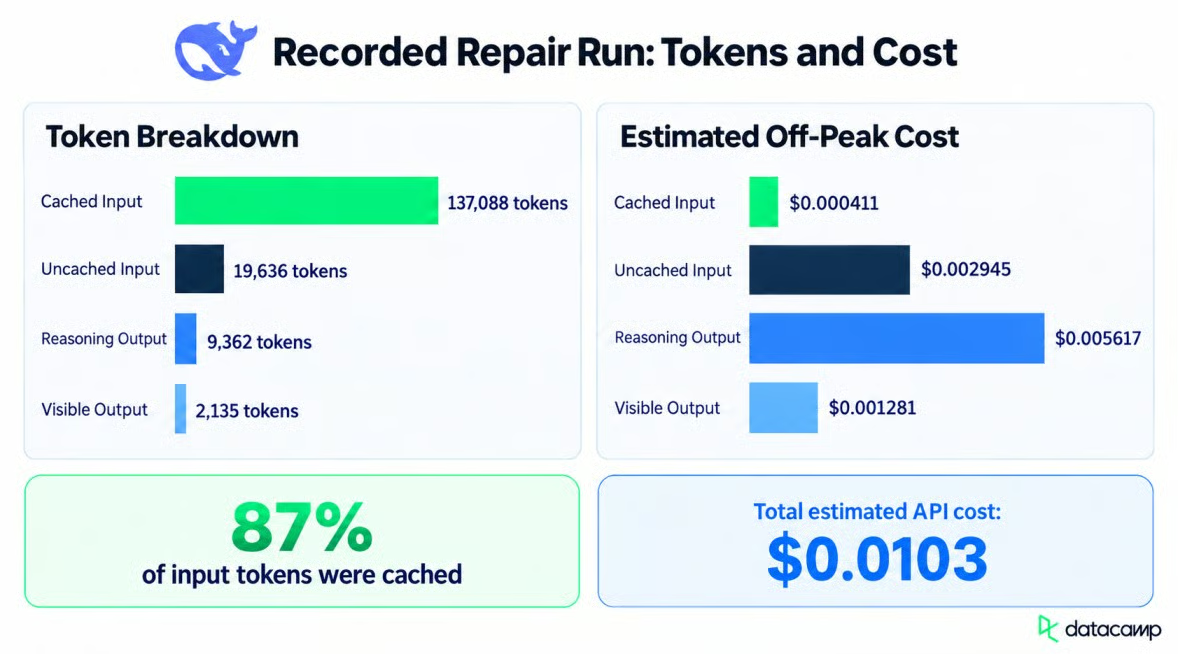
Reasoning output is the largest cost category. Image by Author.
A larger codebase, more screenshots, or fewer cache hits would change both the token count and cost.
Three API limits matter before this runner grows beyond the demo.
Background responses are not supported, so long turns block until they finish.
parallel_tool_calls and max_tool_calls are ignored; parallel tool calling stays enabled.
Automatic truncation is not supported, so requests exceeding the context limit return a 400 error.
Before using this pattern in a live service, place the controls in application code rather than in model instructions.
Use apply_patch when a single change must update multiple files, as it did here. Run tests after the patch, because a single bad call can damage several files.
Use read_file and write_file when each edit needs a separate check or approval. They take more turns, but a bad edit affects one file at a time.
The visual repair loop fixed all three bugs in one patch, but the run was not a clean success. Pytest passed while Flask still served the old Python and template output, so the agent could not confirm the final page until I restarted the server.
I would add a restart_server tool and a pixel comparison before testing a larger app. I would keep the file boundary and turn limit, then treat pytest and the screenshot comparison as separate checks. Passing one should never stand in for passing the other.
Learn AI With DataCamp!
Kurs
Kurs
Program
blog
Tom Farnschläder
14 dk.
Eğitim
Aashi Dutt
11 dk.
Eğitim
Abid Ali Awan
8 dk.
Eğitim
Abid Ali Awan
10 dk.
Eğitim
Aashi Dutt
Eğitim
Aashi Dutt
8 dk.