
Search for "best SQL certification," and you get a mess of conflicting advice. Some lists rank DataCamp's SQL certifications or Oracle's 1Z0-071 first, others push Azure fundamentals, and a third camp insists you shouldn't pay for any certificate when free practice on exists. The problem is that these options are not competing for the same job, so ranking them in one is quite difficult.
This guide is for anyone weighing whether a SQL certification is worth the money. Whether you've never written a SELECT statement, or you already ship queries daily and want a credential that matches your employer's stack, the right choice depends on where you work and what you're trying to prove.
I picked these based on four things: how recognized the credential is with employers, exam cost and renewal policy, how much the exam actually tests SQL versus broader DBA or cloud skills, and practitioner sentiment from community forums. I'll be honest about which ones are worth the fee and which ones are marketing.
One point up front, echoed across nearly every roundup I read: learn SQL properly first, then certify to validate it. A certificate on top of shaky fundamentals fools nobody in a technical interview.
TL;DR: The Best SQL Certifications
| Resource | Type | Level | Best for |
|---|---|---|---|
| DataCamp SQL certifications | Skill assessment + prep | Beginner to advanced | Analysts wanting vendor-neutral proof of SQL skill |
| Google Data Analytics Professional Certificate | Course program | Beginner | Career switchers into analytics using SQL |
| Microsoft Azure Data Fundamentals (DP-900) | Vendor exam | Beginner | Newcomers to cloud data on Azure |
| Oracle Database SQL Certified Associate (1Z0-071) | Vendor exam | Intermediate | People working in Oracle shops |
| EDB PostgreSQL 12 Associate | Vendor exam | Intermediate | Teams running PostgreSQL in production |
| Snowflake SnowPro Core (COF-C02) | Vendor exam | Intermediate | Engineers in cloud data warehousing |
| Microsoft Power BI Data Analyst Associate (PL-300) | Vendor exam | Intermediate | BI professionals who query SQL sources |
| dbt Analytics Engineering Certification | Vendor exam | Intermediate | Analytics engineers modeling data in SQL |
| Oracle MySQL 8.0 Database Administrator | Vendor exam | Advanced | Dedicated MySQL DBAs |
Best SQL Certifications for 2026
I've ordered these roughly from foundational to advanced, and from vendor-neutral to tightly coupled with a single ecosystem.
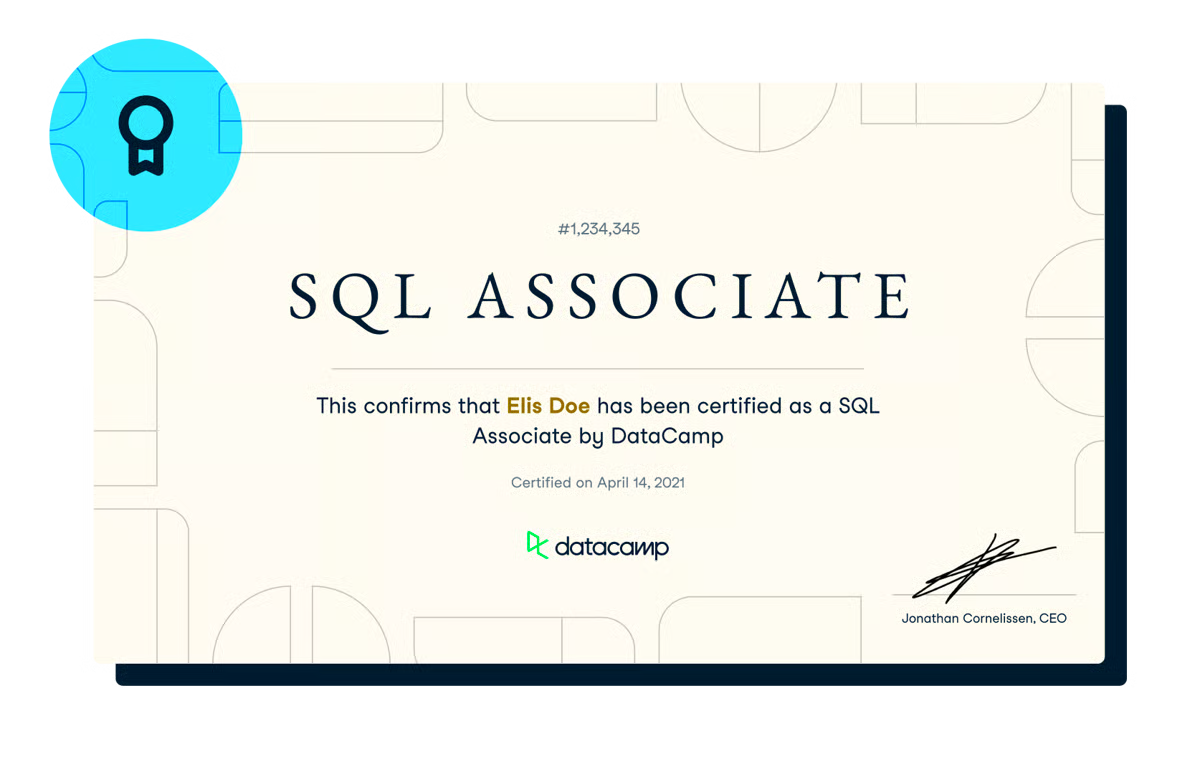
1. DataCamp SQL Associate Certification (skill assessment + prep)
This is the right starting point for analysts who want to prove SQL skills without tying themselves to Oracle, AWS, or any one database vendor.
This credential sits on top of our learning content rather than a single proctored exam, and it comes with structured prep. Our Introduction to SQL course, featuring our new AI tutor, covers the basics, and the Associate Data Analyst in SQL learning track runs to roughly 39 hours across joins, subqueries, aggregation, window functions, and more. The first chapter of most courses is free, so you can gauge the level before paying.
There is also the full Data Analyst Certification, which pairs SQL knowledge with either Python or R Programming.
The honest limitation: This is a platform certification, not a vendor-specific exam like 1Z0-071. Employers who insist on a proctored, vendor-specific credential for an Oracle or Snowflake role may not accept it as a substitute (although it is an industry-recognized qualification). For general analyst positions where demonstrable skill matters more than a vendor badge, it does the job very well and costs far less than a $245 Oracle attempt.
- Level: Beginner to advanced
- Format: Interactive courses, projects, plus timed exam(s) and practical exam, ~39 hours for fundamentals
- Best for: Analysts wanting vendor-neutral proof of SQL skill.
2. Google Data Analytics Professional Certificate (course program)
This is another good pick for a complete beginner switching careers into data analytics, where SQL is one skill among several.
The program is a multi-course path covering spreadsheets, SQL, R, and dashboards, with SQL used to query data in Google BigQuery or comparable environments. It runs on a subscription model rather than a single exam fee, and it's self-paced, so motivated learners can move faster than the suggested schedule.
The caveat is that this is not a straightforward SQL certification. Its SQL coverage is introductory and framed inside a broader analytics workflow, so it won't prove advanced query skills on its own. If you already know SQL and want to validate that specifically, this program is the wrong tool.
- Level: Beginner
- Format: Coursera multi-course program, self-paced
- Best for: Career switchers entering analytics
Search for the Google Data Analytics Professional Certificate to read the current syllabus.
3. Microsoft Azure Data Fundamentals, DP-900 (vendor exam)
DP-900 is the entry-level cloud data credential I'd recommend to anyone new to Azure or to data work generally.
It covers relational and non-relational data concepts on Azure, including SQL concepts, without going deep into vendor-specific query syntax. The exam fee is roughly $100, and a big draw is that it's widely cited as non-expiring, so you earn it once and never pay to recertify.
The limitation is that DP-900 is a fundamentals exam. Its SQL content is introductory, and it's meant to prove broad literacy, not query skill. A senior analyst won't gain much signal from it, but for someone building a first data resume, the low cost and no-renewal policy make it easy to justify.
- Level: Beginner
- Format: Vendor exam, ~$99-$100, non-expiring
- Best for: Newcomers to cloud data on Azure
Check Microsoft's certification page for the current DP-900 exam details and fee.
4. Oracle Database SQL Certified Associate, 1Z0-071 (vendor exam)
1Z0-071 is the go-to SQL-specific credential if you work in, or want to work in, an Oracle shop.
The exam focuses squarely on Oracle SQL: data modeling, DDL, DML, joins, subqueries, constraints, functions, set operators, views, and indexes. It runs about 2 hours as a multiple-choice test, and it's recognized across enterprise, finance, and government sectors as a baseline Oracle SQL credential.
Now the downsides. The exam costs about $245 per attempt, and it's frequently described as needing recertification every 18 to 24 months to track Oracle releases, so the true cost compounds over time. It's also strongly vendor-specific, meaning Oracle syntax and features may not transfer cleanly to PostgreSQL or MySQL.
- Level: Intermediate
- Format: Multiple-choice vendor exam, ~2 hours, ~$245 per attempt
- Best for: People working with Oracle as the primary DBMS
Confirm the current fee and exam outline on Oracle University.
5. EDB PostgreSQL 12 Associate (vendor exam)
This is the credential to target if PostgreSQL is your production database and you want a formal marker of competence.
The EDB PostgreSQL covers PostgreSQL server maintenance and management, plus foundational SQL operations, including installation, configuration, basic performance, and querying. It's a 60-minute exam at roughly $250, and many overviews note it carries no current renewal requirement, so the certificate stays valid indefinitely.
The caveat is that this leans DBA-oriented rather than pure analyst SQL. Its SQL coverage is framed around PostgreSQL specifics, so it's most valuable to people who manage the database, not just query it. Outside PostgreSQL environments, the signal is niche.
- Level: Intermediate
- Format: Vendor exam, 60 minutes, ~$200, no renewal requirement
- Best for: Teams running PostgreSQL in production
Check EnterpriseDB's certification page for current details.
6. Snowflake SnowPro Core, COF-C02 (vendor exam)
SnowPro Core is the credential I'd point cloud data warehousing engineers and analysts toward when Snowflake is the platform.
It covers Snowflake architecture, virtual warehouses, data loading, and SQL querying, combining platform concepts with Snowflake-specific SQL. It's a key credential in modern cloud data teams, and it maps directly to day-to-day Snowflake work.
The obvious limitation is ecosystem lock-in. Much of what you learn is Snowflake-specific, so the credential carries little weight if your next role uses BigQuery or Databricks instead. Treat it as validation for a Snowflake job, not a general SQL badge.
- Level: Intermediate
- Format: Vendor exam covering architecture and SQL
- Best for: Engineers and analysts in cloud data warehousing
See our track that covers Snowflake's certification for preparation for the COF-C02 exam.
7. Microsoft Power BI Data Analyst Associate, PL-300 (vendor exam)
The PL-300 is worth it for BI professionals who pull from SQL sources and build reports in Power BI.
The exam centers on data preparation and modeling in Power BI, including using SQL sources to feed dashboards and models. For someone whose core job is reporting and visualization, it validates a workflow that SQL alone doesn't cover.
The honest framing: this is a BI credential, not a SQL one. SQL is a supporting skill here, so if your goal is to prove query ability specifically, a SQL-focused exam or platform certificate is the better fit.
- Level: Intermediate
- Format: Vendor exam on Power BI data prep and modeling
- Best for: BI professionals who query SQL sources
You can prepare for the PL-300 with our career track, which also gives 50% off your exam fee.
8. dbt Analytics Engineering Certification (vendor exam)
This is the dbt credential for analytics engineers who transform and model data in SQL using dbt.
It covers SQL-based data transformation, modeling, and testing with dbt, which sits at the center of many modern analytics stacks. If your role is building tested, version-controlled SQL models rather than ad hoc queries, this demonstrates exactly that.
The limitation is scope. It assumes you already know SQL well and focuses on dbt workflows on top, so it's not a starting point for beginners. It's most valuable to people already working in a modern data stack that uses dbt.
- Level: Intermediate
- Format: Vendor exam on SQL modeling with dbt
- Best for: Analytics engineers modeling data in SQL
See dbt Labs' certification page for the current exam.
9. Oracle Certified Professional, MySQL 8.0 Database Administrator (vendor exam)
This is a specialist credential for people whose job is administering MySQL, not querying it as an analyst.
It emphasizes MySQL administration: installation, configuration, security, backup and restore, and performance, alongside SQL usage. The exam costs about $245, matching Oracle's other professional-level fees.
The limitation for most readers of this article: it's heavy on server operations. Analysts who mainly write queries will find much of it irrelevant, since the exam is built for DBAs who keep MySQL running.
- Level: Advanced
- Format: Vendor exam, ~$245
- Best for: Dedicated MySQL database administrators
Check Oracle University for the current exam and fee.
Suggested SQL Certification Learning Path
Here's how I'd sequence these if you're starting from scratch and want to end up with a credential that matches your target job.
Stage 1: Build the fundamentals
Start with the Introduction to SQL course and work through joins, subqueries, and aggregation before you think about any exam. If you're switching careers into analytics broadly rather than aiming for a database role, the Google Data Analytics Professional Certificate covers SQL alongside spreadsheets and dashboards.
Stage 2: Validate with a low-risk credential
Once your fundamentals hold, prove them with the DataCamp SQL certification and the DP-900 exam. Both are affordable ways to put a marker on your resume without committing to a $245 Oracle attempt or a $300 AWS exam.
Stage 3: Specialize to your stack
Now match the credential to the job. Pick 1Z0-071 for Oracle shops, EDB PostgreSQL 12 Associate for PostgreSQL teams, SnowPro Core for Snowflake, or the dbt Analytics Engineering Certification if you're moving into analytics engineering. If you have no target employer yet, skip this stage until you do, since these certificates lose value outside their ecosystems.
How to Choose the Right Certification
Use this as a quick decision framework based on where you are and what you're trying to prove.
- Complete beginner with no SQL yet: Start with DataCamp's Introduction to SQL course. Skip exams entirely until you can write joins and aggregations without looking them up.
- Career switcher into analytics: Go with DataCamp SQL certification to sharpen the query-specific signal then add the the Google Data Analytics Professional Certificate for breadth.
- Analyst who wants vendor-neutral proof: Choose the DataCamp SQL certification or DP-900. Both cost far less than Oracle or AWS and don't lock you into one platform.
- Working in an Oracle shop: Take 1Z0-071, and budget for recertification every 18 to 24 months at about $245 per attempt.
- On a Snowflake or dbt team: Go straight to SnowPro Core or the dbt Analytics Engineering Certification, since they map to your daily work.
One thing worth noting: community sentiment on forums like Reddit is consistent that demonstrable skill and real projects outweigh any certificate for general analyst roles. Vendor certifications matter most when they match a specific employer's stack, so a public portfolio on GitHub or practice on LeetCode SQL can be a better use of time than a broad, non-vendor certificate.
Final Thoughts
The single best starting point for most people is the DataCamp SQL certification, because it validates vendor-neutral SQL skills cheaply and comes with structured prep, which matters more than a vendor badge for general analyst roles. From there, branch by stack: 1Z0-071 for Oracle environments, SnowPro Core for Snowflake teams.
Two honest caveats. First, high-fee vendor exams like and at $250 with recertification every 18 to 24 months can cost more over time than they return unless your job specifically requires them. Second, vendor-specific SQL features may not transfer between platforms, so a certificate earned for one ecosystem can go stale if you switch tools.
If you want a solid foundation in SQL before committing to any exam fee, I'd recommend starting with our Introduction to SQL course and building from there.