OpenAI released GPT-6.2 Sol last week as the everyday model in its GPT-6.2 family, keeping GPT-6.1 Sol's $2 / $10 token prices. One day later, Google released Gemini 4 Neon, a mid-tier model adapted from Gemini 4 Carbon that it pitches as frontier-level intelligence with fast end-to-end task completion.
The two launched a day apart into the same slot: the model a team uses by default. Google's Neon model card benchmarks Neon against GPT-6.2 Sol by name, while Sol is the cheaper of the two on every standard token rate, so this article comparison feels like a natural extension of the press release.
To keep up with the AI and data space, I recommend subscribing to our weekly newsletter, The Median.
TL;DR
- On Google's model card, Neon leads GPT-6.2 Sol on almost every shared benchmark, with its clearest leads in long-context reasoning and business workflows.
- Sol costs a third less per token at standard context lengths, but its rates rise above 272K input tokens, where Neon becomes cheaper on input.
- In our Fanorona test, both models implemented an unfamiliar board game exactly and built pages that explain it well.
- Sol matched Neon's result with far less reasoning, at about a third of the cost per run.
- Choose Neon for very long inputs and Google's stack; choose Sol for cost, speed, and the widest reach across clouds and agents.
What Is Gemini 4 Neon?
Gemini 4 Neon is Google's mid-tier Gemini 4 model, released in November 2026 and adapted from Gemini 4 Carbon.
Google pitches it as frontier-level intelligence with fast end-to-end task completion: it sits between Hydrogen and Carbon and finishes complex software, knowledge and science tasks in fewer steps than Carbon.
You can see the model in action in our Gemini 4 Neon API tutorial. Our Gemini 4 Carbon guide covers the model Neon was adapted from, and our Gemini 4 Hydrogen API tutorial walks through the shared Gemini 4 API.
What Is GPT-6.2 Sol?
GPT-6.2 Sol is OpenAI's efficient everyday model in the GPT-6.2 family, released in November 2026 alongside the larger GPT-6.2 Astra.
OpenAI's pitch is better results on demanding tasks with fewer output tokens: Sol is smarter than GPT-6.1 Sol at the same token prices, and it is the model many OpenAI employees use by default.
Our GPT-6.2 Astra and Sol guide covers the launch, and our GPT-6.1 Sol tutorial builds an incident triage agent with the previous Sol.
Gemini 4 Neon vs GPT-6.2 Sol: Head-to-Head Comparison
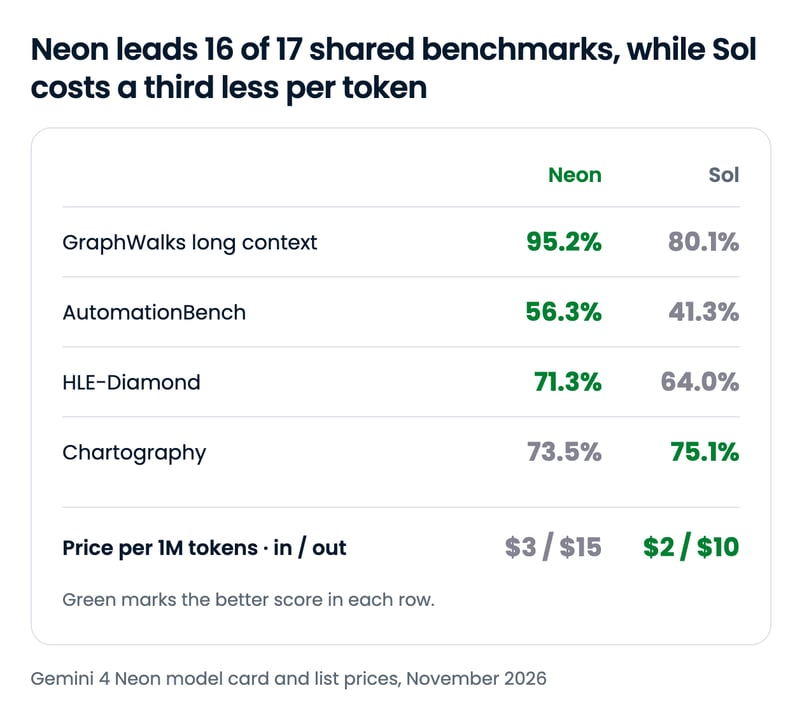
Every head-to-head score below comes from Google's Neon model card, the only source that runs both models on the same benchmarks. Neon leads 16 of the 17 rows where both have a score; Sol leads on chart reading.
| Feature | Gemini 4 Neon | GPT-6.2 Sol |
|---|
| Developer and release | Google, November 18, 2026 | OpenAI, November 17, 2026 |
| Context window | 1,048,576 tokens, shared by input, thinking and output | 1,050,000 tokens (922,000 max input) |
| Synchronous output limit | 64K tokens (up to 1M with long decode) | 128K tokens |
| Reasoning control | Thinking levels: low, medium, high (default), xhigh | Reasoning effort: low, medium, high, xhigh, max |
| Knowledge cutoff | March 2026 | June 1, 2026 |
| GraphWalks (256K to 1M, BFS F1) | 95.2% | 80.1% |
| AutomationBench | 56.3% | 41.3% |
| HLE-Diamond | 71.3% | 64.0% |
| Chartography | 73.5% | 75.1% |
| Price per token (up to 272K input) | Baseline | A third lower on input, output and cached reads |
Long-context and knowledge work
Neon's clearest lead is long-context reasoning. On GraphWalks, which asks a model to traverse a graph spread across 256K to 1M tokens of input, Neon scores 95.2% against Sol's 80.1%. Both accept about a million tokens, but on Google's numbers, Neon holds on to more of what sits at the far end of the window.
| Benchmark | Gemini 4 Neon | GPT-6.2 Sol | Notes |
|---|
| GraphWalks (256K to 1M, BFS F1) | 95.2% | 80.1% | Long-context graph traversal |
| AA Index v5.0.1 | 61 | 57 | Artificial Analysis composite index |
| Vals Index v2.2 | 70.9% | 66.1% | Composite index |
| Agents' Last Exam v1.1 | 75.8% | 73.0% | Long-horizon professional workflows |
| MKA (Climb WSR) | 56.5% | 52.7% | Reported as a win rate |
The composite indexes all point the same way, by roughly 3 to 5 points. OpenAI's own showcase for Sol is everyday and office work, such as GDPval v2 and LifeVal, which Google's card does not report, so those claims have no Neon counterpart.
For long documents, contracts and codebases loaded whole into context, Neon is the stronger pick on the published evidence.
Coding and agentic workflows
Neon leads every shared coding row. Its widest gap, on SWE-sweep, depends on the test harness, so the clearest lead that holds up is Zapier's AutomationBench, where Neon scores 56.3% against 41.3% on business workflows across connected apps. The gaps on Terminal-bench 4.1 and FrontierCode 2.0 are smaller, at about 3.7 and 2.4 points.
| Benchmark | Gemini 4 Neon | GPT-6.2 Sol | Notes |
|---|
| AutomationBench | 56.3% | 41.3% | Business workflows across connected apps |
| Terminal-bench 4.1 | 65.2% | 61.5% | Cheating-adjusted accuracy |
| FrontierCode 2.0 | 46.2% | 43.8% | Whether the change would be merged |
| SWE-sweep (provider harness) | 39.0% | 8.3% | 12.8% vs 11.6% on the Mini-SWE harness |
| CursorBench 4.1 | 65.4% | Not published | No Sol score on Google's card |
A few things to keep in mind when reading these:
- Google ran or collected the Sol scores for its own model card; OpenAI has not published Neon scores.
- Where both vendors report the same benchmark, Google's Sol figures match OpenAI's max-effort results (43.8% on FrontierCode 2.0, 68.0% on Terminal-Bench-Science), so the table compares Neon with Sol at its highest setting.
- The SWE-sweep gap nearly disappears on the Mini-SWE harness, so that row says more about scaffolding than about either model.
On the benchmarks, Neon is the stronger coding and agent model, with its biggest edge in multi-app business workflows.
Science and reasoning
Neon leads all three rows, most clearly on HLE-Diamond, with 71.3% against 64.0%. The other two are closer: 84.0% against 80.0% on RiemannBench and 70.5% against 68.0% on Terminal-Bench-Science 0.1, an agentic research benchmark run in a command line. For quantitative and scientific work, Neon is the better default on Google's numbers.
Multimodal understanding
This is the one dimension where Sol takes a row: on Chartography, which tests reading values off charts, Sol scores 75.1% against Neon's 73.5%. Neon leads on long-video understanding, with 89.0% on LVBench against 87.6%. Both gaps are under two points, so treat multimodal work as a draw.
Cybersecurity
Neon leads both shared security rows: 70.7% against 66.0% on CWE-Bench v2 and 90.5% against 88.3% on SEC-bench Pro. The margins are modest, and Google offers Neon's dual-use offensive capabilities to vetted defenders only, through its Fairwind Program.
Pricing: what you actually pay
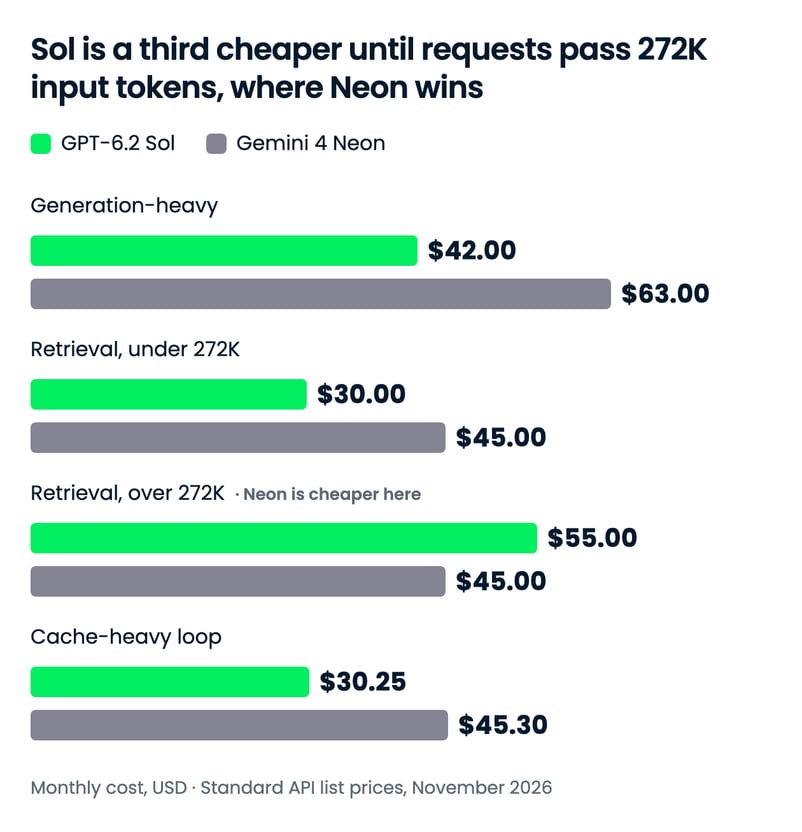
Below 272K input tokens per request, Sol's rates are exactly two-thirds of Neon's on input, output and cached reads. Above that threshold, Sol's input rate doubles and its output rate rises by half, while Neon charges one flat rate across its whole window.
Token rates side by side
| Rate | Gemini 4 Neon | GPT-6.2 Sol |
|---|
| Input, per 1M tokens | $3.00 | $2.00 (up to 272K input); $4.00 above |
| Output, per 1M tokens | $15.00 | $10.00 (up to 272K input); $15.00 above |
| Cached input read, per 1M tokens | $0.15 | $0.10 (up to 272K input); $0.20 above |
| Cache write, per 1M tokens | Not applicable (implicit caching only) | $2.50 (30-minute retention); $5.00 (12-hour) |
| Batch discount | 50% | 50% |
| Consumer access | Google AI Pro and Ultra | ChatGPT Plus, Pro, Enterprise and Edu |
The shape of the difference changes with request size. Under the threshold, Sol is cheaper on everything; over it, Sol's higher rate applies to the whole request, so Neon becomes cheaper on input and the two tie on output. Neon's output price includes thinking tokens, so a higher thinking level raises its bill at the $15 rate.
What a real workload costs
| Workload (monthly) | Gemini 4 Neon | GPT-6.2 Sol | Difference |
|---|
| Generation-heavy: 1M in / 4M out | $63.00 | $42.00 | Sol $21 less (33%) |
| Retrieval, each request under 272K: 10M in / 1M out | $45.00 | $30.00 | Sol $15 less (33%) |
| Retrieval, each request over 272K: 10M in / 1M out | $45.00 | $55.00 | Neon $10 less (18%) |
| Cache-heavy loop: 100K prefix written once, 1,000 cached reads, 5K in / 1K out per request | $45.30 | $30.25 | Sol $15.05 less (33%) |
Each total is (volume ÷ 1M) × rate, summed across input and output at standard rates. The two retrieval rows move the same 10M input and 1M output tokens; the only difference is whether each request crosses Sol's 272K threshold, and that flips the result from Sol $15 cheaper to Neon $10 cheaper. The cache row assumes Sol's 30-minute cache and that every read hits; Neon's implicit cache does not guarantee hits. The two models use different tokenizers and neither vendor has published token counts for a shared workload, so treat these totals as a rate comparison rather than a bill.
To test both models, I ran a task: a single web page that plays a complete game of Fanorona against itself.
Fanorona is the traditional board game of Madagascar, played on a 5-by-9 grid of points, where pieces capture by approaching an enemy line or by withdrawing from one, and the captured line comes off the board all at once. You may know this game. To create it, each model had to implement the rules exactly as the prompt stated them, write an engine that searches ahead for both sides, and make the page explain it: slide every piece along its line, remove captured pieces one after another, label each capture, and show the path of a multi-step capture.
I picked this game because it allowed me to test the model with written rules rather than recall an implementation. The rules have several places to slip:
- capturing is compulsory, and a single step can sometimes capture two ways, which counts as two different moves;
- only every other point has diagonal lines, so a piece on the wrong point cannot move diagonally;
- a capture can continue as a chain, but never in the same direction twice in a row and never back to a point already visited;
- captured pieces leave the board immediately, which changes what the next step of a chain can take.
The prompt stated each rule once and named none of these positions. Both ran in OpenCode with a pinned tool surface (file read and edit only), at medium reasoning effort.
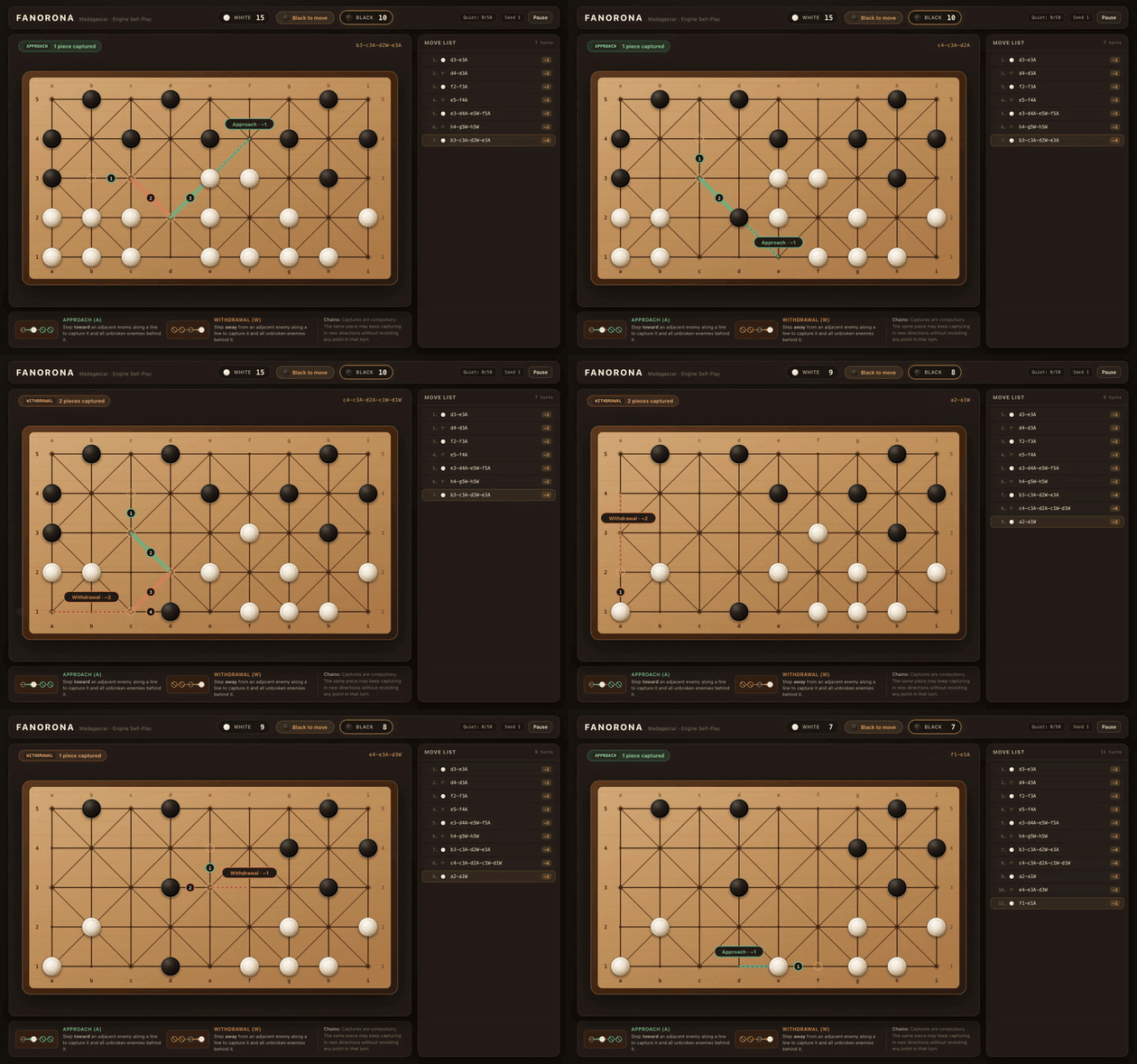
Here is a four-step capture chain on one of Neon's pages, with each step numbered and labeled on the board:
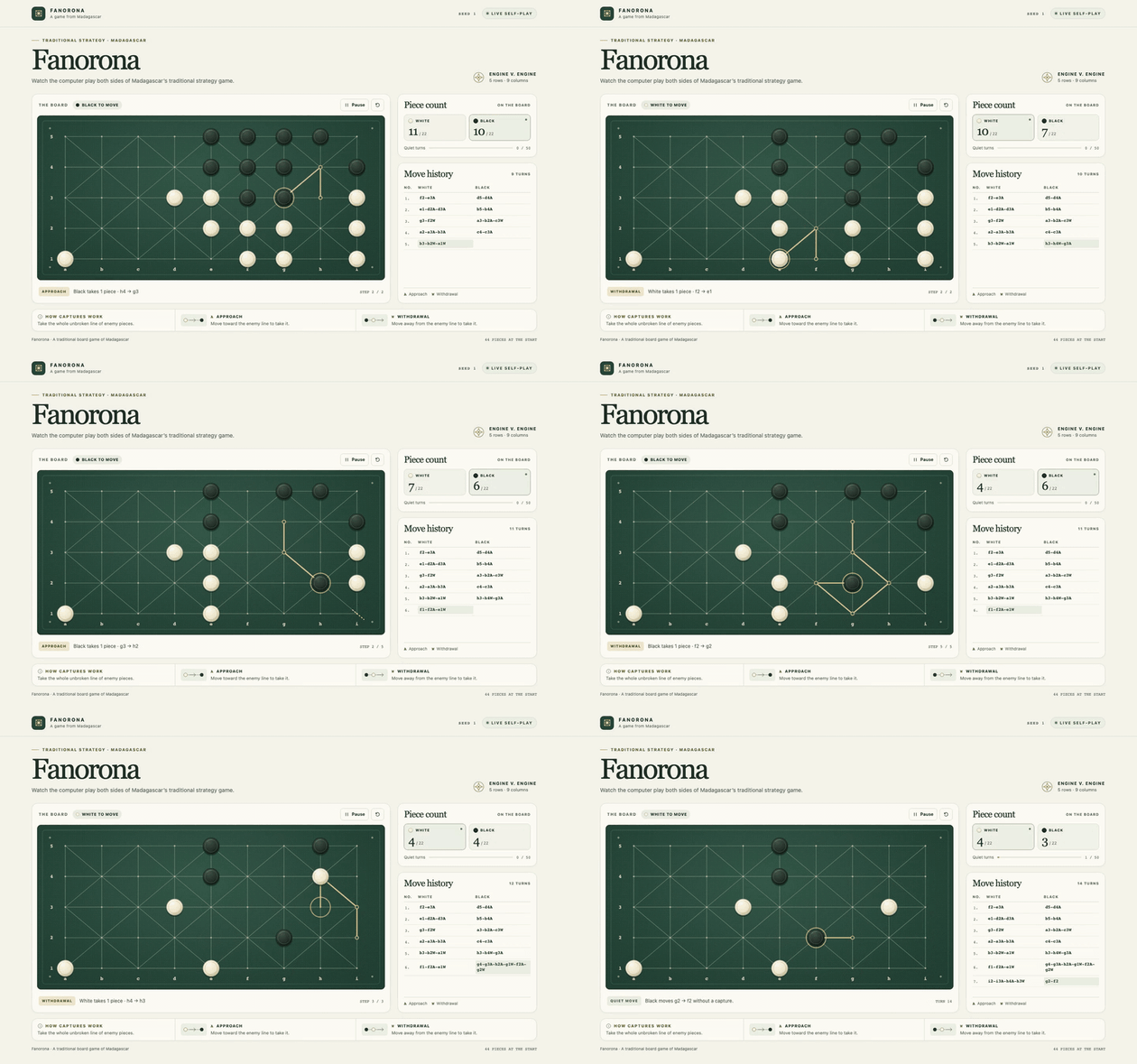
And a five-step chain on one of Sol's pages, with the path traced in gold and a caption under the board:
The main findings:
- Both models followed an unfamiliar rule set exactly. All six pages played 24 games between them without an illegal move or a notation error, declared the right result every time, and answered all ten trap positions correctly, including both chain rules.
- Both pages explain the game well, in different styles. Every page drew the lines, slid the pieces, labeled each capture as an approach or a withdrawal with the number taken, and traced chains step by step. Neon's three pages share one layout, a wooden board with the capture labels placed on the board itself; Sol's three pages each took a different editorial look, with a plain-language caption for every move.
- The engines play to a similar standard. Neon won 7 of its 12 games outright and Sol 8 of 12, with the rest drawn under the 50-turn rule, and both engines found long capture chains.
- Sol got there with much less thinking. Each Sol run used about 3,000 reasoning tokens against Neon's 16,000 to 17,000, wrote a page half the size, and finished faster.
- Neither side had the basic animations. I wanted to be able to follow the moves more easily, but neither model showed the action very smoothly.
| Measure | Gemini 4 Neon | GPT-6.2 Sol |
|---|
| Games won outright (of 12) | 7 | 8 |
| Reasoning tokens per run | 15,902 to 17,388 | 2,813 to 3,652 |
| Page size | 56 to 60 KB | 29 to 33 KB |
| Cost per run (USD) | $0.74, $0.76, $0.77 | $0.19, $0.26, $0.24 |
This one is a tie on quality and a clear win for Sol on cost: both models built a correct, watchable Fanorona from a written rulebook every time, and Sol did it for about a third of the price per run. That matches OpenAI's claim that Sol does demanding work with fewer tokens.
When to Choose Gemini 4 Neon vs GPT-6.2 Sol
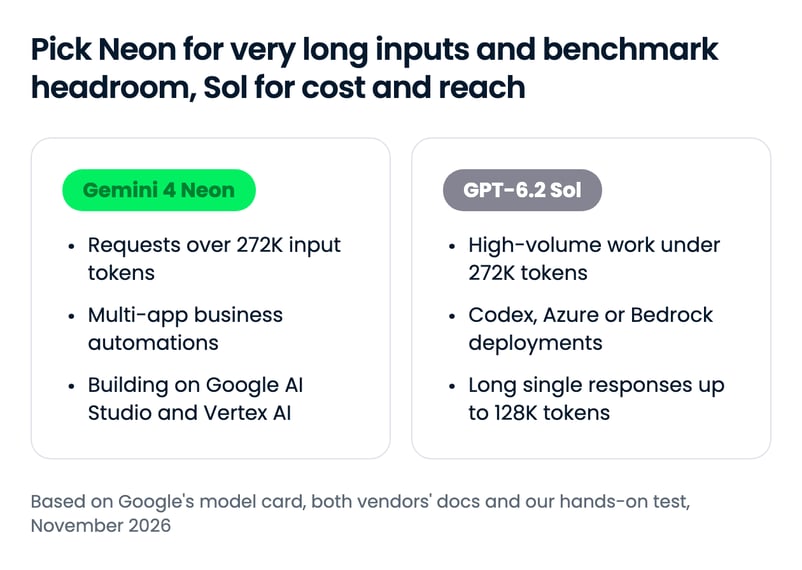
The fork is request size. Under 272K input tokens per request, Sol costs a third less; above it, Neon is cheaper on input and much stronger on Google's long-context benchmark.
Choose Gemini 4 Neon if...
- Your requests regularly pass 272K input tokens. Neon keeps one flat rate and leads GraphWalks by 15 points, while Sol's rates rise for the whole request.
- You automate work across many connected apps. AutomationBench is, with long-context reasoning, one of Neon's two largest leads outside the harness-dependent SWE-sweep row.
- You want the highest benchmark scores in this price range. Neon leads 16 of the 17 rows Google reports for both.
- You build on Google's stack. Neon is in Google AI Studio, Vertex AI and Google Antigravity, and pairs with Gemini 4 Hydrogen in multi-model workflows.
Choose GPT-6.2 Sol if...
- Cost matters at volume. Every standard rate is a third lower, and in our test each Sol run cost about a third as much as a Neon run.
- You work in Codex or deploy on Azure or AWS. Sol is in Codex, Microsoft Foundry and Amazon Bedrock as well as the OpenAI API.
- You need long answers in one response. Sol returns up to 128K tokens synchronously, twice Neon's default limit.
- You want speed. Sol finished our build task faster with a fraction of the reasoning.
How to Get Started With Gemini 4 Neon and GPT-6.2 Sol
| Surface | Gemini 4 Neon | GPT-6.2 Sol |
|---|
| Consumer app | Gemini app (Google AI Pro and Ultra) | ChatGPT Work (Plus, Pro, Enterprise, Edu) |
| First-party API | Gemini API (paid tier), Google AI Studio | OpenAI API |
| Cloud platforms | Vertex AI | Microsoft Foundry, Amazon Bedrock |
| Coding agents | Google Antigravity, GitHub Copilot, Cursor | Codex, GitHub Copilot |
| Third-party routers | OpenRouter | OpenRouter |
| API model ID | gemini-4-neon | gpt-6.2-sol |
The biggest access difference is cloud reach: Sol is on Microsoft Foundry and Amazon Bedrock, while we found Neon only on Google Cloud. Cursor's model docs list Neon but no GPT-6.2 model as of November 20, 2026. The native model IDs are gemini-4-neon and gpt-6.2-sol; on OpenRouter they are google/gemini-4-neon and openai/gpt-6.2-sol.
Final Thoughts
On Google's benchmarks, Gemini 4 Neon beats GPT-6.2 Sol almost everywhere, most clearly on long-context reasoning and business automation. In our Fanorona test, though, both models built a correct, well-explained game every time, and Sol did it for about a third of the cost per run.
My recommendation: default to Sol for everyday work under 272K tokens, where it is cheaper and fast, and switch to Neon for very long inputs or for the tasks where its benchmark lead is large. To build with OpenAI's models, try our Working with the OpenAI API course.







OpenAI released GPT-6.2 Sol last week as the everyday model in its GPT-6.2 family, keeping GPT-6.1 Sol's $2 / $10 token prices. One day later, Google released Gemini 4 Neon, a mid-tier model adapted from Gemini 4 Carbon that it pitches as frontier-level intelligence with fast end-to-end task completion.
The two launched a day apart into the same slot: the model a team uses by default. Google's Neon model card benchmarks Neon against GPT-6.2 Sol by name, while Sol is the cheaper of the two on every standard token rate, so this article comparison feels like a natural extension of the press release.
To keep up with the AI and data space, I recommend subscribing to our weekly newsletter, The Median.
TL;DR
What Is Gemini 4 Neon?
Gemini 4 Neon is Google's mid-tier Gemini 4 model, released in November 2026 and adapted from Gemini 4 Carbon.
Google pitches it as frontier-level intelligence with fast end-to-end task completion: it sits between Hydrogen and Carbon and finishes complex software, knowledge and science tasks in fewer steps than Carbon.
You can see the model in action in our Gemini 4 Neon API tutorial. Our Gemini 4 Carbon guide covers the model Neon was adapted from, and our Gemini 4 Hydrogen API tutorial walks through the shared Gemini 4 API.
What Is GPT-6.2 Sol?
GPT-6.2 Sol is OpenAI's efficient everyday model in the GPT-6.2 family, released in November 2026 alongside the larger GPT-6.2 Astra.
OpenAI's pitch is better results on demanding tasks with fewer output tokens: Sol is smarter than GPT-6.1 Sol at the same token prices, and it is the model many OpenAI employees use by default.
Our GPT-6.2 Astra and Sol guide covers the launch, and our GPT-6.1 Sol tutorial builds an incident triage agent with the previous Sol.
Gemini 4 Neon vs GPT-6.2 Sol: Head-to-Head Comparison
Every head-to-head score below comes from Google's Neon model card, the only source that runs both models on the same benchmarks. Neon leads 16 of the 17 rows where both have a score; Sol leads on chart reading.
Long-context and knowledge work
Neon's clearest lead is long-context reasoning. On GraphWalks, which asks a model to traverse a graph spread across 256K to 1M tokens of input, Neon scores 95.2% against Sol's 80.1%. Both accept about a million tokens, but on Google's numbers, Neon holds on to more of what sits at the far end of the window.
The composite indexes all point the same way, by roughly 3 to 5 points. OpenAI's own showcase for Sol is everyday and office work, such as GDPval v2 and LifeVal, which Google's card does not report, so those claims have no Neon counterpart.
For long documents, contracts and codebases loaded whole into context, Neon is the stronger pick on the published evidence.
Coding and agentic workflows
Neon leads every shared coding row. Its widest gap, on SWE-sweep, depends on the test harness, so the clearest lead that holds up is Zapier's AutomationBench, where Neon scores 56.3% against 41.3% on business workflows across connected apps. The gaps on Terminal-bench 4.1 and FrontierCode 2.0 are smaller, at about 3.7 and 2.4 points.
A few things to keep in mind when reading these:
On the benchmarks, Neon is the stronger coding and agent model, with its biggest edge in multi-app business workflows.
Science and reasoning
Neon leads all three rows, most clearly on HLE-Diamond, with 71.3% against 64.0%. The other two are closer: 84.0% against 80.0% on RiemannBench and 70.5% against 68.0% on Terminal-Bench-Science 0.1, an agentic research benchmark run in a command line. For quantitative and scientific work, Neon is the better default on Google's numbers.
Multimodal understanding
This is the one dimension where Sol takes a row: on Chartography, which tests reading values off charts, Sol scores 75.1% against Neon's 73.5%. Neon leads on long-video understanding, with 89.0% on LVBench against 87.6%. Both gaps are under two points, so treat multimodal work as a draw.
Cybersecurity
Neon leads both shared security rows: 70.7% against 66.0% on CWE-Bench v2 and 90.5% against 88.3% on SEC-bench Pro. The margins are modest, and Google offers Neon's dual-use offensive capabilities to vetted defenders only, through its Fairwind Program.
Pricing: what you actually pay
Below 272K input tokens per request, Sol's rates are exactly two-thirds of Neon's on input, output and cached reads. Above that threshold, Sol's input rate doubles and its output rate rises by half, while Neon charges one flat rate across its whole window.
Token rates side by side
The shape of the difference changes with request size. Under the threshold, Sol is cheaper on everything; over it, Sol's higher rate applies to the whole request, so Neon becomes cheaper on input and the two tie on output. Neon's output price includes thinking tokens, so a higher thinking level raises its bill at the $15 rate.
What a real workload costs
Each total is (volume ÷ 1M) × rate, summed across input and output at standard rates. The two retrieval rows move the same 10M input and 1M output tokens; the only difference is whether each request crosses Sol's 272K threshold, and that flips the result from Sol $15 cheaper to Neon $10 cheaper. The cache row assumes Sol's 30-minute cache and that every read hits; Neon's implicit cache does not guarantee hits. The two models use different tokenizers and neither vendor has published token counts for a shared workload, so treat these totals as a rate comparison rather than a bill.
How Gemini 4 Neon and GPT-6.2 Sol Performed
To test both models, I ran a task: a single web page that plays a complete game of Fanorona against itself.
Fanorona is the traditional board game of Madagascar, played on a 5-by-9 grid of points, where pieces capture by approaching an enemy line or by withdrawing from one, and the captured line comes off the board all at once. You may know this game. To create it, each model had to implement the rules exactly as the prompt stated them, write an engine that searches ahead for both sides, and make the page explain it: slide every piece along its line, remove captured pieces one after another, label each capture, and show the path of a multi-step capture.
I picked this game because it allowed me to test the model with written rules rather than recall an implementation. The rules have several places to slip:
The prompt stated each rule once and named none of these positions. Both ran in OpenCode with a pinned tool surface (file read and edit only), at
mediumreasoning effort.Here is a four-step capture chain on one of Neon's pages, with each step numbered and labeled on the board:
And a five-step chain on one of Sol's pages, with the path traced in gold and a caption under the board:
The main findings:
This one is a tie on quality and a clear win for Sol on cost: both models built a correct, watchable Fanorona from a written rulebook every time, and Sol did it for about a third of the price per run. That matches OpenAI's claim that Sol does demanding work with fewer tokens.
When to Choose Gemini 4 Neon vs GPT-6.2 Sol
The fork is request size. Under 272K input tokens per request, Sol costs a third less; above it, Neon is cheaper on input and much stronger on Google's long-context benchmark.
Choose Gemini 4 Neon if...
Choose GPT-6.2 Sol if...
How to Get Started With Gemini 4 Neon and GPT-6.2 Sol
gemini-4-neongpt-6.2-solThe biggest access difference is cloud reach: Sol is on Microsoft Foundry and Amazon Bedrock, while we found Neon only on Google Cloud. Cursor's model docs list Neon but no GPT-6.2 model as of November 20, 2026. The native model IDs are
gemini-4-neonandgpt-6.2-sol; on OpenRouter they aregoogle/gemini-4-neonandopenai/gpt-6.2-sol.Final Thoughts
On Google's benchmarks, Gemini 4 Neon beats GPT-6.2 Sol almost everywhere, most clearly on long-context reasoning and business automation. In our Fanorona test, though, both models built a correct, well-explained game every time, and Sol did it for about a third of the cost per run.
My recommendation: default to Sol for everyday work under 272K tokens, where it is cheaper and fast, and switch to Neon for very long inputs or for the tasks where its benchmark lead is large. To build with OpenAI's models, try our Working with the OpenAI API course.