
Course
Linear Algebra for Data Science in R
4 hr
21.5K
Put three equal electric charges at the corners of an equilateral triangle, and the resulting field has four balance points, where every push and pull cancels out: one at the center, and three tucked just inside the edges. Now drop two very small charges just above and just below that center. The central balance point shatters into twenty-one, and the whole configuration jumps to twenty-four.
That construction went up on arXiv on July 29 as a counterexample to the Maxwell conjecture, a bound on electrostatic equilibrium points traced back to Maxwell's 1873 treatise. The authors also disclosed that the idea came from a large language model. Below, I'll cover what the conjecture claimed, how the counterexample works, what GPT-5.6 Sol did and didn't do, and why the disclosure is arguably the more interesting half of the story.
The conjecture set a ceiling on how many equilibrium points the field of n point charges could have: at most (n−1)². For five charges, that means 16. Philip Arathoon, Gavin Ball, and Matthew Kvalheim built a five-charge configuration with at least 24, a direct counterexample. GPT-5.6 Sol suggested the geometric idea; the three authors did the analysis, ran the computer algebra, and wrote the proof.
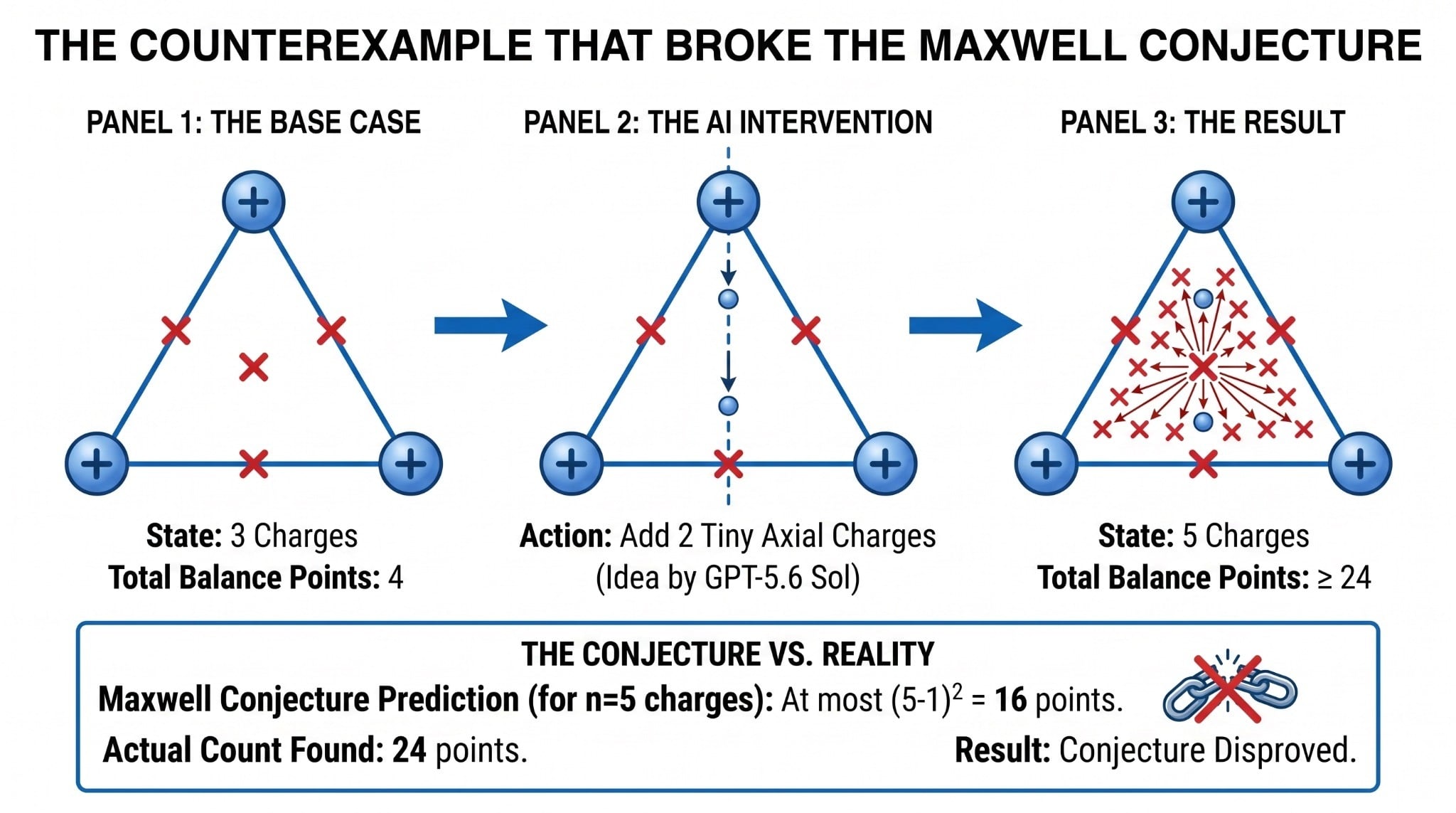
How five charges broke the Maxwell Conjecture using AI. Image by Author.
With that summary in hand, let's look at where the conjecture came from and why it held up for so long.
James Clerk Maxwell raised the question in a short passage of his 1873 Treatise on Electricity and Magnetism, asking how many equilibrium points a system of charges could produce. It stayed a passing remark for nearly a century, until Marston Morse and Stewart Cairns posed the same problem in 1969, apparently unaware Maxwell had gotten there first. That's a small detail I like more than I probably should.
The precise statement everyone now argues about came in 2007, when Andrei Gabrielov, Dmitry Novikov, and Boris Shapiro read Maxwell's passage closely and turned it into a conjecture: if the equilibrium points of the potential generated by n charges are all non-degenerate, there can be at most (n−1)² of them. That's the only formula you actually need, so if algebra makes you tense, you're past the worst of it. The bound holds trivially for two charges. For three, nobody knows whether four is really the maximum, except in the special case where all three charges are equal.
To appreciate why this bound matters, it helps to understand what equilibrium points actually are.
Every charge creates a field. Put several charges in a room and their fields overlap, pushing and pulling in different directions at every point in space. At certain spots, the forces from each charge cancel exactly, and a test particle placed there would feel no net force at all. Those are the equilibrium points, also called critical points of the electrostatic potential.
Counting them isn't a bookkeeping exercise. The number and arrangement of these points constrain the shape of the whole field, the way flat spots on a mountain range constrain how that range can be laid out. So a bound on the count is really a claim about how complicated an electrostatic field is allowed to get, which is why a question raised in passing in 1873 kept mathematicians busy for a century and a half.
Now that we have a sense of what the conjecture was protecting, let's walk through exactly how it came undone.
The construction is short enough to describe in four steps. Unless you want the Hessian computations, skip the arXiv note; the shape of the argument is what's interesting:
The charge strengths aren't arbitrary. The authors pick a specific value tuned so that the leading term of the small charges' potential cancels the corresponding term from the triangle, and that's what exposes the finer structure producing the 21 points. There's also a step that's easy to miss on first read: the argument so far doesn't rule out degenerate critical points sitting somewhere else in the configuration, so the authors apply a transversality argument to a slightly perturbed set of charge strengths, which cleans those up.
Then comes the part the headlines skipped. The same trick can be iterated. Add another pair of small charges and you gain 20 more critical points for the cost of 2 more charges, giving configurations of 3 + 2m charges with at least 4 + 20m equilibria. That's an asymptotic ratio of 10 critical points per charge, against the 25/7 achieved by Herbert Edelsbrunner, Christopher Fillmore, and Gonçalo Oliveira earlier this year. The counterexample is the headline; the ratio is the result other people will build on.
With the construction itself clear, here's where the story gets a little unusual: who, or what, actually came up with the idea.
The disclosure sits in its own short section of the paper, and it's refreshingly plain about what happened: "The idea behind this construction was suggested by an LLM (OpenAI's GPT-5.6 Sol)." The authors add that they checked the mathematics themselves and wrote the argument in their own words, and that Mathematica and Maple handled the computations and figures.
So the model contributed a strategy, perturb a symmetric configuration with small off-axis charges and watch a degenerate point break apart, and the authors turned that into Taylor expansions of harmonic polynomials, a classification of 21 critical points by Hessian signature, three applications of the implicit function theorem, and a transversality argument. Generating an idea and proving a theorem are different activities with different failure modes. An idea that doesn't work costs you an afternoon. A proof that doesn't work costs you a retraction. The model pointed at an unlikely spot on the map; three mathematicians built the road.
Worth pushing on that framing, though. "Just an idea" undersells it. Anyone can propose perturbing a symmetric configuration. The useful part is proposing that perturbation, with small axial charges, on that base configuration, in a problem where the search space of things to try is effectively unbounded. Taste in what to attempt is a large fraction of research mathematics. That the suggestion came from a model rather than a specialist's decade of intuition is the substance of the story.
The question goes back to Maxwell's 1873 remark, which is where the "150 years" in every headline comes from. Worth being precise, though: Maxwell posed a question and made an observation. He didn't state the conjecture that just fell.
As a formal statement, the Maxwell conjecture is 19 years old, and for most of that time it was the organizing assumption of the field, the thing you tried to prove, and the target every improved bound was creeping toward. It now appears to be false. The counterexample is a four-page arXiv preprint that has not yet been through peer review, and its central step is a Hessian classification checked with computer algebra, so the usual caveats apply. But the argument is short, explicit, and easy for others to verify.
Knowing the ceiling isn't (n−1)² doesn't tell us what it is. The authors' iterated construction pushes the known lower bound up to roughly 10 critical points per charge, which is a floor, not an answer. And those three charges from earlier? Whether they can ever produce more than four equilibria is still open, which is a strange thing to still be saying about the smallest interesting case after all this time.
Something shifted over the past year. Between October 2025 and early 2026, AI tools helped move roughly a hundred problems from the Erdős problem database into the solved column, and Terence Tao maintained a running page tracking those contributions until it stopped being updated at the end of June 2026. A lot of that was literature search, the model finds the 1974 paper that already settled the thing. Some of it wasn't. A handful of solutions were original arguments assembled largely by the model, and Tao has flagged at least one as hitting a genuine milestone.
The pattern across these cases is consistent, and it matches what happened with the Maxwell conjecture. Models are good at proposing candidates, scanning a literature no individual can hold in their head, and searching a space of constructions overnight without getting bored. Verification stays with humans and with proof assistants like Lean. If you want the conceptual grounding for how these systems work before forming a view on any of it, our AI Fundamentals track is a good place to start.
Conjecture generation is already routine. Proof assistance is common enough that describing it is unremarkable. Formal theorem proving, a model producing a complete, machine-checked argument for a research-level problem with no human in the loop, is where the boundary sits right now, and there are results on both sides of it depending on how strictly you define "research-level."
The constraint isn't obviously creativity. Current models still hallucinate references, still lose the thread across long chains of reasoning, and are still much better at generating candidates than at knowing which candidate is right. That last asymmetry is exactly why human verification is load-bearing rather than ceremonial. A model that could reliably evaluate its own output would be a different kind of system than what we have, and nobody can currently say how far away that is.
Mathematics is an unusually clean test case because proofs are either right or wrong. But the same dynamic, AI accelerating the idea-generation phase while humans retain verification, is playing out across disciplines.
This extends well past mathematics. Physics, chemistry, materials science, and engineering all share the same bottleneck: hypothesis generation is expensive in human time, and most hypotheses fail. A researcher can seriously pursue a handful of candidate structures or mechanisms in a year. The space of candidates is much larger than that.
Idea generation may turn out to be the research capability that matters most, precisely because it's the step where human throughput is lowest and the cost of a wrong guess is smallest. A model that can scan an enormous space and say "look here" changes the speed of discovery without needing to be right very often. Which is roughly what happened here.
Before drawing broader conclusions, it's worth clearing up a few things the coverage got wrong.
The model suggested the geometric construction. The proof, the expansions, the Hessian classification, the transversality argument, was the authors' work.
Mathematica and Maple checked computations and produced the figures. The mathematical verification was done by the three authors, and they say so explicitly in the paper.
Maxwell made an observation in 1873. Gabrielov, Novikov, and Shapiro formulated the conjecture in 2007 based on their reading of that passage.
Assuming the counterexample holds up, we know (n−1)² is wrong. We don't know what the correct bound is, and the three-charge case remains open.
The Maxwell conjecture fell to a collaboration: an AI-generated geometric idea, and three mathematicians who spent the effort turning it into something checkable. The paper is unusually honest about which half did what. A disclosure section of three sentences that will probably get cited more than the theorem.
What makes this worth your attention is the shape of the contribution rather than its size. A model with no stake in the problem proposed a construction that the people who cared most about it hadn't tried on this configuration, and it turned out to work. The broader question of how many equilibria n charges can have is still open, and so is the question of what research looks like when idea generation stops being the scarce resource. If you want to follow how these systems are being applied in practice rather than how they're marketed, our AI courses cover the ground from concepts to deployment.
Learn with DataCamp
Course
Course
Course
blog
Vinod Chugani
10 min
blog
Tom Farnschläder
14 min
blog
Josef Waples
10 min
blog
Alex Olteanu
8 min
blog
Josep Ferrer
8 min
blog
Josef Waples
8 min