Course
Introduction to AI for Work
2 hr
117.8K
If you are picking a model for agentic work in the second half of 2026, the shortlist is short, and the two names on it launched two weeks apart. Anthropic shipped Claude Opus 5 on July 24, and OpenAI moved GPT-5.6 Sol to general availability on July 9. Both are flagship tiers, both are pitched at long-running professional tasks, and the pricing of both seems to be almost identical.
In this article, I'll compare Claude Opus 5 and GPT-5.6 Sol across coding, reasoning, computer use, tool use, pricing, and access, so you can decide which fits your workflow. For deeper coverage of each model on its own, see our Claude Opus 5 guide and our GPT-5.6 family guide.
Claude Opus 5 is Anthropic's Opus-tier model, released on July 24, 2026, and delivers results similar to the higher-tiered Fable 5 at half the price. It is the new default model on Claude Max and the strongest model available on Claude Pro.
The model's distinguishing behavior is persistence. Anthropic's framing is that Opus 5 verifies its own work and iterates until it succeeds rather than stopping at something plausible, and it reports a misaligned-behavior audit score of 2.3, the lowest of any recent Anthropic model. Context runs to 1M tokens with a 128K output ceiling, and thinking is on by default.
If you want to build with it rather than read about it, our Claude Opus 5 API tutorial walks through constructing a bug-fixing agent and benchmarking it across all five effort levels.
GPT-5.6 Sol is the flagship of OpenAI's GPT-5.6 family, which reached general availability on July 9, 2026, after a limited preview. The family runs three tiers:
OpenAI describes Sol as delivering state-of-the-art results across coding, knowledge work, cybersecurity, and science while spending fewer tokens than the models it beats.
Sol's headline feature is ultra, a reasoning setting that coordinates four agents across parallel workstreams by default. OpenAI also added Programmatic Tool Calling in the Responses API, which lets the model write and run small programs that orchestrate tools and filter intermediate data instead of routing every tool response back through the model.
For more on the family structure and the preview-era caveats, see our GPT-5.6 breakdown. We also covered GPT-5.6 Pro's claimed counterexample to the Dinitz-Garg-Goemans conjecture, which is the most interesting thing anyone has done with the family so far.
Here is the summary before I get into the individual dimensions.
| Feature | Claude Opus 5 | GPT-5.6 Sol |
|---|---|---|
| Released | July 24, 2026 | July 9, 2026 |
| Input, per 1M tokens | $5.00 | $5.00 |
| Output, per 1M tokens | $25.00 | $30.00 |
| Context window | 1M tokens | 1M tokens |
| Max output | 128K tokens | 128K tokens |
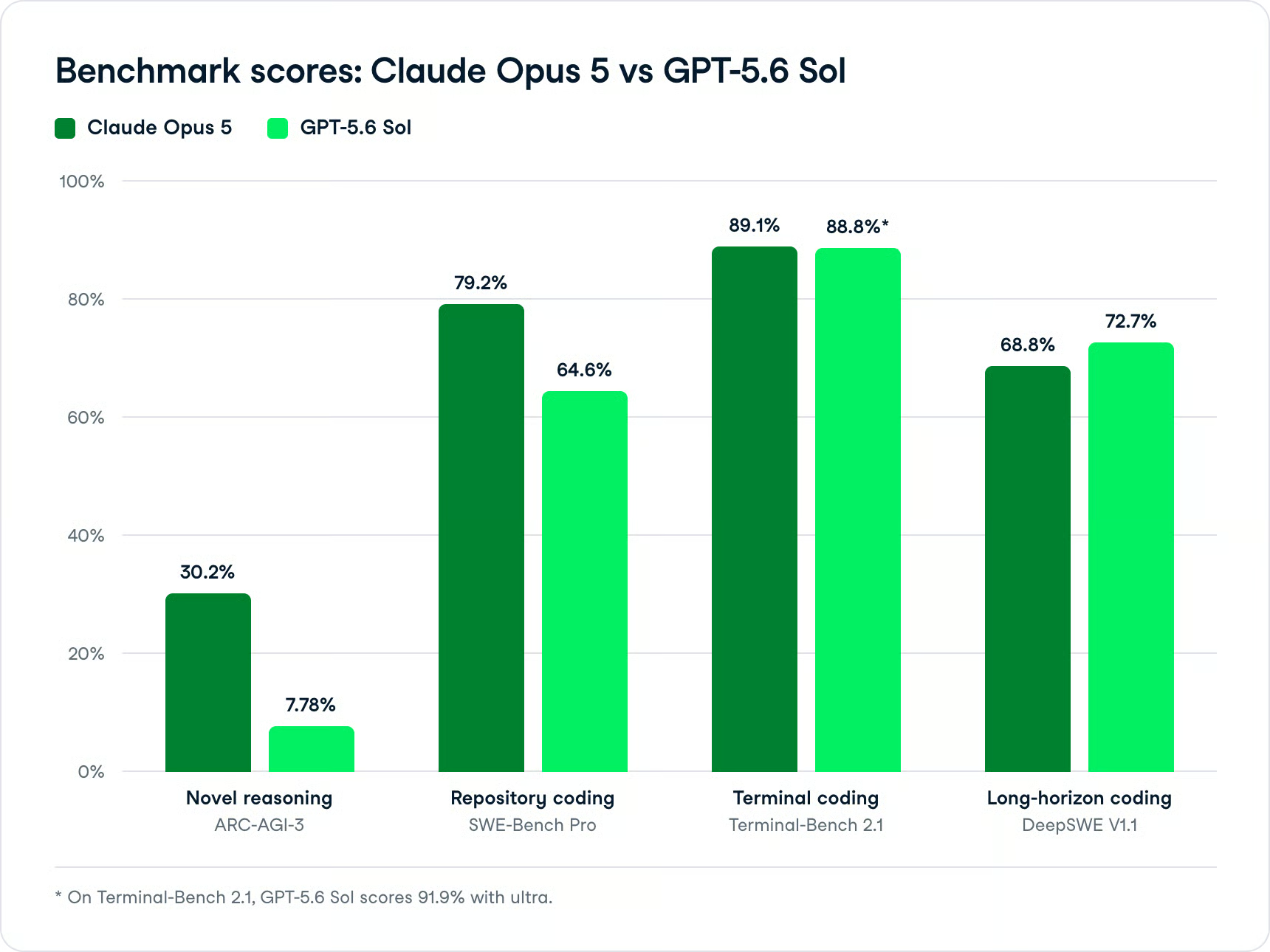
| Novel reasoning (ARC-AGI-3) | 30.2% | 7.78% |
| Repository coding (SWE-Bench Pro) | 79.2% | 64.6% |
| Terminal coding (Terminal-Bench 2.1) | 89.1% | 88.8% (91.9% with ultra) |
| Long-horizon coding (DeepSWE V1.1) | 68.8% | 72.7% |
| Computer use (OSWorld 2.0) | 70.6% | 62.6% |
| Browsing agents (BrowseComp) | 90.8% | 90.4% (92.2% with ultra) |
| Signature feature | Self-verification and iteration | ultra parallel-agent mode |
| Model ID | claude-opus-5 |
gpt-5.6-sol |
This is where the two models diverge most sharply, so I am leading with it. ARC-AGI-3 asks a model to solve problems it has not encountered in training, which makes it the closest thing we have to a test of reasoning rather than recall.
Opus 5 scores 30.2%. GPT-5.6 Sol scores 7.78%, although it is the second-best model in the leaderboard. For comparison, Gemini 3.1 Pro Preview manages 0.42%. To put Opus 5's number in context, Opus 4.8 scored 1.5% two months earlier, which makes this a twentyfold jump within a single Anthropic generation.
I want to be careful about what a 4x gap on one benchmark means. ARC-AGI-3 is deliberately adversarial to memorization, and a 30.2% score is still a majority of failures. But if your work involves problems that do not resemble anything in a training corpus, this is the single most relevant number in the entire comparison, and it is not close.
 Coding and agentic engineering
Coding is where the results are split rather than one model sweeping. Each vendor leads on the benchmarks it chose to emphasize, which is exactly what you would expect and exactly why you should read past the headline claims.
| Benchmark | Claude Opus 5 | GPT-5.6 Sol | Notes |
|---|---|---|---|
| SWE-Bench Verified | 96.0% | 96.2% | Effectively tied; Fable 5 at 95.0% |
| SWE-Bench Pro | 79.2% | 64.6% | Claude Mythos 5 leads at 80.3% |
| DeepSWE v1.1 | 68.8% | 72.7% | Sol leads by 3.9 points |
| Terminal-Bench 2.1 | 89.1% | 88.8% (91.9% with ultra) |
Tied, with ultra making the difference |
| Frontier-Bench v0.1 | 43.3% | 37.5% | Opus 4.8 scored 18.7% two months earlier |
| AA Coding Agent Index v1.1 | Not published | 80 | Fable 5 at 77.2, Opus 4.8 at 72.5 |
The pattern is clean once you separate repository work from terminal work. Opus 5 takes SWE-Bench Pro by nearly 15 points and more than doubles Opus 4.8's Frontier-Bench score, which measures agentic software engineering on tasks like reconstructing a machine part in FreeCAD from a technical drawing. Anthropic's own example is worth quoting: given no way to view the drawing, Opus 5 wrote its own computer vision pipeline to pull the geometry from raw pixels, and no competing model solved it in five attempts.
Sol owns the terminal, but the margin is lower than in previous versions. It ties with Opus 5 on Terminal-Bench 2.1, but pushes to 91.9% with ultra engaged. Sol also takes DeepSWE v1.1, the long-horizon engineering test on real codebases, by 3.9 points while using less than half the output tokens of Fable 5 and about a third less cost.
One thing our hands-on work adds here: when we built a bug-fixing agent with Opus 5 and ran it across all five effort levels, low effort fixed the bug in all three runs, while max effort failed one of three. That failed run returned a schema-valid but completely hollow report, with zero tool calls and a root cause field set to "b0". The lesson is that a structured output guarantees structure, not substance, and higher effort is not automatically better. Full details are in our Opus 5 API tutorial.
My read: if your agents live in a shell and you can afford ultra, Sol has a slight edge. If they live in a repository and need to reason about architecture across many files, Opus 5 does. Neither model is a clean win on "coding" as a category, and any vendor claim that says otherwise is picking benchmarks.
Computer use matters if you are building anything that drives a GUI, and it splits the same way coding did.
Opus 5 takes OSWorld 2.0 at 70.6% against Sol's 62.6%, an 8-point gap. Anthropic also claims Opus 5 surpasses Fable 5's best OSWorld result at just over a third of the cost, which is the more interesting framing since Fable 5 costs $10 per million input tokens against Opus 5's $5.
Browsing is effectively a tie. Opus 5 reports 90.8% on BrowseComp; Sol reports 90.4%, rising to 92.2% with ultra across sixteen parallel agents. Again, ultra makes the difference here.
Sol's OSWorld result comes with a token-efficiency claim worth noting: OpenAI says it surpasses Opus 4.8 while using 85% fewer output tokens. That is a comparison against Anthropic's previous generation rather than against Opus 5, so it cannot be applied to this matchup, but it does signal that Sol's computer-use path is unusually cheap per task.
Tool use is the dimension where the abstract capability gap turns into completed business tasks, and Opus 5 leads it clearly.
On Zapier's AutomationBench, which measures whether a model can carry a business task from start to finish, Opus 5 scores 26.0% against Sol's 18.1%. Anthropic reports its pass rate is roughly 1.5x the next-best model at the same cost per task, and that even at its lowest effort setting, Opus 5 passes more tasks than any other model.
Zapier's CEO Wade Foster describes a specific run: Opus 5 took a raw account-health workbook and executed a churn-prevention sequence end to end, flagging at-risk accounts, alerting the right owner, and summarizing for retention ops. Previous models did not pass; Opus 5 hit 100%.
Sol's counter is architectural rather than score-based. Programmatic Tool Calling in the Responses API lets Sol write small programs that coordinate tools, filter intermediate results, and pick the next action as work unfolds, which means tool-heavy tasks advance with fewer model round trips. That is a real efficiency mechanism, but it is a different claim from finishing more tasks correctly, and AutomationBench measures the latter.
This is the dimension where the two vendors have made deliberately opposite choices, and it will decide the matchup for some readers on its own.
Anthropic has not trained Opus 5 on cyber tasks. It states plainly that Opus 5 does not advance the frontier in dual-use capabilities and remains behind Mythos 5 in both biology research and offensive cybersecurity. On OSS-Fuzz, Opus 5 identifies vulnerabilities at a rate close to Mythos 5 but falls far behind on developing exploits for them. Opus 5's cyber classifiers block binary-based vulnerability scanning, penetration testing, and exploit generation, though Anthropic expects them to intervene around 85% less often than Fable 5's.
OpenAI went the other direction. Sol is described as OpenAI's strongest cybersecurity model, and the numbers are large:
Both vendors gate this. OpenAI routes advanced defensive capability through Daybreak's Trusted Access for Cyber, requires hardware-backed passkeys by September 1 for continued access to its most cyber-capable models, and says Sol's cyber safeguards block roughly ten times more potentially harmful activity than previous models. Anthropic runs a Cyber Verification Program that gives enrolled enterprises and researchers a less restricted Opus 5 build.
On science, Opus 5 beats Opus 4.8 on every one of Anthropic's life sciences evaluations, with the largest gains in organic chemistry (10.2 percentage points on inferring molecular structures from spectroscopy data) and protein sequence-function prediction (7.7 points). Sol reports 28.7% on GeneBench Pro against GPT-5.5's 12% and 59.9% on LifeSciBench. There is no shared benchmark, so this is not a comparison; it is two vendors grading their own homework on different exams.
Input and cached-read rates match exactly at the standard context, which strips a variable out of the decision. What is left is a 20% output premium on Sol, plus a long-context surcharge that only Sol charges.
| Rate | Claude Opus 5 | GPT-5.6 Sol |
|---|---|---|
| Input, per 1M tokens | $5.00 | $5.00 |
| Output, per 1M tokens | $25.00 | $30.00 |
| Cached input read, per 1M tokens | $0.50 | $0.50 |
| Cache write, per 1M tokens | $6.25 | $6.25 |
| Long-context surcharge | None (flat to 1M) | 2× input / 1.5× output above 272K input |
| Fast mode | 2× price, ~2.5× speed | 2× price, ~2.5× speed |
The entire short-context cost gap lands on generation, so Sol's premium bites hardest on verbose reasoning and long-form output. It shrinks on retrieval work where you ship far more tokens in than out, up to the point where Sol's long-context surcharge takes over.
Both models now offer a Fast mode at roughly twice the standard price for about 2.5× the speed. OpenAI folded Sol's old Priority Processing into Fast mode on July 30, 2026, so this lever is symmetric across the two and is not a differentiator.
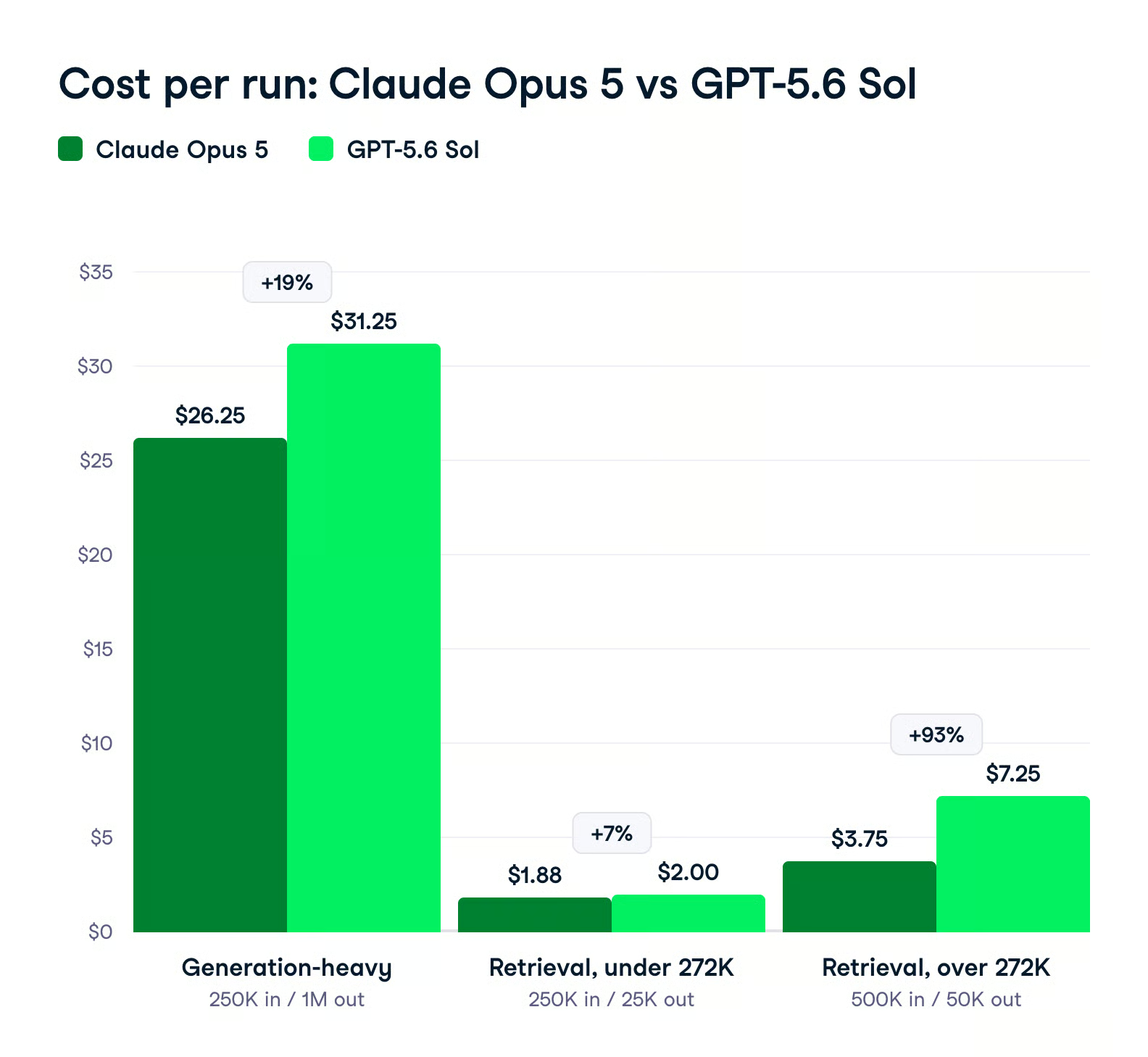
Rates per million tokens are hard to budget against, and a single fixed ratio hides the most important part of this comparison: the gap between these two models depends entirely on the shape of the workload. Here are three representative shapes at standard rates, with no caching or batch discounts.
| Workload | Assumed volume | Claude Opus 5 | GPT-5.6 Sol | Sol vs Opus |
|---|---|---|---|---|
| Generation-heavy | 250K in / 1M out | $26.25 | $31.25 | +19% |
| Retrieval, under 272K | 250K in / 25K out | $1.88 | $2.00 | +7% |
| Retrieval, over 272K | 500K in / 50K out | $3.75 | $7.25 | +93% |
On generation-heavy work, the 20% output premium flows almost straight through, and Sol runs about 19% more. On short retrieval work, it is nearly closed to about 7%, because the output is a rounding error against an identical input rate.
The third row is the one to notice. Once a request crosses 272K input tokens, Sol's surcharge applies 2× input and 1.5× output to the full request while Opus 5 stays flat to 1M, so the premium does not shrink at scale; it nearly doubles the bill. For retrieval-heavy or large-context work, that reversal matters more than the headline output premium.
Two things make identical work ring up different bills here, beyond the headline rates:
ultra. Ultra carries no rate premium, billing at the same $5/$30 as base Sol, but its multi-agent, high-effort mode spends many more tokens per task, which can push an agentic job to roughly triple the cost of base Sol at the same rates. That multiple is a reported estimate, not a measured figure.That caveat applies to the output side generally. The efficiency claims in circulation almost all compare against other models: Sol reportedly uses less than half of Fable 5's output tokens on the Coding Agent Index, and Anthropic reports Opus 5 generating 26% fewer tokens than Opus 4.8 at max reasoning. Both are predecessor comparisons, and neither can adjust the numbers above.
The dimension results map onto workloads fairly cleanly, so here is the decision guide before I expand on each side.
| Use Case | Recommended | Why |
|---|---|---|
| Genuinely novel problems with no training precedent | Claude Opus 5 | 30.2% on ARC-AGI-3 against Sol's 7.78% |
| Complex terminal and command-line agents | GPT-5.6 Sol | 88.8% on Terminal-Bench 2.1, rising to 91.9% with ultra |
| Repository-level refactoring and architecture work | Claude Opus 5 | 79.2% on SWE-Bench Pro against 64.6% |
| Defensive cybersecurity and exploit reproduction | GPT-5.6 Sol | 73.5% on ExploitBench; Opus 5 blocks exploit generation by design |
| GUI-driving and computer-use agents | Claude Opus 5 | 70.6% on OSWorld 2.0 against 62.6% |
| Long-context retrieval over large document sets | Claude Opus 5 | 1M context by default with no surcharge tier |
| Multi-cloud enterprise deployment | Claude Opus 5 | Available on Bedrock, Vertex AI, and Azure AI Foundry |
ultra coordinates four agents by default and pushed BrowseComp to 92.2% at sixteen agents, and the multi-agent beta in the Responses API lets you build similar patterns yourself.SpaceXAI's Grok 4.6 is a third option in this tier, tying Sol on the Intelligence Index at a lower list price
Two weeks apart, the two vendors made opposite bets: Opus 5 chases novel reasoning and task completion, while Sol leans into terminal work, browsing, and defensive security, charging a 20% output premium.
Pick Opus 5 if your problems are genuinely new, your agents need to finish rather than attempt, or you work over long contexts where its flat 1M pricing beats Sol's surcharge; pick Sol if your agents live in a shell, you're doing exploit-reproduction work that Opus 5 blocks by design, or you can afford ultra to top the terminal and browsing leaderboards.
On most other dimensions, the gap is smaller than either vendor's marketing suggests, so match the model to your dominant workload rather than the headline benchmark.
Learn AI with DataCamp!
Course
Course
Track
blog
Tom Farnschläder
11 min
blog
Tom Farnschläder
11 min
blog
Derrick Mwiti
9 min
blog
Khalid Abdelaty
11 min
blog
Josef Waples
9 min
blog
Tom Farnschläder
15 min