
Cours
Algèbre linéaire pour la data science en R
4 h
21.6K
Le produit scalaire, aussi appelé produit intérieur en espace euclidien, est une opération fondamentale en mathématiques qui combine deux vecteurs pour produire une valeur scalaire.
Le produit scalaire est central dans plusieurs disciplines comme l'algèbre linéaire, la physique et le machine learning. Il facilite le calcul d'angles et de projections, et permet ainsi d'évaluer des similarités entre vecteurs. Une compréhension solide du produit scalaire est, selon moi, essentielle pour appréhender les relations vectorielles dans tous ces domaines.
Il existe différentes manières de comprendre et de calculer le produit scalaire ; dans cette section, j'en présente les définitions et propriétés principales.
D'un point de vue algébrique, le produit scalaire de deux vecteurs se calcule comme la somme des produits de leurs composantes correspondantes ; ainsi, pour deux vecteurs :


Le produit scalaire se calcule via :
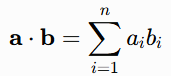
Cette formulation est simple à calculer et se généralise aisément aux dimensions supérieures. À noter que le produit scalaire est invariant par rotation, ce qui en fait une mesure intrinsèque de l'alignement entre vecteurs, indépendante du repère choisi.
L'interprétation géométrique exprime le produit scalaire en fonction des normes des vecteurs et du cosinus de l'angle θ qui les sépare :

Ce point de vue montre comment le produit scalaire quantifie les relations directionnelles et aide à comprendre formellement projections et orthogonalité. L'équivalence des définitions algébrique et géométrique se démontre à l'aide de la loi des cosinus.
Ce point de vue montre comment le produit scalaire quantifie les relations directionnelles et aide à comprendre formellement projections et orthogonalité. L'équivalence des définitions algébrique et géométrique se démontre à l'aide de la loi des cosinus.
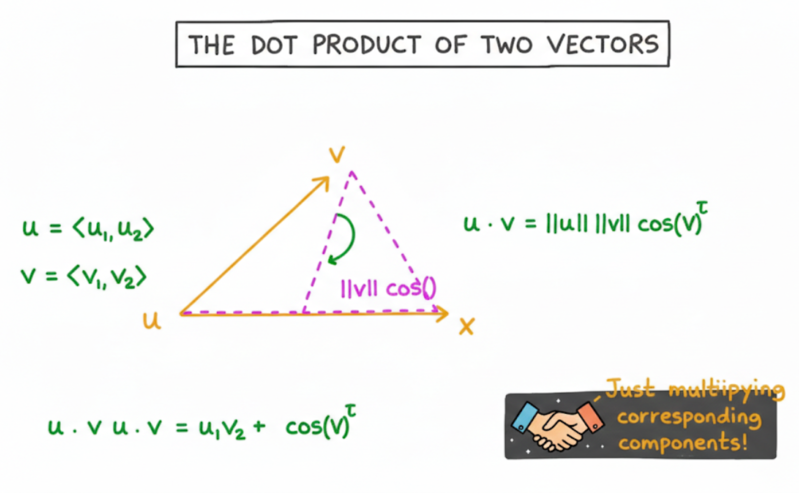
Cette image illustre l'intuition géométrique derrière le produit scalaire de deux vecteurs.
Il est généralement utile d'avoir une bonne intuition des angles et du théorème de Pythagore en géométrie. N'hésitez donc pas à consulter notre tutoriel Théorème de Pythagore : explorer une relation fondamentale de la géométrie.
Le produit scalaire est commutatif. Autrement dit, a·b = b·a, l'ordre des vecteurs n'influe pas sur le résultat.
Le produit scalaire est aussi distributif par rapport à l'addition vectorielle (a·(b+c) = a·b + a·c). De plus, il est homogène (linéaire en chaque argument) et défini positif, c'est-à-dire a·a > 0 pour a non nul, ce qui conduit directement à la définition de la norme euclidienne :
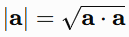
Un produit scalaire nul indique l'orthogonalité, notion centrale dans de nombreuses applications. En supposant que les vecteurs vivent dans un espace euclidien réel, ces propriétés s'appliquent sans perte de généralité.
Pour ancrer le calcul de manière intuitive, voyons quelques exemples. Considérons deux vecteurs 2D a=(1,2) et b=(3,4). Algébriquement :

Géométriquement :
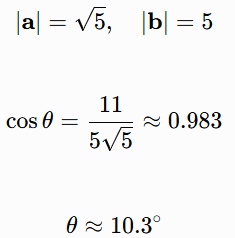
De même en 3D, avec a=(1,2,3) et b=(4,5,6) :
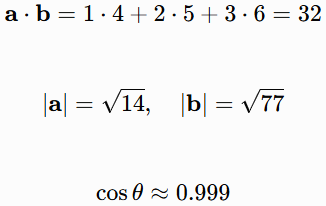
Dans cette section, j'approfondis la formulation géométrique du produit scalaire et ses implications.
La projection scalaire de b sur a est :

La projection vectorielle est :
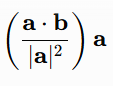
Cette opération décompose les vecteurs en composantes parallèles et orthogonales, avec des applications comme la formation d'ombres ou la résolution des forces en physique. Elle est liée au produit scalaire via la relation au cosinus.
Comme vu plus haut, le produit scalaire aide à calculer l'angle via la formule :
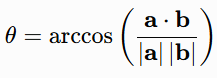
Ainsi, lorsque a·b = 0, l'angle principal vaut θ = 90°, ce qui fournit une méthode pratique pour les décompositions de base.
En physique, le travail W fourni par une force constante F est :
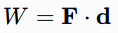
Cette formulation s'étend aux notions de puissance et d'énergie. La projection sur des plans intervient également dans les décompositions en composantes et les cosinus directeurs.
Dans cette section, je replace la structure mathématique du produit scalaire comme cas particulier des produits intérieurs.
Le produit scalaire est une forme bilinéaire définie positive. En principe, les produits intérieurs généralisent ce concept à d'autres espaces satisfaisant symétrie et linéarité. Le produit scalaire euclidien coïncide avec le produit intérieur standard dans Rn
Pour des vecteurs complexes, le produit intérieur devient la forme hermitienne :
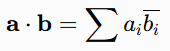
Elle est sesquilinéaire (linéaire en un argument et conjuguée-linéaire en l'autre) et donc non commutative au sens usuel. Cette modification est utilisée en mécanique quantique et en traitement du signal.
L'inégalité de Cauchy-Schwarz énonce que pour deux vecteurs a et b, la relation suivante est vérifiée :
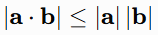
Avec égalité lorsque les vecteurs sont linéairement dépendants. Elle implique l'inégalité triangulaire et fournit des bornes très utiles en analyse. Intuitivement, elle reflète qu'une projection ne peut pas excéder la norme si l'on s'y « concentre » entièrement.
Les bases orthonormées simplifient le calcul du produit scalaire en de simples extractions de coordonnées. Elles aident à construire et vérifier des bases, tant en théorie qu'en pratique, par exemple en analyse de Fourier.
Dans cette section, je mets en avant quelques-unes des nombreuses applications pratiques du produit scalaire.
Le produit scalaire permet de calculer le travail (W = F·d) et la puissance. Je l'ai évoqué plus haut. Ce que je n'avais pas eu le temps de mentionner, c'est qu'il est aussi invariant par rotations et changements de repère, ce qui en fait un outil adapté pour formuler des lois physiques dans différents référentiels.
La géométrie est au cœur de l'infographie, et le produit scalaire est au cœur de la géométrie analytique. Par exemple, il sert aux tests de champ de vision et à l'éclairage via le vecteur normale·lumière. Il intervient aussi dans la détection de collisions (équations de plans) et les calculs d'ombrage.
Le produit scalaire mesure la similarité dans des espaces de grande dimension. Il est utilisé pour la convolution, les couches de réseaux de neurones (sommes pondérées) et les systèmes de recommandation. Dans les plongements de mots, la similarité cosinus (produit scalaire normalisé) compare des vecteurs sémantiques, ce qui est notamment crucial en Retrieval Augmented Generation.
Le produit scalaire se calcule efficacement dans différents environnements de programmation. Cette section illustre quelques exemples.
Python offre de nombreuses options d'implémentation. NumPy propose np.dot(a,b) ou l'opérateur @ pour des opérations vecteur/matrice performantes.
Une version en Python pur utilise sum(ai * bi for ai, bi in zip(a,b)).
Pour les tableaux/matrices, le broadcasting et la vectorisation apportent un gain de performance notable. Voici un exemple :
import numpy as np
a = np.array([1, 2, 3])
b = np.array([4, 5, 6])
print(np.dot(a, b))  # 32
print(a @ b) # 32L'opérateur %*% réalise les multiplications matricielles, tandis que crossprod(a, b) ou sum(a * b) offrent des alternatives.
Comme évoqué, la vectorisation accélère les calculs en base R et dans des packages comme Matrix.
a <- c(1, 2, 3)
b <- c(4, 5, 6)
a %*% b          # renvoie une matrice contenant 32
sum(a * b) # 32Utilisez =SUMPRODUCT(A2:A4, B2:B4) pour des vecteurs en colonnes A et B. Ou multipliez terme à terme puis faites la somme manuellement.
Pour des jeux de données plus volumineux, les formules matricielles ou Power Query sont préférables, même si Excel reste limité en montée en charge par rapport aux outils programmatiques.
Pour aller plus loin, lisez nos tutoriels Produit cartésien en SQL : guide complet et Qu'est-ce qu'un data product ? Concepts et bonnes pratiques.
NumPy en Python surpasse les boucles Python pures et passe à l'échelle grâce à des bibliothèques BLAS optimisées, via ses implémentations et stratégies d'allocation efficaces.
La vectorisation en R est, de son côté, très efficace pour des tailles modérées.
Excel convient à de petits jeux de données ou au prototypage rapide, mais montre ses limites pour l'analyse à grande échelle. Les bibliothèques spécialisées offrent généralement de meilleures performances.
Le produit scalaire ne se limite pas à mesurer des similarités dans Rn ; voici pourquoi.
Dans des espaces de fonctions comme L2, le produit intérieur se généralise en :
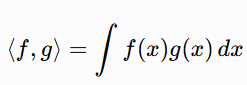
Avec des applications en analyse de Fourier.
Les versions pondérées utilisent une matrice définie positive ; pour les matrices, le produit intérieur de Frobenius est :

Les généralisations tensorielles étendent le concept à des ordres supérieurs.
La métrique de Minkowski conduit à :

Ce qui s'écarte du cas euclidien pour les intervalles d'espace-temps.
Puisque le produit scalaire de deux vecteurs A et B est

alors, en divisant par les normes de A et B de part et d'autre, on obtient la similarité cosinus :
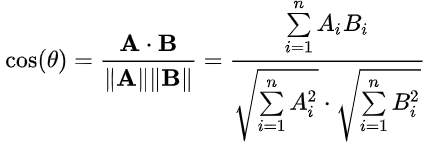
La similarité cosinus normalise le produit scalaire et est largement utilisée en recherche d'information et en machine learning.
Explorez le lien entre produits scalaires et matrices symétriques. Discutez orthogonalité et factorisations matricielles. Relevez la pertinence pour l'analyse en composantes principales et la théorie spectrale.
Cette section met en contraste le produit scalaire et le produit vectoriel.
Une projection scalaire donne la grandeur le long d'une direction. Une projection vectorielle, elle, donne la composante parallèle. Ces notions soutiennent la décomposition en composantes avec des illustrations géométriques.
Le produit mixte (scalaire) est :
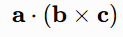
il donne un volume signé. Ici, le produit scalaire fournit un scalaire tandis que le produit vectoriel produit un vecteur. Utilisez le produit scalaire pour la similarité ou l'alignement, et le produit vectoriel pour l'orientation ou la rotation.
|
Aspect |
Produit scalaire |
Produit vectoriel |
|
Résultat |
Scalaire |
Vecteur |
|
Usage |
Angle, travail, similarité |
Couple, aire, perpendicularité |
|
Dimension |
Toute |
3D (principalement) |
|
Nul quand |
Orthogonal |
Parallèle |
Ce tableau met en évidence quelques différences majeures entre les deux opérations.
Le produit scalaire reste inchangé sous les transformations orthogonales, propriété très utile en physique et en ingénierie pour des formulations indépendantes du repère. Il existe bien sûr de nombreux types de multiplications, avec des significations et des méthodes de calcul différentes. Découvrez notre tutoriel sur le produit de Hadamard : guide complet de la multiplication matricielle élément par élément pour un exemple.
En résumé, le produit scalaire est un outil fondamental et polyvalent en mathématiques, utilisé dans des domaines variés comme la physique et l'informatique. Ses applications vont du calcul de travail et des modèles d'éclairage à la similarité dans des données de grande dimension, ce qui souligne sa pertinence durable. Ces perspectives invitent à explorer ses généralisations avancées. Inscrivez-vous à notre cours Linear Algebra for Data Science in R pour continuer à apprendre.
Apprenez avec DataCamp
Cours
Cours
Cours