Cursus
Artificial Intelligence begrijpen
2 Hr
422.2K
GPT-6 Astra launched September 3. Grok 4.7 followed a few weeks later, on September 21, with SpaceXAI's own comparisons against Astra built right into the release. Read both posts back to back and you'd think each one clearly wins. Read them side by side, and it's clearer what's actually going on: two companies chose different benchmarks to headline, and neither one measured itself against the other's favorite chart.
But the launch-post benchmarks only tell you about the specific tasks each company chose to show off. They don't tell you where a model sits overall. On that bigger question, there's reason to think Grok 4.7 isn't actually playing in the same tier as Astra. This is where the Artificial Analysis Intelligence Index is useful because it's a third party. That said, the comparison isn't clean. Grok 4.7 is much cheaper, and the cost per token makes it a good model.
Grok 4.7 is xAI/SpaceXAI's newest model, positioned for coding and knowledge work. The release describes it as "twice as fast, at half the price" of comparable models, and says it's served at the same price and speed as its predecessor, Grok 4.6, which is a good way to generate buzz.
Underneath, Grok 4.7 uses a larger base model than 4.6, trained with a longer reinforcement learning run on a harder mix of tasks and weighted towards problems that take many hours to complete. Also, the model is better at checking its own work and managing longer context. Finally, we should know it was trained to natively understand the Grok Bot harness.
GPT-6 Astra is OpenAI's current flagship model. OpenAI calls it "the world's most intelligent and aligned model." OpenAI says Astra scores 98% on FrontierMath Tier 4, 99.9% on ARC-AGI-3, and 100% on ExploitBench. We're sure in future articles we will be referencing other benchmark tests because Astra has saturated many of the most well-known ones. Also, Astra has already helped with open problems in mathematics, including two new results on gaps between prime numbers.
Even more, OpenAI positions Astra as a major step forward in computer use. It handles tasks like filling out forms, updating CRM records, doing research, building websites, and running frontend QA. Other models were doing all this already, but OpenAI says Astra is just that much faster and more accurate. The release also emphasizes professional output quality, saying Astra is better at following existing templates and house style when producing documents, spreadsheets, slide decks, and the like.
Grok 4.7's release centers CursorBench 4.0 as its signature coding benchmark, where it scores 46.3% (xHigh setting), which is ahead of Grok 4.6 (40.4%). It's also ahead of GPT‑5.6 Sol (41.7%), but it's behind Claude Fable 5.1 (51.8%).
GPT‑6 Astra's post mentions Terminal-Bench 4.0 instead, where it claims 57.9%, which beats GPT‑5.6 Sol (37.3%) and Claude Fable 5.1 (55.8%).
Interestingly, Grok's release also reports a Terminal-Bench 4.0 number of 38.0% for Grok 4.7, which is well below Astra's score.
On DeepSWE v1.1, the two are close, but Astra's ahead: Astra reports 74.1% versus Grok 4.7's 71.0% (at high effort).
Grok 4.7 highlights AA Briefcase v1.1 ("multi-hour office work"), where it scores 1,657, which is ahead of Grok 4.6 (1,546) and GPT‑5.6 Sol (1,487). But it's still behind Claude Fable 5.1, which tops that chart at 1,678.
Grok also cites a GDPval Elo comparison where Fable 5.1 leads at 1,735, followed by Grok 4.7 at 1,695, then Grok 4.6 at 1,605. GPT‑6 Astra comes in last on this chart at 1,542, at least in xAI's own presentation of it.
GPT‑6 Astra's knowledge-work claims lean on different benchmarks entirely: AutomationBench (41.4%, which is ahead of GPT‑5.6 Sol and Fable 5.1) and BenchCAD (95.9%, which is again ahead of Sol and Fable 5.1). It also cites Agents' Last Exam, where it scores 59.3%, ahead of Opus 5's 55.5%.
This is where the two releases tell almost opposite stories.
xAI says Grok 4.7 blocks 96.7% of risky dual-use prompts on HackerBench v0.3, while still allowing legitimate security work through. It also tops LatchBio's biosafety benchmark at 62.4%. The company mentions giving select partners narrower, invite-only access to less-restricted red-team capabilities, but the headline framing is restraint.
OpenAI says GPT‑6 Astra crosses its own "Critical" threshold for cyber capability, and reports a 100% score on ExploitBench, versus 78.5% for GPT‑5.6 Sol. It also says Astra found two real zero-day vulnerabilities during testing, which OpenAI says it disclosed to maintainers. Alongside this, OpenAI reports a 0% "honeypot" exploit rate when Astra was tested without production safeguards, and says Astra will refuse more advanced offensive tasks like proof-of-concept exploit creation.
Let's step back from the cherry-picked charts.
On the Artificial Analysis Intelligence Index — an aggregate across ten benchmarks, not one hand-picked task — Grok 4.7 scores 46. Fable 5.1 and GPT-6 both score 53. That's a gap, and it's not one either company's launch post shows you, because neither post benchmarks against that index.
SpaceXAI's own release claims 38% on Terminal-Bench 4.0, but Artificial Analysis independently measured Grok 4.7 at just 26% on the same benchmark. Astra claims it had 57.9%. Self-reported numbers and independently measured ones aren't always telling the same story.
Elon Musk himself set expectations a week before Grok 4.7 launched:

None of this means Grok 4.7 is a bad model — the price-performance case later in this piece still holds. But it's worth reading the benchmark-by-benchmark comparisons that follow with this in mind: they're comparing two models that may not be peers overall, using metrics each company chose because its model does well on them.
Grok 4.7 is 5x cheaper on input tokens and roughly 8x cheaper on output tokens. So Grok 4.7 does match or beat bigger models at a fraction of the cost, while also keeping pricing flat versus Grok 4.6.
OpenAI doesn't really dispute the price gap. It argues efficiency: Astra allegedly needs fewer tokens to finish a task, which it says partly closes the gap on cost-per-task even if the per-token rate is higher (much higher).
| Input ($/M tokens) | Output ($/M tokens) | Fast tier | |
|---|---|---|---|
| Grok 4.7 (xHigh) | $2 | $6 | 2x speed at 2x price |
| GPT‑6 Astra | $10 | $50 | 2x speed at 2x price |
The Takeaway: If you're optimizing for cost per token, Grok 4.7 wins.
Grok 4.7's safety pitch centers on refusals and jailbreak resistance. xAI calls it the strongest model they've tested on these fronts, backed by a new safeguard stack. It also cites LatchBio's biosafety benchmark, where it scores 62.4%, framed as balancing usefulness on legitimate biological work with safe refusal on dangerous requests.
GPT-6 Astra's safety pitch is about alignment rather than refusals alone. OpenAI calls it "our most aligned model," pointing to a 0.00% score on an internal circumvention benchmark (versus 0.29% for GPT-5.6 Sol) and a 4.2% rate on an internal hallucination benchmark about its own capabilities (versus 12.2% for Sol). It also says Astra never tried to bypass an auto-review safeguard in testing, even when that safeguard was made easy to evade.
Grok 4.7 is available now. You can get it in Cursor, Grok Build, the Grok API, and through third-party coding harnesses, model routers, and cloud platforms.
GPT‑6 Astra is rolling out more slowly. It started with a limited set of organizations, with ChatGPT Plus/Pro/Business/Enterprise access, the OpenAI API, Microsoft Azure, and AWS Bedrock following over subsequent days. Enterprise admins also have to turn it on themselves, since it's off by default.
Benchmarks are one thing. But head-to-head tests are maybe more interesting. Now that both models are out, we are starting to see cool things people are making.
One example: developer Aditya gave GPT-6 Astra, Grok 4.7, Kimi K3, and Fable 5.1 the same prompt, which was about building a flight simulator. His verdict: Astra came out on top overall, but Grok 4.7 was surprisingly close, while Kimi K3 and Fable 5.1 landed in a tie behind it.
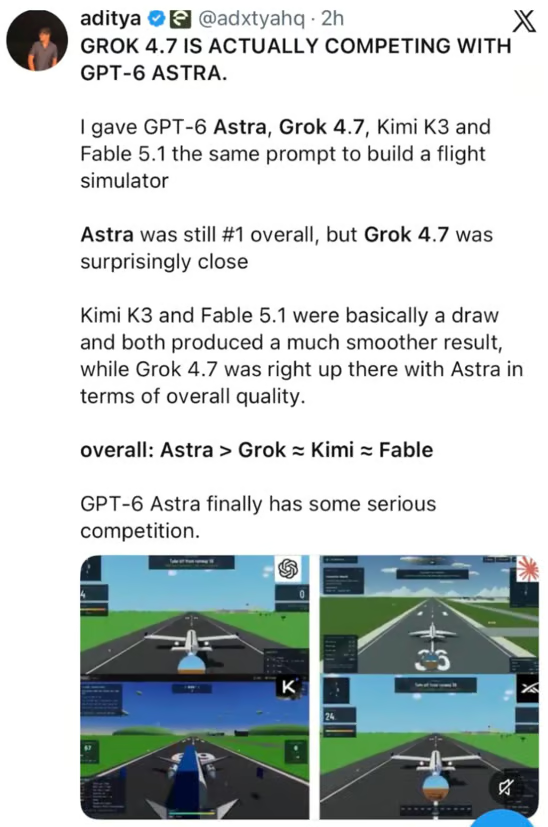
A week before launch, as I mentioned earlier, Musk pegged Grok 4.7 as roughly Opus 5.0-class and a tier below Astra and Fable, and he also flagged multimodal as a specific weakness. A flight simulator is about as multimodal a task as you can hand a model. If anything, Grok 4.7 showing up with Astra on exactly the kind of task Musk warned it would struggle with is a good sign for SpaceXAI. Maybe Elon didn't give the model enough credit.
The model metrics are a little bit of a coin flip. Coding, cybersecurity, safety, knowledge work: It depends on whose chart you trust. Both companies picked the numbers that made them look good.
But the Artificial Analysis Intelligence Index is useful here because a single benchmark number from a vendor and an aggregate number from a neutral third party aren't the same kind of evidence, and we know Astra wins overall, except, of course, on price, where it loses badly.
Learn AI with DataCamp
Cursus
Cursus
Cursus
blog
Khalid Abdelaty
13 min
blog
Tom Farnschläder
15 min
blog
Matt Crabtree
12 min
blog
Tom Farnschläder
11 min
blog
Vinod Chugani
12 min
blog
Tom Farnschläder
11 min