
{count, plural, one {Track} other {Tracks}}
Associate AI Engineer for Developers
{hours} hr
GLM-5.3-Flash is Z.ai's first natively multimodal model in the GLM-5 series, released on 26 August 2026 with 320 billion total parameters and 18 billion active. Z.ai's launch post says it beats GLM-5.2 on coding and agent benches at about one-tenth the price, and scores 57 on the Artificial Analysis Intelligence Index v4.1.1 at $0.045 per task on the discounted tier.
The architecture is the real product story: hybrid linear and sparse attention, Manifold-Constrained Hyper-Connections (mHC), a 30-trillion-token multimodal corpus, and 45 layers instead of GLM-4.5's 92. Z.ai ran it anonymously as ox-alpha on OpenCode and OpenRouter before naming it, served on Chinese AI chips. Weights are on Hugging Face under an MIT license, with serving recipes for SGLang, vLLM, and TokenSpeed.
Read more details in our standalone GLM-5.3-Flash guide and see the model in action in our GLM-5.3-Flash tutorial. For the previous generation, see our GLM-5.2 guide and our tutorial on running GLM-5 locally for agentic coding.
Qwen3.8-Flash-Next is Alibaba's Qwen team's 26 August 2026 open-weight preview of the architecture planned for Qwen4. The main model is 125 billion parameters, plus a 51-billion-parameter n-gram embedding table, with 6 billion parameters active per token. Native context is 262,144 tokens, extensible to 1,000,000 with YaRN. Qwen says training cost about one-ninth of Qwen3.7-Plus.
The production SKU is Qwen3.8-Flash on QwenCloud, listed at $0.16 per 1M input tokens and $0.47 per 1M output tokens, with the API marked coming soon. The cloud model ID is qwen3.8-flash. We already wrote a standalone Qwen3.8-Flash-Next guide and a setup tutorial on how to run Qwen3.8-Flash-Next as a local coding agent with OpenCode.
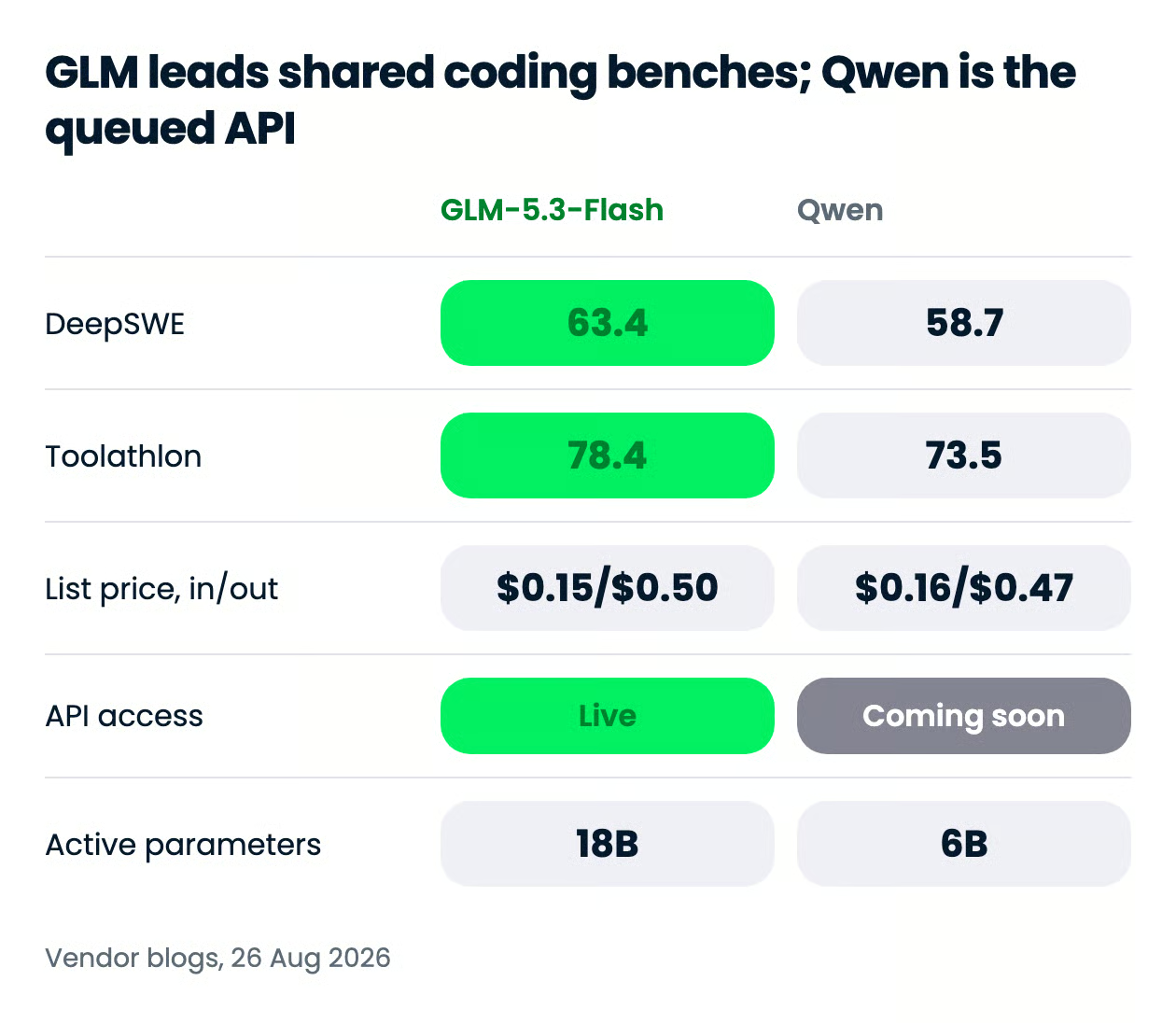
On the benchmarks that both labs published, GLM-5.3-Flash is ahead, as you might expect given that it's the larger model of the two. The pricing of both models is very similar.
| Feature | GLM-5.3-Flash | Qwen3.8-Flash-Next |
|---|---|---|
| Lab / date | Z.ai, 26 August 2026 | Qwen (Alibaba), 26 August 2026 |
| Size | 320B total, 18B active | 125B main + 51B n-gram, 6B active |
| Context | 1M tokens native | 262,144 native; 1,000,000 with YaRN |
| Modalities | Native multimodal (text, image, video in) | Native multimodal MoE |
| Weights | MIT, zai-org/GLM-5.3-Flash |
Open weight, Qwen/Qwen3.8-Flash-Next |
| Shared coding benches | Leads DeepSWE, Toolathlon, NL2Repo | Trails those three; published SWE-bench Pro 62.5 |
| Office-agent benches | AutomationBench 48.8; OfficeQA Pro 62.4 | CoWorkBench 73.9; JobBench 55.7 |
| API list price (per 1M) | $0.15 in / $0.50 out | $0.16 in / $0.47 out (Qwen3.8-Flash) |
| First-party API | Live, glm-5.3-flash |
Queued, qwen3.8-flash |
GLM-5.3-Flash leads the coding and tool-use scores that both vendors put on the same row. Z.ai's 26 August table lists DeepSWE v1.1 at 63.4, Toolathlon Verified at 78.4, and NL2Repo at 56.3. Qwen's table lists 58.7, 73.5, and 48.1 on those same names.
Apart from those, the comparison is difficult since the selected benchmarks differ between the two vendors. Qwen published SWE-bench Pro at 62.5 and SWE-bench Multilingual at 81.0. Z.ai did publish Terminal Bench 2.1 at 84.3 and AutomationBench at 48.8, plus an in-house Z.ai Code Bench v1.0 result of 29.0 at max effort against Claude Opus 4.8's 29.5, run in Claude Code 2.1.207.
| Benchmark | GLM-5.3-Flash | Qwen3.8-Flash-Next | Notes |
|---|---|---|---|
| DeepSWE v1.1 | 63.4 | 58.7 | Vendor tables; GLM used mini-swe-agent, Qwen reports the higher of Claude Code and mini-SWE-agent |
| Toolathlon Verified | 78.4 | 73.5 | Pass@1; GLM averages 3 runs |
| NL2Repo | 56.3 | 48.1 | Qwen labels it NL2Repo-Bench |
| SWE-bench Pro | Not published | 62.5 | Qwen re-ran baselines in Claude Code |
| Terminal Bench 2.1 | 84.3 | Not published | Z.ai, Claude Code 2.1.207 |
| Agents' Last Exam | 26.3 | 24.3 pass@1 (score 51.2) | Reporting formats differ |
I would treat GLM as the stronger published coding agent Flash on the overlapping set, and refuse to crown a SWE-bench winner without Z.ai's published score.
Qwen is the lab that published long-horizon office scores. CoWorkBench is 73.9 and JobBench is 55.7, both miles ahead of Qwen3.7-Plus (65.1 and 27.6) and of Claude Opus 4.6 Max on those rows (68.2 and 36.6).
Z.ai's overlapping "work" numbers are AutomationBench 48.8 and OfficeQA Pro 62.4, plus ZCode Browser Use and Computer Use for visual desktop work.
Those are not the same tests, so they do not settle a winner. If your mental model of the job is a multi-hour office agent, Qwen gave you the benches. If it is Zapier-style automation or PDF office QA, GLM gave you those.
Qwen3.8-Flash-Next activates 6 billion parameters per token. GLM-5.3-Flash activates 18 billion. That 3x gap is the cleanest hardware fact in the pairing, and it is why local serving conversations keep landing on Qwen. In practice, the UD-Q4_K_XL GGUF (~111GB) runs on a single 96GB card with RAM offload — we did it here.
Both use hybrid attention. Z.ai says GLM-5.3-Flash cuts attention compute 3.0x and KV cache size 4.4x versus GLM-5.3. Qwen says QSA's attention kernel is up to 7.6x faster in prefill and 4.9x in decode at 1M tokens, and 8.6x Qwen3.7-Plus prefill throughput at a 90% prefix-cache hit rate.
GLM's extra 51B-style capacity trick is not an embedding table; Qwen's 51B n-gram table is designed to live in host RAM and prefetch. Different recipes, same pitch: more capability per watt.
Both models take images in the same generation as text. GLM-5.3-Flash is explicitly the first native multimodal member of GLM-5, trained on a 30-trillion-token multimodal corpus, with video-capable vision rows (MVBench 77.8, MMVU 80.5).
Qwen3.8-Flash-Next publishes AndroidWorld 84.5, LVBench 76.6, RealWorldQA 88.5, and CharXiv 84.6 without a computer-use tool / 90.6 with one.
The context window size is close enough that I would not pick on it alone. GLM advertises a native 1M-token window. Qwen is native at 262,144 and stretches to 1,000,000 with YaRN. Reviews in the research notes still treat GLM's 1M as lightly stress-tested in production.
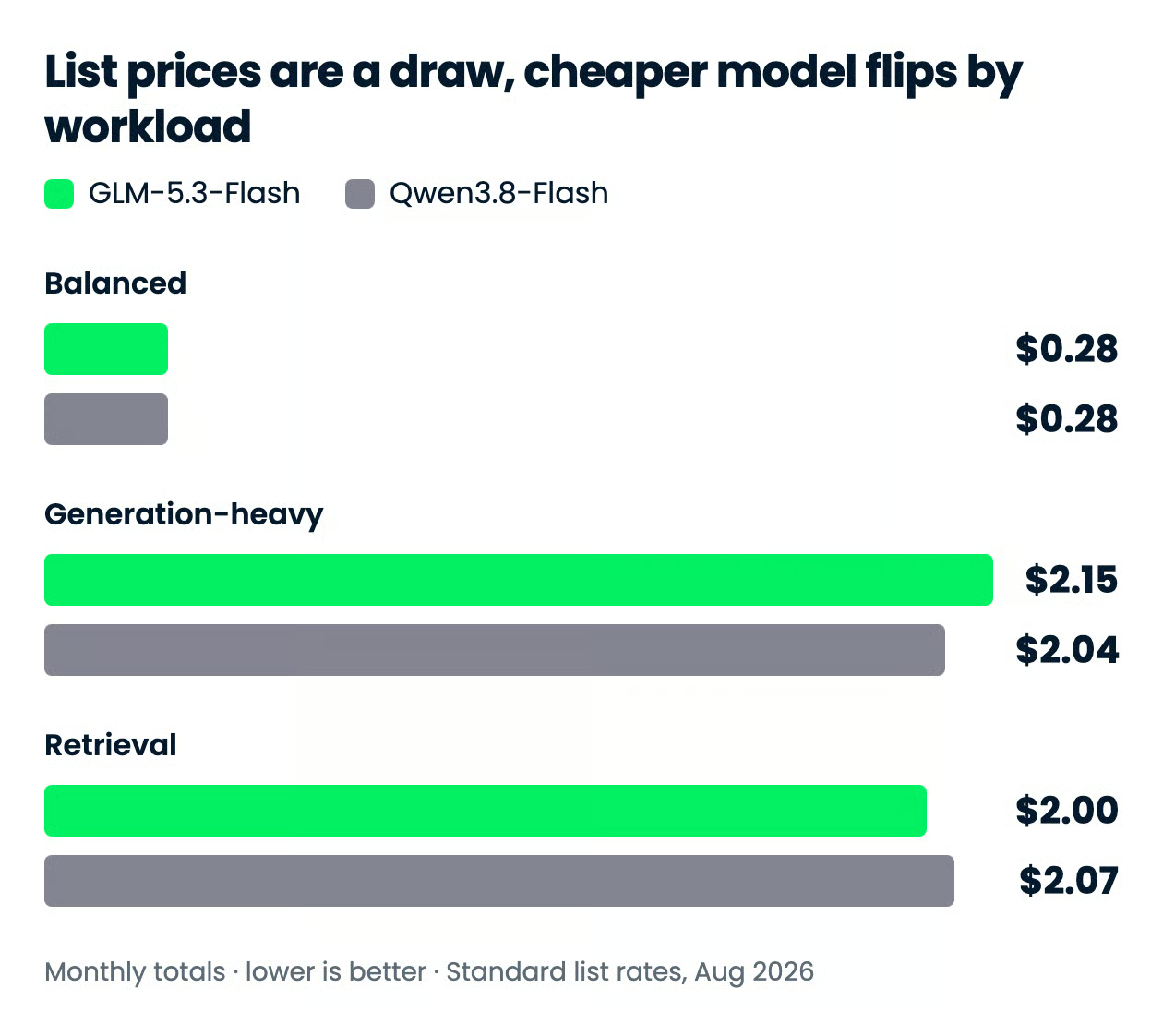
Promo rates aside, you almost can't distinguish between the two models' pricing. Qwen and Z.ai are clearly targeting the same tier here.
| Rate | GLM-5.3-Flash | Qwen3.8-Flash |
|---|---|---|
| Input, per 1M tokens | $0.15 ($0.075 promo) | $0.16 |
| Output, per 1M tokens | $0.50 ($0.25 promo) | $0.47 |
| Cached input, per 1M tokens | $0.03 ($0.015 promo) | $0.016 |
| Cached output, per 1M tokens | Free during promo | $0.20 |
| Launch promo | 50% off through 9 September 2026, 24:00 UTC+8 | None published |
| Coding Plan quota | 3x GLM-5.3 on all plan tiers | Not published |
The shape is almost flat. Qwen's slightly cheaper output helps generation-heavy months; GLM's slightly cheaper input helps retrieval. Z.ai bills thinking tokens at the output rate. Qwen documents enable_thinking and reasoning_effort on QwenCloud without a separate thinking-token price, so treat reasoning as output until they say otherwise.
Both labs publish cache rates, and they price the trade differently. Z.ai lists cached input at $0.03 per 1M tokens ($0.015 on the promo) and makes cache writes free during the promo window. Qwen reads cache at $0.016 but charges $0.20 per 1M tokens to create an explicit cache.
So Qwen halves your cache-read rate, and GLM gives away the write. If your prefixes are stable and long-lived, Qwen's read rate wins; if you rewrite caches often, GLM's free writes do, at least until 9 September.
Formula: (volume ÷ 1M) × rate, summed across input and output, at standard list rates. Promo dollars stay out of the table.
| Workload | GLM-5.3-Flash | Qwen3.8-Flash | Difference |
|---|---|---|---|
| Balanced assistant: 1M in / 250K out | $0.28 | $0.28 | $0.00 (0%) |
| Generation-heavy: 1M in / 4M out | $2.15 | $2.04 | Qwen $0.11 cheaper (5%) |
| Retrieval, sub-threshold: 10M in / 1M out | $2.00 | $2.07 | GLM $0.07 cheaper (3%) |
API list cost is a wash. The decision rests on workload fit and whether the endpoint exists. Both models sit on vendor-specific tokenizers, and neither lab published token counts for a shared workload, so treat these totals as a rate comparison rather than a bill. Through 9 September 2026, GLM's promo halves those GLM column totals ($0.14, $1.08, $1.00).
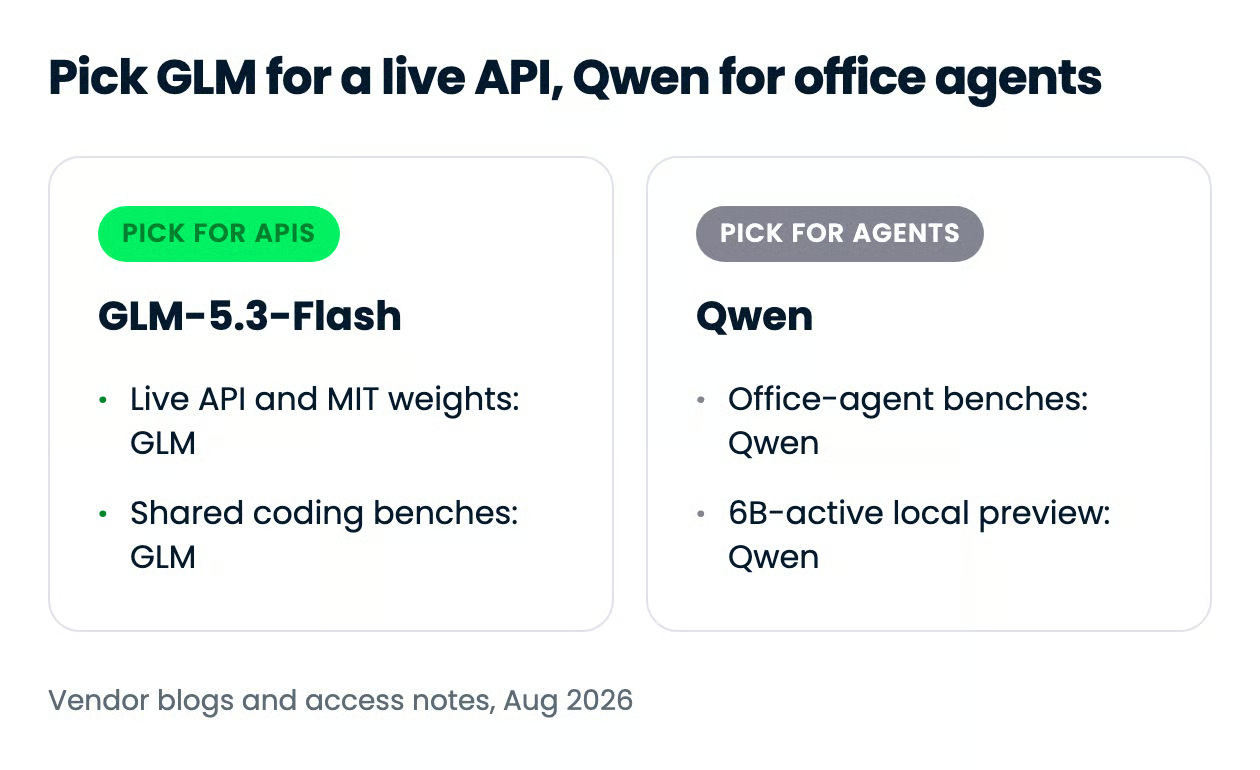
If you need to call a first-party API this week, GLM-5.3-Flash is the only complete product in the pair. If you are evaluating Qwen4's architecture, or you care about CoWorkBench and JobBench, start with Qwen3.8-Flash-Next weights now and add qwen3.8-flash when it is available on QwenCloud.
You need glm-5.3-flash on Z.ai, or z-ai/glm-5.3-flash on OpenRouter, without waiting for a queued cloud SKU.
Your eval set looks like DeepSWE, Toolathlon, NL2Repo, or Terminal Bench 2.1, and you want the lab that published the higher overlapping scores.
You want MIT weights and a native 1M-token window, and you are fine activating 18B parameters.
You are already on a GLM Coding Plan and can use the 3x quota versus GLM-5.3, including the promo through 9 September 2026.
You are buying a Qwen4 preview, not a finished managed API. The weights are the product today.
Office-agent benches are the ones you actually read. CoWorkBench and JobBench are Qwen's published story, not GLM's.
You want 6B active parameters and an n-gram table that can sit in host memory, including next to a Qwen3.8-27B local setup.
You already live in Qwen Chat, Qwen Studio, Qwen Code, or point any OpenAI-compatible agent (OpenCode, Codex, Qwen Code) at a local llama.cpp endpoint today. Claude Code needs a translation proxy.
| Surface | GLM-5.3-Flash | Qwen3.8-Flash-Next |
|---|---|---|
| Consumer app | Z.ai web playground and GLM Coding Plan | Qwen Chat and Qwen Studio |
| First-party API | Yes, Z.ai, glm-5.3-flash |
QwenCloud qwen3.8-flash (API coming soon) |
| Cloud platforms | Not available on Bedrock, Vertex AI, or Azure AI Foundry | Not available on Bedrock, Vertex AI, or Azure AI Foundry |
| Coding agents | ZCode; OpenRouter into IDEs that accept custom providers. Not native in Claude Code, GitHub Copilot, or Cursor | Works today via local llama.cpp + OpenCode; same wiring applies to QwenCloud when live. Not native in Claude Code, GitHub Copilot, or Cursor |
| Third-party routers | OpenRouter, DeepInfra, Together.ai | OpenRouter |
| API model ID | glm-5.3-flash (OpenRouter: z-ai/glm-5.3-flash) |
qwen3.8-flash on QwenCloud and OpenRouter; weights Qwen/Qwen3.8-Flash-Next |
GLM-5.3-Flash is callable now. Qwen3.8-Flash-Next is, too, just only on your own hardware or via routers such as OpenRouter. Qwen's own API endpoint should follow soon.
Type those IDs exactly. Qwen3.8-Flash-Next's ID is qwen3.8-flash (without the "next"), so do not invent a qwen3.8-flash-next cloud ID from the weight name.
Both models speak the OpenAI chat completions format, so you reuse the standard client either way. The fastest way to try them side by side is OpenRouter, where both sit behind one base URL, and the model string is the only thing you change.
from openai import OpenAI
import os

# One client, both models. Swap the model string on line 12 — nothing else changes.
client = OpenAI(
    api_key=os.environ["OPENROUTER_API_KEY"],
    base_url="https://openrouter.ai/api/v1",
)
completion = client.chat.completions.create(
    model="z-ai/glm-5.3-flash",  # or "qwen/qwen3.8-flash"
    messages=[{"role": "user", "content": "Refactor this function..."}],
    extra_body={"reasoning": {"effort": "high"}},
)
print(completion.choices[0].message.content)
Going first-party costs you the portability. Z.ai's endpoint lives at docs.z.ai and takes thinking: {"type": "enabled"} with reasoning_effort set to low, high, or max. Alibaba's takes enable_thinking with reasoning_effort defaulting to xhigh, against a DashScope base URL (international, Beijing, or Virginia). It's the same SDK either way, but the reasoning knob is not portable, so budget for a small adapter if you plan to switch.
For a full Qwen walkthrough, read our tutorial on how to run Qwen3.8-Flash-Next locally and the Qwen Code CLI tutorial. For GLM family local serving, use Run GLM-5 Locally For Agentic Coding. If you are already on a Qwen3.8-27B box, our RTX 5090 setup is the sibling local path, not this 125B preview.
If you need to ship against a live Flash API this week, use GLM-5.3-Flash. If you are studying Qwen4 or you believe CoWorkBench more than DeepSWE, use Qwen3.8-Flash-Next weights locally and switch to qwen3.8-flash via API when it ships.
What I find most interesting is how little the list prices disagree. The argument is access and which unpublished row you are willing to ignore, not a 2x cost cliff.
If you want the concepts under both MoEs, I recommend our Large Language Models (LLMs) Concepts course, then the AI Agent Fundamentals track. For hub-and-weights work, Working with Hugging Face is the practical next step.
Learn AI With DataCamp!
{count, plural, one {Track} other {Tracks}}
{count, plural, one {Track} other {Tracks}}
{count, plural, one {Course} other {Courses}}
{count, plural, one {blog} other {blogs}}
Matt Crabtree
9 min
{count, plural, one {blog} other {blogs}}
Matt Crabtree
9 min
{count, plural, one {blog} other {blogs}}
Matt Crabtree
11 min
{count, plural, one {blog} other {blogs}}
Matt Crabtree
10 min
{count, plural, one {blog} other {blogs}}
Matt Crabtree
10 min
{count, plural, one {blog} other {blogs}}
Tom Farnschläder
11 min

