
Cursus
AI-agents bouwen met Google ADK
1 uur
7.7K
Corrective retrieval-augmented generation (CRAG) is een verbeterde versie van RAG die tot doel heeft taalmodellen nauwkeuriger te maken.
Waar traditionele RAG simpelweg opgehaalde documenten gebruikt om tekst te genereren, gaat CRAG een stap verder door deze documenten actief te controleren en te verfijnen om te verzekeren dat ze relevant en accuraat zijn. Dit helpt fouten of hallucinaties te verminderen, waarbij het model onjuiste of misleidende informatie zou kunnen produceren.
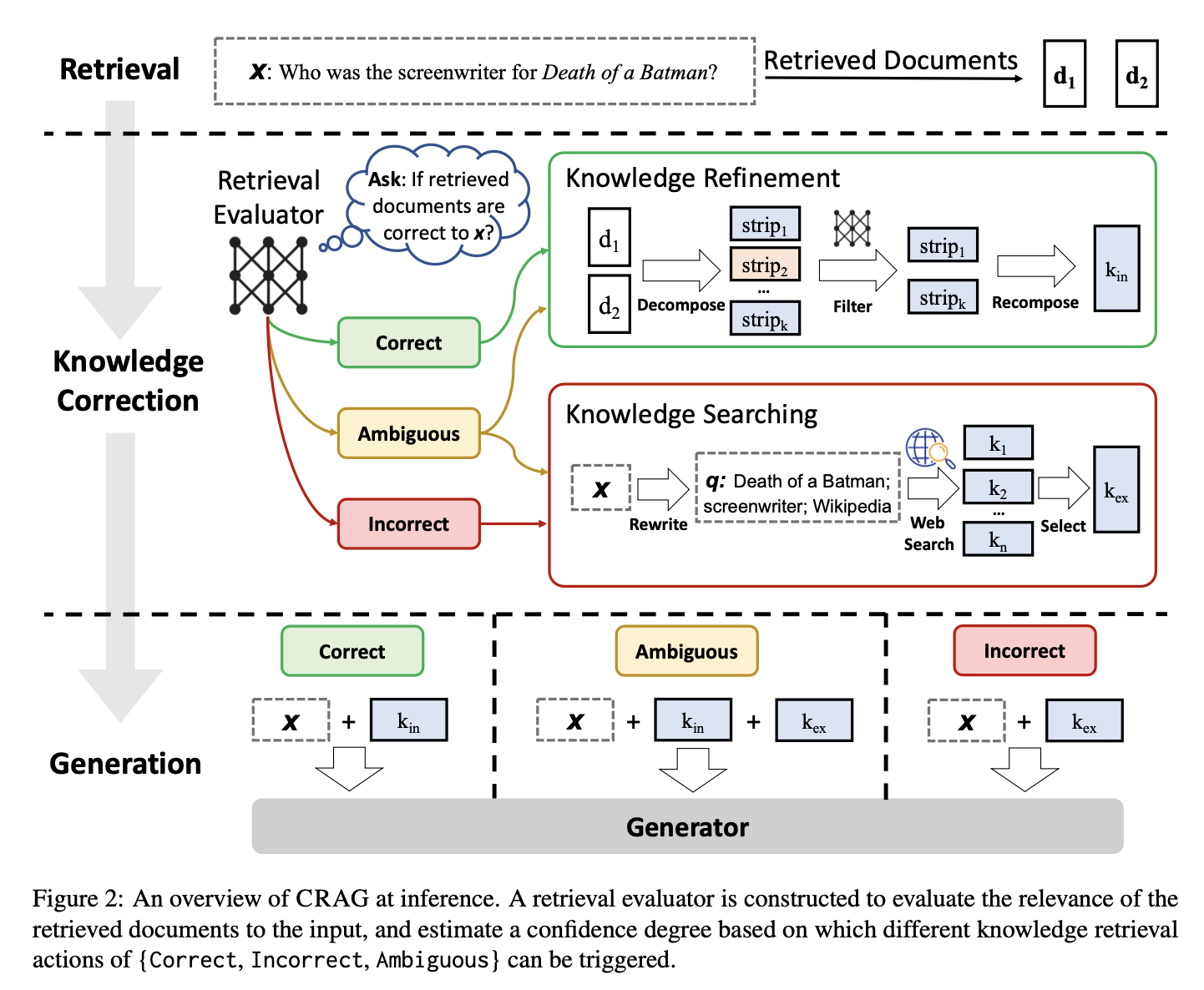
Bron: Shi-Qi Yan et al., 2024
Het CRAG-framework werkt via een paar kernstappen, met een retrieval evaluator en specifieke corrigerende acties.
Voor een gegeven invoervraag haalt een standaard retriever eerst een set documenten uit een kennisbank. Deze documenten worden vervolgens beoordeeld door een retrieval evaluator om de relevantie voor de vraag te bepalen.
In CRAG is de retrieval evaluator een fijn-afgesteld T5-large-model. De evaluator kent een vertrouwensscore toe aan elk document en deelt ze in drie vertrouwensniveaus in:
Na een van deze acties wordt de verfijnde kennis gebruikt om het definitieve antwoord te genereren.
CRAG brengt verschillende belangrijke verbeteringen aan ten opzichte van traditionele RAG. Een van de grootste voordelen is het vermogen om fouten in de opgehaalde informatie te corrigeren. De retrieval evaluator in CRAG helpt te signaleren wanneer informatie onjuist of irrelevant is, zodat dit kan worden gecorrigeerd voordat het de uiteindelijke output beïnvloedt. Dit betekent dat CRAG accuratere en betrouwbaardere informatie levert en fouten en desinformatie terugdringt.
CRAG blinkt ook uit in het waarborgen dat informatie zowel relevant als accuraat is. Waar traditionele RAG mogelijk alleen relevantiescores controleert, gaat CRAG verder door de documenten te verfijnen, zodat ze niet alleen relevant maar ook precies zijn. Het filtert irrelevante details weg en focust op de belangrijkste punten, zodat de gegenereerde tekst op accurate informatie is gebaseerd.
In deze sectie doorlopen we stap voor stap hoe je CRAG implementeert met LangGraph. Je leert je omgeving in te richten, een basis-vectorstore voor kennis te maken en de kerncomponenten voor CRAG te configureren, zoals de retrieval evaluator, question rewriter en webzoektool.
We leren ook hoe je een LangGraph-workflow bouwt die al deze onderdelen samenbrengt en laten zien hoe CRAG verschillende soorten vragen aankan voor nauwkeurigere en betrouwbaardere resultaten.
Installeer eerst de benodigde pakketten. Deze stap richt de omgeving in om de CRAG-pijplijn uit te voeren.
pip install langchain_community tiktoken langchain-openai langchainhub chromadb langchain langgraph tavily-pythonConfigureer vervolgens je API-sleutels voor Tavily en OpenAI:
import os
os.environ["TAVILY_API_KEY"] = "YOUR_TAVILY_API_KEY"
os.environ["OPENAI_API_KEY"] = "YOUR_OPENAI_API_KEY"Om RAG uit te voeren, hebben we eerst een kennisbank met documenten nodig. In deze stap scrapen we enkele voorbeelddocumenten van een Substack-nieuwsbrief om een vectorstore te maken die als onze proxy-kennisbank fungeert. Deze vectorstore helpt ons relevante documenten te vinden op basis van gebruikersvragen.
We beginnen met het laden van documenten van de opgegeven URL’s en splitsen ze in kleinere secties met een text-splitter. Deze secties worden vervolgens geëmbed met OpenAIEmbeddings en opgeslagen in een vectordatabank (Chroma) voor efficiënte documentophaling.
from langchain.text_splitter import RecursiveCharacterTextSplitter
from langchain_community.document_loaders import WebBaseLoader
from langchain_community.vectorstores import Chroma
from langchain_openai import OpenAIEmbeddings
urls = [
    "<https://ryanocm.substack.com/p/mystery-gift-box-049-law-1-fill-your>",
    "<https://ryanocm.substack.com/p/105-the-bagel-method-in-relationships>",
    "<https://ryanocm.substack.com/p/098-i-have-read-100-productivity>",
]
docs = [WebBaseLoader(url).load() for url in urls]
docs_list = [item for sublist in docs for item in sublist]
text_splitter = RecursiveCharacterTextSplitter.from_tiktoken_encoder(
    chunk_size=250, chunk_overlap=0
)
doc_splits = text_splitter.split_documents(docs_list)
# Add to vectorDB
vectorstore = Chroma.from_documents(
    documents=doc_splits,
    collection_name="rag-chroma",
    embedding=OpenAIEmbeddings(),
)
retriever = vectorstore.as_retriever()In deze stap richten we een basis-RAG-keten in die de vraag van een gebruiker en een set documenten gebruikt om een antwoord te genereren.
De RAG-keten gebruikt een vooraf gedefinieerde prompt en een taalmodel (GPT 4-o mini) om antwoorden te maken op basis van de opgehaalde documenten. Een outputparser formatteert vervolgens de gegenereerde tekst zodat die makkelijker te lezen is.
### Generate
from langchain import hub
from langchain_core.output_parsers import StrOutputParser
# Prompt
rag_prompt = hub.pull("rlm/rag-prompt")
# LLM
rag_llm = ChatOpenAI(model_name="gpt-4o-mini", temperature=0)
# Post-processing
def format_docs(docs):
    return "\\n\\n".join(doc.page_content for doc in docs)
# Chain
rag_chain = rag_prompt | rag_llm | StrOutputParser()
print(rag_prompt.messages[0].prompt.template)
You are an assistant for question-answering tasks. Use the following pieces of retrieved context to answer the question. If you don't know the answer, just say that you don't know. Use three sentences maximum and keep the answer concise.
Question: {question}
Context: {context}
Answer:generation = rag_chain.invoke({"context": docs, "question": question})
print("Question: %s" % question)
print("----")
print("Documents:\\n")
print('\\n\\n'.join(['- %s' % x.page_content for x in docs]))
print("----")
print("Final answer: %s" % generation)Question: what is the bagel method
----
Documents:
- the book was called The Bagel Method.The Bagel Method is designed to help partners be on the same team when dealing with differences and trying to find a compromise.The idea behind the method is that, to truly compromise, we need to figure out a way to include both partners’ dreams and core needs; things that are super important to us that giving up on them is too much.Let’s dive into the bagel 😜🚀 If you are new here…Hi, I’m Ryan 👋� I am passionate about lifestyle gamification � and I am obsesssssssss with learning things that can help me live a happy and fulfilling life.And so, with The Limitless Playbook newsletter, I will share with you 1 actionable idea from the world's top thinkers every Sunday �So visit us weekly for highly actionable insights :)…or even better, subscribe below and have all these information send straight to your inbox every Sunday 🥳Subscribe🥯
- #105 | The Bagel Method in Relationships 🥯
- The Limitless Playbook 🧬SubscribeSign inShare this post#105 | The Bagel Method in Relationships 🥯ryanocm.substack.comCopy linkFacebookEmailNoteOther#105 | The Bagel Method in Relationships 🥯A collection of the best hidden gems, mental models, and frameworks from the world’s top thinkers; to help you become 1% better and live a happier life ��Ryan Ong �Feb 25, 2024Share this post#105 | The Bagel Method in Relationships 🥯ryanocm.substack.comCopy linkFacebookEmailNoteOtherShareHello curious minds 🧠I recently finished the book Fight Right: How Successful Couples Turn Conflict into Connection and oh my days, I love every chapter of it!There were many repeating concepts but this time, it was applied in the context of conflicts in relationships. As usual with the Gottman’s books, I highlighted the hell out of the entire book 😄One of the cool exercises in
- The Bagel MethodThe Bagel Method involves mapping out your core needs and areas of flexibility so that you and your partner understand what's important and where there's room for flexibility.It’s called The Bagel Method because, just like a bagel, it has both the inner and outer circles representing your needs.Here are the steps:In the inner circle, list all the aspects of an issue that you can’t give in on. These are your non-negotiables that are usually very closely related to your core needs and dreams.In the outer circle, list all the aspects of an issue that you are able to compromise on IF you are able to have what’s in your inner circle.Now, talk to your partners about your inner and outer circle. Ask each other:Why are the things in your inner circle so important to you?How can I support your core needs here?Tell me more about your areas of flexibility. What does it look like to be flexible?Compare both your “bagel� of needsWhat do we agree on?What feelings do we have in common?What shared goals do we have?How might we accomplish these goals
----
Final answer: The Bagel Method is a relationship strategy that helps partners identify their core needs and areas where they can be flexible. It involves mapping out non-negotiables in the inner circle and compromise areas in the outer circle, facilitating open communication about each partner's priorities. This method aims to foster understanding and collaboration in resolving differences.Om de nauwkeurigheid van de gegenereerde content te verbeteren, richten we een retrieval evaluator in. Deze tool controleert hoe relevant elk opgehaald document is om te zorgen dat alleen de meest bruikbare informatie wordt gebruikt.
De retrieval evaluator is geconfigureerd met een prompt en een taalmodel. Het bepaalt of documenten relevant zijn of niet en filtert irrelevante content eruit voordat een antwoord wordt gegenereerd.
### Retrieval Evaluator
from langchain_core.prompts import ChatPromptTemplate
from langchain_core.pydantic_v1 import BaseModel, Field
from langchain_openai import ChatOpenAI
# Data model
class RetrievalEvaluator(BaseModel):
    """Classify retrieved documents based on how relevant it is to the user's question."""
    binary_score: str = Field(
        description="Documents are relevant to the question, 'yes' or 'no'"
    )
# LLM with function call
retrieval_evaluator_llm = ChatOpenAI(model="gpt-4o-mini", temperature=0)
structured_llm_evaluator = retrieval_evaluator_llm.with_structured_output(RetrievalEvaluator)
# Prompt
system = """You are a document retrieval evaluator that's responsible for checking the relevancy of a retrieved document to the user's question. \\n
    If the document contains keyword(s) or semantic meaning related to the question, grade it as relevant. \\n
    Output a binary score 'yes' or 'no' to indicate whether the document is relevant to the question."""
retrieval_evaluator_prompt = ChatPromptTemplate.from_messages(
    [
        ("system", system),
        ("human", "Retrieved document: \\n\\n {document} \\n\\n User question: {question}"),
    ]
)
retrieval_grader = retrieval_evaluator_prompt | structured_llm_evaluatorWe voegen een question rewriter toe om gebruikersvragen duidelijker en specifieker te maken, wat het zoekproces verbetert.
De rewriter verfijnt de oorspronkelijke query om de zoekopdracht te focussen, wat leidt tot betere en relevantere resultaten.
### Question Re-writer
# LLM
question_rewriter_llm = ChatOpenAI(model="gpt-4o-mini", temperature=0)
# Prompt
system = """You are a question re-writer that converts an input question to a better version that is optimized \\n
     for web search. Look at the input and try to reason about the underlying semantic intent / meaning."""
re_write_prompt = ChatPromptTemplate.from_messages(
    [
        ("system", system),
        (
            "human",
            "Here is the initial question: \\n\\n {question} \
 Formulate an improved question.",
        ),
    ]
)
question_rewriter = re_write_prompt | question_rewriter_llm | StrOutputParser()Als de kennisbank niet genoeg informatie heeft, wendt CRAG zich tot webzoekopdrachten om de gaten te vullen. Dit vergroot het scala aan mogelijke informatiebronnen. In deze stap gebruiken we de Tavily API om het web te doorzoeken en extra documenten te vinden.
### Search
from langchain_community.tools.tavily_search import TavilySearchResults
web_search_tool = TavilySearchResults(k=3)Volg deze drie hoofdstappen om de CRAG-workflow met LangGraph te bouwen:
Maak een gedeelde state om data op te slaan terwijl die tussen knooppunten beweegt tijdens de workflow. Deze state bevat alle variabelen, zoals de vraag van de gebruiker, opgehaalde documenten en gegenereerde antwoorden.
from typing import List
from typing_extensions import TypedDict
class GraphState(TypedDict):
    """
    Represents the state of our graph.
    Attributes:
        question: question
        generation: LLM generation
        web_search: whether to add search
        documents: list of documents
    """
    question: str
    generation: str
    web_search: str
documents: List[str]In de LangGraph-workflow behandelt elk functieknooppunt een specifieke taak in de CRAG-pijplijn, zoals documenten ophalen, antwoorden genereren, relevantie evalueren, queries transformeren en het web doorzoeken. Hier volgt een uitsplitsing per functie:
De retrieve-functie zoekt documenten in de kennisbank die relevant zijn voor de vraag van de gebruiker. Hij gebruikt een retrieverobject, meestal een vectorstore gemaakt van voorbewerkte documenten. Deze functie neemt de huidige state, waaronder de vraag van de gebruiker, en gebruikt de retriever om relevante documenten op te halen. Vervolgens voegt hij deze documenten toe aan de state.
from langchain.schema import Document
def retrieve(state):
    """
    Retrieve documents
    Args:
        state (dict): The current graph state
    Returns:
        state (dict): New key added to state, documents, that contains retrieved documents
    """
    print("---RETRIEVE---")
    question = state["question"]
    # Retrieval
    documents = retriever.get_relevant_documents(question)
    return {"documents": documents, "question": question}
De generate-functie maakt een antwoord op de vraag van de gebruiker met de opgehaalde documenten. Hij werkt met de RAG-keten, die een prompt combineert met een taalmodel. Deze functie neemt de opgehaalde documenten en de vraag van de gebruiker, verwerkt ze via de RAG-keten en voegt het antwoord toe aan de state.
def generate(state):
    """
    Generate answer
    Args:
        state (dict): The current graph state
    Returns:
        state (dict): New key added to state, generation, that contains LLM generation
    """
    print("---GENERATE---")
    question = state["question"]
    documents = state["documents"]
    # RAG generation
    generation = rag_chain.invoke({"context": documents, "question": question})
    return {"documents": documents, "question": question, "generation": generation}
De evaluate_documents-functie controleert hoe relevant elk opgehaald document is voor de vraag van de gebruiker met de retrieval evaluator. Dit helpt te verzekeren dat alleen bruikbare informatie wordt gebruikt voor het definitieve antwoord. Deze functie beoordeelt de relevantie van elk document en filtert de documenten die niet nuttig zijn. Ook werkt hij de state bij met een vlag web_search om aan te geven of een webzoekopdracht nodig is wanneer de meeste documenten niet relevant zijn.
def evaluate_documents(state):
    """
    Determines whether the retrieved documents are relevant to the question.
    Args:
        state (dict): The current graph state
    Returns:
        state (dict): Updates documents key with only filtered relevant documents
    """
    print("---CHECK DOCUMENT RELEVANCE TO QUESTION---")
    question = state["question"]
    documents = state["documents"]
    # Score each doc
    filtered_docs = []
    web_search = "No"
    for d in documents:
        score = retrieval_grader.invoke(
            {"question": question, "document": d.page_content}
        )
        grade = score.binary_score
        if grade == "yes":
            print("---GRADE: DOCUMENT RELEVANT---")
            filtered_docs.append(d)
        else:
            print("---GRADE: DOCUMENT NOT RELEVANT---")
            continue
    if len(filtered_docs) / len(documents) <= 0.7:
        web_search = "Yes"
    return {"documents": filtered_docs, "question": question, "web_search": web_search}
De transform_query-functie verbetert de vraag van de gebruiker om betere zoekresultaten te krijgen, vooral als de oorspronkelijke query geen relevante documenten oplevert. Hij gebruikt een question rewriter om de vraag duidelijker en specifieker te maken. Een betere vraag vergroot de kans om bruikbare documenten te vinden uit zowel de kennisbank als webzoekopdrachten.
def transform_query(state):
    """
    Transform the query to produce a better question.
    Args:
        state (dict): The current graph state
    Returns:
        state (dict): Updates question key with a re-phrased question
    """
    print("---TRANSFORM QUERY---")
    question = state["question"]
    documents = state["documents"]
    # Re-write question
    better_question = question_rewriter.invoke({"question": question})
    return {"documents": documents, "question": better_question}
De web_search-functie zoekt extra informatie online met de verfijnde query. Die wordt gebruikt wanneer de kennisbank niet genoeg informatie heeft om meer content te verzamelen. Deze functie gebruikt de Tavily-webzoektool om extra documenten op het web te vinden, die vervolgens worden toegevoegd aan de bestaande documenten om de kennisbasis te verbeteren.
def web_search(state):
    """
    Web search based on the re-phrased question.
    Args:
        state (dict): The current graph state
    Returns:
        state (dict): Updates documents key with appended web results
    """
    print("---WEB SEARCH---")
    question = state["question"]
    documents = state["documents"]
    # Web search
    docs = web_search_tool.invoke({"query": question})
    web_results = "\\n".join([d["content"] for d in docs])
    web_results = Document(page_content=web_results)
    documents.append(web_results)
    return {"documents": documents, "question": question}
De decide_to_generate-functie beslist wat de volgende stap is: ofwel een antwoord genereren met de huidige documenten, of de query verfijnen en opnieuw zoeken. Deze keuze wordt gemaakt op basis van hoe relevant de documenten zijn (zoals eerder beoordeeld).
def decide_to_generate(state):
    """
    Determines whether to generate an answer, or re-generate a question.
    Args:
        state (dict): The current graph state
    Returns:
        str: Binary decision for next node to call
    """
    print("---ASSESS GRADED DOCUMENTS---")
    state["question"]
    web_search = state["web_search"]
    state["documents"]
    if web_search == "Yes":
        # All documents have been filtered check_relevance
        # We will re-generate a new query
        print(
            "---DECISION: ALL DOCUMENTS ARE NOT RELEVANT TO QUESTION, TRANSFORM QUERY---"
        )
        return "transform_query"
    else:
        # We have relevant documents, so generate answer
        print("---DECISION: GENERATE---")
return "generate"Zodra alle functieknooppunten zijn gedefinieerd, kunnen we ze in de LangGraph-workflow aan elkaar koppelen om de CRAG-pijplijn te bouwen. Dit betekent dat we de knooppunten met edges verbinden om de informatiestroom en beslissingen te sturen, zodat de workflow correct draait op basis van de resultaten van elke stap.
from langgraph.graph import END, StateGraph, START
workflow = StateGraph(GraphState)
# Define the nodes
workflow.add_node("retrieve", retrieve)  # retrieve
workflow.add_node("grade_documents", evaluate_documents)  # evaluate documents
workflow.add_node("generate", generate)  # generate
workflow.add_node("transform_query", transform_query)  # transform_query
workflow.add_node("web_search_node", web_search)  # web search
# Build graph
workflow.add_edge(START, "retrieve")
workflow.add_edge("retrieve", "grade_documents")
workflow.add_conditional_edges(
    "grade_documents",
    decide_to_generate,
    {
        "transform_query": "transform_query",
        "generate": "generate",
    },
)
workflow.add_edge("transform_query", "web_search_node")
workflow.add_edge("web_search_node", "generate")
workflow.add_edge("generate", END)
# Compile
app = workflow.compile()
from IPython.display import Image, display
try:
display(Image(app.get_graph(xray=True).draw_mermaid_png()))
except Exception:
# This requires some extra dependencies and is optional
pass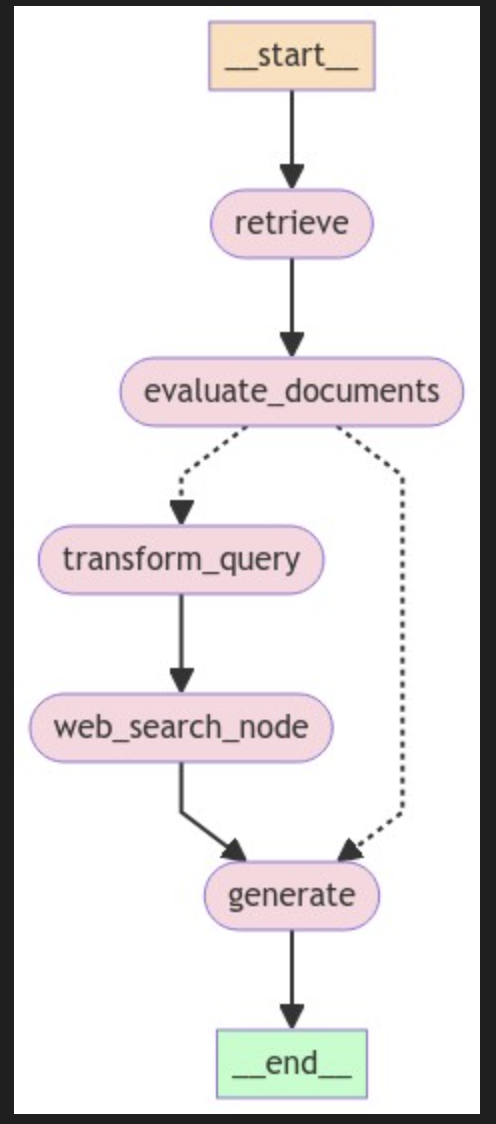
Om onze setup te testen, draaien we de workflow met voorbeeldvragen om te controleren hoe informatie wordt opgehaald, hoe de relevantie van documenten wordt beoordeeld en hoe reacties worden gegenereerd.
De eerste query controleert hoe goed CRAG antwoorden vindt binnen de eigen kennisbank.
from pprint import pprint
# Run
inputs = {"question": "What's the bagel method?"}
for output in app.stream(inputs):
    for key, value in output.items():
        # Node
        pprint(f"Node '{key}':")
        # Optional: print full state at each node
        pprint(value, indent=2, width=80, depth=None)
    pprint("\\n---\\n")
# Final generation
pprint(value["generation"])
---RETRIEVE---
"Node 'retrieve':"
{ 'documents': [ Document(page_content="the book was called The Bagel Method.The Bagel Method is designed to help partners be on the same team when dealing with differences and trying to find a compromise.The idea behind the method is that, to truly compromise, we need to figure out a way to include both partners’ dreams and core needs; things that are super important to us that giving up on them is too much.Let’s dive into the bagel 😜🚀 If you are new here…Hi, I’m Ryan 👋� I am passionate about lifestyle gamification � and I am obsesssssssss with learning things that can help me live a happy and fulfilling life.And so, with The Limitless Playbook newsletter, I will share with you 1 actionable idea from the world's top thinkers every Sunday �So visit us weekly for highly actionable insights :)…or even better, subscribe below and have all these information send straight to your inbox every Sunday 🥳Subscribe🥯", metadata={'description': 'A collection of the best hidden gems, mental models, and frameworks from the world’s top thinkers; to help you become 1% better and live a happier life ��', 'language': 'en', 'source': '<https://ryanocm.substack.com/p/105-the-bagel-method-in-relationships>', 'title': '#105 | The Bagel Method in Relationships 🥯'}),
Document(page_content='#105 | The Bagel Method in Relationships 🥯', metadata={'description': 'A collection of the best hidden gems, mental models, and frameworks from the world’s top thinkers; to help you become 1% better and live a happier life ��', 'language': 'en', 'source': '<https://ryanocm.substack.com/p/105-the-bagel-method-in-relationships>', 'title': '#105 | The Bagel Method in Relationships 🥯'}),
Document(page_content='The Limitless Playbook 🧬SubscribeSign inShare this post#105 | The Bagel Method in Relationships 🥯ryanocm.substack.comCopy linkFacebookEmailNoteOther#105 | The Bagel Method in Relationships 🥯A collection of the best hidden gems, mental models, and frameworks from the world’s top thinkers; to help you become 1% better and live a happier life â�¤ï¸�Ryan Ong ğŸ�®Feb 25, 2024Share this post#105 | The Bagel Method in Relationships 🥯ryanocm.substack.comCopy linkFacebookEmailNoteOtherShareHello curious minds ğŸ§\\xa0I recently finished the book Fight Right: How Successful Couples Turn Conflict into Connection and oh my days, I love every chapter of it!There were many repeating concepts but this time, it was applied in the context of conflicts in relationships. As usual with the Gottman’s books, I highlighted the hell out of the entire book 😄One of the cool exercises in', metadata={'description': 'A collection of the best hidden gems, mental models, and frameworks from the world’s top thinkers; to help you become 1% better and live a happier life â�¤ï¸�', 'language': 'en', 'source': '<https://ryanocm.substack.com/p/105-the-bagel-method-in-relationships>', 'title': '#105 | The Bagel Method in Relationships 🥯'}),
Document(page_content="The Bagel MethodThe Bagel Method involves mapping out your core needs and areas of flexibility so that you and your partner understand what's important and where there's room for flexibility.It’s called The Bagel Method because, just like a bagel, it has both the inner and outer circles representing your needs.Here are the steps:In the inner circle, list all the aspects of an issue that you can’t give in on. These are your non-negotiables that are usually very closely related to your core needs and dreams.In the outer circle, list all the aspects of an issue that you are able to compromise on IF you are able to have what’s in your inner circle.Now, talk to your partners about your inner and outer circle. Ask each other:Why are the things in your inner circle so important to you?How can I support your core needs here?Tell me more about your areas of flexibility. What does it look like to be flexible?Compare both your “bagel� of needsWhat do we agree on?What feelings do we have in common?What shared goals do we have?How might we accomplish these goals", metadata={'description': 'A collection of the best hidden gems, mental models, and frameworks from the world’s top thinkers; to help you become 1% better and live a happier life ��', 'language': 'en', 'source': '<https://ryanocm.substack.com/p/105-the-bagel-method-in-relationships>', 'title': '#105 | The Bagel Method in Relationships 🥯'})],
'question': "What's the bagel method?"}
'\\n---\\n'
---CHECK DOCUMENT RELEVANCE TO QUESTION---
---GRADE: DOCUMENT RELEVANT---
---GRADE: DOCUMENT RELEVANT---
---GRADE: DOCUMENT NOT RELEVANT---
---GRADE: DOCUMENT RELEVANT---
---ASSESS GRADED DOCUMENTS---
---DECISION: GENERATE---
"Node 'evaluate_documents':"
{ 'documents': [ Document(page_content="the book was called The Bagel Method.The Bagel Method is designed to help partners be on the same team when dealing with differences and trying to find a compromise.The idea behind the method is that, to truly compromise, we need to figure out a way to include both partners’ dreams and core needs; things that are super important to us that giving up on them is too much.Let’s dive into the bagel 😜🚀 If you are new here…Hi, I’m Ryan 👋� I am passionate about lifestyle gamification � and I am obsesssssssss with learning things that can help me live a happy and fulfilling life.And so, with The Limitless Playbook newsletter, I will share with you 1 actionable idea from the world's top thinkers every Sunday �So visit us weekly for highly actionable insights :)…or even better, subscribe below and have all these information send straight to your inbox every Sunday 🥳Subscribe🥯", metadata={'description': 'A collection of the best hidden gems, mental models, and frameworks from the world’s top thinkers; to help you become 1% better and live a happier life ��', 'language': 'en', 'source': '<https://ryanocm.substack.com/p/105-the-bagel-method-in-relationships>', 'title': '#105 | The Bagel Method in Relationships 🥯'}),
Document(page_content='#105 | The Bagel Method in Relationships 🥯', metadata={'description': 'A collection of the best hidden gems, mental models, and frameworks from the world’s top thinkers; to help you become 1% better and live a happier life ��', 'language': 'en', 'source': '<https://ryanocm.substack.com/p/105-the-bagel-method-in-relationships>', 'title': '#105 | The Bagel Method in Relationships 🥯'}),
Document(page_content="The Bagel MethodThe Bagel Method involves mapping out your core needs and areas of flexibility so that you and your partner understand what's important and where there's room for flexibility.It’s called The Bagel Method because, just like a bagel, it has both the inner and outer circles representing your needs.Here are the steps:In the inner circle, list all the aspects of an issue that you can’t give in on. These are your non-negotiables that are usually very closely related to your core needs and dreams.In the outer circle, list all the aspects of an issue that you are able to compromise on IF you are able to have what’s in your inner circle.Now, talk to your partners about your inner and outer circle. Ask each other:Why are the things in your inner circle so important to you?How can I support your core needs here?Tell me more about your areas of flexibility. What does it look like to be flexible?Compare both your “bagel� of needsWhat do we agree on?What feelings do we have in common?What shared goals do we have?How might we accomplish these goals", metadata={'description': 'A collection of the best hidden gems, mental models, and frameworks from the world’s top thinkers; to help you become 1% better and live a happier life ��', 'language': 'en', 'source': '<https://ryanocm.substack.com/p/105-the-bagel-method-in-relationships>', 'title': '#105 | The Bagel Method in Relationships 🥯'})],
'question': "What's the bagel method?",
'web_search': 'No'}
'\\n---\\n'
---GENERATE---
"Node 'generate':"
{ 'documents': [ Document(page_content="the book was called The Bagel Method.The Bagel Method is designed to help partners be on the same team when dealing with differences and trying to find a compromise.The idea behind the method is that, to truly compromise, we need to figure out a way to include both partners’ dreams and core needs; things that are super important to us that giving up on them is too much.Let’s dive into the bagel 😜🚀 If you are new here…Hi, I’m Ryan 👋� I am passionate about lifestyle gamification � and I am obsesssssssss with learning things that can help me live a happy and fulfilling life.And so, with The Limitless Playbook newsletter, I will share with you 1 actionable idea from the world's top thinkers every Sunday �So visit us weekly for highly actionable insights :)…or even better, subscribe below and have all these information send straight to your inbox every Sunday 🥳Subscribe🥯", metadata={'description': 'A collection of the best hidden gems, mental models, and frameworks from the world’s top thinkers; to help you become 1% better and live a happier life ��', 'language': 'en', 'source': '<https://ryanocm.substack.com/p/105-the-bagel-method-in-relationships>', 'title': '#105 | The Bagel Method in Relationships 🥯'}),
Document(page_content='#105 | The Bagel Method in Relationships 🥯', metadata={'description': 'A collection of the best hidden gems, mental models, and frameworks from the world’s top thinkers; to help you become 1% better and live a happier life ��', 'language': 'en', 'source': '<https://ryanocm.substack.com/p/105-the-bagel-method-in-relationships>', 'title': '#105 | The Bagel Method in Relationships 🥯'}),
Document(page_content="The Bagel MethodThe Bagel Method involves mapping out your core needs and areas of flexibility so that you and your partner understand what's important and where there's room for flexibility.It’s called The Bagel Method because, just like a bagel, it has both the inner and outer circles representing your needs.Here are the steps:In the inner circle, list all the aspects of an issue that you can’t give in on. These are your non-negotiables that are usually very closely related to your core needs and dreams.In the outer circle, list all the aspects of an issue that you are able to compromise on IF you are able to have what’s in your inner circle.Now, talk to your partners about your inner and outer circle. Ask each other:Why are the things in your inner circle so important to you?How can I support your core needs here?Tell me more about your areas of flexibility. What does it look like to be flexible?Compare both your “bagel� of needsWhat do we agree on?What feelings do we have in common?What shared goals do we have?How might we accomplish these goals", metadata={'description': 'A collection of the best hidden gems, mental models, and frameworks from the world’s top thinkers; to help you become 1% better and live a happier life ��', 'language': 'en', 'source': '<https://ryanocm.substack.com/p/105-the-bagel-method-in-relationships>', 'title': '#105 | The Bagel Method in Relationships 🥯'})],
'generation': 'The Bagel Method is a framework designed to help partners '
'navigate differences and find compromises by mapping out '
'their core needs and areas of flexibility. It involves '
'creating two circles: the inner circle for non-negotiable '
'needs and the outer circle for aspects where compromise is '
'possible. This method encourages open communication about '
"each partner's priorities and shared goals.",
'question': "What's the bagel method?"}
'\\n---\\n'
('The Bagel Method is a framework designed to help partners navigate '
'differences and find compromises by mapping out their core needs and areas '
'of flexibility. It involves creating two circles: the inner circle for '
'non-negotiable needs and the outer circle for aspects where compromise is '
"possible. This method encourages open communication about each partner's "
'priorities and shared goals.')En de tweede query test het vermogen van CRAG om het web te doorzoeken voor extra informatie wanneer de kennisbank niet de relevante documenten heeft.
from pprint import pprint
# Run
inputs = {"question": "What is prompt engineering?"}
for output in app.stream(inputs):
    for key, value in output.items():
        # Node
        pprint(f"Node '{key}':")
        # Optional: print full state at each node
        pprint(value, indent=2, width=80, depth=None)
    pprint("\\n---\\n")
# Final generation
pprint(value["generation"])
---RETRIEVE---
"Node 'retrieve':"
{ 'documents': [ Document(page_content='Mystery Gift Box #049 | Law 1: Fill your Five Buckets in the Right Order (The Diary of a CEO)', metadata={'description': "The best hidden gems I've found; interesting ideas and concepts, thought-provoking questions, mind-blowing books/podcasts, cool animes/films, and other mysteries ��", 'language': 'en', 'source': '<https://ryanocm.substack.com/p/mystery-gift-box-049-law-1-fill-your>', 'title': 'Mystery Gift Box #049 | Law 1: Fill your Five Buckets in the Right Order (The Diary of a CEO)'}),
Document(page_content='ğŸ�¦Â\\xa0Twitter, 👨ğŸ�»â€�💻Â\\xa0LinkedIn, ğŸŒ�Â\\xa0Personal Website, and 📸Â\\xa0InstagramShare this postMystery Gift Box #049 | Law 1: Fill your Five Buckets in the Right Order (The Diary of a CEO)ryanocm.substack.comCopy linkFacebookEmailNoteOtherSharePreviousNextCommentsTopLatestDiscussionsNo postsReady for more?Subscribe© 2024 Ryan Ong ğŸ�®Privacy ∙ Terms ∙ Collection notice Start WritingGet the appSubstack is the home for great cultureShareCopy linkFacebookEmailNoteOther', metadata={'description': "The best hidden gems I've found; interesting ideas and concepts, thought-provoking questions, mind-blowing books/podcasts, cool animes/films, and other mysteries â�¤ï¸�", 'language': 'en', 'source': '<https://ryanocm.substack.com/p/mystery-gift-box-049-law-1-fill-your>', 'title': 'Mystery Gift Box #049 | Law 1: Fill your Five Buckets in the Right Order (The Diary of a CEO)'}),
Document(page_content='skills are the foundation of which you build your life and career and it’s truly yours to own; you can lose your network, resources, and reputation but you will never lose your knowledge and skills.Never try to skip the first two buckets. If you try to jump straight to network, resources, and / or reputation bucket, you might “succeed� in the short-run but in the long run, your lack of knowledge and skill will catch on to you.There is no skipping the first two buckets of knowledge and skills if you’re playing long-term sustainable results. Any attempt to do so is equivalent to building your house on sand.💥 Key takeawayFocus on using your knowledge and skills to create lots of values in the world and the world will reward you with growing network (people will come to you), resources (people will pay for your services), and reputation (people will know what you are capable of).⛰ 4-4-4 Exploration ProjectEach month, I would explore one new thing; a skill, a subject, or an experience.January 2023: Writing and Storytelling (Subject)', metadata={'description': "The best hidden gems I've found; interesting ideas and concepts, thought-provoking questions, mind-blowing books/podcasts, cool animes/films, and other mysteries ��", 'language': 'en', 'source': '<https://ryanocm.substack.com/p/mystery-gift-box-049-law-1-fill-your>', 'title': 'Mystery Gift Box #049 | Law 1: Fill your Five Buckets in the Right Order (The Diary of a CEO)'}),
Document(page_content='This site requires JavaScript to run correctly. Please turn on JavaScript or unblock scripts', metadata={'description': 'A collection of the best hidden gems, mental models, and frameworks from the world’s top thinkers; to help you become 1% better and live a happier life ��', 'language': 'en', 'source': '<https://ryanocm.substack.com/p/105-the-bagel-method-in-relationships>', 'title': '#105 | The Bagel Method in Relationships 🥯'})],
'question': 'What is prompt engineering?'}
'\\n---\\n'
---CHECK DOCUMENT RELEVANCE TO QUESTION---
---GRADE: DOCUMENT NOT RELEVANT---
---GRADE: DOCUMENT NOT RELEVANT---
---GRADE: DOCUMENT NOT RELEVANT---
---GRADE: DOCUMENT NOT RELEVANT---
---ASSESS GRADED DOCUMENTS---
---DECISION: ALL DOCUMENTS ARE NOT RELEVANT TO QUESTION, TRANSFORM QUERY---
"Node 'evaluate_documents':"
{ 'documents': [],
'question': 'What is prompt engineering?',
'web_search': 'Yes'}
'\\n---\\n'
---TRANSFORM QUERY---
"Node 'transform_query':"
{ 'documents': [],
'question': 'What is the concept of prompt engineering and how is it applied '
'in artificial intelligence?'}
'\\n---\\n'
---WEB SEARCH---
"Node 'web_search_node':"
{ 'documents': [ Document(page_content="Prompt engineering is the method to ask generative AI to produce what the individual needs. There are two main principles of building a successful prompt for any AI, specificity and iteration. The box below includes one example of a framework that can be applied when prompting any generative AI.\\nPrompt Engineering is the process of designing and refining text inputs (prompts) to achieve specific application objectives with AI models. Think of it as a two-step journey: Designing the Initial Prompt: Creating the initial input for the model to achieve the desired result. Refining the Prompt: Continuously adjusting the prompt to enhance ...\\nPrompt engineering is the process of designing and refining the inputs given to language models, like those in AI, to achieve desired outputs more effectively. It involves creatively crafting prompts that guide the model in generating responses that are accurate, relevant, and aligned with the user's intentions.. For students and researchers in higher education, mastering prompt engineering is ...\\nJune 25, 2024. Prompt engineering means writing precise instructions for AI models. These instructions are different from coding because they use natural language. And today, everybody does it—from software developers to artists and content creators. Prompt engineering can help you improve productivity and save time by automating repetitive ...\\nMaster Prompt Engineering - The (AI) Prompt\\nAI Takes Wall Street by Storm: C3.ai's Strong Forecast Sparks a Surge in AI Stocks\\nAsk Me Anything (AMA) Prompting\\nHow Self-Critique Improves Logic and Reasoning in LLMs Like ChatGPT\\nOptimizing Large Language Models to Maximize Performance\\nThe Black Box Problem: Opaque Inner Workings of Large Language Models\\nHow to Evaluate Large Language Models for Business Tasks\\nIntroduction to the AI Prompt Development Process\\nSubscribe to new posts\\nThe Official Source For Everything Prompt Engineering & Generative AI Defining Prompt Engineering\\nGiven that the prompt is the singular input channel to large language models, prompt engineering can be defined as:\\nPrompt Engineering can be thought of as any process that contributes to the development of a well-crafted prompt to generate quality, useful outputs from an AI system.\\n A Simplified Approach to Defining Prompt Engineering\\nThe Prompt is the Sole Input\\nWhen interacting with Generative AI Models such as large language models (LLMs), the prompt is the only thing that gets input into the AI system. Its applications cut across diverse sectors, from healthcare and education to business, securing its place as a cornerstone of our interactions with AI.\\nExploration of Essential Prompt Engineering Techniques and Concepts\\nIn the rapidly evolving landscape of Artificial Intelligence (AI), mastering key techniques of Prompt Engineering has become increasingly vital. The key concepts of Prompt Engineering include prompts and prompting the AI, training the AI, developing and maintaining a prompt library, and testing, evaluation, and categorization.\\n")],
'question': 'What is the concept of prompt engineering and how is it applied '
'in artificial intelligence?'}
'\\n---\\n'
---GENERATE---
"Node 'generate':"
{ 'documents': [ Document(page_content="Prompt engineering is the method to ask generative AI to produce what the individual needs. There are two main principles of building a successful prompt for any AI, specificity and iteration. The box below includes one example of a framework that can be applied when prompting any generative AI.\\nPrompt Engineering is the process of designing and refining text inputs (prompts) to achieve specific application objectives with AI models. Think of it as a two-step journey: Designing the Initial Prompt: Creating the initial input for the model to achieve the desired result. Refining the Prompt: Continuously adjusting the prompt to enhance ...\\nPrompt engineering is the process of designing and refining the inputs given to language models, like those in AI, to achieve desired outputs more effectively. It involves creatively crafting prompts that guide the model in generating responses that are accurate, relevant, and aligned with the user's intentions.. For students and researchers in higher education, mastering prompt engineering is ...\\nJune 25, 2024. Prompt engineering means writing precise instructions for AI models. These instructions are different from coding because they use natural language. And today, everybody does it—from software developers to artists and content creators. Prompt engineering can help you improve productivity and save time by automating repetitive ...\\nMaster Prompt Engineering - The (AI) Prompt\\nAI Takes Wall Street by Storm: C3.ai's Strong Forecast Sparks a Surge in AI Stocks\\nAsk Me Anything (AMA) Prompting\\nHow Self-Critique Improves Logic and Reasoning in LLMs Like ChatGPT\\nOptimizing Large Language Models to Maximize Performance\\nThe Black Box Problem: Opaque Inner Workings of Large Language Models\\nHow to Evaluate Large Language Models for Business Tasks\\nIntroduction to the AI Prompt Development Process\\nSubscribe to new posts\\nThe Official Source For Everything Prompt Engineering & Generative AI Defining Prompt Engineering\\nGiven that the prompt is the singular input channel to large language models, prompt engineering can be defined as:\\nPrompt Engineering can be thought of as any process that contributes to the development of a well-crafted prompt to generate quality, useful outputs from an AI system.\\n A Simplified Approach to Defining Prompt Engineering\\nThe Prompt is the Sole Input\\nWhen interacting with Generative AI Models such as large language models (LLMs), the prompt is the only thing that gets input into the AI system. Its applications cut across diverse sectors, from healthcare and education to business, securing its place as a cornerstone of our interactions with AI.\\nExploration of Essential Prompt Engineering Techniques and Concepts\\nIn the rapidly evolving landscape of Artificial Intelligence (AI), mastering key techniques of Prompt Engineering has become increasingly vital. The key concepts of Prompt Engineering include prompts and prompting the AI, training the AI, developing and maintaining a prompt library, and testing, evaluation, and categorization.\\n")],
'generation': 'Prompt engineering is the process of designing and refining '
'text inputs to guide AI models in generating desired outputs. '
'It focuses on specificity and iteration to create effective '
'prompts that align with user intentions. This technique is '
'widely applicable across various sectors, enhancing '
'productivity and automating tasks.',
'question': 'What is the concept of prompt engineering and how is it applied '
'in artificial intelligence?'}
'\\n---\\n'
('Prompt engineering is the process of designing and refining text inputs to '
'guide AI models in generating desired outputs. It focuses on specificity and '
'iteration to create effective prompts that align with user intentions. This '
'technique is widely applicable across various sectors, enhancing '
'productivity and automating tasks.')Hoewel CRAG verbeteringen biedt ten opzichte van traditionele RAG, zijn er beperkingen die aandacht vragen.
Een belangrijk punt is de afhankelijkheid van de kwaliteit van de retrieval evaluator. Deze evaluator is essentieel om te beoordelen of de opgehaalde documenten relevant en accuraat zijn. Het trainen en fine-tunen van de evaluator kan echter veeleisend zijn en veel hoogwaardige data en rekenkracht vereisen. De evaluator up-to-date houden met nieuwe soorten queries en databronnen vergroot de complexiteit en kosten.
Een andere beperking is het gebruik van webzoekopdrachten door CRAG om documenten te vinden of te vervangen die onjuist of ambigu zijn. Hoewel deze aanpak recentere en diverse informatie kan opleveren, bestaat ook het risico dat bevooroordeelde of onbetrouwbare data wordt geïntroduceerd. De kwaliteit van webcontent varieert sterk, en het is een uitdaging om daaruit de meest accurate informatie te selecteren. Dit betekent dat zelfs een goed getrainde evaluator niet volledig kan voorkomen dat content van lage kwaliteit of met bias wordt opgenomen.
Deze uitdagingen onderstrepen de noodzaak van voortdurend onderzoek en ontwikkeling.
Al met al verbetert CRAG traditionele RAG-systemen door controles en verfijning toe te voegen aan de opgehaalde informatie, waardoor taalmodellen nauwkeuriger en betrouwbaarder worden. Dit maakt CRAG een nuttige tool voor veel verschillende toepassingen.
Wil je meer leren over CRAG? Bekijk dan het originele paper hier.
Zoek je meer leermateriaal over RAG? Dan raad ik deze blogs aan:
Bouw AI-agents met deze cursussen!
Cursus
Cursus
Cursus
blog
Adel Nehme
15 min