
Kurs
KI-Agenten mit dem Google ADK entwickeln
1 Std.
7.5K
Corrective Retrieval-Augmented Generation (CRAG) ist eine verbesserte Variante von RAG, die Sprachmodelle genauer machen soll.
Während klassisches RAG die abgerufenen Dokumente direkt zur Antwortgenerierung nutzt, geht CRAG einen Schritt weiter: Es prüft und verfeinert diese Dokumente aktiv, um sicherzustellen, dass sie relevant und korrekt sind. Dadurch sinken Fehler und Halluzinationen, bei denen das Modell falsche oder irreführende Informationen erzeugen könnte.
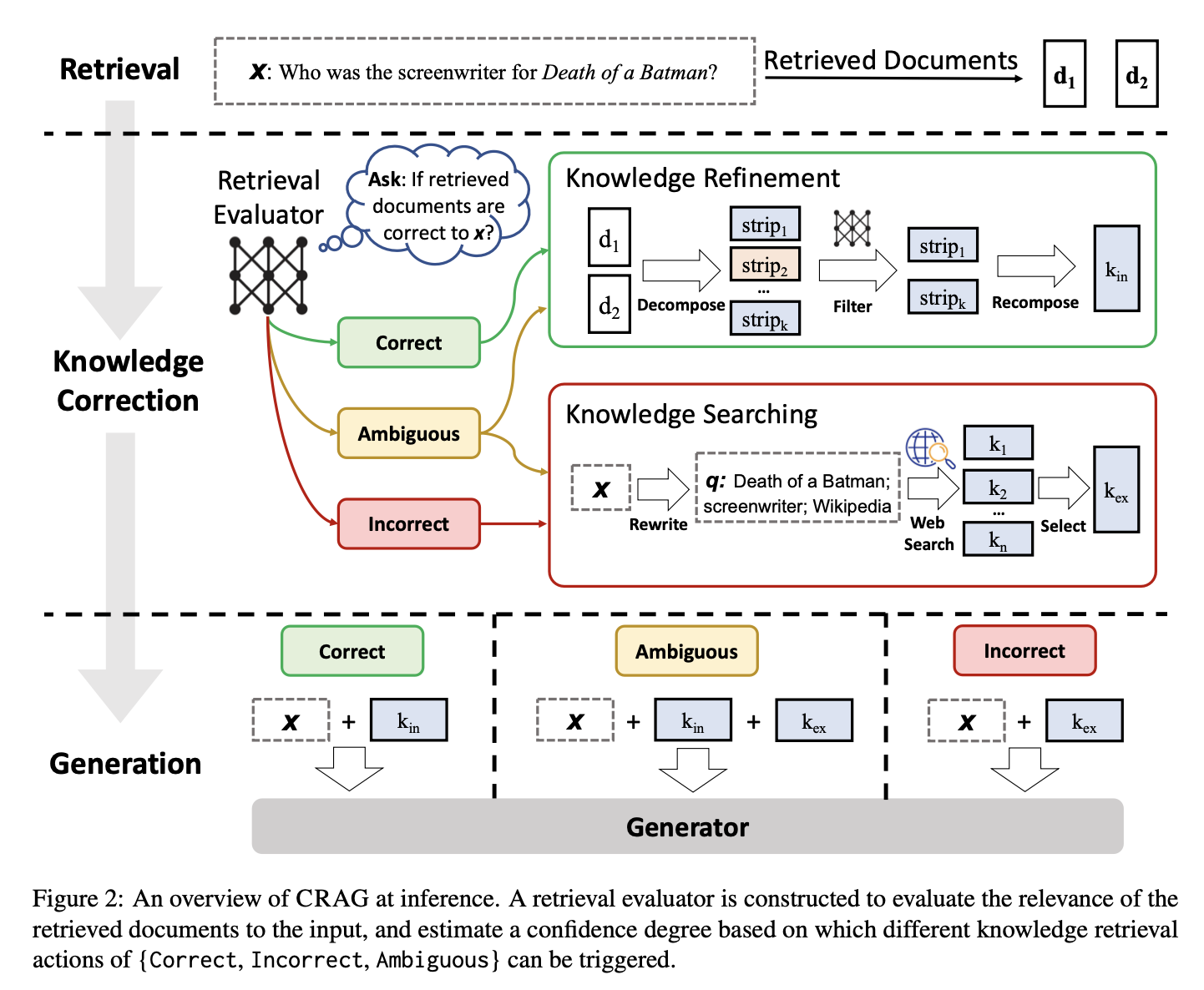
Quelle: Shi-Qi Yan et al., 2024
Das CRAG-Framework arbeitet in mehreren Schritten mit einem Retrieval-Evaluator und gezielten Korrekturmaßnahmen.
Für eine Eingabeanfrage ruft ein Standard-Retriever zunächst eine Menge Dokumente aus einer Wissensbasis ab. Diese Dokumente werden anschließend von einem Retrieval-Evaluator auf ihre Relevanz zur Anfrage geprüft.
In CRAG ist der Retrieval-Evaluator ein feinabgestimmtes T5-large-Modell. Der Evaluator vergibt einen Konfidenzwert je Dokument und ordnet sie in drei Stufen ein:
Nach einer dieser Aktionen wird das verfeinerte Wissen zur finalen Antwortgenerierung genutzt.
CRAG bringt mehrere zentrale Verbesserungen gegenüber klassischem RAG. Ein wesentlicher Vorteil ist die Fähigkeit, Fehler in den abgerufenen Informationen zu erkennen und zu korrigieren. Der Retrieval-Evaluator in CRAG identifiziert falsche oder irrelevante Inhalte, sodass sie bereinigt werden, bevor sie die Ausgabe beeinflussen. Das Ergebnis sind präzisere und verlässlichere Informationen bei weniger Fehlern und Fehlinformationen.
CRAG punktet außerdem bei Relevanz und Genauigkeit. Während klassisches RAG oft nur Relevanzscores betrachtet, geht CRAG weiter und verfeinert die Dokumente, damit sie nicht nur relevant, sondern auch exakt sind. Unwichtige Details werden ausgeblendet und die Kernpunkte hervorgehoben, sodass die Antworten auf belastbaren Informationen beruhen.
In diesem Abschnitt gehen wir Schritt für Schritt durch die Umsetzung von CRAG mit LangGraph. Du lernst, wie du deine Umgebung einrichtest, eine einfache Vektor-Wissensbasis aufbaust und die zentralen Komponenten für CRAG konfigurierst, etwa den Retrieval-Evaluator, den Question Rewriter und das Websuche-Tool.
Außerdem bauen wir einen LangGraph-Workflow, der alles zusammenführt und zeigt, wie CRAG unterschiedliche Anfragen für genauere und verlässlichere Ergebnisse verarbeitet.
Installiere zuerst die benötigten Pakete. Damit richtest du die Umgebung für die CRAG-Pipeline ein.
pip install langchain_community tiktoken langchain-openai langchainhub chromadb langchain langgraph tavily-pythonAls Nächstes konfigurierst du deine API-Schlüssel für Tavily und OpenAI:
import os
os.environ["TAVILY_API_KEY"] = "YOUR_TAVILY_API_KEY"
os.environ["OPENAI_API_KEY"] = "YOUR_OPENAI_API_KEY"Für RAG brauchen wir zunächst eine mit Dokumenten gefüllte Wissensbasis. In diesem Schritt scrapen wir Beispielinhalte aus einem Substack-Newsletter und erstellen daraus einen Vektorspeicher als Proxy-Wissensbasis. Dieser Vektorspeicher hilft uns, anhand von Nutzeranfragen relevante Dokumente zu finden.
Wir laden die Dokumente von den angegebenen URLs und zerlegen sie mit einem Textsplitter in kleinere Abschnitte. Diese Abschnitte werden anschließend embeddet (OpenAIEmbeddings) und in einer Vektordatenbank (Chroma) gespeichert, um die Dokumentenabfrage effizient zu machen.
from langchain.text_splitter import RecursiveCharacterTextSplitter
from langchain_community.document_loaders import WebBaseLoader
from langchain_community.vectorstores import Chroma
from langchain_openai import OpenAIEmbeddings
urls = [
    "<https://ryanocm.substack.com/p/mystery-gift-box-049-law-1-fill-your>",
    "<https://ryanocm.substack.com/p/105-the-bagel-method-in-relationships>",
    "<https://ryanocm.substack.com/p/098-i-have-read-100-productivity>",
]
docs = [WebBaseLoader(url).load() for url in urls]
docs_list = [item for sublist in docs for item in sublist]
text_splitter = RecursiveCharacterTextSplitter.from_tiktoken_encoder(
    chunk_size=250, chunk_overlap=0
)
doc_splits = text_splitter.split_documents(docs_list)
# Add to vectorDB
vectorstore = Chroma.from_documents(
    documents=doc_splits,
    collection_name="rag-chroma",
    embedding=OpenAIEmbeddings(),
)
retriever = vectorstore.as_retriever()Jetzt richten wir eine einfache RAG-Chain ein, die eine Nutzerfrage und eine Menge Dokumente als Input nimmt und daraus eine Antwort generiert.
Die RAG-Chain nutzt einen vordefinierten Prompt und ein Sprachmodell (GPT 4-o mini), um Antworten auf Basis der gefundenen Dokumente zu erstellen. Ein Output-Parser formatiert die Ausgabe anschließend lesefreundlich.
### Generate
from langchain import hub
from langchain_core.output_parsers import StrOutputParser
# Prompt
rag_prompt = hub.pull("rlm/rag-prompt")
# LLM
rag_llm = ChatOpenAI(model_name="gpt-4o-mini", temperature=0)
# Post-processing
def format_docs(docs):
    return "\\n\\n".join(doc.page_content for doc in docs)
# Chain
rag_chain = rag_prompt | rag_llm | StrOutputParser()
print(rag_prompt.messages[0].prompt.template)
You are an assistant for question-answering tasks. Use the following pieces of retrieved context to answer the question. If you don't know the answer, just say that you don't know. Use three sentences maximum and keep the answer concise.
Question: {question}
Context: {context}
Answer:generation = rag_chain.invoke({"context": docs, "question": question})
print("Question: %s" % question)
print("----")
print("Documents:\\n")
print('\\n\\n'.join(['- %s' % x.page_content for x in docs]))
print("----")
print("Final answer: %s" % generation)Question: what is the bagel method
----
Documents:
- the book was called The Bagel Method.The Bagel Method is designed to help partners be on the same team when dealing with differences and trying to find a compromise.The idea behind the method is that, to truly compromise, we need to figure out a way to include both partners’ dreams and core needs; things that are super important to us that giving up on them is too much.Let’s dive into the bagel 😜🚀 If you are new here…Hi, I’m Ryan 👋� I am passionate about lifestyle gamification � and I am obsesssssssss with learning things that can help me live a happy and fulfilling life.And so, with The Limitless Playbook newsletter, I will share with you 1 actionable idea from the world's top thinkers every Sunday �So visit us weekly for highly actionable insights :)…or even better, subscribe below and have all these information send straight to your inbox every Sunday 🥳Subscribe🥯
- #105 | The Bagel Method in Relationships 🥯
- The Limitless Playbook 🧬SubscribeSign inShare this post#105 | The Bagel Method in Relationships 🥯ryanocm.substack.comCopy linkFacebookEmailNoteOther#105 | The Bagel Method in Relationships 🥯A collection of the best hidden gems, mental models, and frameworks from the world’s top thinkers; to help you become 1% better and live a happier life ��Ryan Ong �Feb 25, 2024Share this post#105 | The Bagel Method in Relationships 🥯ryanocm.substack.comCopy linkFacebookEmailNoteOtherShareHello curious minds 🧠I recently finished the book Fight Right: How Successful Couples Turn Conflict into Connection and oh my days, I love every chapter of it!There were many repeating concepts but this time, it was applied in the context of conflicts in relationships. As usual with the Gottman’s books, I highlighted the hell out of the entire book 😄One of the cool exercises in
- The Bagel MethodThe Bagel Method involves mapping out your core needs and areas of flexibility so that you and your partner understand what's important and where there's room for flexibility.It’s called The Bagel Method because, just like a bagel, it has both the inner and outer circles representing your needs.Here are the steps:In the inner circle, list all the aspects of an issue that you can’t give in on. These are your non-negotiables that are usually very closely related to your core needs and dreams.In the outer circle, list all the aspects of an issue that you are able to compromise on IF you are able to have what’s in your inner circle.Now, talk to your partners about your inner and outer circle. Ask each other:Why are the things in your inner circle so important to you?How can I support your core needs here?Tell me more about your areas of flexibility. What does it look like to be flexible?Compare both your “bagel� of needsWhat do we agree on?What feelings do we have in common?What shared goals do we have?How might we accomplish these goals
----
Final answer: The Bagel Method is a relationship strategy that helps partners identify their core needs and areas where they can be flexible. It involves mapping out non-negotiables in the inner circle and compromise areas in the outer circle, facilitating open communication about each partner's priorities. This method aims to foster understanding and collaboration in resolving differences.Um die Genauigkeit der generierten Inhalte zu erhöhen, richten wir einen Retrieval-Evaluator ein. Dieses Modul bewertet, wie relevant jedes abgerufene Dokument ist, damit nur die nützlichsten Informationen verwendet werden.
Der Retrieval-Evaluator wird mit einem Prompt und einem Sprachmodell konfiguriert. Er entscheidet, ob Dokumente relevant sind, und filtert Irrelevantes, bevor eine Antwort generiert wird.
### Retrieval Evaluator
from langchain_core.prompts import ChatPromptTemplate
from langchain_core.pydantic_v1 import BaseModel, Field
from langchain_openai import ChatOpenAI
# Data model
class RetrievalEvaluator(BaseModel):
    """Classify retrieved documents based on how relevant it is to the user's question."""
    binary_score: str = Field(
        description="Documents are relevant to the question, 'yes' or 'no'"
    )
# LLM with function call
retrieval_evaluator_llm = ChatOpenAI(model="gpt-4o-mini", temperature=0)
structured_llm_evaluator = retrieval_evaluator_llm.with_structured_output(RetrievalEvaluator)
# Prompt
system = """You are a document retrieval evaluator that's responsible for checking the relevancy of a retrieved document to the user's question. \\n
    If the document contains keyword(s) or semantic meaning related to the question, grade it as relevant. \\n
    Output a binary score 'yes' or 'no' to indicate whether the document is relevant to the question."""
retrieval_evaluator_prompt = ChatPromptTemplate.from_messages(
    [
        ("system", system),
        ("human", "Retrieved document: \\n\\n {document} \\n\\n User question: {question}"),
    ]
)
retrieval_grader = retrieval_evaluator_prompt | structured_llm_evaluatorWir ergänzen einen Question Rewriter, um Anfragen klarer und spezifischer zu machen und so die Suche zu verbessern.
Der Rewriter schärft die ursprüngliche Frage, damit die Suche fokussierter wird und bessere, relevantere Ergebnisse liefert.
### Question Re-writer
# LLM
question_rewriter_llm = ChatOpenAI(model="gpt-4o-mini", temperature=0)
# Prompt
system = """You are a question re-writer that converts an input question to a better version that is optimized \\n
     for web search. Look at the input and try to reason about the underlying semantic intent / meaning."""
re_write_prompt = ChatPromptTemplate.from_messages(
    [
        ("system", system),
        (
            "human",
            "Here is the initial question: \\n\\n {question} \\n Formulate an improved question.",
        ),
    ]
)
question_rewriter = re_write_prompt | question_rewriter_llm | StrOutputParser()Wenn die Wissensbasis nicht genug hergibt, greift CRAG zur Websuche und schließt Wissenslücken. So erweitert sich das Spektrum der möglichen Quellen. In diesem Schritt nutzen wir die Tavily-API, um zusätzliche Dokumente im Web zu finden.
### Search
from langchain_community.tools.tavily_search import TavilySearchResults
web_search_tool = TavilySearchResults(k=3)Um den CRAG-Workflow mit LangGraph zu bauen, folgen wir drei Hauptschritten:
Erstelle einen gemeinsamen Status, der Daten beim Übergang zwischen den Knoten hält. Dieser State speichert Variablen wie die Frage, die abgerufenen Dokumente und die generierten Antworten.
from typing import List
from typing_extensions import TypedDict
class GraphState(TypedDict):
    """
    Represents the state of our graph.
    Attributes:
        question: question
        generation: LLM generation
        web_search: whether to add search
        documents: list of documents
    """
    question: str
    generation: str
    web_search: str
documents: List[str]Im LangGraph-Workflow übernimmt jeder Funktionsknoten eine konkrete Aufgabe in der CRAG-Pipeline: Dokumente abrufen, Antworten generieren, Relevanz bewerten, Anfragen umformulieren und im Web suchen. Hier ist der Überblick:
Die Funktion retrieve findet zur Frage passende Dokumente in der Wissensbasis. Sie nutzt einen Retriever, meist einen Vektorspeicher aus vorverarbeiteten Dokumenten. Die Funktion nimmt den aktuellen State mit der Frage, ruft relevante Dokumente ab und schreibt sie in den State.
from langchain.schema import Document
def retrieve(state):
    """
    Retrieve documents
    Args:
        state (dict): The current graph state
    Returns:
        state (dict): New key added to state, documents, that contains retrieved documents
    """
    print("---RETRIEVE---")
    question = state["question"]
    # Retrieval
    documents = retriever.get_relevant_documents(question)
    return {"documents": documents, "question": question}
Die Funktion generate erzeugt eine Antwort auf Basis der abgerufenen Dokumente. Sie arbeitet mit der RAG-Chain, die Prompt und Sprachmodell kombiniert. Die Funktion verarbeitet Dokumente und Frage in der RAG-Chain und ergänzt den State um die Antwort.
def generate(state):
    """
    Generate answer
    Args:
        state (dict): The current graph state
    Returns:
        state (dict): New key added to state, generation, that contains LLM generation
    """
    print("---GENERATE---")
    question = state["question"]
    documents = state["documents"]
    # RAG generation
    generation = rag_chain.invoke({"context": documents, "question": question})
    return {"documents": documents, "question": question, "generation": generation}
Die Funktion evaluate_documents bewertet mit dem Retrieval-Evaluator die Relevanz der abgerufenen Dokumente zur Frage. So wird sichergestellt, dass nur nützliche Informationen in die finale Antwort einfließen. Irrelevantes wird herausgefiltert. Zusätzlich setzt die Funktion ein Flag web_search, wenn zu wenige Dokumente relevant sind und eine Websuche nötig wird.
def evaluate_documents(state):
    """
    Determines whether the retrieved documents are relevant to the question.
    Args:
        state (dict): The current graph state
    Returns:
        state (dict): Updates documents key with only filtered relevant documents
    """
    print("---CHECK DOCUMENT RELEVANCE TO QUESTION---")
    question = state["question"]
    documents = state["documents"]
    # Score each doc
    filtered_docs = []
    web_search = "No"
    for d in documents:
        score = retrieval_grader.invoke(
            {"question": question, "document": d.page_content}
        )
        grade = score.binary_score
        if grade == "yes":
            print("---GRADE: DOCUMENT RELEVANT---")
            filtered_docs.append(d)
        else:
            print("---GRADE: DOCUMENT NOT RELEVANT---")
            continue
    if len(filtered_docs) / len(documents) <= 0.7:
        web_search = "Yes"
    return {"documents": filtered_docs, "question": question, "web_search": web_search}
Die Funktion transform_query formuliert die Frage um, um bessere Suchergebnisse zu erzielen, vor allem wenn die ursprüngliche Abfrage wenig Relevantes gefunden hat. Sie nutzt den Question Rewriter, um die Frage klarer und spezifischer zu machen. Eine bessere Frage erhöht die Chance auf nützliche Treffer aus Wissensbasis und Websuche.
def transform_query(state):
    """
    Transform the query to produce a better question.
    Args:
        state (dict): The current graph state
    Returns:
        state (dict): Updates question key with a re-phrased question
    """
    print("---TRANSFORM QUERY---")
    question = state["question"]
    documents = state["documents"]
    # Re-write question
    better_question = question_rewriter.invoke({"question": question})
    return {"documents": documents, "question": better_question}
Die Funktion web_search recherchiert mit der verfeinerten Frage zusätzlich im Web. Sie kommt zum Einsatz, wenn die Wissensbasis nicht genug Informationen liefert, und ergänzt die Inhalte. Dafür nutzt sie das Tavily-Tool, fügt die Webtreffer als Dokument hinzu und erweitert so die Wissensgrundlage.
def web_search(state):
    """
    Web search based on the re-phrased question.
    Args:
        state (dict): The current graph state
    Returns:
        state (dict): Updates documents key with appended web results
    """
    print("---WEB SEARCH---")
    question = state["question"]
    documents = state["documents"]
    # Web search
    docs = web_search_tool.invoke({"query": question})
    web_results = "\\n".join([d["content"] for d in docs])
    web_results = Document(page_content=web_results)
    documents.append(web_results)
    return {"documents": documents, "question": question}
Die Funktion decide_to_generate entscheidet über den nächsten Schritt: sofort mit den vorhandenen Dokumenten generieren oder die Frage verfeinern und erneut suchen. Grundlage ist die zuvor bewertete Relevanz.
def decide_to_generate(state):
    """
    Determines whether to generate an answer, or re-generate a question.
    Args:
        state (dict): The current graph state
    Returns:
        str: Binary decision for next node to call
    """
    print("---ASSESS GRADED DOCUMENTS---")
    state["question"]
    web_search = state["web_search"]
    state["documents"]
    if web_search == "Yes":
        # All documents have been filtered check_relevance
        # We will re-generate a new query
        print(
            "---DECISION: ALL DOCUMENTS ARE NOT RELEVANT TO QUESTION, TRANSFORM QUERY---"
        )
        return "transform_query"
    else:
        # We have relevant documents, so generate answer
        print("---DECISION: GENERATE---")
return "generate"Nachdem alle Knoten definiert sind, verknüpfen wir sie im LangGraph-Workflow zur vollständigen CRAG-Pipeline. Wir verbinden die Knoten mit Kanten, steuern den Informationsfluss und sorgen dafür, dass die Entscheidungen anhand der Zwischenergebnisse korrekt greifen.
from langgraph.graph import END, StateGraph, START
workflow = StateGraph(GraphState)
# Define the nodes
workflow.add_node("retrieve", retrieve)  # retrieve
workflow.add_node("grade_documents", evaluate_documents)  # evaluate documents
workflow.add_node("generate", generate)  # generate
workflow.add_node("transform_query", transform_query)  # transform_query
workflow.add_node("web_search_node", web_search)  # web search
# Build graph
workflow.add_edge(START, "retrieve")
workflow.add_edge("retrieve", "grade_documents")
workflow.add_conditional_edges(
    "grade_documents",
    decide_to_generate,
    {
        "transform_query": "transform_query",
        "generate": "generate",
    },
)
workflow.add_edge("transform_query", "web_search_node")
workflow.add_edge("web_search_node", "generate")
workflow.add_edge("generate", END)
# Compile
app = workflow.compile()
from IPython.display import Image, display
try:
display(Image(app.get_graph(xray=True).draw_mermaid_png()))
except Exception:
# This requires some extra dependencies and is optional
pass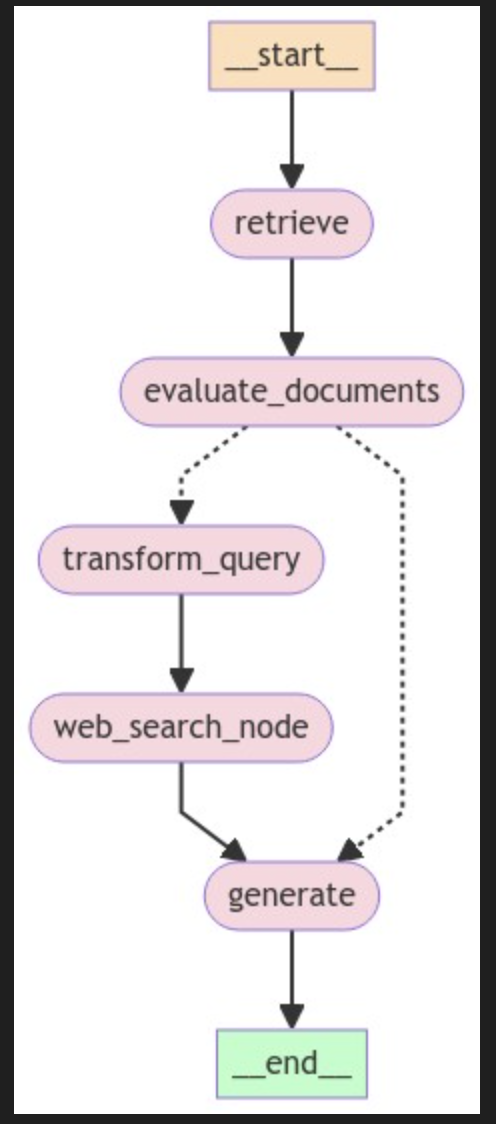
Zum Testen führen wir den Workflow mit Beispielanfragen aus und prüfen, wie Informationen abgerufen, die Relevanz bewertet und Antworten generiert werden.
Die erste Anfrage prüft, wie gut CRAG innerhalb der Wissensbasis Antworten findet.
from pprint import pprint
# Run
inputs = {"question": "What's the bagel method?"}
for output in app.stream(inputs):
    for key, value in output.items():
        # Node
        pprint(f"Node '{key}':")
        # Optional: print full state at each node
        pprint(value, indent=2, width=80, depth=None)
    pprint("\\n---\\n")
# Final generation
pprint(value["generation"])
---RETRIEVE---
"Node 'retrieve':"
{ 'documents': [ Document(page_content="the book was called The Bagel Method.The Bagel Method is designed to help partners be on the same team when dealing with differences and trying to find a compromise.The idea behind the method is that, to truly compromise, we need to figure out a way to include both partners’ dreams and core needs; things that are super important to us that giving up on them is too much.Let’s dive into the bagel 😜🚀 If you are new here…Hi, I’m Ryan 👋� I am passionate about lifestyle gamification � and I am obsesssssssss with learning things that can help me live a happy and fulfilling life.And so, with The Limitless Playbook newsletter, I will share with you 1 actionable idea from the world's top thinkers every Sunday �So visit us weekly for highly actionable insights :)…or even better, subscribe below and have all these information send straight to your inbox every Sunday 🥳Subscribe🥯", metadata={'description': 'A collection of the best hidden gems, mental models, and frameworks from the world’s top thinkers; to help you become 1% better and live a happier life ��', 'language': 'en', 'source': '<https://ryanocm.substack.com/p/105-the-bagel-method-in-relationships>', 'title': '#105 | The Bagel Method in Relationships 🥯'}),
Document(page_content='#105 | The Bagel Method in Relationships 🥯', metadata={'description': 'A collection of the best hidden gems, mental models, and frameworks from the world’s top thinkers; to help you become 1% better and live a happier life ��', 'language': 'en', 'source': '<https://ryanocm.substack.com/p/105-the-bagel-method-in-relationships>', 'title': '#105 | The Bagel Method in Relationships 🥯'}),
Document(page_content='The Limitless Playbook 🧬SubscribeSign inShare this post#105 | The Bagel Method in Relationships 🥯ryanocm.substack.comCopy linkFacebookEmailNoteOther#105 | The Bagel Method in Relationships 🥯A collection of the best hidden gems, mental models, and frameworks from the world’s top thinkers; to help you become 1% better and live a happier life â�¤ï¸�Ryan Ong ğŸ�®Feb 25, 2024Share this post#105 | The Bagel Method in Relationships 🥯ryanocm.substack.comCopy linkFacebookEmailNoteOtherShareHello curious minds ğŸ§\\xa0I recently finished the book Fight Right: How Successful Couples Turn Conflict into Connection and oh my days, I love every chapter of it!There were many repeating concepts but this time, it was applied in the context of conflicts in relationships. As usual with the Gottman’s books, I highlighted the hell out of the entire book 😄One of the cool exercises in', metadata={'description': 'A collection of the best hidden gems, mental models, and frameworks from the world’s top thinkers; to help you become 1% better and live a happier life â�¤ï¸�', 'language': 'en', 'source': '<https://ryanocm.substack.com/p/105-the-bagel-method-in-relationships>', 'title': '#105 | The Bagel Method in Relationships 🥯'}),
Document(page_content="The Bagel MethodThe Bagel Method involves mapping out your core needs and areas of flexibility so that you and your partner understand what's important and where there's room for flexibility.It’s called The Bagel Method because, just like a bagel, it has both the inner and outer circles representing your needs.Here are the steps:In the inner circle, list all the aspects of an issue that you can’t give in on. These are your non-negotiables that are usually very closely related to your core needs and dreams.In the outer circle, list all the aspects of an issue that you are able to compromise on IF you are able to have what’s in your inner circle.Now, talk to your partners about your inner and outer circle. Ask each other:Why are the things in your inner circle so important to you?How can I support your core needs here?Tell me more about your areas of flexibility. What does it look like to be flexible?Compare both your “bagel� of needsWhat do we agree on?What feelings do we have in common?What shared goals do we have?How might we accomplish these goals", metadata={'description': 'A collection of the best hidden gems, mental models, and frameworks from the world’s top thinkers; to help you become 1% better and live a happier life ��', 'language': 'en', 'source': '<https://ryanocm.substack.com/p/105-the-bagel-method-in-relationships>', 'title': '#105 | The Bagel Method in Relationships 🥯'})],
'question': "What's the bagel method?"}
'\\n---\\n'
---CHECK DOCUMENT RELEVANCE TO QUESTION---
---GRADE: DOCUMENT RELEVANT---
---GRADE: DOCUMENT RELEVANT---
---GRADE: DOCUMENT NOT RELEVANT---
---GRADE: DOCUMENT RELEVANT---
---ASSESS GRADED DOCUMENTS---
---DECISION: GENERATE---
"Node 'evaluate_documents':"
{ 'documents': [ Document(page_content="the book was called The Bagel Method.The Bagel Method is designed to help partners be on the same team when dealing with differences and trying to find a compromise.The idea behind the method is that, to truly compromise, we need to figure out a way to include both partners’ dreams and core needs; things that are super important to us that giving up on them is too much.Let’s dive into the bagel 😜🚀 If you are new here…Hi, I’m Ryan 👋� I am passionate about lifestyle gamification � and I am obsesssssssss with learning things that can help me live a happy and fulfilling life.And so, with The Limitless Playbook newsletter, I will share with you 1 actionable idea from the world's top thinkers every Sunday �So visit us weekly for highly actionable insights :)…or even better, subscribe below and have all these information send straight to your inbox every Sunday 🥳Subscribe🥯", metadata={'description': 'A collection of the best hidden gems, mental models, and frameworks from the world’s top thinkers; to help you become 1% better and live a happier life ��', 'language': 'en', 'source': '<https://ryanocm.substack.com/p/105-the-bagel-method-in-relationships>', 'title': '#105 | The Bagel Method in Relationships 🥯'}),
Document(page_content='#105 | The Bagel Method in Relationships 🥯', metadata={'description': 'A collection of the best hidden gems, mental models, and frameworks from the world’s top thinkers; to help you become 1% better and live a happier life ��', 'language': 'en', 'source': '<https://ryanocm.substack.com/p/105-the-bagel-method-in-relationships>', 'title': '#105 | The Bagel Method in Relationships 🥯'}),
Document(page_content="The Bagel MethodThe Bagel Method involves mapping out your core needs and areas of flexibility so that you and your partner understand what's important and where there's room for flexibility.It’s called The Bagel Method because, just like a bagel, it has both the inner and outer circles representing your needs.Here are the steps:In the inner circle, list all the aspects of an issue that you can’t give in on. These are your non-negotiables that are usually very closely related to your core needs and dreams.In the outer circle, list all the aspects of an issue that you are able to compromise on IF you are able to have what’s in your inner circle.Now, talk to your partners about your inner and outer circle. Ask each other:Why are the things in your inner circle so important to you?How can I support your core needs here?Tell me more about your areas of flexibility. What does it look like to be flexible?Compare both your “bagel� of needsWhat do we agree on?What feelings do we have in common?What shared goals do we have?How might we accomplish these goals", metadata={'description': 'A collection of the best hidden gems, mental models, and frameworks from the world’s top thinkers; to help you become 1% better and live a happier life ��', 'language': 'en', 'source': '<https://ryanocm.substack.com/p/105-the-bagel-method-in-relationships>', 'title': '#105 | The Bagel Method in Relationships 🥯'})],
'question': "What's the bagel method?",
'web_search': 'No'}
'\\n---\\n'
---GENERATE---
"Node 'generate':"
{ 'documents': [ Document(page_content="the book was called The Bagel Method.The Bagel Method is designed to help partners be on the same team when dealing with differences and trying to find a compromise.The idea behind the method is that, to truly compromise, we need to figure out a way to include both partners’ dreams and core needs; things that are super important to us that giving up on them is too much.Let’s dive into the bagel 😜🚀 If you are new here…Hi, I’m Ryan 👋� I am passionate about lifestyle gamification � and I am obsesssssssss with learning things that can help me live a happy and fulfilling life.And so, with The Limitless Playbook newsletter, I will share with you 1 actionable idea from the world's top thinkers every Sunday �So visit us weekly for highly actionable insights :)…or even better, subscribe below and have all these information send straight to your inbox every Sunday 🥳Subscribe🥯", metadata={'description': 'A collection of the best hidden gems, mental models, and frameworks from the world’s top thinkers; to help you become 1% better and live a happier life ��', 'language': 'en', 'source': '<https://ryanocm.substack.com/p/105-the-bagel-method-in-relationships>', 'title': '#105 | The Bagel Method in Relationships 🥯'}),
Document(page_content='#105 | The Bagel Method in Relationships 🥯', metadata={'description': 'A collection of the best hidden gems, mental models, and frameworks from the world’s top thinkers; to help you become 1% better and live a happier life ��', 'language': 'en', 'source': '<https://ryanocm.substack.com/p/105-the-bagel-method-in-relationships>', 'title': '#105 | The Bagel Method in Relationships 🥯'}),
Document(page_content="The Bagel MethodThe Bagel Method involves mapping out your core needs and areas of flexibility so that you and your partner understand what's important and where there's room for flexibility.It’s called The Bagel Method because, just like a bagel, it has both the inner and outer circles representing your needs.Here are the steps:In the inner circle, list all the aspects of an issue that you can’t give in on. These are your non-negotiables that are usually very closely related to your core needs and dreams.In the outer circle, list all the aspects of an issue that you are able to compromise on IF you are able to have what’s in your inner circle.Now, talk to your partners about your inner and outer circle. Ask each other:Why are the things in your inner circle so important to you?How can I support your core needs here?Tell me more about your areas of flexibility. What does it look like to be flexible?Compare both your “bagel� of needsWhat do we agree on?What feelings do we have in common?What shared goals do we have?How might we accomplish these goals", metadata={'description': 'A collection of the best hidden gems, mental models, and frameworks from the world’s top thinkers; to help you become 1% better and live a happier life ��', 'language': 'en', 'source': '<https://ryanocm.substack.com/p/105-the-bagel-method-in-relationships>', 'title': '#105 | The Bagel Method in Relationships 🥯'})],
'generation': 'The Bagel Method is a framework designed to help partners '
'navigate differences and find compromises by mapping out '
'their core needs and areas of flexibility. It involves '
'creating two circles: the inner circle for non-negotiable '
'needs and the outer circle for aspects where compromise is '
'possible. This method encourages open communication about '
"each partner's priorities and shared goals.",
'question': "What's the bagel method?"}
'\\n---\\n'
('The Bagel Method is a framework designed to help partners navigate '
'differences and find compromises by mapping out their core needs and areas '
'of flexibility. It involves creating two circles: the inner circle for '
'non-negotiable needs and the outer circle for aspects where compromise is '
"possible. This method encourages open communication about each partner's "
'priorities and shared goals.')Die zweite Anfrage prüft, wie CRAG per Websuche zusätzliche Informationen findet, wenn die Wissensbasis nicht die passenden Dokumente enthält.
from pprint import pprint
# Run
inputs = {"question": "What is prompt engineering?"}
for output in app.stream(inputs):
    for key, value in output.items():
        # Node
        pprint(f"Node '{key}':")
        # Optional: print full state at each node
        pprint(value, indent=2, width=80, depth=None)
    pprint("\\n---\\n")
# Final generation
pprint(value["generation"])
---RETRIEVE---
"Node 'retrieve':"
{ 'documents': [ Document(page_content='Mystery Gift Box #049 | Law 1: Fill your Five Buckets in the Right Order (The Diary of a CEO)', metadata={'description': "The best hidden gems I've found; interesting ideas and concepts, thought-provoking questions, mind-blowing books/podcasts, cool animes/films, and other mysteries ��", 'language': 'en', 'source': '<https://ryanocm.substack.com/p/mystery-gift-box-049-law-1-fill-your>', 'title': 'Mystery Gift Box #049 | Law 1: Fill your Five Buckets in the Right Order (The Diary of a CEO)'}),
Document(page_content='ğŸ�¦Â\\xa0Twitter, 👨ğŸ�»â€�💻Â\\xa0LinkedIn, ğŸŒ�Â\\xa0Personal Website, and 📸Â\\xa0InstagramShare this postMystery Gift Box #049 | Law 1: Fill your Five Buckets in the Right Order (The Diary of a CEO)ryanocm.substack.comCopy linkFacebookEmailNoteOtherSharePreviousNextCommentsTopLatestDiscussionsNo postsReady for more?Subscribe© 2024 Ryan Ong ğŸ�®Privacy ∙ Terms ∙ Collection notice Start WritingGet the appSubstack is the home for great cultureShareCopy linkFacebookEmailNoteOther', metadata={'description': "The best hidden gems I've found; interesting ideas and concepts, thought-provoking questions, mind-blowing books/podcasts, cool animes/films, and other mysteries â�¤ï¸�", 'language': 'en', 'source': '<https://ryanocm.substack.com/p/mystery-gift-box-049-law-1-fill-your>', 'title': 'Mystery Gift Box #049 | Law 1: Fill your Five Buckets in the Right Order (The Diary of a CEO)'}),
Document(page_content='skills are the foundation of which you build your life and career and it’s truly yours to own; you can lose your network, resources, and reputation but you will never lose your knowledge and skills.Never try to skip the first two buckets. If you try to jump straight to network, resources, and / or reputation bucket, you might “succeed� in the short-run but in the long run, your lack of knowledge and skill will catch on to you.There is no skipping the first two buckets of knowledge and skills if you’re playing long-term sustainable results. Any attempt to do so is equivalent to building your house on sand.💥 Key takeawayFocus on using your knowledge and skills to create lots of values in the world and the world will reward you with growing network (people will come to you), resources (people will pay for your services), and reputation (people will know what you are capable of).⛰ 4-4-4 Exploration ProjectEach month, I would explore one new thing; a skill, a subject, or an experience.January 2023: Writing and Storytelling (Subject)', metadata={'description': "The best hidden gems I've found; interesting ideas and concepts, thought-provoking questions, mind-blowing books/podcasts, cool animes/films, and other mysteries ��", 'language': 'en', 'source': '<https://ryanocm.substack.com/p/mystery-gift-box-049-law-1-fill-your>', 'title': 'Mystery Gift Box #049 | Law 1: Fill your Five Buckets in the Right Order (The Diary of a CEO)'}),
Document(page_content='This site requires JavaScript to run correctly. Please turn on JavaScript or unblock scripts', metadata={'description': 'A collection of the best hidden gems, mental models, and frameworks from the world’s top thinkers; to help you become 1% better and live a happier life ��', 'language': 'en', 'source': '<https://ryanocm.substack.com/p/105-the-bagel-method-in-relationships>', 'title': '#105 | The Bagel Method in Relationships 🥯'})],
'question': 'What is prompt engineering?'}
'\\n---\\n'
---CHECK DOCUMENT RELEVANCE TO QUESTION---
---GRADE: DOCUMENT NOT RELEVANT---
---GRADE: DOCUMENT NOT RELEVANT---
---GRADE: DOCUMENT NOT RELEVANT---
---GRADE: DOCUMENT NOT RELEVANT---
---ASSESS GRADED DOCUMENTS---
---DECISION: ALL DOCUMENTS ARE NOT RELEVANT TO QUESTION, TRANSFORM QUERY---
"Node 'evaluate_documents':"
{ 'documents': [],
'question': 'What is prompt engineering?',
'web_search': 'Yes'}
'\\n---\\n'
---TRANSFORM QUERY---
"Node 'transform_query':"
{ 'documents': [],
'question': 'What is the concept of prompt engineering and how is it applied '
'in artificial intelligence?'}
'\\n---\\n'
---WEB SEARCH---
"Node 'web_search_node':"
{ 'documents': [ Document(page_content="Prompt engineering is the method to ask generative AI to produce what the individual needs. There are two main principles of building a successful prompt for any AI, specificity and iteration. The box below includes one example of a framework that can be applied when prompting any generative AI.\\nPrompt Engineering is the process of designing and refining text inputs (prompts) to achieve specific application objectives with AI models. Think of it as a two-step journey: Designing the Initial Prompt: Creating the initial input for the model to achieve the desired result. Refining the Prompt: Continuously adjusting the prompt to enhance ...\\nPrompt engineering is the process of designing and refining the inputs given to language models, like those in AI, to achieve desired outputs more effectively. It involves creatively crafting prompts that guide the model in generating responses that are accurate, relevant, and aligned with the user's intentions.. For students and researchers in higher education, mastering prompt engineering is ...\\nJune 25, 2024. Prompt engineering means writing precise instructions for AI models. These instructions are different from coding because they use natural language. And today, everybody does it—from software developers to artists and content creators. Prompt engineering can help you improve productivity and save time by automating repetitive ...\\nMaster Prompt Engineering - The (AI) Prompt\\nAI Takes Wall Street by Storm: C3.ai's Strong Forecast Sparks a Surge in AI Stocks\\nAsk Me Anything (AMA) Prompting\\nHow Self-Critique Improves Logic and Reasoning in LLMs Like ChatGPT\\nOptimizing Large Language Models to Maximize Performance\\nThe Black Box Problem: Opaque Inner Workings of Large Language Models\\nHow to Evaluate Large Language Models for Business Tasks\\nIntroduction to the AI Prompt Development Process\\nSubscribe to new posts\\nThe Official Source For Everything Prompt Engineering & Generative AI Defining Prompt Engineering\\nGiven that the prompt is the singular input channel to large language models, prompt engineering can be defined as:\\nPrompt Engineering can be thought of as any process that contributes to the development of a well-crafted prompt to generate quality, useful outputs from an AI system.\\n A Simplified Approach to Defining Prompt Engineering\\nThe Prompt is the Sole Input\\nWhen interacting with Generative AI Models such as large language models (LLMs), the prompt is the only thing that gets input into the AI system. Its applications cut across diverse sectors, from healthcare and education to business, securing its place as a cornerstone of our interactions with AI.\\nExploration of Essential Prompt Engineering Techniques and Concepts\\nIn the rapidly evolving landscape of Artificial Intelligence (AI), mastering key techniques of Prompt Engineering has become increasingly vital. The key concepts of Prompt Engineering include prompts and prompting the AI, training the AI, developing and maintaining a prompt library, and testing, evaluation, and categorization.\\n")],
'question': 'What is the concept of prompt engineering and how is it applied '
'in artificial intelligence?'}
'\\n---\\n'
---GENERATE---
"Node 'generate':"
{ 'documents': [ Document(page_content="Prompt engineering is the method to ask generative AI to produce what the individual needs. There are two main principles of building a successful prompt for any AI, specificity and iteration. The box below includes one example of a framework that can be applied when prompting any generative AI.\\nPrompt Engineering is the process of designing and refining text inputs (prompts) to achieve specific application objectives with AI models. Think of it as a two-step journey: Designing the Initial Prompt: Creating the initial input for the model to achieve the desired result. Refining the Prompt: Continuously adjusting the prompt to enhance ...\\nPrompt engineering is the process of designing and refining the inputs given to language models, like those in AI, to achieve desired outputs more effectively. It involves creatively crafting prompts that guide the model in generating responses that are accurate, relevant, and aligned with the user's intentions.. For students and researchers in higher education, mastering prompt engineering is ...\\nJune 25, 2024. Prompt engineering means writing precise instructions for AI models. These instructions are different from coding because they use natural language. And today, everybody does it—from software developers to artists and content creators. Prompt engineering can help you improve productivity and save time by automating repetitive ...\\nMaster Prompt Engineering - The (AI) Prompt\\nAI Takes Wall Street by Storm: C3.ai's Strong Forecast Sparks a Surge in AI Stocks\\nAsk Me Anything (AMA) Prompting\\nHow Self-Critique Improves Logic and Reasoning in LLMs Like ChatGPT\\nOptimizing Large Language Models to Maximize Performance\\nThe Black Box Problem: Opaque Inner Workings of Large Language Models\\nHow to Evaluate Large Language Models for Business Tasks\\nIntroduction to the AI Prompt Development Process\\nSubscribe to new posts\\nThe Official Source For Everything Prompt Engineering & Generative AI Defining Prompt Engineering\\nGiven that the prompt is the singular input channel to large language models, prompt engineering can be defined as:\\nPrompt Engineering can be thought of as any process that contributes to the development of a well-crafted prompt to generate quality, useful outputs from an AI system.\\n A Simplified Approach to Defining Prompt Engineering\\nThe Prompt is the Sole Input\\nWhen interacting with Generative AI Models such as large language models (LLMs), the prompt is the only thing that gets input into the AI system. Its applications cut across diverse sectors, from healthcare and education to business, securing its place as a cornerstone of our interactions with AI.\\nExploration of Essential Prompt Engineering Techniques and Concepts\\nIn the rapidly evolving landscape of Artificial Intelligence (AI), mastering key techniques of Prompt Engineering has become increasingly vital. The key concepts of Prompt Engineering include prompts and prompting the AI, training the AI, developing and maintaining a prompt library, and testing, evaluation, and categorization.\\n")],
'generation': 'Prompt engineering is the process of designing and refining '
'text inputs to guide AI models in generating desired outputs. '
'It focuses on specificity and iteration to create effective '
'prompts that align with user intentions. This technique is '
'widely applicable across various sectors, enhancing '
'productivity and automating tasks.',
'question': 'What is the concept of prompt engineering and how is it applied '
'in artificial intelligence?'}
'\\n---\\n'
('Prompt engineering is the process of designing and refining text inputs to '
'guide AI models in generating desired outputs. It focuses on specificity and '
'iteration to create effective prompts that align with user intentions. This '
'technique is widely applicable across various sectors, enhancing '
'productivity and automating tasks.')Auch wenn CRAG klassisches RAG verbessert, gibt es Einschränkungen, die beachtet werden sollten.
Ein zentrales Thema ist die Abhängigkeit von der Qualität des Retrieval-Evaluators. Er ist entscheidend dafür, ob abgerufene Dokumente relevant und korrekt sind. Das Training und die Feinabstimmung des Evaluators sind jedoch aufwendig, erfordern viele hochwertige Daten und Rechenressourcen. Ihn kontinuierlich an neue Fragetypen und Datenquellen anzupassen, erhöht Komplexität und Kosten zusätzlich.
Eine weitere Einschränkung ist die Nutzung der Websuche, um unklare oder inkorrekte Dokumente zu ersetzen. Zwar liefert dieser Ansatz aktuellere und vielfältigere Informationen, birgt aber das Risiko, voreingenommene oder unzuverlässige Inhalte einzuschleusen. Die Qualität von Webinhalten variiert stark, und das Heraussieben der besten Informationen ist herausfordernd. Selbst ein gut trainierter Evaluator kann die Aufnahme minderwertiger oder voreingenommener Inhalte nicht immer vollständig verhindern.
Diese Herausforderungen zeigen, dass weitere Forschung und Entwicklung nötig sind.
In Summe erweitert CRAG klassische RAG-Systeme um Schritte zum Prüfen und Verfeinern der abgerufenen Informationen und macht Sprachmodelle dadurch genauer und verlässlicher. Damit ist CRAG für viele Anwendungsfälle ein wertvolles Werkzeug.
Wenn du mehr über CRAG erfahren willst, lies das Originalpaper hier.
Weitere Lernressourcen zu RAG findest du in diesen Blogposts:
Baue KI-Agenten mit diesen Kursen!
Kurs
Kurs
Kurs