
Corso
Creare agenti AI con Google ADK
1 ore
7.7K
La corrective retrieval-augmented generation (CRAG) è una versione migliorata della RAG che punta a rendere i modelli linguistici più accurati.
Mentre la RAG tradizionale si limita a usare i documenti recuperati per aiutare a generare testo, CRAG fa un passo avanti controllando attivamente e affinando questi documenti per garantirne pertinenza e accuratezza. Questo aiuta a ridurre errori o allucinazioni in cui il modello potrebbe produrre informazioni scorrette o fuorvianti.
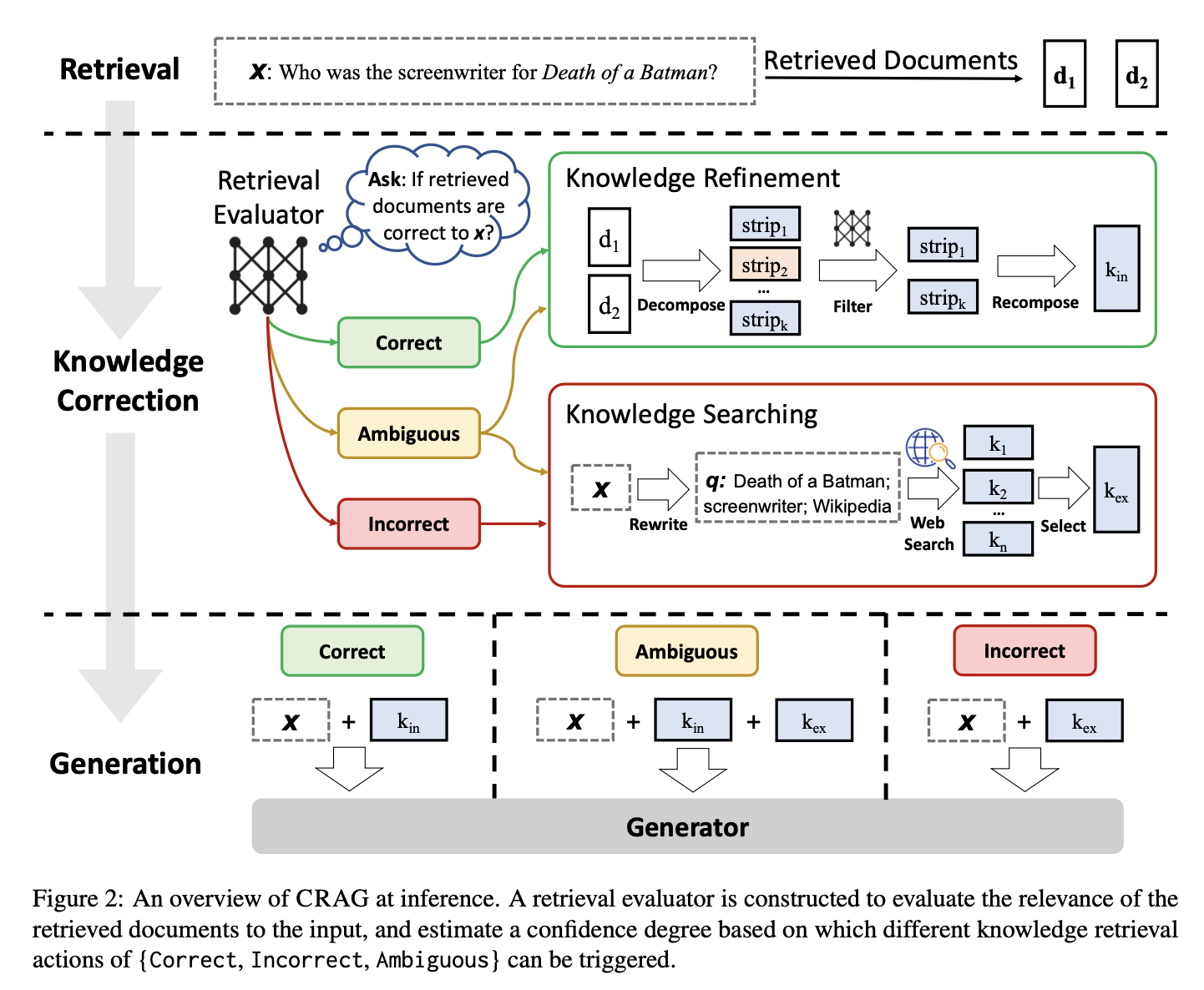
Fonte: Shi-Qi Yan et al., 2024
Il framework CRAG opera attraverso alcuni passaggi chiave, che coinvolgono un valutatore del recupero e azioni correttive specifiche.
Per una determinata query in input, un retriever standard estrae innanzitutto un insieme di documenti da una base di conoscenza. Questi documenti vengono poi esaminati da un valutatore del recupero per determinarne la pertinenza rispetto alla query.
In CRAG, il valutatore del recupero è un modello T5-large messo a punto. L'evaluator assegna un punteggio di confidenza a ciascun documento, classificandoli in tre livelli di confidenza:
Dopo una di queste azioni, la conoscenza raffinata viene usata per generare la risposta finale.
CRAG introduce diversi miglioramenti rispetto alla RAG tradizionale. Uno dei maggiori vantaggi è la capacità di correggere errori nelle informazioni recuperate. Il valutatore del recupero in CRAG aiuta a individuare quando le informazioni sono errate o irrilevanti, così da poterle correggere prima che influenzino l'output finale. Questo significa che CRAG fornisce informazioni più accurate e affidabili, riducendo errori e disinformazione.
CRAG eccelle anche nell'assicurare che le informazioni siano sia pertinenti sia accurate. Mentre la RAG tradizionale potrebbe limitarsi a controllare i punteggi di pertinenza, CRAG va oltre raffinando i documenti per garantire che non siano solo pertinenti ma anche precisi. Filtra i dettagli irrilevanti e si concentra sui punti più importanti, così il testo generato si basa su informazioni accurate.
In questa sezione, vedremo una guida passo passo su come implementare CRAG usando LangGraph. Imparerai a configurare l'ambiente, creare un semplice vector store di conoscenza e impostare i componenti chiave necessari per CRAG, come il valutatore del recupero, il riscrittore di domande e lo strumento di ricerca web.
Impareremo anche a creare un workflow LangGraph che riunisce tutte queste parti, mostrando come CRAG possa gestire vari tipi di query per risultati più accurati e affidabili.
Per prima cosa, installa i pacchetti necessari. Questo step configura l'ambiente per eseguire la pipeline CRAG.
pip install langchain_community tiktoken langchain-openai langchainhub chromadb langchain langgraph tavily-pythonPoi, configura le chiavi API per Tavily e OpenAI:
import os
os.environ["TAVILY_API_KEY"] = "YOUR_TAVILY_API_KEY"
os.environ["OPENAI_API_KEY"] = "YOUR_OPENAI_API_KEY"Per eseguire la RAG, abbiamo prima bisogno di una base di conoscenza popolata di documenti. In questo passaggio, effettueremo lo scraping di alcuni documenti di esempio da una newsletter Substack per creare un vector store, che fungerà da knowledge base proxy. Questo vector store ci aiuta a trovare documenti pertinenti in base alle query degli utenti.
Iniziamo caricando i documenti dagli URL forniti e suddividendoli in sezioni più piccole usando un text splitter. Queste sezioni vengono poi incorporate usando OpenAIEmbeddings e memorizzate in un database vettoriale (Chroma) per un recupero efficiente dei documenti.
from langchain.text_splitter import RecursiveCharacterTextSplitter
from langchain_community.document_loaders import WebBaseLoader
from langchain_community.vectorstores import Chroma
from langchain_openai import OpenAIEmbeddings
urls = [
    "<https://ryanocm.substack.com/p/mystery-gift-box-049-law-1-fill-your>",
    "<https://ryanocm.substack.com/p/105-the-bagel-method-in-relationships>",
    "<https://ryanocm.substack.com/p/098-i-have-read-100-productivity>",
]
docs = [WebBaseLoader(url).load() for url in urls]
docs_list = [item for sublist in docs for item in sublist]
text_splitter = RecursiveCharacterTextSplitter.from_tiktoken_encoder(
    chunk_size=250, chunk_overlap=0
)
doc_splits = text_splitter.split_documents(docs_list)
# Add to vectorDB
vectorstore = Chroma.from_documents(
    documents=doc_splits,
    collection_name="rag-chroma",
    embedding=OpenAIEmbeddings(),
)
retriever = vectorstore.as_retriever()In questo passaggio, configuriamo una semplice catena RAG che prende la domanda di un utente e un insieme di documenti per generare una risposta.
La catena RAG utilizza un prompt predefinito e un modello linguistico (GPT 4-o mini) per creare risposte basate sui documenti recuperati. Un parser di output formatta poi il testo generato per renderlo più leggibile.
### Generate
from langchain import hub
from langchain_core.output_parsers import StrOutputParser
# Prompt
rag_prompt = hub.pull("rlm/rag-prompt")
# LLM
rag_llm = ChatOpenAI(model_name="gpt-4o-mini", temperature=0)
# Post-processing
def format_docs(docs):
    return "\\n\\n".join(doc.page_content for doc in docs)
# Chain
rag_chain = rag_prompt | rag_llm | StrOutputParser()
print(rag_prompt.messages[0].prompt.template)
You are an assistant for question-answering tasks. Use the following pieces of retrieved context to answer the question. If you don't know the answer, just say that you don't know. Use three sentences maximum and keep the answer concise.
Question: {question}
Context: {context}
Answer:generation = rag_chain.invoke({"context": docs, "question": question})
print("Question: %s" % question)
print("----")
print("Documents:\\n")
print('\\n\\n'.join(['- %s' % x.page_content for x in docs]))
print("----")
print("Final answer: %s" % generation)Question: what is the bagel method
----
Documents:
- the book was called The Bagel Method.The Bagel Method is designed to help partners be on the same team when dealing with differences and trying to find a compromise.The idea behind the method is that, to truly compromise, we need to figure out a way to include both partners’ dreams and core needs; things that are super important to us that giving up on them is too much.Let’s dive into the bagel 😜🚀 If you are new here…Hi, I’m Ryan 👋� I am passionate about lifestyle gamification � and I am obsesssssssss with learning things that can help me live a happy and fulfilling life.And so, with The Limitless Playbook newsletter, I will share with you 1 actionable idea from the world's top thinkers every Sunday �So visit us weekly for highly actionable insights :)…or even better, subscribe below and have all these information send straight to your inbox every Sunday 🥳Subscribe🥯
- #105 | The Bagel Method in Relationships 🥯
- The Limitless Playbook 🧬SubscribeSign inShare this post#105 | The Bagel Method in Relationships 🥯ryanocm.substack.comCopy linkFacebookEmailNoteOther#105 | The Bagel Method in Relationships 🥯A collection of the best hidden gems, mental models, and frameworks from the world’s top thinkers; to help you become 1% better and live a happier life ��Ryan Ong �Feb 25, 2024Share this post#105 | The Bagel Method in Relationships 🥯ryanocm.substack.comCopy linkFacebookEmailNoteOtherShareHello curious minds 🧠I recently finished the book Fight Right: How Successful Couples Turn Conflict into Connection and oh my days, I love every chapter of it!There were many repeating concepts but this time, it was applied in the context of conflicts in relationships. As usual with the Gottman’s books, I highlighted the hell out of the entire book 😄One of the cool exercises in
- The Bagel MethodThe Bagel Method involves mapping out your core needs and areas of flexibility so that you and your partner understand what's important and where there's room for flexibility.It’s called The Bagel Method because, just like a bagel, it has both the inner and outer circles representing your needs.Here are the steps:In the inner circle, list all the aspects of an issue that you can’t give in on. These are your non-negotiables that are usually very closely related to your core needs and dreams.In the outer circle, list all the aspects of an issue that you are able to compromise on IF you are able to have what’s in your inner circle.Now, talk to your partners about your inner and outer circle. Ask each other:Why are the things in your inner circle so important to you?How can I support your core needs here?Tell me more about your areas of flexibility. What does it look like to be flexible?Compare both your “bagel� of needsWhat do we agree on?What feelings do we have in common?What shared goals do we have?How might we accomplish these goals
----
Final answer: The Bagel Method is a relationship strategy that helps partners identify their core needs and areas where they can be flexible. It involves mapping out non-negotiables in the inner circle and compromise areas in the outer circle, facilitating open communication about each partner's priorities. This method aims to foster understanding and collaboration in resolving differences.Per migliorare l'accuratezza dei contenuti generati, configuriamo un valutatore del recupero. Questo strumento verifica quanto sia pertinente ciascun documento recuperato, per assicurarsi che venga usata solo l'informazione più utile.
Il valutatore del recupero è configurato con un prompt e un modello linguistico. Determina se i documenti sono pertinenti o meno, filtrando i contenuti irrilevanti prima della generazione della risposta.
### Retrieval Evaluator
from langchain_core.prompts import ChatPromptTemplate
from langchain_core.pydantic_v1 import BaseModel, Field
from langchain_openai import ChatOpenAI
# Data model
class RetrievalEvaluator(BaseModel):
    """Classify retrieved documents based on how relevant it is to the user's question."""
    binary_score: str = Field(
        description="Documents are relevant to the question, 'yes' or 'no'"
    )
# LLM with function call
retrieval_evaluator_llm = ChatOpenAI(model="gpt-4o-mini", temperature=0)
structured_llm_evaluator = retrieval_evaluator_llm.with_structured_output(RetrievalEvaluator)
# Prompt
system = """You are a document retrieval evaluator that's responsible for checking the relevancy of a retrieved document to the user's question. \\n
    If the document contains keyword(s) or semantic meaning related to the question, grade it as relevant. \\n
    Output a binary score 'yes' or 'no' to indicate whether the document is relevant to the question."""
retrieval_evaluator_prompt = ChatPromptTemplate.from_messages(
    [
        ("system", system),
        ("human", "Retrieved document: \\n\\n {document} \\n\\n User question: {question}"),
    ]
)
retrieval_grader = retrieval_evaluator_prompt | structured_llm_evaluatorAggiungeremo un riscrittore di domande per rendere le query degli utenti più chiare e specifiche, facilitando il processo di ricerca.
Il riscrittore affina la query originale per rendere la ricerca più mirata, portando a risultati migliori e più pertinenti.
### Question Re-writer
# LLM
question_rewriter_llm = ChatOpenAI(model="gpt-4o-mini", temperature=0)
# Prompt
system = """You are a question re-writer that converts an input question to a better version that is optimized \\n
     for web search. Look at the input and try to reason about the underlying semantic intent / meaning."""
re_write_prompt = ChatPromptTemplate.from_messages(
    [
        ("system", system),
        (
            "human",
            "Here is the initial question: \\n\\n {question} \\n Formulate an improved question.",
        ),
    ]
)
question_rewriter = re_write_prompt | question_rewriter_llm | StrOutputParser()Se la base di conoscenza non ha informazioni sufficienti, CRAG ricorre alla ricerca sul web per colmare le lacune. Questo amplia la gamma di possibili fonti informative. In questo passaggio, usiamo l'API Tavily per cercare sul web e trovare documenti aggiuntivi.
### Search
from langchain_community.tools.tavily_search import TavilySearchResults
web_search_tool = TavilySearchResults(k=3)Per costruire il workflow CRAG con LangGraph, segui questi tre passaggi principali:
Crea uno stato condiviso per memorizzare i dati mentre si spostano tra i nodi durante il workflow. Questo stato conterrà tutte le variabili, come la domanda dell'utente, i documenti recuperati e le risposte generate.
from typing import List
from typing_extensions import TypedDict
class GraphState(TypedDict):
    """
    Represents the state of our graph.
    Attributes:
        question: question
        generation: LLM generation
        web_search: whether to add search
        documents: list of documents
    """
    question: str
    generation: str
    web_search: str
documents: List[str]Nel workflow LangGraph, ogni nodo funzione gestisce un compito specifico della pipeline CRAG, come recuperare documenti, generare risposte, valutare la pertinenza, trasformare le query e cercare sul web. Ecco una panoramica di ciascuna funzione:
La funzione retrieve trova documenti dalla base di conoscenza pertinenti alla domanda dell'utente. Usa un oggetto retriever, solitamente un vector store creato da documenti pre-processati. Questa funzione prende lo stato corrente, inclusa la domanda dell'utente, e usa il retriever per ottenere documenti pertinenti. Aggiunge poi questi documenti allo stato.
from langchain.schema import Document
def retrieve(state):
    """
    Retrieve documents
    Args:
        state (dict): The current graph state
    Returns:
        state (dict): New key added to state, documents, that contains retrieved documents
    """
    print("---RETRIEVE---")
    question = state["question"]
    # Retrieval
    documents = retriever.get_relevant_documents(question)
    return {"documents": documents, "question": question}
La funzione generate crea una risposta alla domanda dell'utente usando i documenti recuperati. Lavora con la catena RAG, che combina un prompt con un modello linguistico. Questa funzione prende i documenti recuperati e la domanda dell’utente, li elabora attraverso la catena RAG e aggiunge la risposta allo stato.
def generate(state):
    """
    Generate answer
    Args:
        state (dict): The current graph state
    Returns:
        state (dict): New key added to state, generation, that contains LLM generation
    """
    print("---GENERATE---")
    question = state["question"]
    documents = state["documents"]
    # RAG generation
    generation = rag_chain.invoke({"context": documents, "question": question})
    return {"documents": documents, "question": question, "generation": generation}
La funzione evaluate_documents verifica quanto ciascun documento recuperato sia pertinente alla domanda dell'utente utilizzando il valutatore del recupero. Questo aiuta a garantire che per la risposta finale vengano usate solo informazioni utili. La funzione valuta la pertinenza di ogni documento e filtra quelli non utili. Aggiorna anche lo stato con un flag web_search per indicare se è necessaria una ricerca web quando la maggior parte dei documenti non è pertinente.
def evaluate_documents(state):
    """
    Determines whether the retrieved documents are relevant to the question.
    Args:
        state (dict): The current graph state
    Returns:
        state (dict): Updates documents key with only filtered relevant documents
    """
    print("---CHECK DOCUMENT RELEVANCE TO QUESTION---")
    question = state["question"]
    documents = state["documents"]
    # Score each doc
    filtered_docs = []
    web_search = "No"
    for d in documents:
        score = retrieval_grader.invoke(
            {"question": question, "document": d.page_content}
        )
        grade = score.binary_score
        if grade == "yes":
            print("---GRADE: DOCUMENT RELEVANT---")
            filtered_docs.append(d)
        else:
            print("---GRADE: DOCUMENT NOT RELEVANT---")
            continue
    if len(filtered_docs) / len(documents) <= 0.7:
        web_search = "Yes"
    return {"documents": filtered_docs, "question": question, "web_search": web_search}
La funzione transform_query migliora la domanda dell’utente per ottenere risultati di ricerca migliori, soprattutto se la query originale non trova documenti pertinenti. Usa un riscrittore di domande per rendere la domanda più chiara e specifica. Una domanda migliore aumenta le probabilità di trovare documenti utili sia nella base di conoscenza sia nelle ricerche web.
def transform_query(state):
    """
    Transform the query to produce a better question.
    Args:
        state (dict): The current graph state
    Returns:
        state (dict): Updates question key with a re-phrased question
    """
    print("---TRANSFORM QUERY---")
    question = state["question"]
    documents = state["documents"]
    # Re-write question
    better_question = question_rewriter.invoke({"question": question})
    return {"documents": documents, "question": better_question}
La funzione web_search cerca online informazioni aggiuntive usando la query raffinata. Viene usata quando la base di conoscenza non ha informazioni sufficienti, aiutando a raccogliere più contenuti. Questa funzione usa lo strumento di ricerca web Tavily per trovare documenti extra sul web, che vengono poi aggiunti ai documenti esistenti per migliorare la base di conoscenza.
def web_search(state):
    """
    Web search based on the re-phrased question.
    Args:
        state (dict): The current graph state
    Returns:
        state (dict): Updates documents key with appended web results
    """
    print("---WEB SEARCH---")
    question = state["question"]
    documents = state["documents"]
    # Web search
    docs = web_search_tool.invoke({"query": question})
    web_results = "\\n".join([d["content"] for d in docs])
    web_results = Document(page_content=web_results)
    documents.append(web_results)
    return {"documents": documents, "question": question}
La funzione decide_to_generate decide cosa fare dopo: generare una risposta con i documenti correnti oppure affinare la query e cercare di nuovo. Questa scelta si basa su quanto i documenti siano pertinenti (come valutato in precedenza).
def decide_to_generate(state):
    """
    Determines whether to generate an answer, or re-generate a question.
    Args:
        state (dict): The current graph state
    Returns:
        str: Binary decision for next node to call
    """
    print("---ASSESS GRADED DOCUMENTS---")
    state["question"]
    web_search = state["web_search"]
    state["documents"]
    if web_search == "Yes":
        # All documents have been filtered check_relevance
        # We will re-generate a new query
        print(
            "---DECISION: ALL DOCUMENTS ARE NOT RELEVANT TO QUESTION, TRANSFORM QUERY---"
        )
        return "transform_query"
    else:
        # We have relevant documents, so generate answer
        print("---DECISION: GENERATE---")
return "generate"Una volta definiti tutti i nodi funzione, possiamo collegarli nel workflow di LangGraph per costruire la pipeline CRAG. Significa connettere i nodi con archi per gestire il flusso di informazioni e decisioni, assicurando che il workflow venga eseguito correttamente in base ai risultati di ciascun passaggio.
from langgraph.graph import END, StateGraph, START
workflow = StateGraph(GraphState)
# Define the nodes
workflow.add_node("retrieve", retrieve)  # retrieve
workflow.add_node("grade_documents", evaluate_documents)  # evaluate documents
workflow.add_node("generate", generate)  # generate
workflow.add_node("transform_query", transform_query)  # transform_query
workflow.add_node("web_search_node", web_search)  # web search
# Build graph
workflow.add_edge(START, "retrieve")
workflow.add_edge("retrieve", "grade_documents")
workflow.add_conditional_edges(
    "grade_documents",
    decide_to_generate,
    {
        "transform_query": "transform_query",
        "generate": "generate",
    },
)
workflow.add_edge("transform_query", "web_search_node")
workflow.add_edge("web_search_node", "generate")
workflow.add_edge("generate", END)
# Compile
app = workflow.compile()
from IPython.display import Image, display
try:
display(Image(app.get_graph(xray=True).draw_mermaid_png()))
except Exception:
# This requires some extra dependencies and is optional
pass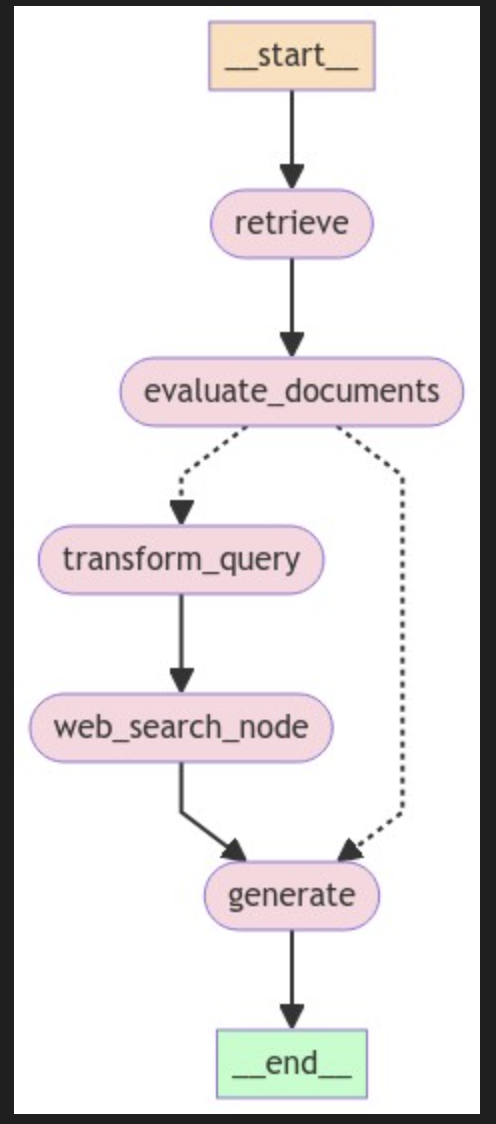
Per testare la nostra configurazione, eseguiamo il workflow con query di esempio per verificare come recupera le informazioni, valuta la pertinenza dei documenti e genera le risposte.
La prima query verifica quanto bene CRAG trovi risposte all'interno della sua base di conoscenza.
from pprint import pprint
# Run
inputs = {"question": "What's the bagel method?"}
for output in app.stream(inputs):
    for key, value in output.items():
        # Node
        pprint(f"Node '{key}':")
        # Optional: print full state at each node
        pprint(value, indent=2, width=80, depth=None)
    pprint("\\n---\\n")
# Final generation
pprint(value["generation"])
---RETRIEVE---
"Node 'retrieve':"
{ 'documents': [ Document(page_content="the book was called The Bagel Method.The Bagel Method is designed to help partners be on the same team when dealing with differences and trying to find a compromise.The idea behind the method is that, to truly compromise, we need to figure out a way to include both partners’ dreams and core needs; things that are super important to us that giving up on them is too much.Let’s dive into the bagel 😜🚀 If you are new here…Hi, I’m Ryan 👋� I am passionate about lifestyle gamification � and I am obsesssssssss with learning things that can help me live a happy and fulfilling life.And so, with The Limitless Playbook newsletter, I will share with you 1 actionable idea from the world's top thinkers every Sunday �So visit us weekly for highly actionable insights :)…or even better, subscribe below and have all these information send straight to your inbox every Sunday 🥳Subscribe🥯", metadata={'description': 'A collection of the best hidden gems, mental models, and frameworks from the world’s top thinkers; to help you become 1% better and live a happier life ��', 'language': 'en', 'source': '<https://ryanocm.substack.com/p/105-the-bagel-method-in-relationships>', 'title': '#105 | The Bagel Method in Relationships 🥯'}),
Document(page_content='#105 | The Bagel Method in Relationships 🥯', metadata={'description': 'A collection of the best hidden gems, mental models, and frameworks from the world’s top thinkers; to help you become 1% better and live a happier life ��', 'language': 'en', 'source': '<https://ryanocm.substack.com/p/105-the-bagel-method-in-relationships>', 'title': '#105 | The Bagel Method in Relationships 🥯'}),
Document(page_content='The Limitless Playbook 🧬SubscribeSign inShare this post#105 | The Bagel Method in Relationships 🥯ryanocm.substack.comCopy linkFacebookEmailNoteOther#105 | The Bagel Method in Relationships 🥯A collection of the best hidden gems, mental models, and frameworks from the world’s top thinkers; to help you become 1% better and live a happier life â�¤ï¸�Ryan Ong ğŸ�®Feb 25, 2024Share this post#105 | The Bagel Method in Relationships 🥯ryanocm.substack.comCopy linkFacebookEmailNoteOtherShareHello curious minds ğŸ§\\xa0I recently finished the book Fight Right: How Successful Couples Turn Conflict into Connection and oh my days, I love every chapter of it!There were many repeating concepts but this time, it was applied in the context of conflicts in relationships. As usual with the Gottman’s books, I highlighted the hell out of the entire book 😄One of the cool exercises in', metadata={'description': 'A collection of the best hidden gems, mental models, and frameworks from the world’s top thinkers; to help you become 1% better and live a happier life â�¤ï¸�', 'language': 'en', 'source': '<https://ryanocm.substack.com/p/105-the-bagel-method-in-relationships>', 'title': '#105 | The Bagel Method in Relationships 🥯'}),
Document(page_content="The Bagel MethodThe Bagel Method involves mapping out your core needs and areas of flexibility so that you and your partner understand what's important and where there's room for flexibility.It’s called The Bagel Method because, just like a bagel, it has both the inner and outer circles representing your needs.Here are the steps:In the inner circle, list all the aspects of an issue that you can’t give in on. These are your non-negotiables that are usually very closely related to your core needs and dreams.In the outer circle, list all the aspects of an issue that you are able to compromise on IF you are able to have what’s in your inner circle.Now, talk to your partners about your inner and outer circle. Ask each other:Why are the things in your inner circle so important to you?How can I support your core needs here?Tell me more about your areas of flexibility. What does it look like to be flexible?Compare both your “bagel� of needsWhat do we agree on?What feelings do we have in common?What shared goals do we have?How might we accomplish these goals", metadata={'description': 'A collection of the best hidden gems, mental models, and frameworks from the world’s top thinkers; to help you become 1% better and live a happier life ��', 'language': 'en', 'source': '<https://ryanocm.substack.com/p/105-the-bagel-method-in-relationships>', 'title': '#105 | The Bagel Method in Relationships 🥯'})],
'question': "What's the bagel method?"}
'\\n---\\n'
---CHECK DOCUMENT RELEVANCE TO QUESTION---
---GRADE: DOCUMENT RELEVANT---
---GRADE: DOCUMENT RELEVANT---
---GRADE: DOCUMENT NOT RELEVANT---
---GRADE: DOCUMENT RELEVANT---
---ASSESS GRADED DOCUMENTS---
---DECISION: GENERATE---
"Node 'evaluate_documents':"
{ 'documents': [ Document(page_content="the book was called The Bagel Method.The Bagel Method is designed to help partners be on the same team when dealing with differences and trying to find a compromise.The idea behind the method is that, to truly compromise, we need to figure out a way to include both partners’ dreams and core needs; things that are super important to us that giving up on them is too much.Let’s dive into the bagel 😜🚀 If you are new here…Hi, I’m Ryan 👋� I am passionate about lifestyle gamification � and I am obsesssssssss with learning things that can help me live a happy and fulfilling life.And so, with The Limitless Playbook newsletter, I will share with you 1 actionable idea from the world's top thinkers every Sunday �So visit us weekly for highly actionable insights :)…or even better, subscribe below and have all these information send straight to your inbox every Sunday 🥳Subscribe🥯", metadata={'description': 'A collection of the best hidden gems, mental models, and frameworks from the world’s top thinkers; to help you become 1% better and live a happier life ��', 'language': 'en', 'source': '<https://ryanocm.substack.com/p/105-the-bagel-method-in-relationships>', 'title': '#105 | The Bagel Method in Relationships 🥯'}),
Document(page_content='#105 | The Bagel Method in Relationships 🥯', metadata={'description': 'A collection of the best hidden gems, mental models, and frameworks from the world’s top thinkers; to help you become 1% better and live a happier life ��', 'language': 'en', 'source': '<https://ryanocm.substack.com/p/105-the-bagel-method-in-relationships>', 'title': '#105 | The Bagel Method in Relationships 🥯'}),
Document(page_content="The Bagel MethodThe Bagel Method involves mapping out your core needs and areas of flexibility so that you and your partner understand what's important and where there's room for flexibility.It’s called The Bagel Method because, just like a bagel, it has both the inner and outer circles representing your needs.Here are the steps:In the inner circle, list all the aspects of an issue that you can’t give in on. These are your non-negotiables that are usually very closely related to your core needs and dreams.In the outer circle, list all the aspects of an issue that you are able to compromise on IF you are able to have what’s in your inner circle.Now, talk to your partners about your inner and outer circle. Ask each other:Why are the things in your inner circle so important to you?How can I support your core needs here?Tell me more about your areas of flexibility. What does it look like to be flexible?Compare both your “bagel� of needsWhat do we agree on?What feelings do we have in common?What shared goals do we have?How might we accomplish these goals", metadata={'description': 'A collection of the best hidden gems, mental models, and frameworks from the world’s top thinkers; to help you become 1% better and live a happier life ��', 'language': 'en', 'source': '<https://ryanocm.substack.com/p/105-the-bagel-method-in-relationships>', 'title': '#105 | The Bagel Method in Relationships 🥯'})],
'question': "What's the bagel method?",
'web_search': 'No'}
'\\n---\\n'
---GENERATE---
"Node 'generate':"
{ 'documents': [ Document(page_content="the book was called The Bagel Method.The Bagel Method is designed to help partners be on the same team when dealing with differences and trying to find a compromise.The idea behind the method is that, to truly compromise, we need to figure out a way to include both partners’ dreams and core needs; things that are super important to us that giving up on them is too much.Let’s dive into the bagel 😜🚀 If you are new here…Hi, I’m Ryan 👋� I am passionate about lifestyle gamification � and I am obsesssssssss with learning things that can help me live a happy and fulfilling life.And so, with The Limitless Playbook newsletter, I will share with you 1 actionable idea from the world's top thinkers every Sunday �So visit us weekly for highly actionable insights :)…or even better, subscribe below and have all these information send straight to your inbox every Sunday 🥳Subscribe🥯", metadata={'description': 'A collection of the best hidden gems, mental models, and frameworks from the world’s top thinkers; to help you become 1% better and live a happier life ��', 'language': 'en', 'source': '<https://ryanocm.substack.com/p/105-the-bagel-method-in-relationships>', 'title': '#105 | The Bagel Method in Relationships 🥯'}),
Document(page_content='#105 | The Bagel Method in Relationships 🥯', metadata={'description': 'A collection of the best hidden gems, mental models, and frameworks from the world’s top thinkers; to help you become 1% better and live a happier life ��', 'language': 'en', 'source': '<https://ryanocm.substack.com/p/105-the-bagel-method-in-relationships>', 'title': '#105 | The Bagel Method in Relationships 🥯'}),
Document(page_content="The Bagel MethodThe Bagel Method involves mapping out your core needs and areas of flexibility so that you and your partner understand what's important and where there's room for flexibility.It’s called The Bagel Method because, just like a bagel, it has both the inner and outer circles representing your needs.Here are the steps:In the inner circle, list all the aspects of an issue that you can’t give in on. These are your non-negotiables that are usually very closely related to your core needs and dreams.In the outer circle, list all the aspects of an issue that you are able to compromise on IF you are able to have what’s in your inner circle.Now, talk to your partners about your inner and outer circle. Ask each other:Why are the things in your inner circle so important to you?How can I support your core needs here?Tell me more about your areas of flexibility. What does it look like to be flexible?Compare both your “bagel� of needsWhat do we agree on?What feelings do we have in common?What shared goals do we have?How might we accomplish these goals", metadata={'description': 'A collection of the best hidden gems, mental models, and frameworks from the world’s top thinkers; to help you become 1% better and live a happier life ��', 'language': 'en', 'source': '<https://ryanocm.substack.com/p/105-the-bagel-method-in-relationships>', 'title': '#105 | The Bagel Method in Relationships 🥯'})],
'generation': 'The Bagel Method is a framework designed to help partners '
'navigate differences and find compromises by mapping out '
'their core needs and areas of flexibility. It involves '
'creating two circles: the inner circle for non-negotiable '
'needs and the outer circle for aspects where compromise is '
'possible. This method encourages open communication about '
"each partner's priorities and shared goals.",
'question': "What's the bagel method?"}
'\\n---\\n'
('The Bagel Method is a framework designed to help partners navigate '
'differences and find compromises by mapping out their core needs and areas '
'of flexibility. It involves creating two circles: the inner circle for '
'non-negotiable needs and the outer circle for aspects where compromise is '
"possible. This method encourages open communication about each partner's "
'priorities and shared goals.')E la seconda query mette alla prova la capacità di CRAG di cercare sul web informazioni aggiuntive quando la base di conoscenza non contiene i documenti pertinenti.
from pprint import pprint
# Run
inputs = {"question": "What is prompt engineering?"}
for output in app.stream(inputs):
    for key, value in output.items():
        # Node
        pprint(f"Node '{key}':")
        # Optional: print full state at each node
        pprint(value, indent=2, width=80, depth=None)
    pprint("\\n---\\n")
# Final generation
pprint(value["generation"])
---RETRIEVE---
"Node 'retrieve':"
{ 'documents': [ Document(page_content='Mystery Gift Box #049 | Law 1: Fill your Five Buckets in the Right Order (The Diary of a CEO)', metadata={'description': "The best hidden gems I've found; interesting ideas and concepts, thought-provoking questions, mind-blowing books/podcasts, cool animes/films, and other mysteries ��", 'language': 'en', 'source': '<https://ryanocm.substack.com/p/mystery-gift-box-049-law-1-fill-your>', 'title': 'Mystery Gift Box #049 | Law 1: Fill your Five Buckets in the Right Order (The Diary of a CEO)'}),
Document(page_content='ğŸ�¦Â\\xa0Twitter, 👨ğŸ�»â€�💻Â\\xa0LinkedIn, ğŸŒ�Â\\xa0Personal Website, and 📸Â\\xa0InstagramShare this postMystery Gift Box #049 | Law 1: Fill your Five Buckets in the Right Order (The Diary of a CEO)ryanocm.substack.comCopy linkFacebookEmailNoteOtherSharePreviousNextCommentsTopLatestDiscussionsNo postsReady for more?Subscribe© 2024 Ryan Ong ğŸ�®Privacy ∙ Terms ∙ Collection notice Start WritingGet the appSubstack is the home for great cultureShareCopy linkFacebookEmailNoteOther', metadata={'description': "The best hidden gems I've found; interesting ideas and concepts, thought-provoking questions, mind-blowing books/podcasts, cool animes/films, and other mysteries â�¤ï¸�", 'language': 'en', 'source': '<https://ryanocm.substack.com/p/mystery-gift-box-049-law-1-fill-your>', 'title': 'Mystery Gift Box #049 | Law 1: Fill your Five Buckets in the Right Order (The Diary of a CEO)'}),
Document(page_content='skills are the foundation of which you build your life and career and it’s truly yours to own; you can lose your network, resources, and reputation but you will never lose your knowledge and skills.Never try to skip the first two buckets. If you try to jump straight to network, resources, and / or reputation bucket, you might “succeed� in the short-run but in the long run, your lack of knowledge and skill will catch on to you.There is no skipping the first two buckets of knowledge and skills if you’re playing long-term sustainable results. Any attempt to do so is equivalent to building your house on sand.💥 Key takeawayFocus on using your knowledge and skills to create lots of values in the world and the world will reward you with growing network (people will come to you), resources (people will pay for your services), and reputation (people will know what you are capable of).⛰ 4-4-4 Exploration ProjectEach month, I would explore one new thing; a skill, a subject, or an experience.January 2023: Writing and Storytelling (Subject)', metadata={'description': "The best hidden gems I've found; interesting ideas and concepts, thought-provoking questions, mind-blowing books/podcasts, cool animes/films, and other mysteries ��", 'language': 'en', 'source': '<https://ryanocm.substack.com/p/mystery-gift-box-049-law-1-fill-your>', 'title': 'Mystery Gift Box #049 | Law 1: Fill your Five Buckets in the Right Order (The Diary of a CEO)'}),
Document(page_content='This site requires JavaScript to run correctly. Please turn on JavaScript or unblock scripts', metadata={'description': 'A collection of the best hidden gems, mental models, and frameworks from the world’s top thinkers; to help you become 1% better and live a happier life ��', 'language': 'en', 'source': '<https://ryanocm.substack.com/p/105-the-bagel-method-in-relationships>', 'title': '#105 | The Bagel Method in Relationships 🥯'})],
'question': 'What is prompt engineering?'}
'\\n---\\n'
---CHECK DOCUMENT RELEVANCE TO QUESTION---
---GRADE: DOCUMENT NOT RELEVANT---
---GRADE: DOCUMENT NOT RELEVANT---
---GRADE: DOCUMENT NOT RELEVANT---
---GRADE: DOCUMENT NOT RELEVANT---
---ASSESS GRADED DOCUMENTS---
---DECISION: ALL DOCUMENTS ARE NOT RELEVANT TO QUESTION, TRANSFORM QUERY---
"Node 'evaluate_documents':"
{ 'documents': [],
'question': 'What is prompt engineering?',
'web_search': 'Yes'}
'\\n---\\n'
---TRANSFORM QUERY---
"Node 'transform_query':"
{ 'documents': [],
'question': 'What is the concept of prompt engineering and how is it applied '
'in artificial intelligence?'}
'\\n---\\n'
---WEB SEARCH---
"Node 'web_search_node':"
{ 'documents': [ Document(page_content="Prompt engineering is the method to ask generative AI to produce what the individual needs. There are two main principles of building a successful prompt for any AI, specificity and iteration. The box below includes one example of a framework that can be applied when prompting any generative AI.\\nPrompt Engineering is the process of designing and refining text inputs (prompts) to achieve specific application objectives with AI models. Think of it as a two-step journey: Designing the Initial Prompt: Creating the initial input for the model to achieve the desired result. Refining the Prompt: Continuously adjusting the prompt to enhance ...\\nPrompt engineering is the process of designing and refining the inputs given to language models, like those in AI, to achieve desired outputs more effectively. It involves creatively crafting prompts that guide the model in generating responses that are accurate, relevant, and aligned with the user's intentions.. For students and researchers in higher education, mastering prompt engineering is ...\\nJune 25, 2024. Prompt engineering means writing precise instructions for AI models. These instructions are different from coding because they use natural language. And today, everybody does it—from software developers to artists and content creators. Prompt engineering can help you improve productivity and save time by automating repetitive ...\\nMaster Prompt Engineering - The (AI) Prompt\\nAI Takes Wall Street by Storm: C3.ai's Strong Forecast Sparks a Surge in AI Stocks\\nAsk Me Anything (AMA) Prompting\\nHow Self-Critique Improves Logic and Reasoning in LLMs Like ChatGPT\\nOptimizing Large Language Models to Maximize Performance\\nThe Black Box Problem: Opaque Inner Workings of Large Language Models\\nHow to Evaluate Large Language Models for Business Tasks\\nIntroduction to the AI Prompt Development Process\\nSubscribe to new posts\\nThe Official Source For Everything Prompt Engineering & Generative AI Defining Prompt Engineering\\nGiven that the prompt is the singular input channel to large language models, prompt engineering can be defined as:\\nPrompt Engineering can be thought of as any process that contributes to the development of a well-crafted prompt to generate quality, useful outputs from an AI system.\\n A Simplified Approach to Defining Prompt Engineering\\nThe Prompt is the Sole Input\\nWhen interacting with Generative AI Models such as large language models (LLMs), the prompt is the only thing that gets input into the AI system. Its applications cut across diverse sectors, from healthcare and education to business, securing its place as a cornerstone of our interactions with AI.\\nExploration of Essential Prompt Engineering Techniques and Concepts\\nIn the rapidly evolving landscape of Artificial Intelligence (AI), mastering key techniques of Prompt Engineering has become increasingly vital. The key concepts of Prompt Engineering include prompts and prompting the AI, training the AI, developing and maintaining a prompt library, and testing, evaluation, and categorization.\\n")],
'question': 'What is the concept of prompt engineering and how is it applied '
'in artificial intelligence?'}
'\\n---\\n'
---GENERATE---
"Node 'generate':"
{ 'documents': [ Document(page_content="Prompt engineering is the method to ask generative AI to produce what the individual needs. There are two main principles of building a successful prompt for any AI, specificity and iteration. The box below includes one example of a framework that can be applied when prompting any generative AI.\\nPrompt Engineering is the process of designing and refining text inputs (prompts) to achieve specific application objectives with AI models. Think of it as a two-step journey: Designing the Initial Prompt: Creating the initial input for the model to achieve the desired result. Refining the Prompt: Continuously adjusting the prompt to enhance ...\\nPrompt engineering is the process of designing and refining the inputs given to language models, like those in AI, to achieve desired outputs more effectively. It involves creatively crafting prompts that guide the model in generating responses that are accurate, relevant, and aligned with the user's intentions.. For students and researchers in higher education, mastering prompt engineering is ...\\nJune 25, 2024. Prompt engineering means writing precise instructions for AI models. These instructions are different from coding because they use natural language. And today, everybody does it—from software developers to artists and content creators. Prompt engineering can help you improve productivity and save time by automating repetitive ...\\nMaster Prompt Engineering - The (AI) Prompt\\nAI Takes Wall Street by Storm: C3.ai's Strong Forecast Sparks a Surge in AI Stocks\\nAsk Me Anything (AMA) Prompting\\nHow Self-Critique Improves Logic and Reasoning in LLMs Like ChatGPT\\nOptimizing Large Language Models to Maximize Performance\\nThe Black Box Problem: Opaque Inner Workings of Large Language Models\\nHow to Evaluate Large Language Models for Business Tasks\\nIntroduction to the AI Prompt Development Process\\nSubscribe to new posts\\nThe Official Source For Everything Prompt Engineering & Generative AI Defining Prompt Engineering\\nGiven that the prompt is the singular input channel to large language models, prompt engineering can be defined as:\\nPrompt Engineering can be thought of as any process that contributes to the development of a well-crafted prompt to generate quality, useful outputs from an AI system.\\n A Simplified Approach to Defining Prompt Engineering\\nThe Prompt is the Sole Input\\nWhen interacting with Generative AI Models such as large language models (LLMs), the prompt is the only thing that gets input into the AI system. Its applications cut across diverse sectors, from healthcare and education to business, securing its place as a cornerstone of our interactions with AI.\\nExploration of Essential Prompt Engineering Techniques and Concepts\\nIn the rapidly evolving landscape of Artificial Intelligence (AI), mastering key techniques of Prompt Engineering has become increasingly vital. The key concepts of Prompt Engineering include prompts and prompting the AI, training the AI, developing and maintaining a prompt library, and testing, evaluation, and categorization.\\n")],
'generation': 'Prompt engineering is the process of designing and refining '
'text inputs to guide AI models in generating desired outputs. '
'It focuses on specificity and iteration to create effective '
'prompts that align with user intentions. This technique is '
'widely applicable across various sectors, enhancing '
'productivity and automating tasks.',
'question': 'What is the concept of prompt engineering and how is it applied '
'in artificial intelligence?'}
'\\n---\\n'
('Prompt engineering is the process of designing and refining text inputs to '
'guide AI models in generating desired outputs. It focuses on specificity and '
'iteration to create effective prompts that align with user intentions. This '
'technique is widely applicable across various sectors, enhancing '
'productivity and automating tasks.')Anche se CRAG migliora la RAG tradizionale, presenta alcuni limiti che richiedono attenzione.
Un problema importante è la dipendenza dalla qualità del valutatore del recupero. Questo valutatore è essenziale per giudicare se i documenti recuperati sono pertinenti e accurati. Tuttavia, l'addestramento e il fine-tuning del valutatore possono essere impegnativi, richiedendo molti dati di alta qualità e potenza computazionale. Mantenere il valutatore aggiornato con nuovi tipi di query e fonti di dati aggiunge complessità e costi.
Un altro limite è l'uso da parte di CRAG delle ricerche web per trovare o sostituire documenti errati o ambigui. Sebbene questo approccio possa fornire informazioni più recenti e diversificate, rischia anche di introdurre dati faziosi o inaffidabili. La qualità dei contenuti web varia molto e selezionare le informazioni più accurate può essere impegnativo. Ciò significa che anche un valutatore ben addestrato non può prevenire del tutto l'inclusione di informazioni di scarsa qualità o faziose.
Queste sfide evidenziano la necessità di ricerca e sviluppo continui.
Nel complesso, CRAG migliora i sistemi RAG tradizionali aggiungendo funzionalità che verificano e affinano le informazioni recuperate, rendendo i modelli linguistici più accurati e affidabili. Questo rende CRAG uno strumento utile per molte applicazioni diverse.
Per saperne di più su CRAG, consulta l'articolo originale qui.
Se cerchi altre risorse su RAG, ti consiglio questi blog:
Costruisci agenti di AI con questi corsi!
Corso
Corso
Corso
blog
Abid Ali Awan
10 min
blog
Abid Ali Awan
15 min
blog
Tim Lu
12 min