
Kurs
Geliştiriciler için Yapay Zeka Destekli Kodlama
1 sa 30 dk
10.7K
Z.ai, amiral gemisi GLM-5.3'ün maliyet optimize edilmiş kardeşi GLM-5.3-Flash'i yayımladı; model, halka açıklanmadan önce anonim bir önizleme kod adıyla geldi ve daha sonra "Ox Alpha" olarak duyuruldu. Qwen3.8-Flash-Next de aynı gün piyasaya çıktı; bütçe segmentindeki LLM rekabeti hızla kızıştı.
Açık ağırlıklı Çin laboratuvarlarıyla Batı'daki sınır-üstü modeller arasındaki yarışı takip ediyorsanız, buna bakmaya değer.
Ana iddia basit: Maliyetin küçük bir kısmına yakın-öncü kodlama ve ajans performansı.
GLM-5.3-Flash, Terminal-Bench 2.1'de 84,3 puan alıyor; bu da onu Claude Opus 4.8 (85,0) ve GPT-5.6 Terra (87,4) ile benzer seviyelere getiriyor.
320B-A18B konfigürasyonunda (toplam 320B parametre, token başına 18B aktif) bir uzman karışımı mimarisi kullanıyor, 1M token bağlam penceresini destekliyor ve yerel olarak çok modlu.
Bu yazıda GLM-5.3-Flash ile gelen tüm yenilikleri, özellikleri ve kıyaslamaları ele alacağım. Modeli çalışırken görmek için, CrewAI ile çok-ajanlı bir finansal analist ekibi oluşturduğumuz GLM-5.3-Flash eğitimimize mutlaka göz atın.
Aynı gün çıkan diğer bütçe modelle karşılaştırmak isterseniz, Qwen3.8-Flash-Next rehberimize bakın; yerelde çalıştırdığımız benzer bir MoE model için de DeepSeek-V4-Flash-0731'i çalıştırma eğitimimize göz atın.
GLM-5.3-Flash, GLM-5.3 ailesindeki Z.ai'nin maliyet optimize edilmiş modeli; yetenek olarak tam donanımlı GLM-5.3 amiral gemisinin altında, fiyat olarak ise çok daha aşağıda konumlanıyor.
Artificial Analysis, modeli zeka endeksinde 57 olarak derecelendiriyor; GLM-5.3 için bu değer 60.
Takas hızı ve maliyette: Flash, GLM-5.2'nin fiyatının yaklaşık onda birine, GLM-5.3'ün harmanlanmış fiyatının ise yaklaşık dokuzda birine hizmet veriyor ve token başına daha yavaş çalışıyor.
Model önce isimsiz bir önizleme olarak yayımlandı, ardından adlandırıldı; topluluk hızla ona "Ox Alpha" kod adını yakıştırdı.
Genel kontrol noktası, uzun bağlam desteği (~1M token) ve araç çağırma ile çok modlu yeteneklerin çevre ekosistem aracılığıyla sunulmasıyla Hugging Face'te zai-org/GLM-5.3-Flash olarak mevcut.
Burada en kritik kıyas Terminal-Bench 2.1; GLM-5.3-Flash 84,3 puan alıyor. Bu değer, DeepSeek-V4-Flash-0731 için gördüğümüz 82,7'nin üzerinde ve Claude Opus 4.8'in sadece 0,7 puan gerisinde. Kullanıma göre harmanlanmış fiyatın 1M token başına yaklaşık 0,10 ABD doları olduğu tahminiyle, bu sürümün ana mesajı bu.
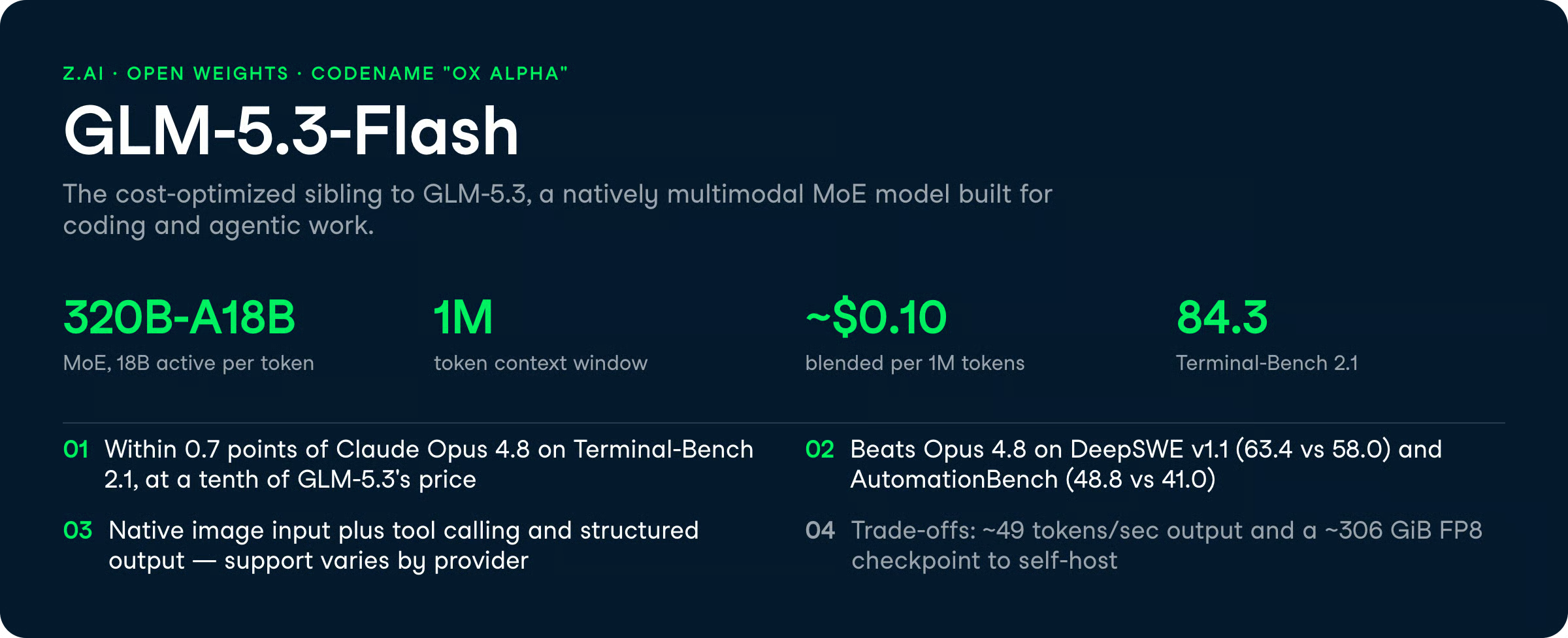
GLM-5.3-Flash, amiral gemisi fiyatlandırması olmadan ajans ve kodlama performansı isteyen geliştiriciler için tasarlandı.
İşte pratik işler için önemli yetenekler.
Kodlama ajanlarını ve otomasyon iş akışlarını, yüksek hacimli kullanımı gerçekçi kılacak bir fiyat noktasında çalıştırabilirsiniz.
GLM-5.3-Flash, Terminal-Bench 2.1'de 84,3 ve DeepSWE v1.1'de 63,4 puan alıyor; bu da GLM-5.2'nin aynı DeepSWE değerlendirmesindeki 46,2 puanına göre ciddi bir artış.
Uygulayıcılar için cazibe, Opus sınıfı modellerde pahalıya gelecek kodlama görevlerini çalıştırabilmektir.
Bazı karşılaştırmalar, Flash'ı GLM-5.3'ten önemli ölçüde daha düşük maliyetle kodlama ve otomasyon ajanları için "güçlü" olarak konumlandırıyor; GLM-5.2 üzerinde görülen DeepSWE sıçraması da bu iyileştirmelerin yalnızca belirli bir kıyaslamaya özgü olmadığını düşündürüyor.
Tüm kod tabanlarını, uzun belgeleri veya çok dosyalı ajan izlerini tek bir isteğe koyabilirsiniz.
GLM-5.3-Flash, GLM-5.3 ile aynı ve GPT-5.6 Terra ile Claude Sonnet 5'teki 1M pencereleri eşleştiren 1M tokenlık bir bağlam penceresi destekliyor.
Bununla birlikte, topluluk raporları yaklaşık 700K tokenın ötesindeki aşırı uzunluklarda dikkat kayması yaşanabildiğini belirtiyor; bu, geniş bağlam pencerelerine sahip çoğu benzerde görülen bir sınırlama.
Yüz binlerce token boyunca iyi hatırlama bildiriliyor; ancak pencerenin en ucunda kusursuz geri getirme varsaymayın.
GLM-5.3-Flash'i, fonksiyon çağrıları ve zorunlu JSON şemalarıyla ajan çerçevelerine bağlayabilirsiniz. Model, Toolathlon'da 78,4 ve AutomationBench'te 48,8 puan alıyor; ikincisi, GLM-5.2'nin 26,2 puanına göre büyük bir sıçrama.
Dikkat edilmesi gereken bir nokta: Destek sağlayıcıya göre değişiyor.
Bazı geçitler yapılandırılmış çıktıyı desteklenmiyor olarak işaretliyor ve sistem istemi işleme biçimi barındırılan sağlayıcılar arasında farklılık gösteriyor; bu nedenle, araç şemanızı ve JSON modunuzu uç noktaya göre uyarlamanız gerekebilir.
Grafik okuma, belge analizi ve görsel akıl yürütme için metnin yanında görselleri de iletebilirsiniz.
GLM-5.3-Flash, CharXiv-R'de %89,4, MMVU'da 80,5 ve Chartography'de 78,0 puan alıyor; bu da sağlam grafik ve görsel-belge işleme yeteneklerine işaret ediyor.
Çok modlu destek yerel; ancak araç çağırmada olduğu gibi, tam yüzey hangi sağlayıcıyı kullandığınıza bağlı. Salt bir Hugging Face çıktısı, barındırılan API'nin sunduğu her şeyi göstermeyebilir.
GLM-5.3-Flash, Artificial Analysis Intelligence Index v4.1.1'de görev başına 0,045 ABD doları (indirimli) maliyetle 57 puan alıyor. Z.ai, bu zeka düzeyinin daha önce yaklaşık on kat daha pahalı olduğunu söylüyor.
Aşağıdaki altı kıyas değerlendirmesi, Flash'i GLM-5.2, DeepSeek-V4-Vision-Exp, Claude Opus 4.8, GPT-5.6 Terra ve Gemini 3.7 Flash ile karşılaştırıyor.
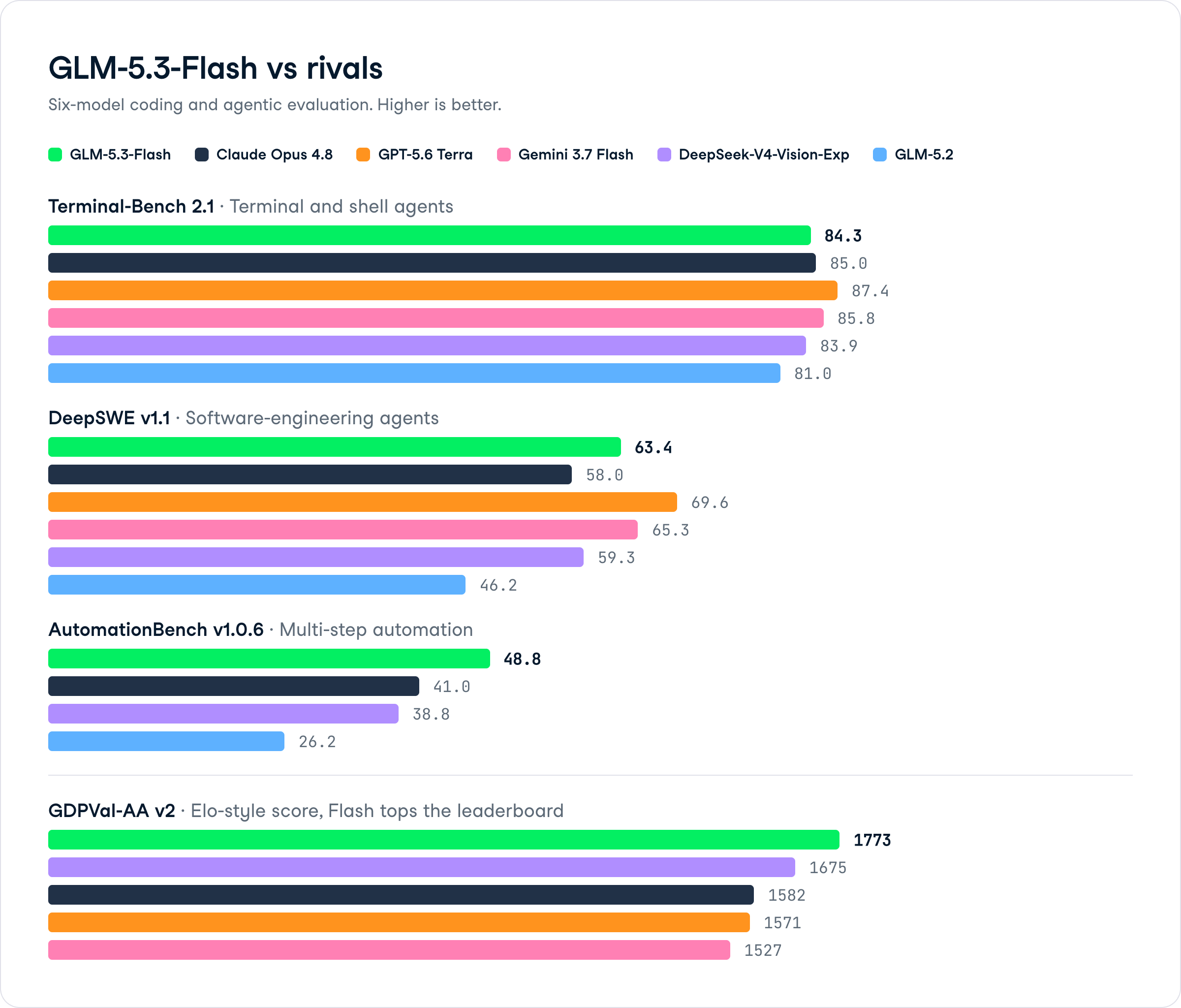
Bu yazılım mühendisliği ajan kıyaslamasında, GLM-5.3-Flash 63,4 puan alıyor; Claude Opus 4.8'in (58,0) ve DeepSeek-V4-Vision-Exp'in (59,3) önünde ve GLM-5.2'nin 46,2 puanından yukarıda.
GPT-5.6 Terra'nın (69,6) ve Gemini 3.7 Flash'ın (65,3) gerisinde kalsa da, Flash maliyetinde Claude'u geçmek burada pratik açıdan manşet.
GLM-5.3-Flash, çok adımlı otomasyon iş akışlarında 48,8 puan alıyor; bu, setteki tüm kıyaslamalar arasında Claude Opus 4.8 (41,0) ve DeepSeek-V4-Vision-Exp (38,8) karşısındaki en büyük üstünlüğü.
GLM-5.2, 26,2 puan almıştı; bu da nesilden nesile en keskin iyileşme anlamına geliyor.
Genel geliştirme ve programlama değerlendirmesinde, Flash 1773 puanla lider; DeepSeek-V4-Vision-Exp (1675), Claude Opus 4.8 (1582), GPT-5.6 Terra (1571) ve Gemini 3.7 Flash'ın (1527) önünde.
Flash, terminal ve kabuk ajan görevlerinde 84,3 puan alıyor; Claude Opus 4.8'in (85,0) ve Gemini 3.7 Flash'ın (85,8) hemen altında ve GPT-5.6 Terra'nın (87,4) gerisinde. GLM-5.2'yi (81,0) ve DeepSeek-V4-Vision-Exp'i (83,9) geride bırakıyor. Rekabetçi, ama baskın değil.
GLM-5.3-Flash, Z.ai'nin API'si ve Baseten, Deep Infra, Venice AI ve Requesty dâhil olmak üzere birçok üçüncü taraf geçidi aracılığıyla kullanılabilir.
Genel kontrol noktası, kendi kendine barındırma için Hugging Face'te zai-org/GLM-5.3-Flash olarak bulunuyor.
Z.ai'nin resmi temel liste fiyatlandırması ve sınırlı süreli promosyonu aşağıdaki gibidir:
Apidog, Flash için kullanım ağırlıklı harmanlanmış fiyatı 1M token başına yaklaşık 0,10 ABD doları, GLM-5.3 için ise yaklaşık 0,90 ABD doları olarak bildiriyor.
Üçüncü taraf geçitlerde fiyatlandırma farklı: EmpirioLabs girdi 0,07 ABD doları / çıktı 0,25 ABD doları, Venice AI 0,09 / 0,31 ABD doları ve Requesty 0,14 / 0,45 ABD doları; 9 Eyl 2026'ya kadar %55 indirimli bir promosyon notu var.
Püf noktası ise aktarım hızı ve donanım.
Flash ~49 token/sn hızında hizmet verirken GLM-5.3 ~86 token/sn; Artificial Analysis, hızı 2/4 olarak derecelendiriyor.
Kendi kendine barındırma da hafif değil: FP8 kontrol noktası yalnızca ağırlıklarda ~306 GiB; KV önbelleği ve çalışma zamanı hariç. Bu nedenle tek bir kart yerine birden fazla yüksek bellekli GPU'ya (>&4×80 GiB sınıfını düşünün) ihtiyaç duyarsınız.
İki model arasındaki seçim, maliyet ile zeka endeksi ve aktarım hızı arasındaki dengeye bağlı. Aşağıdaki tablo bu ödünü özetliyor.
| Özellik | GLM-5.3-Flash | GLM-5.3 |
|---|---|---|
| Zeka endeksi (Artificial Analysis) | 57 | 60 |
| Harmanlanmış fiyat / 1M token | ~$0,10 | ~$0,90 |
| Çıkış hızı | ~49 token/sn | ~86 token/sn |
| İlk token süresi | ~1,52 sn | ~1,57 sn |
| Terminal-Bench 2.1 | 84,3 | Notlarda yok |
| Bağlam penceresi | 1M | 1M |
Maliyet/token kısıtınız varsa ve işleriniz kodlama ya da ajans ağırlıklıysa Flash'ı seçin. Ek 3 puanlık zeka endeksi ve yaklaşık iki kat aktarım hızına ihtiyaç duyuyorsanız GLM-5.3'ü seçin.
Her iki model de 26 Ağustos 2026'da piyasaya çıktı ve aynı bütçe-ajans segmentini hedefliyor. GLM-5.3-Flash, doğrudan paylaştıkları tek kıyaslamada Qwen3.8-Flash-Next'i az farkla geçiyor (DeepSWE v1.1: 63,4'e karşı 58,7); ancak iki model yeterince farklı inşa edildiğinden seçim, tek bir skordan çok iş yükünüze bağlı.
| GLM-5.3-Flash | Qwen3.8-Flash-Next | |
|---|---|---|
| Mimari | Toplam 320B / aktif 18B | Toplam 125B / aktif 6B |
| Yerel bağlam | 1M token | 262K (YaRN ile 1M) |
| DeepSWE v1.1 | 63,4 | 58,7 |
| Girdi fiyatı | ~$0,075/1M (promo) | $0,16/1M |
| Çok modlu | Evet (yerel) | Evet (yerel) |
GLM-5.3-Flash, token başına üç kat daha fazla parametreyi etkinleştiriyor; bu da muhtemelen DeepSWE üstünlüğünü ve Terminal-Bench 2.1 sonucunu (84,3) açıklıyor.
Qwen3.8-Flash-Next ise SWE-bench Pro'da (62,5) ve CoWorkBench (73,9) ile JobBench (55,7) gibi ofis ve ajan kıyaslarında daha güçlü bildirilen skorlarla karşılık veriyor; GLM bu alanlarda karşılaştırılabilir rakamlar yayımlamıyor.
Fiyat açısından, promosyon döneminde GLM daha ucuz. Parametre verimliliğinde, Qwen daha küçük bir aktif ayak iziyle daha fazlasını yapıyor. Kendi kendine barındırmada, Qwen'in daha küçük kontrol noktası yerelde çalıştırmayı belirgin şekilde kolaylaştırıyor.
Önceliğiniz kodlama ajanları ve ham ajans aktarımıysa, doğrudan karşılaştırmanın mümkün olduğu alanlarda GLM-5.3-Flash daha güçlü rakamlara sahip. İş akışlarınız ofis ağırlıklı, çok modlu veya daha küçük bir yerel kontrol noktasından fayda görüyorsa, önce Qwen3.8-Flash-Next'i test etmeye değer.
Tam bir döküm için Qwen3.8-Flash-Next'e dair kapsamlı rehberimize bakın.
GLM-5.3-Flash, Z.ai'nin bütçe-ajans segmentine net bir bahis: kodlama değerlendirmelerinde Opus 4.8 ve GPT-5.6 Terra'ya bir iki puan yaklaş, ardından fiyatı bir büyüklük mertebesi düşür.
Terminal-Bench 2.1'deki 84,3 ve 1M token başına yaklaşık 0,10 ABD doları harmanlanmış maliyet sunumu güçlü; yüksek hacimli kodlama ve otomasyon için ikna edici.
Sınırlamalar hız ve altyapıyla geliyor.
~49 token/sn hız, gecikmeye duyarlı akış için bu modeli uygun kılmıyor ve ~306 GiB'lık FP8 kontrol noktası rahat yerel dağıtımı dışlıyor. r/opencodeCLI'deki erken önizleme kullanıcıları, yük altında kuyruk süreleri ve yavaş başlangıçlar bildirdi; GA ile bunun iyileşmiş olması muhtemel.
Bana göre, maliyet/token bağlayıcı kısıtınızsa ve işleriniz kodlama ya da ajans ağırlıklıysa, GLM-5.3-Flash'ı taahhüt etmeden önce GPT-5.6 Terra ve Claude Opus 4.8 ile karşılaştırmalı olarak test etmeye değer.
Ek 3 puanlık zeka endeksi ve daha hızlı aktarım hızı gerekiyorsa, tam GLM-5.3 bunun için var. Ayrıca Qwen3.8-Flash-Next ile aynı gün çıktı; şu anda bütçe segmentinde seçeneklere bakmakta fayda var.
Bu tür modellerle çalışmaya alışmak isterseniz, temel altyapıyı oluşturmak için AI Fundamentals beceri yolumuzu ve uygulamalı taraf için de yerelde bir MoE Flash modeli çalıştırma eğitimimizi öneririm.
En İyi DataCamp Kursları
Kurs
Kurs
Kurs
blog
Abid Ali Awan
14 dk.
blog
Dario Radečić
15 dk.
Eğitim
Adel Nehme
Eğitim
Kurtis Pykes
8 dk.