Course
Introduction to Claude Models
3 hr
14.1K
Claude Opus 5 is Anthropic's newest model in the Opus tier, released on July 24, 2026, and priced identically to its predecessor Opus 4.8.
Anthropic describes it as a thoughtful and proactive model built for daily use, and it's now the default model on Claude Max and the strongest model on Claude Pro. Its signature trait is agentic persistence: it verifies its own work and iterates until a task actually succeeds rather than stopping at a plausible-looking answer.
To see how it behaves in practice, check out our Claude Opus 5 API tutorial, where we build and benchmark a bug-fixing coding agent across all five reasoning-effort levels. You might also want our guide to Claude Code templates if you plan to run Opus 5 inside an agentic workflow.
Claude Fable 5 is a Mythos-class model that Anthropic made safe for general use, released on June 9, 2026, at $10 per million input tokens and $50 per million output tokens. It was briefly pulled on June 12, 2026, to comply with a U.S. export-control order, and Anthropic restored access on July 1, 2026, once the order was lifted.
Anthropic positions it above the Opus tier in raw capability, and at launch, it was state-of-the-art on nearly all tested benchmarks, with its lead growing the longer and more complex the task. Its distinctive feature is a set of classifiers that route flagged cybersecurity, biology, and distillation requests to Opus 4.8 instead of answering directly.
Here's the summary before I dig into each dimension. The short version: Opus 5 and Fable 5 land within noise of each other on most benchmarks, but Opus 5 does it at half the price.
| Feature | Claude Opus 5 | Claude Fable 5 |
|---|---|---|
| Release date | July 24, 2026 | June 9, 2026 |
| Input price (per 1M tokens) | $5 | $10 |
| Output price (per 1M tokens) | $25 | $50 |
| SWE-bench Verified | 96.0% * | 95.0% |
| SWE-bench Pro | 79.2% | 80.3% * |
| Frontier-Bench v0.1 | 43.3% * | 33.7% |
| ARC-AGI 3 | 30.2% * | not published |
| GDPval-AA v2 (Elo) | 1,861 * | 1,747 |
| Safeguard posture | Lighter cyber classifiers | Broad cyber/bio/distillation classifiers |
| Availability | All platforms and tiers | All platforms, phased consumer rollout |
* current overall leader on this benchmark
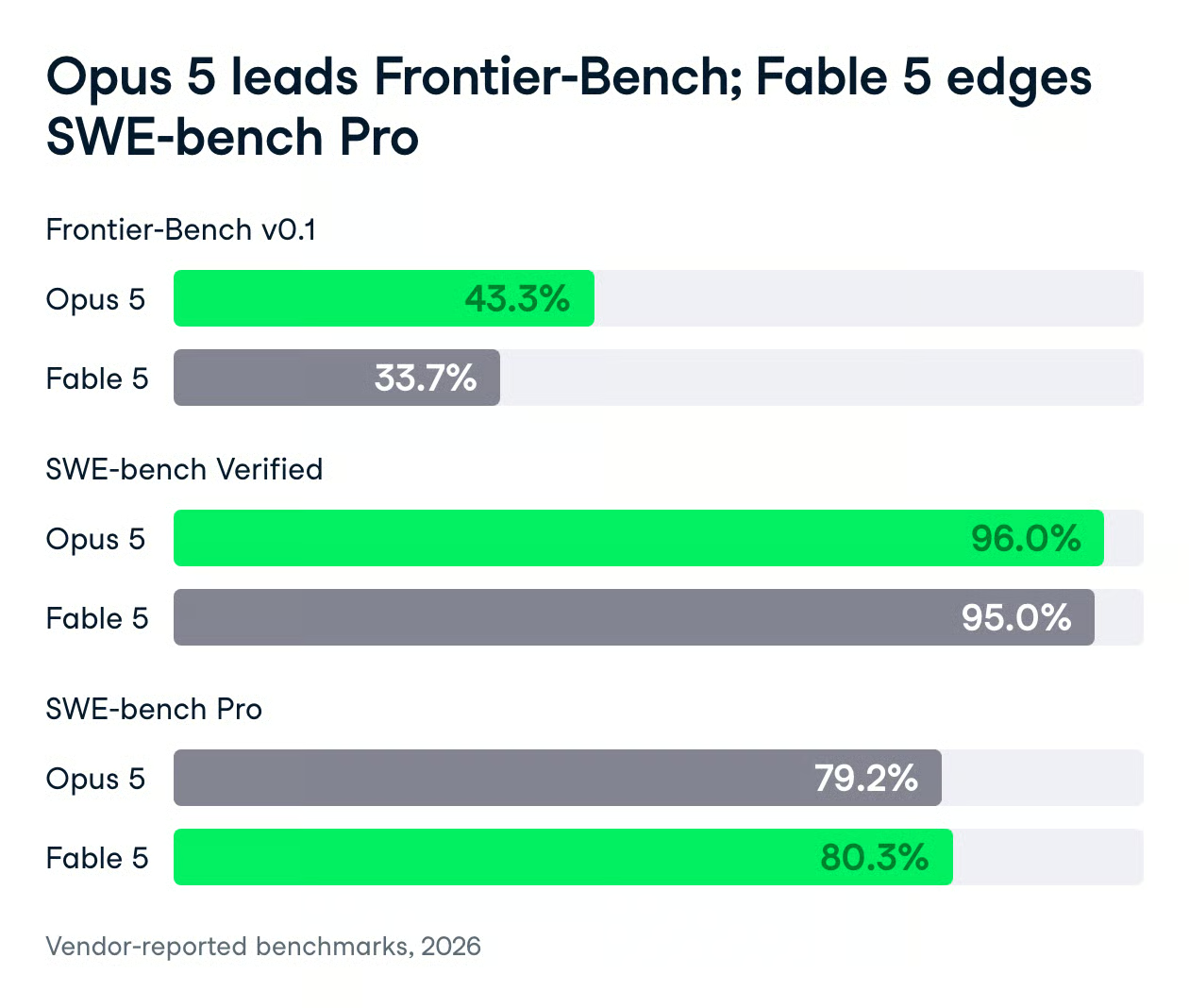
Coding is where most people will actually deploy these models, and it's also where the pricing gap looks least justified. On SWE-bench Verified, Opus 5 scores 96.0% against Fable 5's 95.0%, a lead of one point for the cheaper model. On Frontier-Bench v0.1, the terminal-coding eval, Opus 5 pulls further ahead at 43.3% versus 33.7%.
Fable 5 does claw back a narrow win on SWE-bench Pro, scoring 80.3% to Opus 5's 79.2%. That's a one-point gap in the other direction, which tells you these two models are effectively tied on repository-level engineering. Cognition's team reported that Opus 5 approaches Fable-level performance at half the cost on their FrontierCode 1.1 eval, which matches what the public numbers show.
| Benchmark | Opus 5 | Fable 5 | Notes |
|---|---|---|---|
| SWE-bench Verified | 96.0% | 95.0% | Vendor-reported |
| SWE-bench Pro | 79.2% | 80.3% | Fable 5's only coding win here |
| Frontier-Bench v0.1 | 43.3% | 33.7% | Terminal coding; Opus 5 +9.6pp |
| Terminal-Bench 2.1 | Not published | 88.0% | Opus 5 score not published |
The takeaway is that Opus 5 either matches or beats Fable 5 on the coding benchmarks, where both published numbers, with the single exception of SWE-bench Pro. Anthropic's own framing is that Opus 5 more than doubled Opus 4.8's Frontier-Bench score at a lower cost per task, and it beats Fable 5 there too. For coding, the pricier model gives you nothing extra.
Both models are built for long-horizon agentic work, so this dimension matters if you're running autonomous pipelines rather than one-shot prompts. Here, Opus 5's proactive verification behavior is the differentiator that benchmarks capture partly.
On ARC-AGI 3, an eval where the model has to solve novel problems, Opus 5 jumps from Opus 4.8's 1.5% to 30.2%, which is almost four times as high as the next-best model (GPT-5.6 Sol at 7.8%). Sadly, Anthropic did not publish any score for Fable 5, so we cannot compare the two models directly.
On OSWorld 2.0, the computer-use benchmark, Opus 5 (70.6%) replaces Fable 5 (66.1%) as the overall leading model, and on Zapier's AutomationBench, it hit a 100% pass rate on a churn-prevention sequence that previous models couldn't complete at all.
Opus 5 wins agentic tasks on a per-dollar basis by a wide margin.
Knowledge work is Fable 5's marketing home turf, so I expected it to lead here, but it doesn't. On GDPval-AA v2, the knowledge-work Elo benchmark, Opus 5 scores 1,861 against Fable 5's 1,747. That's a 114-point Elo gap in favor of the cheaper model.
Fable 5 still holds a genuine edge on the very hardest, longest scientific reasoning, and Anthropic is explicit that Mythos-class capability remains stronger for long-running autonomous biology research. But for the analytical and knowledge tasks most teams run, Opus 5's higher GDPval-AA score means you're paying double for Fable 5 to do worse.
This is the dimension where the two models genuinely diverge, and it's the real reason Fable 5 exists as a separate product. It is also the dimension most likely to be read wrong, because two different things get called "safety" here, and they measure opposite ends of the problem.
The first is misuse resistance: an external classifier system that sits in front of the model and reroutes dangerous requests before they reach it. The second is alignment: how the model itself behaves, including whether it deceives, takes reckless, irreversible actions, or can be talked into misuse.
A model can score well on one and still need heavy support on the other, because the classifiers are not guarding against the model going rogue. They guard against a user pulling something harmful out of it.
Fable 5 is a Mythos-class model with the heavier classifier system of the two. Its classifiers cover three areas, and when they fire, the request falls back to Opus 4.8:
Anthropic tuned these conservatively: early data shows more than 95% of Fable 5 sessions trigger no fallback at all.
Opus 5 carries a lighter version of the same system. Its cyber classifiers allow source-code vulnerability finding but block binary-based scanning, penetration testing, and exploit generation, and Anthropic expects them to fire around 85% less often than Fable 5's.
On its automated behavioral audit, Opus 5 scored 2.3 on misaligned behavior, which Anthropic calls its most aligned model to date, ahead of Opus 4.8, Sonnet 5, and Fable 5.
So this is a fork, not a scoreboard. For general coding, knowledge work, and computer use, Opus 5 is a well-aligned model that gets in the way less. For the frontier of a guarded domain, such as offensive security research or long-horizon biology, Fable 5 (or Mythos 5 through the Cyber Verification Program) is the more capable tool, and the heavier refusal behavior is the price of reaching it.
Fable 5 costs exactly twice as much as Opus 5 on both input and output. Opus 5's Fast mode, which runs at roughly 2.5x default speed, costs $10 input and $50 output, which lands it at exactly Fable 5's standard rate.
| Rate | Opus 5 | Fable 5 |
|---|---|---|
| Input, per 1M tokens | $5.00 | $10.00 |
| Output, per 1M tokens | $25.00 | $50.00 |
| Fast mode input, per 1M tokens | $10.00 | Not applicable |
| Fast mode output, per 1M tokens | $50.00 | Not applicable |
Both models share Anthropic's newer tokenizer that arrived with the Opus 4.7 generation, so identical text costs the same number of input tokens on each, and neither vendor has published a controlled token-count comparison between the two for the same task.
| Monthly volume | Opus 5 | Fable 5 | Difference |
|---|---|---|---|
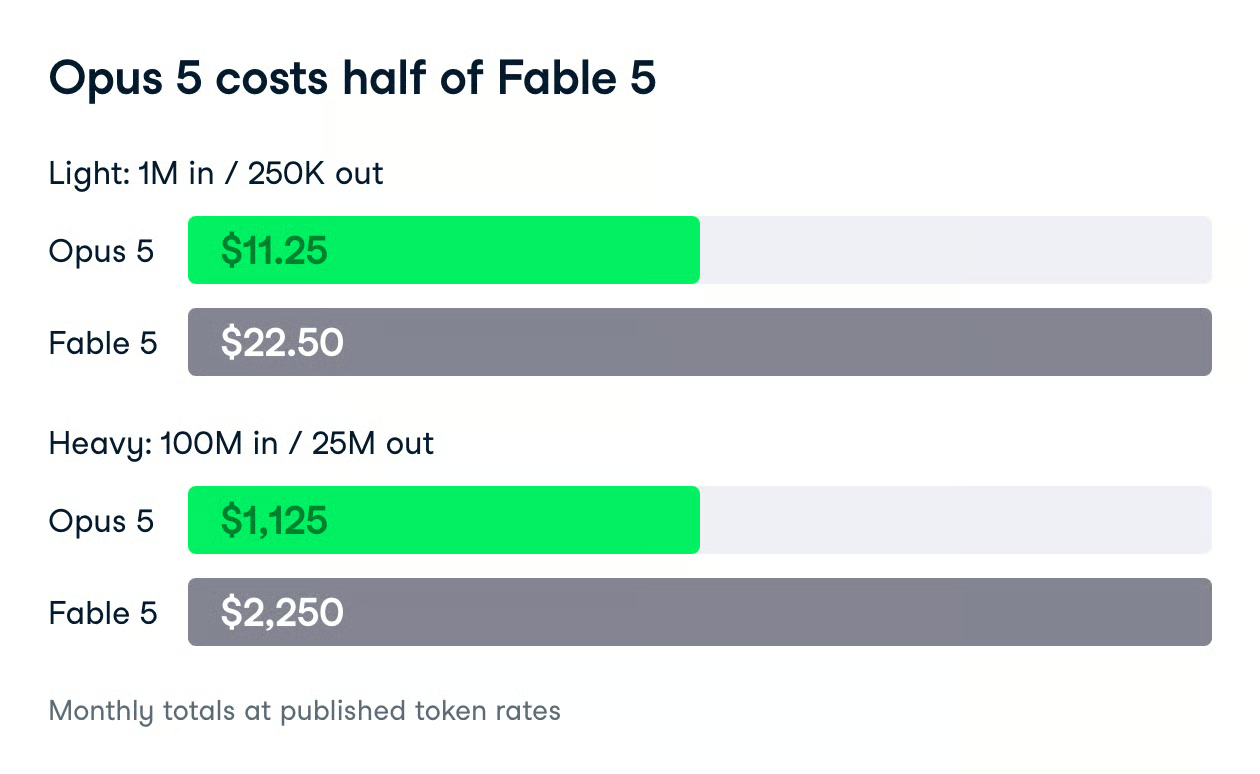
| Light: 1M in / 250K out | $11.25 | $22.50 | Opus 5 saves $11.25 (50%) |
| Heavy: 100M in / 25M out | $1,125 | $2,250 | Opus 5 saves $1,125 (50%) |
At the heavy level, that's a $1,125 monthly difference for a production feature or a continuously running agent, and the benchmarks say you're giving up nothing on coding or knowledge work to capture it.
That said, treat these totals as a rate comparison rather than a precise forecast. Opus 5 can cost more than Opus 4.8 in practice because it tends to emit more thinking tokens, but it doesn't change the general picture that Opus 5 will be the significantly cheaper model of the two in most cases.
 When to Choose Claude Opus 5 vs Claude Fable 5
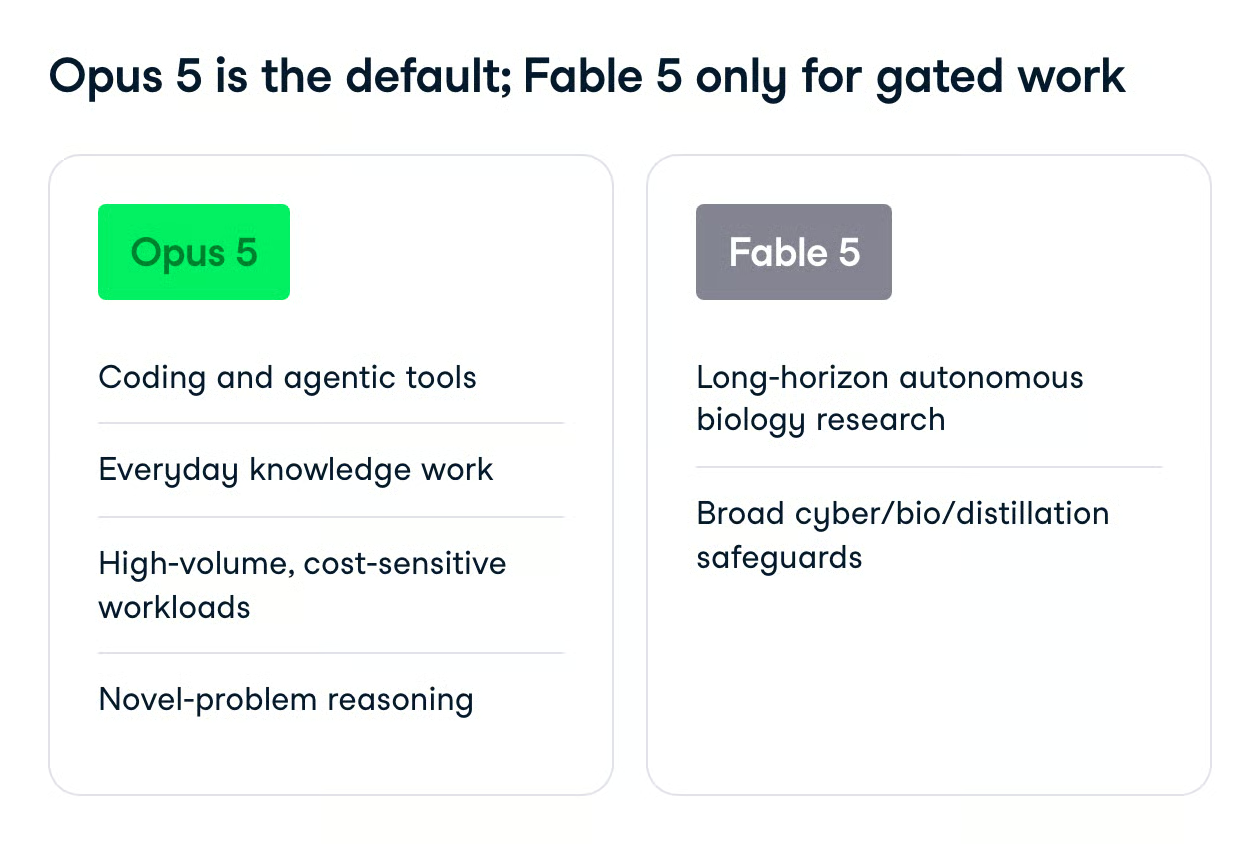
For most readers this is a short decision: Opus 5 is the default, and Fable 5 is the exception. The table below covers the scenarios where that flips.
| Use Case | Recommended | Why |
|---|---|---|
| Repository-level coding agents | Opus 5 | Matches or beats Fable 5 on SWE-bench and leads Frontier-Bench at half the cost. |
| Everyday knowledge work and analysis | Opus 5 | Higher GDPval-AA v2 Elo (1,861 vs 1,747) for half the price. |
| High-volume production workloads | Opus 5 | The 50% saving compounds to over $1,000/month at the heavy tier. |
| Novel-problem and abstract reasoning | Opus 5 | ARC-AGI 3 score of 30.2%, three times the next-best model. |
| Long-running autonomous biology research | Fable 5 | Mythos-class capability remains stronger for this specific work. |
| Workflows needing broad safeguard coverage | Fable 5 | Its classifiers cover cyber, biology, and distillation more broadly. |
Choose Opus 5 if...
Both models are broadly available across the Claude apps, the API, the major cloud platforms, and Anthropic's coding agents. The practical differences are narrow and mostly show up at the consumer plan level.
| Surface | Opus 5 | Fable 5 |
|---|---|---|
| Consumer app | Claude apps (included on Pro, Max, Team, Enterprise; default on Max, strongest on Pro) | Claude apps (Max & Team Premium: included, 50% weekly cap; Pro & Team Standard: usage credits only) |
| First-party API | Anthropic API | Anthropic API |
| Cloud platforms | Amazon Bedrock, Vertex AI, Microsoft Foundry | Amazon Bedrock, Vertex AI, Microsoft Foundry |
| Coding agents | Claude Code, Claude Cowork | Claude Code, Claude Cowork |
| API model ID | claude-opus-5 |
claude-fable-5 |
On the API, both are a single string swap, using claude-opus-5 and claude-fable-5, respectively.
The clearest gap: on Pro and Team Standard, Fable 5 isn't included at all. It runs on pay-as-you-go usage credits at API rates, while Opus 5 is included on those plans.
Both models are selectable in Claude Code, and switching between them is a matter of changing the model string in your request or agent config. Because they share the same SDK, moving a working agent from one to the other is a one-line change.
from anthropic import Anthropic

client = Anthropic()
response = client.messages.create(
    model="claude-opus-5",  # swap for "claude-fable-5"
    max_tokens=1024,
    messages=[{"role": "user", "content": "Refactor this function..."}],
)
print(response.content.text)
One implementation detail from our hands-on testing: Opus 5 returns thinking blocks by default, so accessing response.content.text directly can raise an AttributeError when the first block is a thinking block. We cover the full setup, effort-level tuning, and prompt-caching behavior in our Claude Opus 5 API tutorial.
I recommend using Opus 5 unless you have a specific reason not to. It matches or beats Fable 5 on coding, wins the knowledge-work Elo benchmark, triples the field on novel reasoning, and does all of it for half the price while posting Anthropic's best alignment score.
Fable 5 clearly is not a bad model. It's just not made for most of what teams actually do. It carries heavier safeguards and holds a real edge on the frontier of long-running autonomous work like biology research, but outside that narrow slice, paying double for Fable 5 means paying double to score slightly lower on the benchmarks that matter for coding and analysis.
What I find most interesting is that this comparison inverts the usual model-tier logic. Normally, the newer, cheaper model trades some capability for accessibility. Here, Anthropic shipped a cheaper model that is also the more capable choice for nearly every mainstream task, which suggests Fable 5's price is buying you its safeguard posture and Mythos lineage more than raw performance.
Learn AI with DataCamp!
Course
Course
Track
blog
Josef Waples
5 min
blog
Tom Farnschläder
11 min
blog
Tom Farnschläder
11 min
blog
Josef Waples
7 min
blog
Tom Farnschläder
14 min
Tutorial
Bex Tuychiev
14 min