Course
Introduction to AI for Work
2 hr
119.7K
It depends entirely on how deep you go:
Most beginners make two opposite errors: they overestimate entry-level difficulty, assuming "AI" means deep neural-network math, and underestimate senior-level difficulty.
In 2026, the majority of AI work is API integration and prompt engineering, and consistency matters more than raw intelligence. Steady weekly practice beats occasional bursts.
Reaching beginner-level AI skills takes about 30 hours, and advanced proficiency about 137 hours, according to the World Economic Forum. For a job-ready engineering or ML role, expect 6 to 12 months of focused study. Senior expertise takes years.
The answer differs sharply by path, and the DataCamp track durations give concrete anchors:
Those hours build the foundation. The months that follow, where you build projects and a portfolio, are what turn that foundation into a hireable skill set.
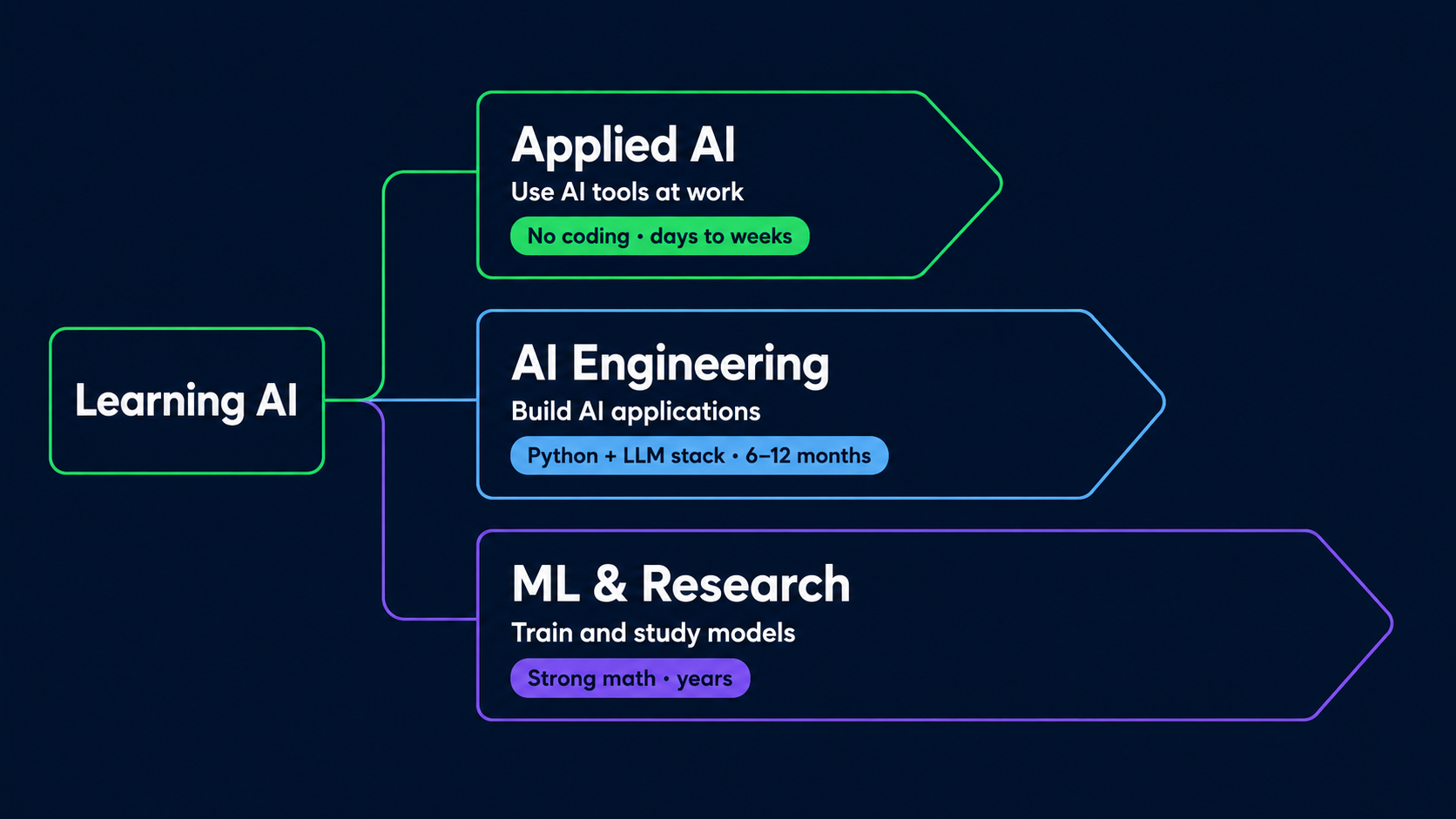
Most workplace AI value comes from using tools well, not building them. Here's what that looks like for non-technical professionals.
Workplace AI value comes from using tools, not building them. With ChatGPT, Claude, Gemini, and Microsoft Copilot, you can draft and edit writing, summarize long documents, synthesize research, and automate routine tasks. No coding required, the skill is knowing what to hand off and how to direct it.
The highest-value beginner skill is workflow integration: spotting which parts of your week are repetitive enough to delegate, then giving clear instructions. Strong use cases include:
Because you're using AI rather than building it, the learning curve is days, not months. DataCamp's Introduction to AI for Work course is built for non-technical professionals applying AI to their day-to-day roles.
Good prompting is specific: give the model context and a role, state the format you want, then iterate. A vague request gets a vague answer; a prompt that says who the model is, what you need, and how to present it gets a usable one. These fundamentals transfer across ChatGPT, Claude, and Gemini.
A reliable structure has four parts:
The most common beginner mistakes are asking for too much at once, omitting examples, and accepting the first output instead of refining it. Differences between the major engines are marginal for everyday work.
The ChatGPT Fundamentals track on DataCamp teaches structured prompting to help you get the most out of each prompt.
Yes, for foundational literacy and tool use. Free tiers of ChatGPT and Claude, official documentation, and introductory courses cover the basics well enough to make you AI-literate. Where free options fall short is structured, job-oriented progression and hands-on practice with real feedback.
Free learning works well for understanding concepts, experimenting with prompting, and getting comfortable with the major tools. The gaps appear when you want:
An honest approach is to start free to confirm the field interests you, then invest once you've chosen a direction. DataCamp's AI Fundamentals track is a good place to test the waters first.
What you need to start learning AI is less than most people assume: for applied paths, the right tools and curiosity; for engineering and ML, Python and some math. A computer science degree isn't a prerequisite. Here's the detail.
No math is needed for applied AI. Linear algebra, calculus, and probability matter for ML engineering, and deep math is essential only for research. The level you need scales with how far down the stack you go, and prompt engineering and AI-for-business roles require none of it.
Modern frameworks like PyTorch and TensorFlow abstract the underlying linear algebra even when it's running underneath.
The math genuinely matters when you move into machine learning engineering, where gradient descent, matrix operations, and probability distributions show up directly, and it becomes unavoidable in research.
The belief that "you need to be good at math for AI" is largely a holdover from the pre-LLM era, when AI effectively meant ML. If your path does require it, the Statistics Fundamentals skill track and Machine Learning Scientist in Python career track, both on DataCamp, cover what you need.
Python, in almost every case. R stays viable for ML research and statistics, and C++ and Rust show up in performance-critical infrastructure, but for beginners and most applied work, the answer is Python. Pin's 2026 hiring data found Python in 92% of AI/ML job postings.
The ecosystem settles it: PyTorch, TensorFlow, scikit-learn, LangChain, and Hugging Face are all Python-first. R still holds ground in academic and statistical settings.
Framework fluency matters more than language choice, so knowing how to build with the Python AI stack is a transferable skill. Start with DataCamp's Python Data Fundamentals or Associate Python Developer, depending on the level of depth you're aiming for.
It depends on the role. For applied AI and most AI engineering jobs, a strong portfolio outweighs a degree. For research positions, frontier labs, and visa-sponsored roles, a bachelor's, often a master's or PhD, is still typically expected. The market has shifted hard toward skills-based hiring.
In their latest job barometer, PwC found that employer demand for formal degrees is falling, and fastest in AI-exposed jobs. Portfolios, bootcamps, and certifications are now accepted credentialing paths for applied roles, where what you can build matters more than where you studied.
The exceptions, where a degree often remains a practical requirement, are specific:
The real question is which role you're targeting. On DataCamp, the AI Fundamentals and Associate AI Engineer for Developers tracks each end in a certification you can put on your résumé, mapped to applied AI and AI engineering roles, respectively.
AI skills open a wide range of roles across nearly every industry, and they pay a premium. Here's the jobs-and-money picture, and whether it's still worth starting.
AI skills open a list of different roles:
In the US, most companies pay AI/ML roles in a $170K to $245K total-compensation band, and AI skills carry a 62% wage premium over comparable non-AI roles, according to PwC's 2026 Global AI Jobs Barometer.
The market splits into builders, who create models and systems, and implementers, who integrate AI into products and workflows. The US Bureau of Labor Statistics projects 20% growth for computer and information research scientists from 2024 to 2034, much faster than average.
On pay, Glassdoor put the AI/ML engineer average at $131K to $205K in 2026, while frontier-lab compensation reaches far higher. DataCamp's Associate AI Engineer for Developers and Machine Learning Scientist in Python tracks map to these roles.
Yes, 2026 is an actively good time to start. AI replaces tasks, not whole careers, and the people who can direct, evaluate, and build with AI are the ones earning the premium. The "too late" worry and the "AI can code itself" worry are two versions of the same misread.
PwC's 2026 Global AI Jobs Barometer found the AI wage premium climbing to 62%, up from 25% in 2024, so the value of these skills is rising. Demand still outpaces supply: Pin's 2026 data shows roughly 3.4 open AI roles per qualified candidate, with postings growing faster than the talent pool.
Mechanical code-writing is becoming cheap, but companies still struggle to find people who can ship reliable AI systems and exercise judgment about them.
Mid-career professionals bring an edge here, with domain expertise that new graduates lack. The AI for Software Engineering track on DataCamp is built for this kind of transition.
Build and deploy 3 to 5 real AI projects on GitHub, contribute to open source, and target adjacent roles instead of waiting for a perfect entry-level AI posting. The side door is wider than the front door, since most people move into AI from a neighboring title.
Pin's 2026 survey found that 71% of AI/ML roles are filled by engineers whose current title isn't "AI" or "ML", such as backend engineers, infrastructure engineers, and data analysts who built the skills and moved across.
Recruiters increasingly look for demonstrated ability, such as GitHub contributions and RAG implementations, rather than job titles. Portfolio projects that signal real competence include RAG applications, fine-tuned models, and working agents, and Kaggle competitions add credibility.
Top-voted first-job threads on r/learnmachinelearning are worth reading for current, grounded advice.
AI engineering sits at the advanced application layer: learn Python, then climb to LLM APIs, applications, and deployment. These four questions cover the path and the most common transitions into it.
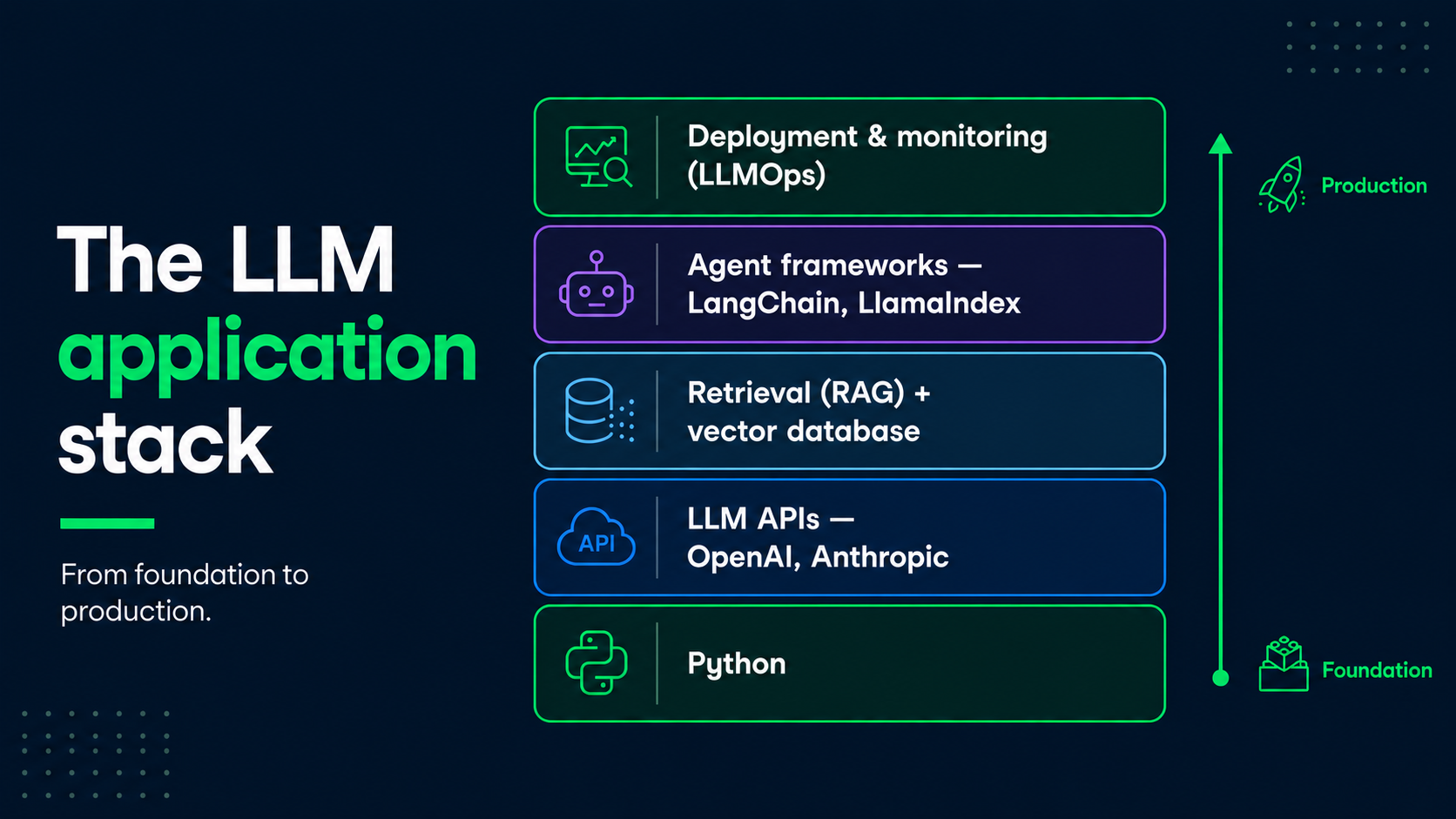
Learn Python, then climb the stack: working with LLM APIs, building applications with retrieval and agents, and deploying to production.
In 2026, most AI engineering is integrating pretrained models from OpenAI, Anthropic, and the open-source ecosystem, not training models from scratch. The role is closer to software engineering than to research.
A typical progression looks like this:
Training foundation models is a specialized research activity that very few AI engineers ever do, so don't let it intimidate you out of the field. DataCamp's Associate AI Engineer for Developers track follows this exact arc.
Both are short, well-defined jumps in 2026. Software engineers already have the hardest part, production engineering, and mainly need LLM and ML fundamentals. Data scientists know the modeling and mainly need deployment skills and software practices. These are the two most common routes into the role.
A software developer who knows Python but has no ML or LLM experience needs to learn how foundation models work, how to build with APIs, and how retrieval and agents fit together. That's modeling intuition, not years of theory.
A data scientist needs the reverse: software rigor, deployment, and the production practices grouped under MLOps.
Both routes are faster than starting cold because the foundation already exists. DataCamp serves both paths: The Associate AI Engineer for Developers track suits the software-engineering route, while our Associate AI Engineer for Data Scientists track is built for the data-science route.
You need Python plus the modern LLM application stack: API access (OpenAI, Anthropic), an orchestration framework like LangChain or LlamaIndex, retrieval with a vector database (RAG), agent frameworks, and basic deployment and monitoring, often called LLMOps.
Framework fluency matters more than picking the one "right" framework. In practice, the stack breaks down into a learnable sequence:
Fine-tuning is a narrower, later skill than most beginners assume; you reach for it only when prompting and retrieval aren't enough. DataCamp's Developing Applications with LangChain track covers the core of this stack using one of the most popular frameworks.
Build and deploy 3 to 5 real LLM applications, put them in a public portfolio, and plan on 6 to 12 months of focused study. Shipped, deployed projects outweigh certificates, because hiring managers look for proof you can take a model from prototype to production.
Job-ready for an AI engineer means deployed applications, not notebooks that only run on your laptop.
The portfolio projects that signal real ability are a working RAG application, an agent that completes a multi-step task, and at least one project involving fine-tuning or careful evaluation.
Pin's 2026 hiring data rewards production-grade work over credentials, which is why deployment is the line between "took a course" and "can do the job." Anchor your timeline to a structured curriculum: DataCamp's Associate AI Engineer for Developers track builds toward deployable, portfolio-ready projects.
The takeaway I'd want a beginner to leave with is this: most "should I learn AI" questions are really "which AI path fits me" questions. Once you know whether you want to use AI, build with it, or engineer the models, the answers to how long, how hard, and what you need fall into place.
So pick one next step and start. For applied and at-work AI, the AI Business Fundamentals track is the place to begin. For engineering, start with the Associate AI Engineer for Developers track. For ML and research, the Machine Learning Scientist in Python track. The 30 hours to beginner level start the moment you do.
Learn AI with DataCamp!
Course
Track
Track
blog
Adel Nehme
15 min
blog
Nahla Davies
15 min
blog
Adel Nehme
15 min
blog
Matt Crabtree
8 min
blog
Natassha Selvaraj
14 min
blog
Matt Crabtree