
Free access is closing! 700+ free courses are waiting.
Ends in:
Start Now

Practice and track your progress.
Continue with GoogleBy continuing, you accept our Terms of Use, our Privacy Policy and that your data is stored in the USA.The fact to remember from this release is audio: Genie 4 is DeepMind's first real-time world model to generate sound natively, including interactive dialogue that reacts to what you do. That matters more than it sounds, because a silent simulation is a visualization, while one with ambient sound and speaking characters is closer to a training environment for agents and robots.
DeepMind groups the release around four capabilities, with a fifth emerging from its robotics work. Here is what each one lets you actually do.
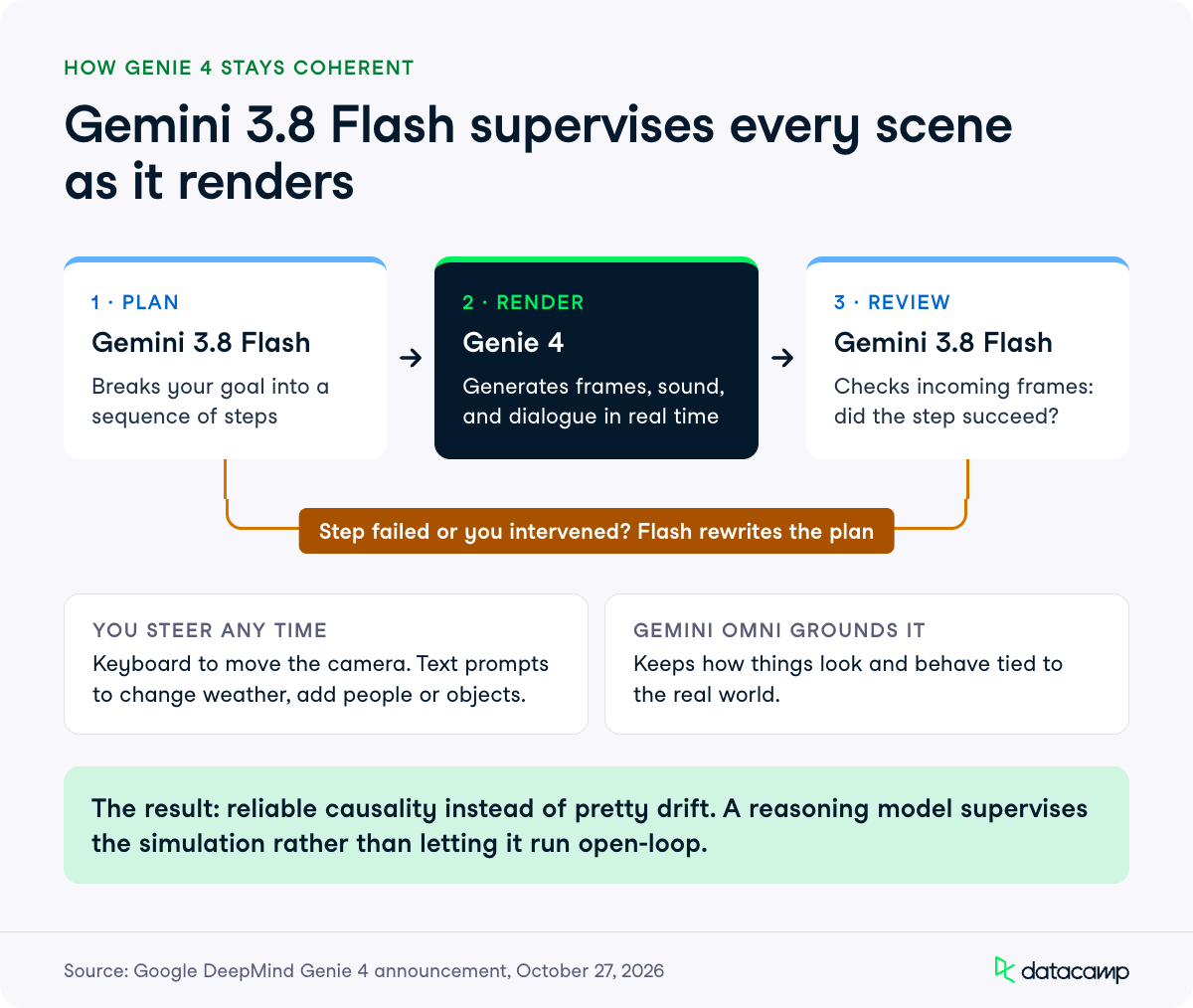
You change a live simulation by typing: switch the weather, move the camera, add a person or an object. Gemini adapts your prompt to fit what is already on screen, so the new element arrives in the style and geometry of the existing scene instead of being pasted on top of it.
Between your inputs, Gemini keeps watching and steering so the world carries on progressing on its own. That combination, keyboard navigation plus natural-language edits, is what separates Genie 4 from a text-to-video model where the only control you have is the prompt you started with.
Genie 4 simulates aerodynamics, collisions, and similar physical behavior, built on what DeepMind calls an advanced physical understanding of the world. The demo prompts push at this deliberately, from a glossy watermelon on a stone plinth with airborne droplets in slow motion to a macro shot of a maple seed falling into grass.
DeepMind's own framing is that the most dramatic leap is people. Characters move naturally, respond to their surroundings, and can be steered interactively while the scene plays, which is the part that previous world models handled worst.
Every Genie 4 world carries the ambient sound of its own setting, from wind in trees to waves at a beach, plus music where the scene calls for it. The demo prompts specify audio as tightly as visuals, down to "no background music beyond the instruments physically present in the scene".
Speech is the harder claim. Characters converse and react to your inputs and to events in the world as they happen, which is the piece that makes this usable for dialogue previz or agent training. Treat the demo audio as a ceiling rather than a floor: DeepMind lists real-time audio accuracy as an active area of research.
Gemini 3.8 Flash runs in the loop as a guiding agent while Genie 4 renders. It breaks a goal into a sequence of steps, reviews incoming frames to check each step actually succeeded, and rewrites its plan when the world shifts or you intervene.
That loop is what gives a scene reliable causality and procedural behavior instead of pretty drift. It is also the closest thing in this release to a technical differentiator, since the simulation is being supervised by a reasoning model rather than left to run open-loop.
 Robot scenario generation with Gemini 4 Argon
DeepMind is pairing Genie 4 with Gemini 4 Argon and Gemini Robotics. Argon decomposes a user-instructed task into steps, which are interleaved into Genie 4 as text captions while the simulation renders, so the world adapts as the task progresses. The published example is Apptronik's Apollo humanoid playing a game of checkers.
For robotics teams, the appeal is generating a breadth of scenarios without hand-building each environment. The caveat is that these are imagined worlds, and nothing in the announcement quantifies how well behavior learned in a Genie 4 scene transfers to hardware.
It doesn't, at least not publicly. Google's announcement contains no benchmark table, no scores, and no comparison against any other world model, and as of October 28, 2026 no third-party review, independent evaluation, or benchmark reproduction for Genie 4 appeared in the available coverage. Every capability claim below traces back to DeepMind's own demos and its own testers.
The evidence is recordings of real-time interactions, where users navigate with keyboard controls and type prompts to change the scene as it evolves. DeepMind's post on X, which had 276.9K views at the time of writing, lists five claims: photorealism from Gemini Omni, advanced physics, real-time controls, native audio, and Gemini reasoning for multi-step coherence.
Demo reels are selected takes, so I'd read them as an upper bound. The prompts themselves are worth studying, though: they are long, split into environment and character sections, and loaded with negative constraints like "no CGI look" and "no empty platforms".
DeepMind ran cohorts across creative industries, journalism, education, gaming, and engineering before the preview. The four use cases they describe are concrete enough to be useful:
The recurring word in that feedback is "draft mode", and I think that is the honest positioning for this release.
DeepMind is unusually direct about the failure modes, which I appreciate. Visual details and object permanence shift or drift the longer a session runs, after several complex prompt edits, or as you navigate around a scene.
The named open problems are complex physical interactions, real-time audio accuracy, rendering legible text, spatial accuracy, and long-term consistency. That last one is the practical ceiling: if a world cannot hold its own objects in place across a long session, you are prototyping with it, not shooting with it.
DeepMind's stated next step is hybrid world models, combining the structured reasoning of code and language models with pixel-level simulation. Gemini maps the structure and plans the narrative timeline, while Genie renders how the world looks, sounds, and responds.
The Gemini 3.8 Flash loop in this release is the first version of that split. If it works, it addresses the exact failure mode DeepMind admits to: long-session coherence, which no amount of pixel fidelity fixes on its own.
Genie 4 has no published price. Google has not released per-token or per-session costs, has not given an API identifier, and has not set a general availability date. It is a research preview.
The rollout runs in stages: trusted testers have it now, Google AI Ultra subscribers get it in Project Genie next, and early access partners reach it through the Gemini API and Google AI Studio. The Project Genie waitlist is open to anyone.
For scale on what Google charges at the frontier elsewhere, Gemini 4 Argon is priced at $2 per million input tokens and $10 per million output tokens through November 30, 2026, rising to $4 and $20 from December 1. None of that tells you what an interactive world-model session will cost, and Google has not said.
On third-party surfaces, Genie 4 is not listed on OpenRouter and not listed in the OpenCode catalog (models.dev) as of October 28, 2026. Every frame of video and every second of audio it produces carries SynthID, Google's imperceptible watermark, and DeepMind ran internal safety evaluations before the preview opened.
| Surface | Genie 4 status (checked October 28, 2026) |
|---|---|
| Project Genie (Google AI Ultra) | Coming soon, waitlist open |
| Gemini API and Google AI Studio | Early access partners only |
| OpenRouter | Not listed in catalog |
| OpenCode catalog (models.dev) | Not listed in catalog |
Gating is the sore point with users. In the replies to DeepMind's launch thread on X, the top complaint is that Genie 3 still had not reached all Pro subscribers a year on, which is a fair thing to raise when the next generation arrives behind another waitlist.
There are three doors into Genie 4 right now, and Google controls who walks through two of them:
I would not guess at an API string. Google has not published a Genie 4 model ID, and inferring one from the marketing name is how you end up with a 404 in your client code, so there is no snippet worth printing here yet.
What you can do before access arrives is learn the prompt format, because it is not casual. The demo prompts separate an environment prompt from a character prompt, specify camera behavior explicitly, and list negative constraints at the end ("no third-person perspective", "no drone camera", "no 3D-render aesthetic"). DeepMind's Genie prompt guide is the place to start, and our Gemini 4 Argon write-up covers the model doing the planning behind these scenes.
The demo prompts follow a pattern worth copying: an environment prompt that fixes the setting, a separate character prompt that fixes the subject and camera relationship, then a block of negative constraints. One hot air balloon demo specifies a first-person view from inside a wicker basket, with the leather-trimmed edge on the right of frame, before describing the Antarctic ice sheet below.
The negative constraints do most of the work. Prompts repeatedly rule out a video game look, drone cameras, over-the-shoulder shots, and empty platforms, which suggests those are the defaults Genie 4 falls back to when a prompt leaves room.
Genie 4 is the clearest sign yet that DeepMind treats simulation, not just text, as the path to AGI, and it is spending frontier capacity accordingly. In the same month that OpenAI aimed GPT-6.1 Terra at cheap, high-volume workday tasks, Google shipped an agent flagship in Gemini 4 Argon and a world model that feeds its robotics research.
Is it worth switching to? There is nothing to switch: no price, no model ID, no API for the rest of us. If you work in previsualization, game prototyping, or robot simulation, join the Project Genie waitlist and keep your expectations at draft quality, which is exactly where DeepMind's own testers put it.
If you want to get up to speed with the Gemini models doing the reasoning behind Genie 4, I recommend starting with our AI Fundamentals skill track.

A senior editor in the AI and edtech space. Committed to exploring data and AI trends.

blog
 Josef Waples• 7 min
blog
 Alex Olteanu• 8 min

blog
 Tom Farnschläder• 13 min


Google DeepMind spent October 2026 shipping across the stack. Gemini 4 Argon went generally available on October 13, and on October 27, the team announced Genie 4, a new world model that generates environments you can walk through, steer with text, and listen to in real time.
Genie 4 is natively multimodal, generating ambient noise, music, and interactive dialogue alongside the visuals. It is built on the Gemini family, with Gemini Omni anchoring how things look and behave, and Gemini 3.8 Flash acting as a guiding agent that keeps multi-step events coherent.
It ships as a research preview to trusted testers first, with Google AI Ultra subscribers in Project Genie and early access partners in the Gemini API and Google AI Studio next.
In this article, I'll cover everything new with Genie 4, looking at the capabilities DeepMind demonstrated, what trusted testers reported back, the limitations Google is open about, and how to get access. You can also see our guides to Gemini 4 Argon vs Claude Opus 5.5 and GPT-6.1 Terra.
TL;DR
What Is Genie 4?
Genie 4 is Google DeepMind's new world model, announced on October 27, 2026, and the successor to Genie 3. A world model generates an environment you act inside, frame by frame, rather than rendering a fixed video clip, so keyboard inputs and typed prompts change what happens next.
The model borrows from the Gemini family rather than standing alone.
Gemini Omni grounds the simulation in real-world appearance and behavior, and other Gemini models supply the reasoning that holds a scene together as it runs.
In the demos, users navigate and move the camera with standard keyboard controls while typing prompts to reshape the world mid-session.