Course
Building AI Agents with Google ADK
1 hr
7.5K
Voice is the fight of the month. On Artificial Analysis' Speech to Speech Index, OpenAI's GPT-Live-1 Astra and SpaceXAI's Grok Voice Think Fast 2.0 sat 0.2 points apart at the top, and OpenAI shipped GPT-6 Astra in early September. On September 15, Google answered with two new speech-to-speech models: Gemini 3.8 Live and Gemini 3.8 Live Extended Thinking.
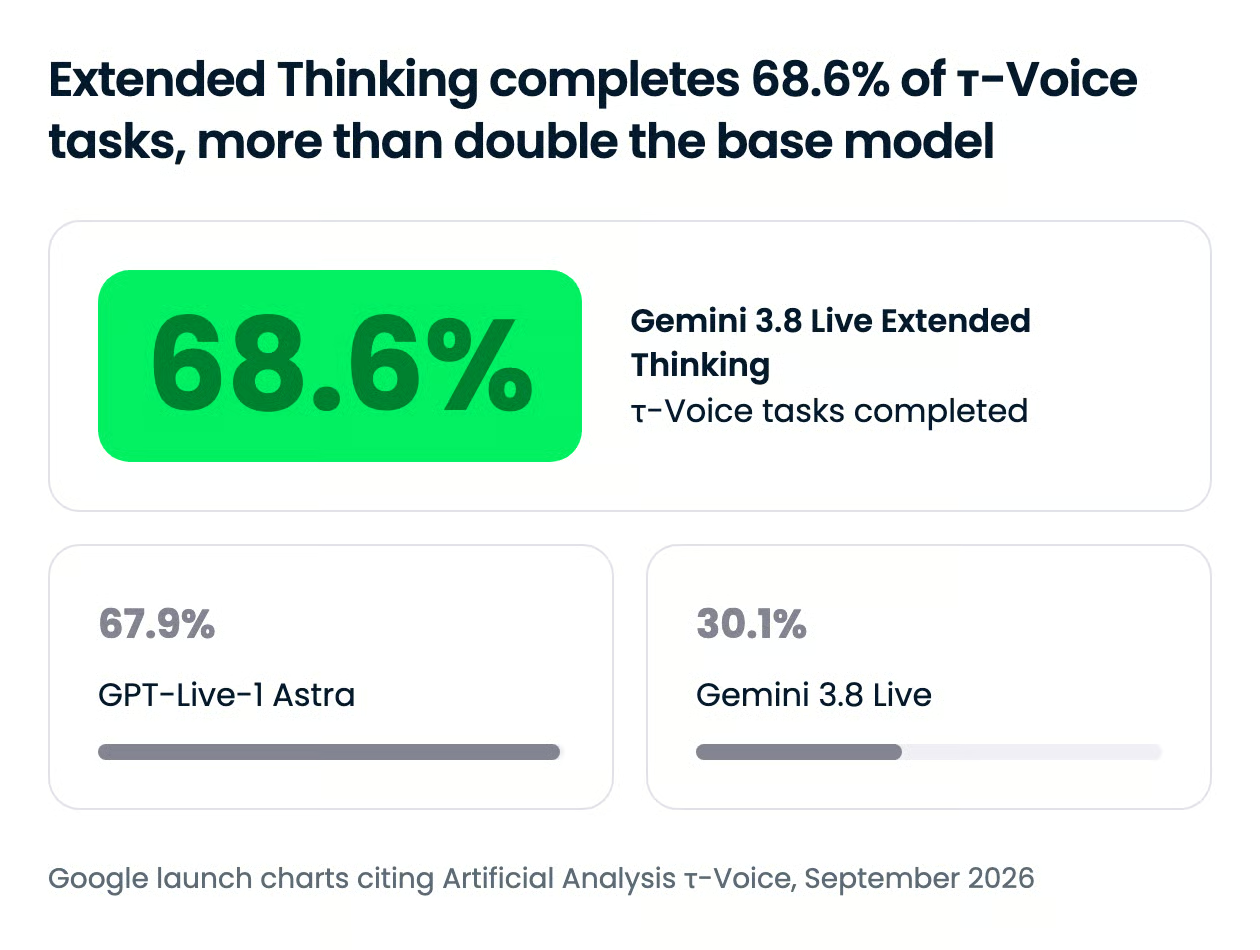
Extended Thinking takes the number one spot on that index with a score of 82.6 and leads the τ-Voice agentic benchmark at 68.6%. The base 3.8 Live model is the cheap one: in Artificial Analysis' cost test it processes an hour of input audio for $0.84, the lowest of any model Google charted. Both are generally available in the Gemini API today at the same price as their predecessor, Gemini 3.1 Flash Live.
In this article, I'll cover everything new with Gemini 3.8 Live, looking at the features, the benchmarks, the split between the two variants, and what it costs to run. You can also see our guides to getting started with the Gemini Live API and building a voice assistant with GPT-Live-1.
Gemini 3.8 Live is Google's native speech-to-speech model for real-time voice agents, released on September 15, 2026 alongside a higher-reasoning sibling, Gemini 3.8 Live Extended Thinking. Both run through the Gemini Live API over a WebSocket connection, take audio, video, images, and text as input, and return audio. Google positions 3.8 Live as the default for low-latency dialogue and Extended Thinking as the pick for complex, multi-step tasks.
The generational change over Gemini 3.1 Flash Live is in how the model handles work that is not talking. Tool and API calls now run in the background by default while the model continues the conversation, and Extended Thinking adds configurable background reasoning on top. Google describes the pair as a step change from its previous live models and as a replacement for cascaded pipelines that chain speech-to-text, an LLM, and text-to-speech.
Google lists five capabilities for the new models, and the ones that matter most for anyone building a voice agent are the two that change the conversational loop: asynchronous tool calls and background reasoning.
Both models execute function calls and API requests in the background while streaming audio back to the user. On Gemini 3.8 Live, asynchronous execution is now the default function-calling mode. You can still force the old synchronous behavior by setting behavior: BLOCKING on a tool declaration, and the model supports function scheduling with SILENT, WHEN_IDLE, and INTERRUPTED options that decide when a result gets spoken.
Extended Thinking goes further: it requires non-blocking tools and returns a hard error if you declare a blocking one. The practical effect is that a caller asking to change a booking hears an acknowledgment right away, then a progress update, then the result, instead of the silence that a cascaded pipeline produces while it waits on an API. On Gemini 3.1 Flash Live, function calling was sequential only, and the model would not start responding until you sent the tool result back.
Gemini 3.8 Live Extended Thinking reasons and speaks at the same time. Google's docs describe the model using early verbal cues such as "Let me check that" to acknowledge a prompt, then narrating progress as multi-step background work completes. You control the depth with thinking_level set to low, medium, or high; the MINIMAL level that existed on 3.1 Flash Live is gone.
This changes the protocol, and I think it is the most important migration detail in the release. Because the model can speak several times during one request, turnComplete: true no longer means it is idle.
Your client has to watch a new interaction_status field, which reports IN_PROGRESS while reasoning or tools are running and IDLE when the whole task is done. Skip that, and your UI will flip back to "listening" while the model is still mid-task.
Gemini 3.8 Live grounds dialogue in live visual input, processing video frames in near real time so an agent can respond to what a user is looking at as well as what they say. Google's demos include a live chess game and an employee onboarding walkthrough where the model answers questions about what is on screen.
Video is not free, though. Turn coverage now defaults to sending audio activity plus all video frames to the model, so if your app does not need vision, you should send frames only when they are useful, both for context budget and for cost. Audio-plus-video sessions are also capped at 2 minutes before you need session management to extend them, against 15 minutes for audio-only sessions.
Google calls this "alphanumeric precision": accurately parsing strings like confirmation codes, claim numbers, and technical identifiers spoken aloud. Anyone who has built a voice agent for support or logistics knows this is where cascaded stacks fall over, because a speech-to-text error early in the chain is unrecoverable downstream. A native speech model that hears the whole utterance in context has a structural advantage here.
Gemini 3.8 Live detects and switches between 97 supported languages during a conversation, with what Google calls accent consistency across them. Both models also support what Google terms incremental content updates: you can send structured data into the session at any point, with an explicit user or model role, and the model merges it with the live audio. That is how you feed a customer record or an order status into an ongoing call without breaking the flow.
Two smaller changes affect existing code. Proactive audio, where the model can decide not to respond to speech that is not directed at it, is now permanently on, and setting it to false returns an error. Affective dialogue has been removed from the API entirely, so any enable_affective_dialog configuration has to go.
Extended Thinking leads every quality and agentic board Google published, but by narrow margins over OpenAI's GPT-Live-1 Astra, while the base 3.8 Live model wins on cost by a wide margin but loses on agentic tasks.
The index, τ-Voice, Big Bench Audio, and cost figures below are all on Artificial Analysis' public leaderboard, so they're independently measured rather than vendor-reported. The τ³-Banking numbers come from Google's launch chart citing Sierra, so treat that row as vendor-reported until Sierra's board shows the same.
Gemini 3.8 Live Extended Thinking leads on τ-Voice, Sierra's benchmark for whether a voice agent completes multi-step tasks with tools, as measured by Artificial Analysis. GPT-Live-1 Astra is close behind, with the rest of the competition falling behind:
The number that surprised me is that the base model's score on τ-Voice sits below its own predecessor. Google is explicit that 3.8 Live is built for scale and cost efficiency rather than for complex workflows, but a gap of more than 38 points between the two variants means the choice of tier is not a matter of nuance. If your agent chains tools, the base model is the wrong default.
On Sierra's τ³-Banking leaderboard, a harder customer-service benchmark built around banking workflows, Extended Thinking scores 35.1% against 32.0% for GPT-Live-1 Astra, 16.5% for SpaceXAI's Grok Voice Think Fast 2.0, 11.3% for Gemini 3.1 Flash Live, and 10.3% for GPT-Realtime 2. Every model on that board fails most of the time, which tells you how far voice agents still are from unsupervised banking work, but a tripling over the previous Gemini generation is a real step.
On the Speech to Speech Index, Extended Thinking edges the competition, too:
A 1.1-point lead over OpenAI is a lead, but I would not build a purchasing decision on it.
For pure reasoning over spoken input, Google reports 97.7% on Big Bench Audio for Extended Thinking. Google also reports that both models push the Pareto frontier on ServiceNow's EVA-Bench for voice agents, balancing accuracy against conversational quality, though that run was done on the Live API through the Gemini Enterprise Agent Platform rather than the public API.
This is the chart Google most wants you to see. In Artificial Analysis' cost test on the Big Bench Audio subset, Gemini 3.8 Live processes an hour of input audio for $0.84.
Extended Thinking costs $3.50 for the same hour, Grok Voice Think Fast 2.0 costs $4.80, and GPT-Live-1 Astra costs $5.83. Gemini 3.1 Flash Live sat at $1.50 and $1.75 depending on thinking level.
Read the two Gemini bars together, and the product strategy is obvious. The base model undercuts everything on the board by a wide margin, and the reasoning model that matches OpenAI on quality still costs 40% less per hour of input. Note that the reasoning model burns more tokens at higher thinking levels, which is why it costs roughly 4 times as much as its sibling despite sharing a price table.
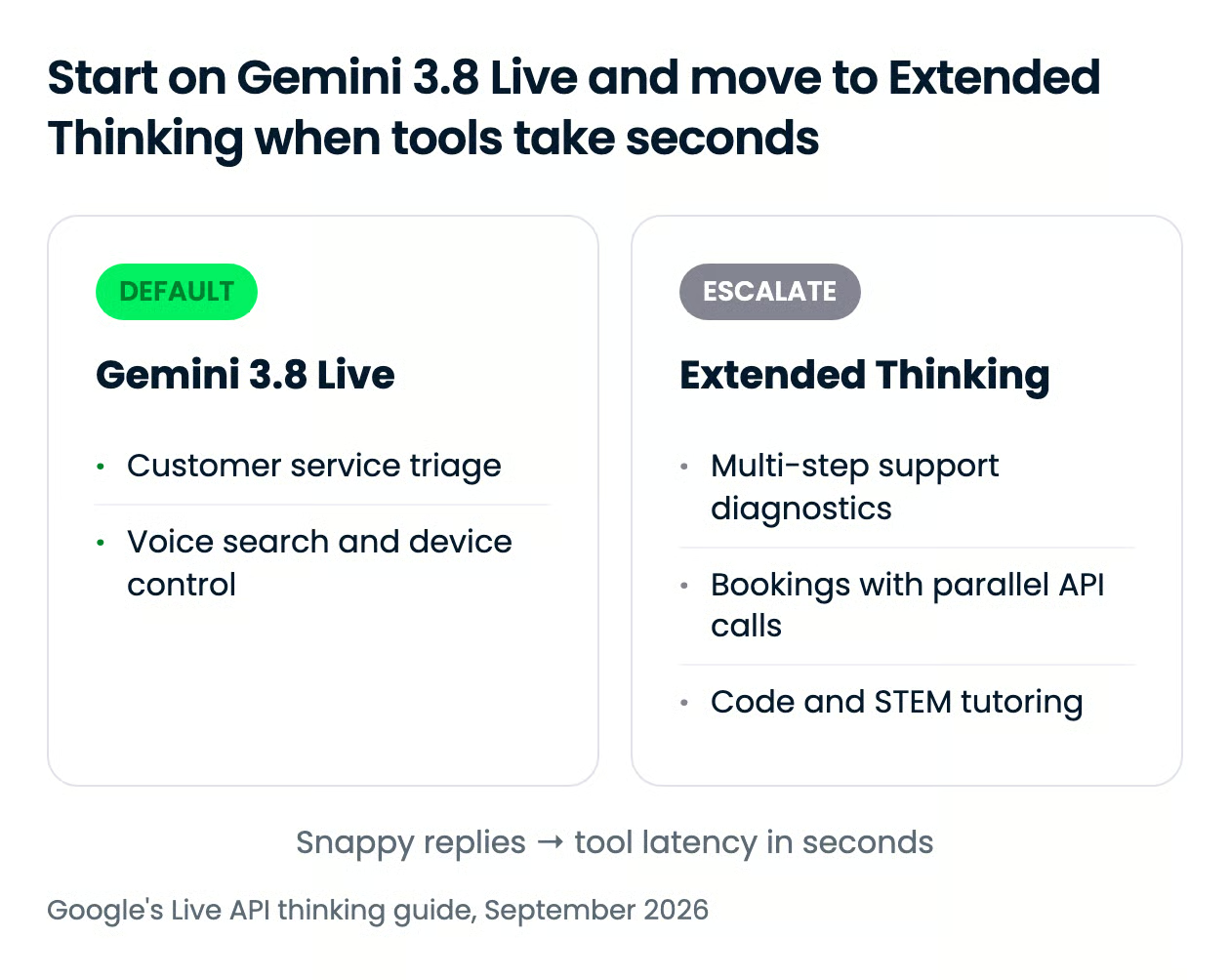
Gemini 3.8 Live is the right default for most voice agents, and Extended Thinking is worth its higher token burn only when the agent has to plan, compare, or wait on slow tools. Google's own guidance draws the line at tool latency: if your functions return in milliseconds, stay on the base model.
The two variants share a price table (which I'll cover below), token limits of 131,072 input and 65,536 output, and the same WebSocket endpoint. What separates them is the reasoning architecture.
Gemini 3.8 Live uses interleaved reasoning with a fixed latency profile and no thinking_level setting at all. Extended Thinking exposes low, medium, and high background reasoning, streams conversational fillers while it works, and requires asynchronous tools. Those thinking levels are the only effort control in the release.
| Use case | Pick | Why |
|---|---|---|
| Customer service triage, voice search, language practice | Gemini 3.8 Live | Immediate turn-taking matters more than depth, and each user's turn gets one response |
| Smart-device control, reading sensor values | Gemini 3.8 Live | Tools return in milliseconds, so there is nothing to mask |
| Technical support across logs, error codes, and config checks | Extended Thinking | A multi-step diagnosis needs background reasoning between utterances |
| Travel and booking agents querying flights and hotels in parallel | Extended Thinking | Parallel async calls with spoken progress updates instead of silence |
| STEM and code tutoring | Extended Thinking | The model verifies formulas or debugs code before it speaks an explanation |
One more consideration: client complexity. Moving to Extended Thinking means rewriting your state handling around interaction_status, so if you have a working 3.1 Flash Live app, the base model is the drop-in upgrade, and the reasoning model is a small refactor.
Both models share the Gemini 3.1 Flash Live Preview price table, so the upgrade is free. On the paid tier, audio input costs $3.00 per 1 million tokens, which Google estimates at $0.005 per minute, and audio output costs $12.00 per 1 million tokens, or about $0.018 per minute. Thinking tokens bill at the output rate, which is where Extended Thinking's higher running cost comes from.
| Modality | Paid tier, per 1M tokens | Per-minute estimate |
|---|---|---|
| Text input | $0.75 | n/a |
| Audio input | $3.00 | $0.005/min |
| Image and video input | $1.00 | $0.002/min |
| Text output | $4.50 | n/a |
| Audio output (including thinking tokens) | $12.00 | $0.018/min |
The free tier covers both models at no charge for input and output, with the usual catch that Google uses free-tier data to improve its products; paid-tier data is not used that way.
Grounding with Google Search is supported on both tiers, with 5,000 free search requests a month shared across all Gemini 3.x models and $14 per 1,000 requests after that. Google has not published rate limits specific to these models, so check the Gemini API rate-limits page for your tier before you plan a launch.
Availability is split three ways:
Every audio output from both models carries a SynthID watermark, and Google's model card is candid about the limits: the models may still hallucinate, jailbreak resistance is still being improved, and there may be occasional slowness or timeouts. Those caveats are worth reading before you put either model in front of customers.
The model IDs are gemini-3.8-live and gemini-3.8-live-extended-thinking, both stable strings with no preview suffix.
You can reach them through the Gemini Live API with the google-genai SDK for Python or JavaScript, through raw WebSockets, or interactively in Google AI Studio's Stream view. Google also lists Agora, Fishjam, LiveKit, LangChain, Pipecat, Vercel, and Vision Agents as integration partners that handle the media-streaming layer, and there is an Agent Development Kit streaming path if you are already building on ADK.
The minimal Python session below opens a connection, sends a text turn, and turns on an output transcript so you can read what the model said:
import asyncio
from google import genai

client = genai.Client()
config = {"response_modalities": ["AUDIO"], "output_audio_transcription": {}}

async def main():
    async with client.aio.live.connect(model="gemini-3.8-live", config=config) as session:
        await session.send_client_content(
            turns={"role": "user", "parts": [{"text": "Read back the claim number 7Q-4418-B."}]},
            turn_complete=True,
        )
        async for response in session.receive():
            if response.server_content and response.server_content.output_transcription:
                print(response.server_content.output_transcription.text)

asyncio.run(main())
If you are migrating from gemini-3.1-flash-live-preview, change the model string and delete any thinking_level or thinking_config from your setup; the turn lifecycle is otherwise identical. The Live API is server-to-server by default, so browser and mobile clients need ephemeral tokens.
For a full walkthrough of audio capture, playback, and session management, see our Gemini Live API tutorial, and for the text-side of the same family, our Gemini 3.8 Flash API tutorial covers thinking levels and function calling in Python.
Google is making a statement on price rather than on raw quality. Extended Thinking's lead over GPT-Live-1 Astra is a point or two on every board, but Gemini 3.8 Live at $0.84 per hour of input audio undercuts OpenAI's model by nearly 7 times, and that is the number that decides where production voice traffic goes.
My view: if you run anything on Gemini 3.1 Flash Live, upgrade this week, since the price is the same and the async tool calling alone is worth it. If you run OpenAI's realtime stack, the base model is worth a trial for triage and search flows, and Extended Thinking is worth one wherever your tools take seconds. The base model's 30.1% on τ-Voice is the reason not to use it for anything agentic.
If you want to build the tool-calling side of a voice agent properly, I recommend our Building AI Agents with Google ADK course, which wires Gemini into a customer-support agent with tools, guardrails, and delegation.
Learn Agentic AI With DataCamp!
Course
Course
Course
blog
Matt Crabtree
10 min
blog
Matt Crabtree
10 min
blog
Alex Olteanu
8 min
blog
Khalid Abdelaty
11 min
blog
Matt Crabtree
8 min
blog
Josef Waples
9 min