Courses
Claude モデル入門
3時間
14.5K
Anthropic released Claude Sonnet 5 on June 30, 2026, and the pitch is straightforward: this is the most agentic Sonnet model the company has shipped. It can make plans, drive tools like browsers and terminals, and run autonomously at a level that, until recently, only larger Opus-class models could reach.
The headline claim is that Sonnet 5 performs close to Opus 4.8 across reasoning, tool use, coding, and knowledge work, but at a lower price. On the agentic coding benchmark Anthropic published, Sonnet 5 scores 63.2% against Opus 4.8's 69.2% and Sonnet 4.6's 58.1%. On one knowledge work benchmark, Sonnet 5 actually edges past Opus 4.8.
In this article, I'll cover everything new with Claude Sonnet 5, looking at the new features, exploring the benchmarks, and seeing how much it costs. If you want more Anthropic context, see our recent guide to Claude Code slash commands and our look at Claude Tag.
Claude Sonnet 5 is Anthropic's mid-tier model, sitting below the Opus line and built to handle agentic work that previously demanded the more expensive Opus models. It replaces Sonnet 4.6, which launched in February 2026, and uses an updated tokenizer that changes how the model processes text.
For many developers, the agentic era began with Sonnet-class models like Claude Sonnet 3.5, 3.6, and 3.7, which were the first Claude releases to show real skill at coding and tool use. More recently, the clearest agentic gains had moved to Opus-class models, and Sonnet 5 is Anthropic's attempt to pull the mid-tier back up toward the frontier.

Source: Anthropic
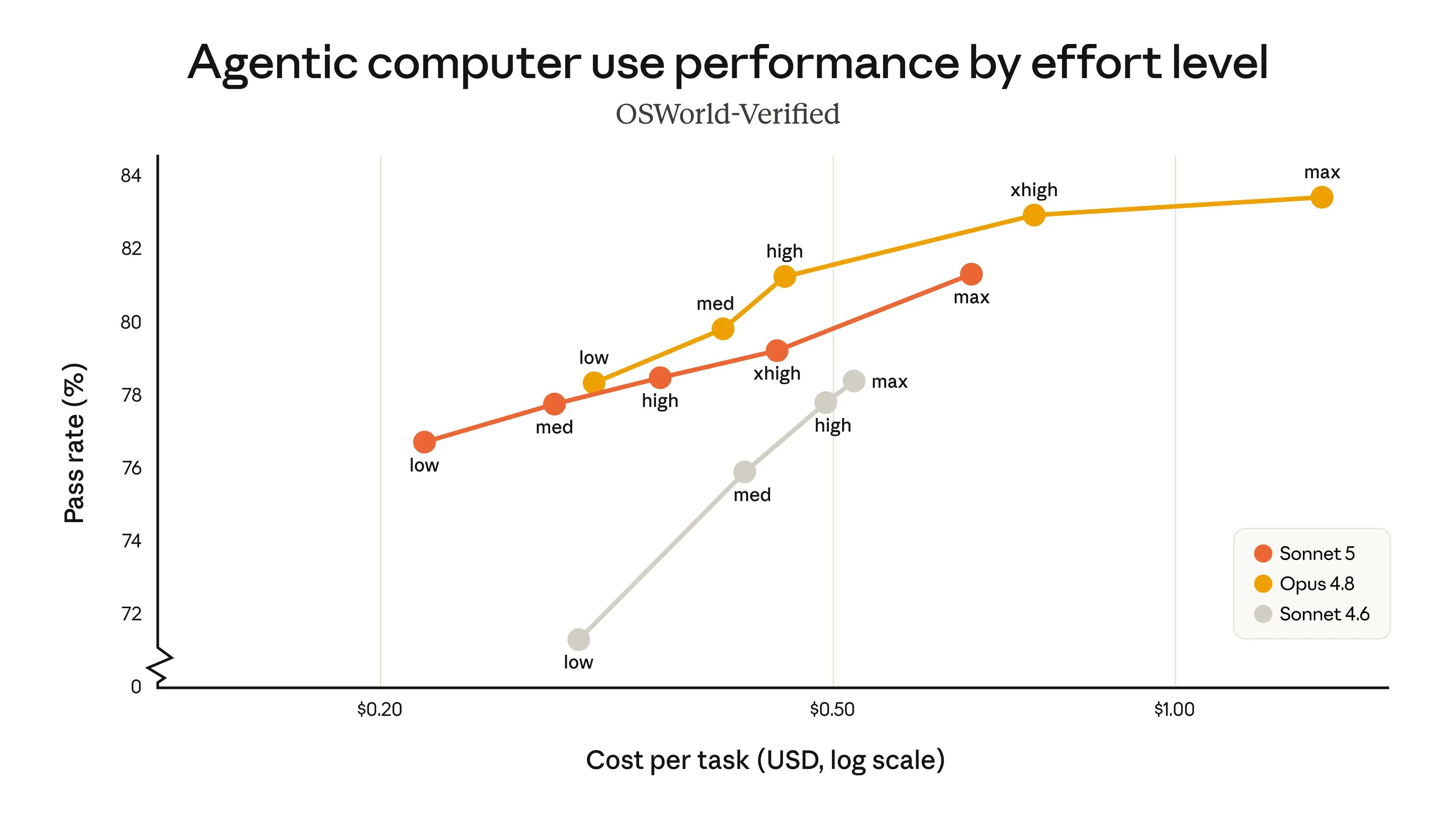
The most telling number is the cost-performance picture. Anthropic's own charts show that Sonnet 4.6 fell well short of Opus 4.8 on the BrowseComp agentic search and OSWorld-Verified computer-use evaluations. Sonnet 5 and Opus 4.8 now cover a single range, with Sonnet 5 offering lower cost and Opus 4.8 offering higher accuracy at a higher price.
The improvements in Sonnet 5 cluster around one theme: finishing agentic tasks without stopping short. Here are the capabilities that stand out.
Sonnet 5's biggest practical change is task follow-through. Anthropic's early-access testers reported that the model completes complex tasks where previous Sonnet versions would stall partway, and that it checks its own output without being asked to.
To picture this in your own work, imagine handing the model a job that spans two systems: pull failing test results from a CI run, then open a pull request with a fix. Earlier Sonnet models tended to stop after the first half. Anthropic's own example involved updating Salesforce account tiers and sending a launch announcement to enterprise contacts in a single pass, a workflow a Zapier engineer said used to stall halfway.
For anyone building agents, this is the difference between a model that drafts a plan and one that executes it. It reduces the number of times a human has to step in to nudge the agent forward.
Sonnet 5 supports adjustable effort levels, so you can dial reasoning depth up or down depending on the task and budget. Anthropic positions this as a way to find the right point between Sonnet 5 and Opus 4.8 rather than picking one model and living with it.
At its maxed-out Extra High reasoning level, Sonnet 5 performs roughly in line with Opus 4.8's medium-to-high setting on OSWorld-Verified and BrowseComp. The catch is that running Sonnet 5 at that level can cost more than Opus 4.8 at a comparable reasoning setting, so Opus 4.8 remains the better choice for some high-accuracy tasks.
If you already use Claude Code, effort levels will be familiar. We cover the /effort command and its levels in our Claude Code slash commands tutorial.
Sonnet 5 ships with measurable safety improvements over Sonnet 4.6, which matters when an agent is touching live systems. Anthropic's pre-deployment evaluations found that it is better at refusing malicious requests and resisting hijack attempts in prompt injection attacks.
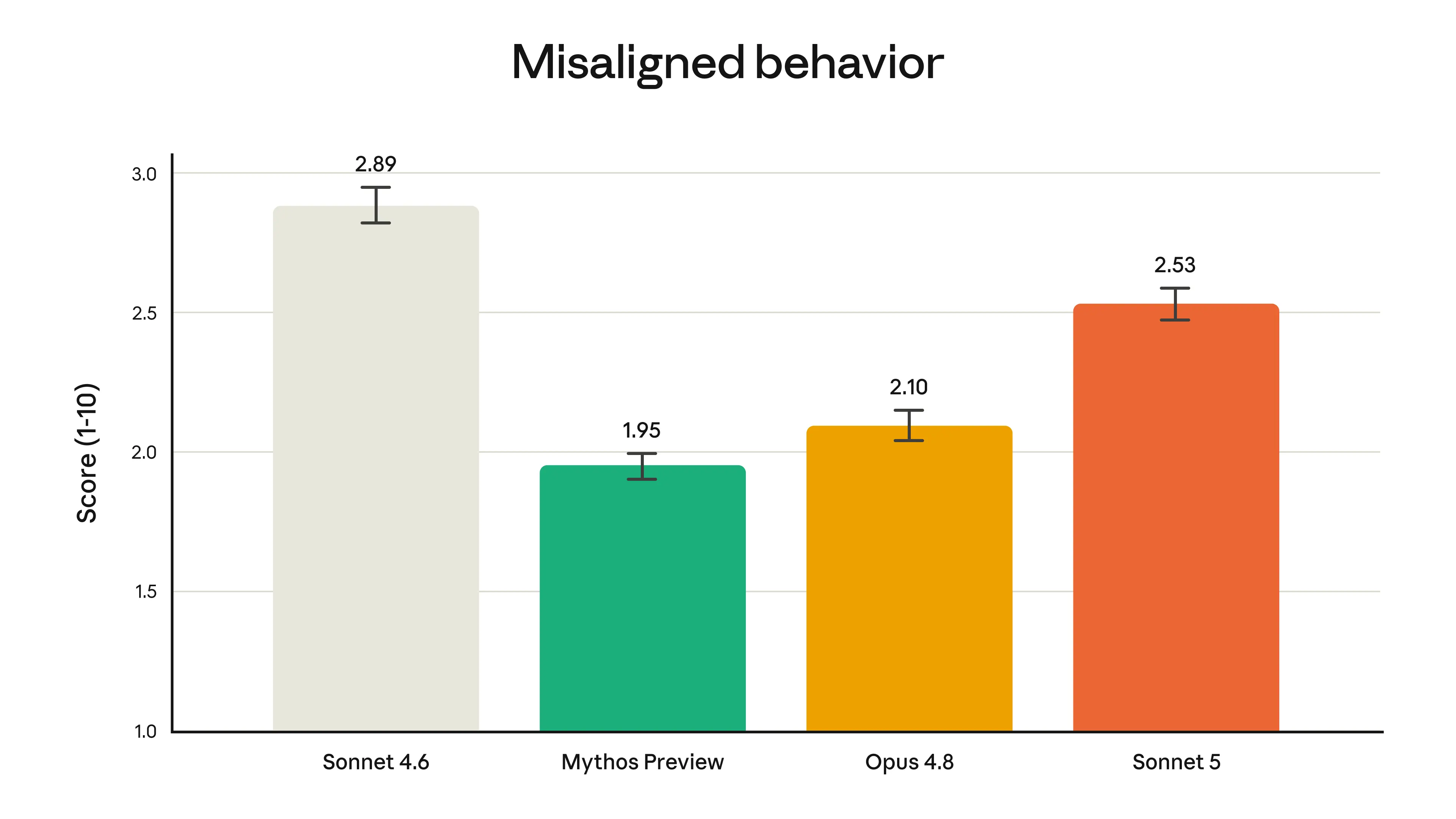
The model also shows lower rates of hallucination and sycophancy than Sonnet 4.6, and scored lower (safer) on Anthropic's automated behavioral audit covering misaligned behaviors like cooperation with misuse and deception. Lovable's co-founder framed the value plainly: a model that knows when to say no is as important as one that knows how to build.
The caveat is that Sonnet 5 still shows higher rates of misaligned behavior than the more capable Opus 4.8 and Claude Mythos Preview, so it is safer than its predecessor but not the safest model in Anthropic's lineup.
Source: Anthropic
Sonnet 5 launches with real-time cyber safeguards turned on, the same ones present in Claude Opus 4.7 and 4.8. These detect and block dangerous cyber usage as it happens.
On Anthropic's evaluations, Sonnet 5 has substantially weaker dangerous-cyber skills than Opus 4.8 and Mythos 5. In a test built with Mozilla to develop exploits for vulnerabilities in Firefox 147, neither Sonnet 5 nor Sonnet 4.6 ever produced a working exploit (both scored 0.0%), though Sonnet 5 showed a slightly higher partial-success rate, which Anthropic attributes to general intelligence gains rather than cyber training.
For security researchers who need reduced guardrails, Anthropic recommends Opus 4.8 instead. The safeguards on Sonnet 5 are less strict than those that shipped with Fable 5, which blocked a wider range of cybersecurity tasks.
Anthropic's benchmark story for Sonnet 5 is consistent: it is a strict improvement over Sonnet 4.6 and sits just below Opus 4.8 on the evaluations published so far. The numbers below come from Anthropic's launch materials. One note of caution: third-party reviewers have reported different figures for the same benchmarks, likely due to different datasets, context settings, or agent scaffolds, so treat headline numbers as configuration-dependent.
| Sonnet 5 | Sonnet 4.6 | Opus 4.8 For reference |
|
|---|---|---|---|
| Agentic coding SWE-bench Pro |
63.2% | 58.1% | 69.2% |
| Agentic coding Terminal-Bench 2.1 |
80.4% | 67.0% | 82.7% |
| Multidisciplinary reasoning Humanity's Last Exam |
43.2% no tools 57.4% with tools |
34.6% no tools 46.8% with tools |
49.8% no tools 57.9% with tools |
| Computer use OSWorld-Verified |
81.2% | 78.5% | 83.4% |
| Knowledge work GDPval-AA v2 |
1618 | 1395 | 1615 |
On the agentic coding benchmark Anthropic published, Sonnet 5 scores 63.2%, compared to Opus 4.8's 69.2% and Sonnet 4.6's 58.1%. This benchmark measures whether a model can write, run, and fix code across multiple steps rather than producing a single snippet.
The gap to Opus 4.8 is about 6 points, while the jump over Sonnet 4.6 is roughly 5 points. For developers, that means Sonnet 5 is a clear upgrade over the previous mid-tier model without quite matching the flagship.
Source: Anthropic
OSWorld-Verified measures computer-use ability, controlling a desktop to complete real tasks, and BrowseComp measures agentic web search. Anthropic updated its OSWorld-Verified methodology and now reports Sonnet 4.6 at 78.5% on the revised setup.
Across both evaluations, Sonnet 5 is a strict improvement over Sonnet 4.6 at every effort level, while Opus 4.8 remains the higher-accuracy choice. At Extra High effort, Sonnet 5 reaches roughly Opus 4.8's medium-to-high performance, but at that point the cost advantage narrows, which is why Anthropic frames the two models as a single cost-accuracy range rather than a straight upgrade.
On a knowledge work benchmark, Sonnet 5 slightly outperforms Opus 4.8, according to TechCrunch's reporting. That is notable because Opus 4.8 is the model usually associated with the hardest judgment calls and deep research.
Anthropic also updated its grader for Humanity's Last Exam and now reports Sonnet 4.6 at 34.6% (no tools) and 46.8% (with tools), which is why those figures differ from the original Sonnet 4.6 launch. For practitioners, the knowledge-work result suggests Sonnet 5 is viable for analysis and research tasks that previously felt like Opus territory.
For a broader context on where the Sonnet tier sits, our coverage of Sakana Fugu vs Claude Fable 5 is useful. In that comparison, the higher-tier Claude Fable 5 scored 80.3% on SWE-Bench Pro and 59.0% on Humanity's Last Exam (no tools), well above the mid-tier figures here.
That spread is the point. Anthropic's lineup runs from the agentic, lower-cost Sonnet 5 up through Opus 4.8 and the Mythos and Fable classes, with each tier trading cost for accuracy on the hardest problems.
Claude Sonnet 5 is available everywhere from launch day. It is the default model for Free and Pro plans, and is available to Max, Team, and Enterprise users, as well as in Claude Code and on the Claude Platform.
Developers can call it via the Claude API using the model ID claude-sonnet-5. Pricing works in two phases:
One detail to budget for: Sonnet 5 uses an updated tokenizer, so the same input can map to more tokens than before, roughly 1.0 to 1.35 times depending on content type. Anthropic set the introductory pricing so the transition from Sonnet 4.6 is roughly cost-neutral. The company also raised rate limits across Chat, Cowork, Claude Code, and the Claude Platform to handle the heavier token usage that higher effort levels bring.
For readers who want the quick comparison, here is how the three models line up on the figures Anthropic published.
| Model | Agentic coding | OSWorld-Verified | Input / output price (per 1M tokens) |
|---|---|---|---|
| Sonnet 5 | 63.2% | Improves on 4.6 at all effort levels | $2 / $10 (intro), then $3 / $15 |
| Sonnet 4.6 | 58.1% | 78.5% (revised) | $3 / $15 |
| Opus 4.8 | 69.2% | Higher-accuracy choice | $5 / $25 |
Sonnet 5 is Anthropic's clearest statement yet that agentic capability is now the baseline expectation at every price tier, not a flagship-only feature. The differentiator is no longer who can do agentic work best, but who can do it cheaply and reliably without human oversight.
What I find most interesting is the introductory pricing. Anthropic seems to want customers to test Sonnet 5 against real workloads at the lowest possible cost during the migration window, which reads like a deliberate push to move people off Opus 4.8 for routine agentic work and free up that capacity. It also undercuts OpenAI's GPT-5.5 and Google's Gemini 3.1 Pro on price, though Gemini 3.5 Flash remains cheaper.
If you are building agents that run sustained, multi-step tasks, Sonnet 5 looks like the new default to reach for first, dropping up to Opus 4.8 only when a task genuinely needs the extra accuracy. The honest caveat is that some third-party reviewers see Sonnet 5 trading reasoning depth for coding speed, so for PhD-level science or browsing-heavy work, Opus 4.8 may still be the safer pick.
If you want to get hands-on with the kind of automation Sonnet 5 is built for, I recommend our Claude Code Routines tutorial, which walks through running a coding agent on a schedule in the cloud.
Top DataCamp Courses
Courses
Courses
Courses
blogs
Alex Olteanu
8 分
blogs
Tom Farnschläder
10 分
blogs
Matt Crabtree
8 分
blogs
Alex Olteanu
8 分
blogs
Josef Waples
5 分
blogs
Josef Waples
7 分