강의
개발자를 위한 AI 보조 코딩
1시간 30분
10.7K
On the same day as the launch of GLM-5.3 Flash, Alibaba's Qwen team has opened the weights of Qwen3.8-Flash-Next, a multimodal mixture-of-experts (MoE) model that doubles as an early preview of the architecture behind the upcoming Qwen4 family.
This mirrors what Qwen3-Next did for Qwen3.5: release the architectural changes ahead of the full model line so the community can pick them apart first.
The big story here is cost. Thanks to a highly efficient new architecture, Qwen3.8-Flash-Next costs roughly a ninth of what it took to train its predecessor, Qwen3.7-Plus. But it doesn't sacrifice power to get there; it actually beats heavyweights like Claude Opus 4.6 Max on major coding tests like SWE-bench.
In this article, I'll cover everything new with Qwen3.8-Flash-Next, looking at its architecture and features, and exploring the benchmarks. For a deep dive into how to download and run the model locally, read our Qwen3.8-Flash-Next tutorial. If you want context on some of the other Chinese models, see our guide to Qwen3.8-Max and our tutorial on running DeepSeek-V4-Flash-0731 locally. I also recommend checking out the new Qwen3.8-Omni-Flash release.
Qwen3.8-Flash-Next is a multimodal MoE model from Alibaba's Qwen team, released August 26, 2026, positioned as a cost-efficient workhorse rather than a top-tier flagship.
It sits below the Max-class models in intelligence but undercuts almost everything on price, which is the whole point of the "Flash" line.
The model natively supports a 262,144-token context window, extensible to 1,000,000 tokens with YaRN ([Yet another RoPE extensioN] method, a positional encoding technique that stretches a model's context window, letting it handle massive text inputs while maintaining its original performance).
It handles text, image, and video through a single API, which is one of the reasons commentators labeled it an "overnight community darling" in the August 2026 release roundups.
What makes this release matter for practitioners is the benchmark-per-dollar ratio.
Qwen3.8-Flash-Next beats its own 27B sibling on every published benchmark, and it outperforms Claude Opus 4.6 Max on most practical coding and agent evaluations while activating just 6B parameters per token. This is a preview of the Qwen4 architecture, so the design choices here signal where Alibaba is heading next.
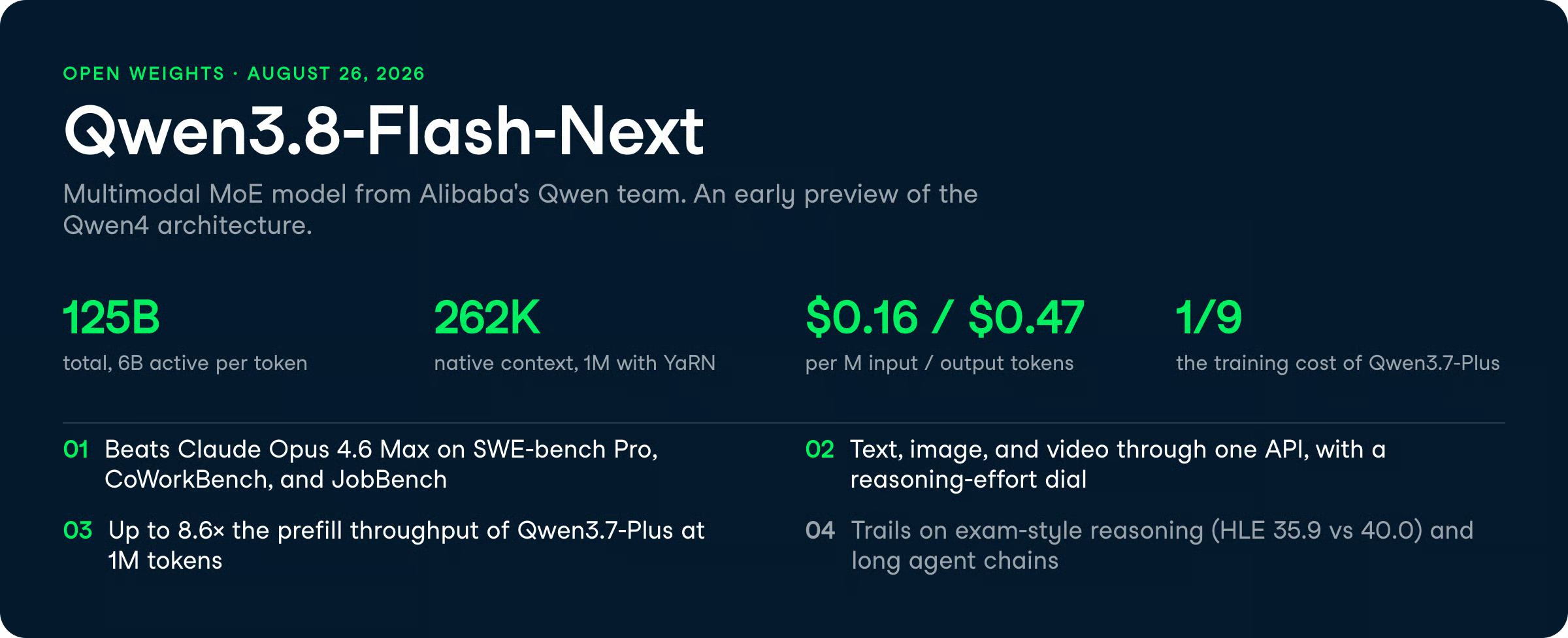
Qwen3.8-Flash-Next upgrades the model along four axes: attention, residual, embedding, and optimization.
Below, I break down what each change actually buys you as a user, rather than just what it is.
The biggest practical gain is speed on long inputs.
Qwen3.8-Flash-Next uses a hybrid attention design, where it compresses most of the context history to save space, and uses a targeted "Sparse Attention" tool to retrieve only the most relevant details when needed.
The speedups at 1 million tokens are massive: up to 7.6x faster prompt processing (prefill) and 4.9x faster generation (decode). In a typical serving setup with cached prefixes, overall throughput jumps by 8.6x compared to Qwen3.7-Plus.
For anyone running high-volume retrieval or repo-scale coding agents, that throughput difference is the feature.
You pay for compute, and this design slashes the bill on exactly the long sequences that used to be notoriously expensive.
Qwen uses a neat trick called an N-gram Embedding to add 51 billion parameters essentially for free. Instead of just looking at one token at a time, it looks at the current token plus its recent neighbors, giving the model a massive "local-pattern memory."
Because the model knows what to look up in advance, these extra 51B parameters live in standard system memory (RAM), not on the GPU. They get pulled in automatically behind the scenes, meaning they never permanently hog GPU memory or slow down per-token compute.
You get the brains of a much larger model without paying the usual VRAM tax.
Qwen3.8-Flash-Next handles text, image, and video through a single interface, and its vision capabilities punch way above its cost tier.
It comfortably beats Claude Opus 4.6 Max on mobile use tests (84.5 vs 62.0 on AndroidWorld) and real-world visual understanding (88.5 vs 73.9 on RealWorldQA).
It also crushes visual math, scoring up to 95.7 on MathVision (well ahead of Opus's 65.5).
If your workflow involves parsing screenshots, charts, or app UIs, Qwen offers a genuine advantage over Claude at this price point.
The API gives you a reasoning effort dial with three settings (high, medium, and low), allowing you to trade deep thinking for lower latency and cheaper requests.
The model is also baked with a multi-token prediction module, which basically means it predicts several steps ahead to speed up generation in real-world workloads.
The practical upshot is control.
You can dial reasoning down for high-volume, cost-sensitive traffic, and crank it up for complex agentic tasks, all using the exact same model ID.
Across the published numbers, Qwen3.8-Flash-Next leads on most coding and agentic benchmarks while trailing on a couple of exam-style reasoning evaluations.
It beats its 27B sibling everywhere, with the largest gaps in agentic work.
All comparisons below come from Qwen's own release table unless stated otherwise.
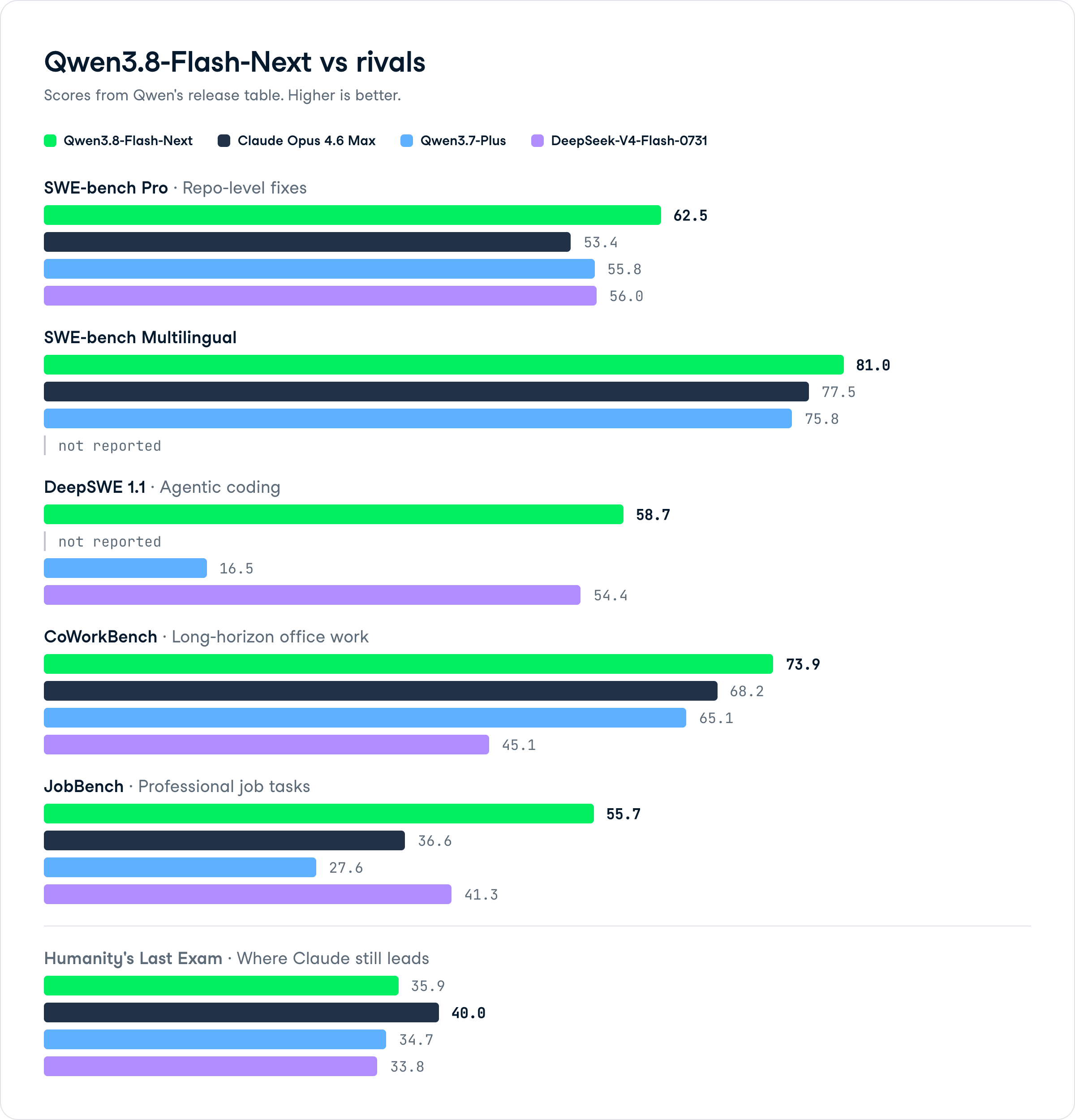
SWE-bench Pro measures real repository-level software fixes, and Qwen3.8-Flash-Next scores 62.5, ahead of Claude Opus 4.6 Max's 53.4 and Qwen3.7-Plus's 55.8.
On SWE-bench Multilingual, which tests fixes across languages, it hits 81.0 versus Opus 4.6 Max's 77.5.
These are the numbers that carry the release.
For a 6B-active model to beat a Max-tier Claude on repo-level engineering is the reason it drew so much attention.
DeepSWE 1.1 evaluates agentic coding through harnesses like Claude Code and mini-SWE-agent, and Qwen3.8-Flash-Next scores 58.7 against its 27B sibling's 42.2 and Qwen3.7-Plus's 16.5.
DeepSeek-V4-Flash-0731 sits at 54.4 here.
When we ran DeepSeek-V4-Flash-0731 as a coding agent in our tutorial, it built a full stock analytics website from a single prompt in about 20 minutes, generating chat at roughly 33 tokens per second.
The DeepSWE gap between the two models suggests Qwen3.8-Flash-Next should hold up well in similar agentic coding loops.
On the agent side, the model posts strong numbers across several evaluations:
The JobBench gap stands out.
On professional workflow tasks, Qwen3.8-Flash-Next scores nearly 20 points above a Max-tier Claude, which is the kind of result that makes it worth trialling for enterprise automation.
On general reasoning, Qwen3.8-Flash-Next reaches 91.7 on GPQA Diamond (scientific reasoning), just ahead of Claude Opus 4.6 Max's 91.3, and 91.9 on LiveCodeBench v6 (competitive coding) versus Opus 4.6 Max's 88.8.
It does not win everywhere, though.
On Humanity's Last Exam (HLE), which tests multidisciplinary reasoning, it scores 35.9 against Claude Opus 4.6 Max's 40.0. On Agents' Last Exam Pass@1, DeepSeek-V4-Flash-0731 edges it 25.2 to 24.3.
The pattern holds across independent trackers: Qwen3.8-Flash-Next leads on practical coding and agent work, while Claude retains a lead on some exam-style reasoning benchmarks.
Qwen3.8-Flash-Next-Base wins 8 of 14 pretraining benchmarks against the base models of Qwen3.8-27B and the much larger Qwen3.7-Plus.
It leads on MMLU-Pro (73.23), SuperGPQA (51.36), BBH (90.87), GSM8K (93.29), EvalPlus (78.76), SWEBench-Pretrain (50.99), MGSM (89.33), and MMMLU (84.86).
What's striking is that it does this with 6B activated parameters against Qwen3.7-Plus's 17B active and 397B total, and stays within a point of it on MMLU, MMLU-Redux, GPQA, MATH, and MultiPL-E.
The 51B N-gram embedding parameters are deterministically addressed and never enter the per-token matmul budget, so this is genuine efficiency rather than a parameter-count trick.
Here's how the model stacks up against Claude Opus 4.6 Max, its Qwen3.7-Plus predecessor, and DeepSeek-V4-Flash-0731 on the headline evaluations.
| Benchmark | Qwen3.8-Flash-Next | Claude Opus 4.6 Max | Qwen3.7-Plus | DeepSeek-V4-Flash-0731 |
|---|---|---|---|---|
| SWE-bench Pro | 62.5 | 53.4 | 55.8 | 56.0 |
| SWE-bench Multilingual | 81.0 | 77.5 | 75.8 | -- |
| DeepSWE 1.1 | 58.7 | -- | 16.5 | 54.4 |
| CoWorkBench | 73.9 | 68.2 | 65.1 | 45.1 |
| JobBench | 55.7 | 36.6 | 27.6 | 41.3 |
| GPQA Diamond | 91.7 | 91.3 | 90.3 | 90.8 |
| LiveCodeBench v6 | 91.9 | 88.8 | 89.6 | 90.6 |
| HLE | 35.9 | 40.0 | 34.7 | 33.8 |
Qwen3.8-Flash-Next weights are available now as an open-weight model on Hugging Face and ModelScope.
The production version, with 1M context by default and built-in tools, is served as Qwen3.8-Flash on QwenCloud under the model ID qwen3.8-flash.
Pricing is where this model competes hardest:
For comparison, our Qwen3.8-Max coverage lists that model at $2.00 input and $6.00 output per million tokens, so Flash-Next undercuts its own Max sibling by more than 10x on input.
QwenCloud supports OpenAI-compatible Chat Completions and Responses APIs plus an Anthropic-compatible interface, so it drops into Claude Code, Codex, and Qwen Code with minimal config changes.
Note that at the announcement, the API was listed as coming soon, so check QwenCloud for live availability.
GLM-5.3-Flash is the other budget model that launched the same day, and it is the most direct rival worth putting side by side.
| Qwen3.8-Flash-Next | GLM-5.3-Flash | |
|---|---|---|
| Architecture | 125B total / 6B active | 320B total / 18B active |
| Native context | 262K (1M with YaRN) | 1M tokens |
| DeepSWE v1.1 | 58.7 | 63.4 |
| SWE-bench Pro | 62.5 | Not published |
| Input price | $0.16/1M | ~$0.075/1M (promo) |
| Multimodal | Yes | Yes |
GLM-5.3-Flash leads on DeepSWE v1.1 (63.4 vs 58.7) and scores 84.3 on Terminal-Bench 2.1, a benchmark Qwen does not publish figures for.
It also has a lower input price during its promotional window and a 1M-token context window natively, without needing YaRN.
Qwen3.8-Flash-Next leads on SWE-bench Pro (62.5), CoWorkBench (73.9), and JobBench (55.7), where GLM does not publish equivalent numbers. Qwen also activates far fewer parameters per token (6B vs 18B), which makes it significantly cheaper to self-host and faster to serve at scale.
To summarize, GLM has stronger published numbers on the benchmarks they share directly. Qwen leads on office and professional workflow evals, and is the better choice if you are running your own infrastructure. For a complete breakdown of GLM-5.3-Flash, see our full guide.
Qwen3.8-Flash-Next is Alibaba making a clear statement about cost-efficiency as the battleground.
Beating Claude Opus 4.6 Max on SWE-bench Pro, CoWorkBench, and JobBench with 6B active parameters, at $0.16 per million input tokens, is a serious pitch to anyone running high-volume coding or agent workloads.
I'd treat it as a strong default for tool-driven and coding-heavy pipelines, with two caveats.
Community reports flag occasional instability on very long agentic chains and brittleness when tools return non-standard JSON, and the model is less conservative on safety than the Claude series, so it needs careful prompting for borderline content.
The HLE and Agents' Last Exam results also show that it is not the model to reach for on the hardest exam-style reasoning.
As an early preview of the Qwen4 architecture, the GDN + QSA hybrid and N-gram Embedding designs are worth watching, because they are what the full Qwen4 family will be built on.
If Alibaba can keep this benchmark-per-dollar ratio at the flagship tier, the frontier pricing conversation changes.
If you want to build agentic and coding workflows around models like this, I recommend starting with our AI Agent Fundamentals skill track to get up to speed on the core concepts.
Top DataCamp Courses
강의
강의
강의
블로그
Tom Farnschläder
11분
블로그
Matt Crabtree
10분
블로그
Alex Olteanu
8분
블로그
Matt Crabtree
12분
블로그
Matt Crabtree
10분
블로그
Alex Olteanu
6분