Point-slope form is an equation that describes a line from one known point and its slope: y - y1 = m(x - x1).
Most of us learn slope-intercept form first, so we think of it as the only way to write a line. But that approach needs the y-intercept, and you often don't have one in the real world. You get a point and a rate of change, like a cost of $40 at 5 units and $3 per extra unit.
Point-slope form doesn't need this step. You add your point and slope into the formula, and that's it. It is also the technique behind tangent lines and linear regression, so it's a topic worth exploring on its own.
In this article, I'll walk you through the formula, its components and graph, worked examples, real-world uses, and how it compares to slope-intercept and standard form.
Another topic worth exploring is linear regression: our blog post explains everything you need to know, including equations, assumptions, diagnostics, and the interpretation.
If you know one point on a line and its slope, you know the whole line - that's the entire idea.
Point-slope form writes a line's equation from a single point and the slope. Here's the formula:
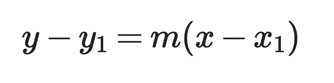
Point-slope form formula
m is the slope, (x1, y1) is the point you know, x and y stay as variables, and every point (x, y) on the line satisfies the equation.
The formula comes from the definition of slope, which is the change in y divided by the change in x. You can pick any point (x, y) on the line and compare it to your known point:
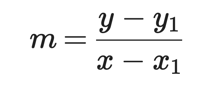
Slope calculation
Multiply both sides by (x - x1) and you get point-slope form. That's it.
You need to multiply because the fraction is undefined at x = x1, as the denominator is zero. The multiplied version doesn't have this problem, so it's valid for every point on the line.
Here's a quick example. A line has a slope of 2 and passes through (3, 5). Just add the values in:
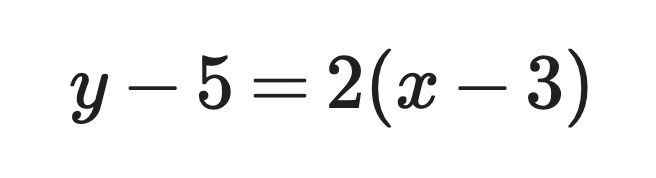
Point-slope form calculation
You don't need to solve for anything.
Historical context
Point-slope form came much later than analytic geometry.
Pierre de Fermat and René Descartes developed analytic geometry in the 17th century. This is the idea that algebraic equations can describe lines and curves. But neither of them used point-slope form.
According to a history of calculus paper, Gaspard Monge first introduced it explicitly in a paper from 1784. That's more than 100 years after Descartes' method of tangents.
Descartes found tangent lines with a longer method that used circles. With point-slope form, you write the tangent line once you know the slope. Calculus courses still teach it this way.
Each part of the formula has one task. Here's how they work together and how the line looks on a graph.
Key components
Here's what each symbol means:
-
m is the slope. It's the change in y for each one-unit change in x. A positive value means the line goes up, and a negative value means it goes down
-
x1 is the x-coordinate of the point you know
-
y1 is the y-coordinate of the same point
-
x and y are the variables. They stand for every other point on the line
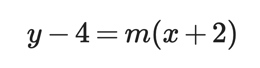
The minus signs are something newcomers often get wrong. If your point is (3, 5), you write x - 3 and y - 5. If a coordinate is negative, you get a double negative. For the point (-2, 4), the equation starts as:
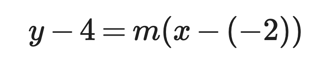
Point-slope form with a negative x-coordinate
It simplifies to:
Simplified equation
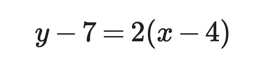
You can use any point on the line. Different points give different equations, but they describe the same line. The line from earlier also passes through (4, 7), so this works too:
Point-slope form with a second point
One limit applies, though. A vertical line has an undefined slope, so point-slope form can't describe it. You write it as x = x1 instead.
Visual representation
On a graph, (x1, y1) is your starting point. The slope tells you how to move from it.
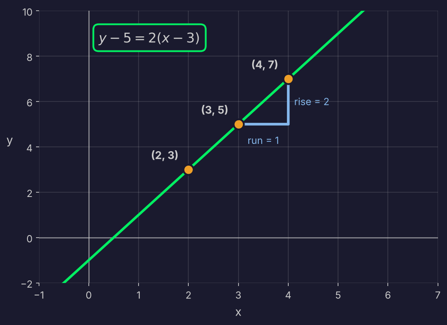
Slope is rise over run. A slope of 2 is 2/1, which means 2 units up for every 1 unit right. Here's how to graph y - 5 = 2(x - 3):
-
Plot the point (3, 5).
-
Move 1 unit right and 2 units up to reach (4, 7).
-
Draw a line through both points and extend it in both directions.
You can also move the other way. Go 1 unit left and 2 units down to reach (2, 3). It's on the same line.
Graph of y - 5 = 2(x - 3)
Once you can read the point and slope from the equation, you can sketch the line without extra algebra.
Detailed Examples and Use Cases
Point-slope form is easiest to understand with numbers. Here are three problems, followed by a couple of real-world scenarios.
Example problems
Problem 1: Slope and one point
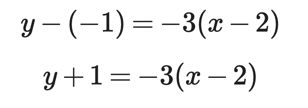
A line has a slope of -3 and passes through (2, -1). Write its equation in point-slope form, then convert it to slope-intercept form.
Step 1: Identify the values: m = -3, x1 = 2, and y1 = -1.
Step 2: Add them to the equation. Remember that two minus signs make a plus sign.
Example 1 (1)
Step 3: Convert the equation. Distribute the slope, then subtract 1 from both sides.
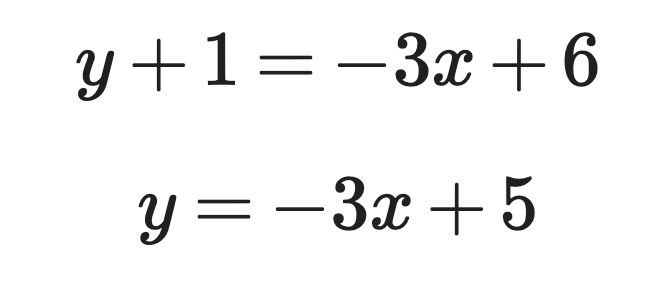
Example 1 (2)
Problem 2: Two points
A line passes through (1, 2) and (4, 11). Find its equation.
Step 1: Calculate the slope. Divide the change in y by the change in x.
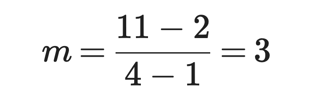
Example 2 (1)
Step 2: Choose a point. Either point works, so I'll use (1, 2).
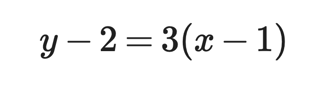
Example 2 (2)
Step 3: Check the result. Add in the other point, (4, 11).
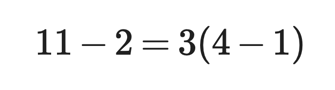
Example 2 (3)
Both sides equal 9, so the equation is correct.
If you choose (4, 11) as your point, you get y - 11 = 3(x - 4). Both versions simplify to y = 3x - 1.
Problem 3: Parallel and perpendicular lines
Find the line through (4, 3) that's parallel to y = 2x + 1. Then find the line through the same point that's perpendicular to it.
Parallel lines have the same slope, so m = 2.
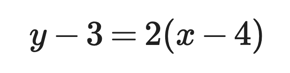
Example 3 (1)
Perpendicular lines have slopes that are negative reciprocals, so m = -1/2.
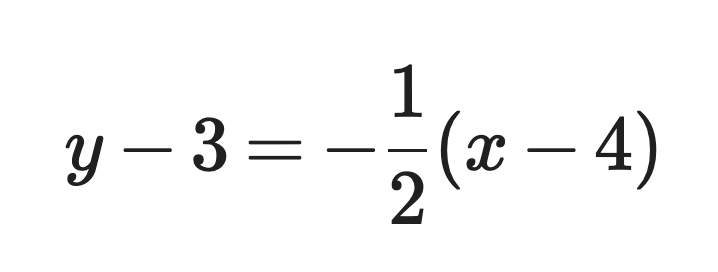
Example 3 (2)
You don't need the y-intercept for either line.
Real-world applications
Point-slope form is applicable in any situation where you know one data point and a constant rate of change.
Let's say a taxi ride costs $18 after 6 miles, and the rate is $2 per mile. With x as the miles and y as the cost, the equation is:
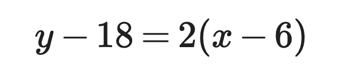
Real-world applications (1)
To estimate the cost of a 10-mile ride, just plug in x = 10:
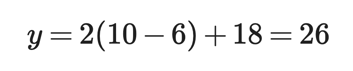
Real-world applications (2)
The fare is $26.
Here's a second case. You have $200 saved after 4 weeks, and you add $25 each week. The balance after x weeks is:
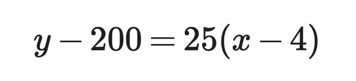
Real-world applications (3)
After 10 weeks, you have $350.
Point-slope form isn't the only way to write a line. Slope-intercept form and standard form are the other two, and each is best in a different situation.
The slope-intercept form is y = mx + b, where m is the slope and b is the y-intercept. You can read both values from the equation, which makes it the common choice when you graph a line. But it needs the y-intercept, and you often have a different point.
The two forms are similar. Slope-intercept form is point-slope form with the point (0, b):
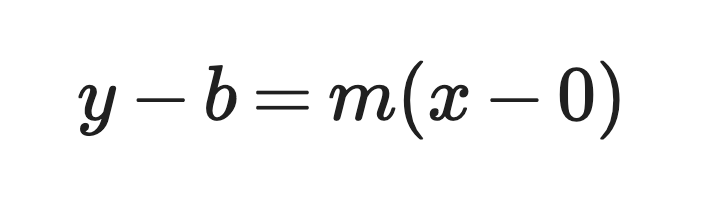
Slope-intercept form
To convert from point-slope form, distribute the slope and move y1 to the right side. The y-intercept is:
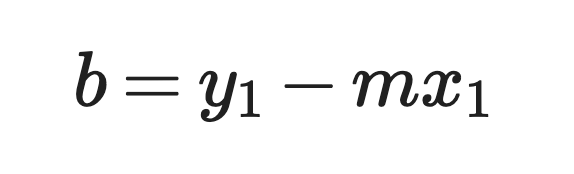
Slope-intercept form (2)
For y - 5 = 2(x - 3), that gives b = 5 - 2(3) = -1, so y = 2x - 1.
The standard form is Ax + By = C. The values A, B, and C are usually integers, and A isn't negative.
Unlike the other two forms, it can describe vertical lines. If B = 0, you get x = C/A. It's also the common format for systems of equations. But the slope isn't visible, and you calculate it as -A/B.
To convert from point-slope form, distribute the slope and move the x term to the left side. For y - 5 = 2(x - 3):
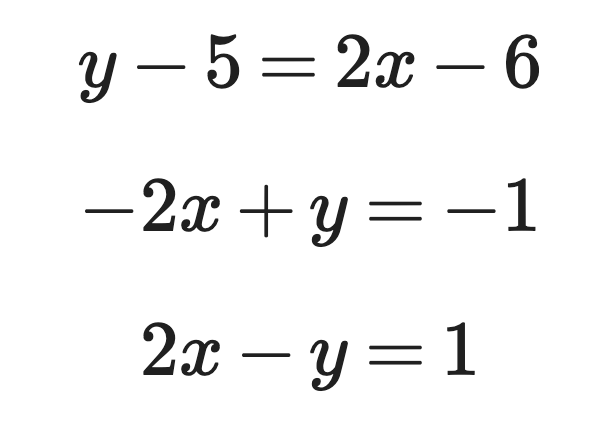
Standard form
In the last step, I multiplied both sides by -1 to make A positive.
Here's how the three forms compare:
| | Equation | Best for | Limitation |
|---|
| Point slope | y − y₁ = m(x − x₁) | Lines from a known point and slope | Can’t describe vertical lines |
| Slope-intercept | y = mx + b | Graphs and y-intercept values | Can’t describe vertical lines |
| Standard | Ax + By = C | Vertical lines and systems of equations | Slope isn’t visible |
Point-slope form compared to slope-intercept and standard form
Point-slope form is often seen wherever a rate of change has a known value. Here are four fields:
-
Calculus: The tangent line to a function at x = a is y - f(a) = f'(a)(x - a). For f(x) = x^2 at x = 3, the point is (3, 9) and the slope is 6, so the line is y - 9 = 6(x - 3)
-
Linear regression: A least-squares line with an intercept always passes through the point of the means, so you can write it as y - y_bar = m(x - x_bar)
-
Physics: Position under constant velocity follows the same pattern. If an object is at s1 at time t1 and moves at velocity v, then s - s1 = v(t - t1)
-
Business projections: A known cost or revenue figure plus a constant rate of change gives a quick linear estimate for any other period
Conclusion
Point-slope form builds the equation of a line from one point and the slope. The formula is y - y1 = m(x - x1), and any point on the line works.
You can convert it to slope-intercept or standard form in a couple of steps, so it’s a good starting point when you don’t have the y-intercept. It’s also often seen in tangent lines and linear regression.
To go further, try our Introduction to Regression with statsmodels in Python course. If you want to understand the math behind lines and systems of equations, our Linear Algebra for Data Science in R course will give you working knowledge in a weekend.








Point-slope form is an equation that describes a line from one known point and its slope:
y - y1 = m(x - x1).Most of us learn slope-intercept form first, so we think of it as the only way to write a line. But that approach needs the y-intercept, and you often don't have one in the real world. You get a point and a rate of change, like a cost of $40 at 5 units and $3 per extra unit.
Point-slope form doesn't need this step. You add your point and slope into the formula, and that's it. It is also the technique behind tangent lines and linear regression, so it's a topic worth exploring on its own.
In this article, I'll walk you through the formula, its components and graph, worked examples, real-world uses, and how it compares to slope-intercept and standard form.
Another topic worth exploring is linear regression: our blog post explains everything you need to know, including equations, assumptions, diagnostics, and the interpretation.
What Is Point-Slope Form?
If you know one point on a line and its slope, you know the whole line - that's the entire idea.
Definition and formula
Point-slope form writes a line's equation from a single point and the slope. Here's the formula:
Point-slope form formula
mis the slope,(x1, y1)is the point you know,xandystay as variables, and every point(x, y)on the line satisfies the equation.The formula comes from the definition of slope, which is the change in
ydivided by the change inx. You can pick any point(x, y)on the line and compare it to your known point:Slope calculation
Multiply both sides by
(x - x1)and you get point-slope form. That's it.You need to multiply because the fraction is undefined at
x = x1, as the denominator is zero. The multiplied version doesn't have this problem, so it's valid for every point on the line.Here's a quick example. A line has a slope of 2 and passes through
(3, 5). Just add the values in:Point-slope form calculation
You don't need to solve for anything.
Historical context
Point-slope form came much later than analytic geometry.
Pierre de Fermat and René Descartes developed analytic geometry in the 17th century. This is the idea that algebraic equations can describe lines and curves. But neither of them used point-slope form.
According to a history of calculus paper, Gaspard Monge first introduced it explicitly in a paper from 1784. That's more than 100 years after Descartes' method of tangents.
Descartes found tangent lines with a longer method that used circles. With point-slope form, you write the tangent line once you know the slope. Calculus courses still teach it this way.
Understanding Point-Slope Form
Each part of the formula has one task. Here's how they work together and how the line looks on a graph.
Key components
Here's what each symbol means:
mis the slope. It's the change inyfor each one-unit change inx. A positive value means the line goes up, and a negative value means it goes downx1is the x-coordinate of the point you knowy1is the y-coordinate of the same pointxandyare the variables. They stand for every other point on the lineThe minus signs are something newcomers often get wrong. If your point is
(3, 5), you writex - 3andy - 5. If a coordinate is negative, you get a double negative. For the point(-2, 4), the equation starts as:Point-slope form with a negative x-coordinate
It simplifies to:
Simplified equation
You can use any point on the line. Different points give different equations, but they describe the same line. The line from earlier also passes through
(4, 7), so this works too:Point-slope form with a second point
One limit applies, though. A vertical line has an undefined slope, so point-slope form can't describe it. You write it as
x = x1instead.Visual representation
On a graph,
(x1, y1)is your starting point. The slope tells you how to move from it.Slope is rise over run. A slope of 2 is
2/1, which means 2 units up for every 1 unit right. Here's how to graphy - 5 = 2(x - 3):Plot the point
(3, 5).Move 1 unit right and 2 units up to reach
(4, 7).Draw a line through both points and extend it in both directions.
You can also move the other way. Go 1 unit left and 2 units down to reach
(2, 3). It's on the same line.Graph of y - 5 = 2(x - 3)
Once you can read the point and slope from the equation, you can sketch the line without extra algebra.
Detailed Examples and Use Cases
Point-slope form is easiest to understand with numbers. Here are three problems, followed by a couple of real-world scenarios.
Example problems
Problem 1: Slope and one point
A line has a slope of -3 and passes through
(2, -1). Write its equation in point-slope form, then convert it to slope-intercept form.Step 1: Identify the values:
m = -3,x1 = 2, andy1 = -1.Step 2: Add them to the equation. Remember that two minus signs make a plus sign.
Example 1 (1)
Step 3: Convert the equation. Distribute the slope, then subtract 1 from both sides.
Example 1 (2)
Problem 2: Two points
A line passes through
(1, 2)and(4, 11). Find its equation.Step 1: Calculate the slope. Divide the change in
yby the change inx.Example 2 (1)
Step 2: Choose a point. Either point works, so I'll use
(1, 2).Example 2 (2)
Step 3: Check the result. Add in the other point,
(4, 11).Example 2 (3)
Both sides equal 9, so the equation is correct.
If you choose
(4, 11)as your point, you gety - 11 = 3(x - 4). Both versions simplify toy = 3x - 1.Problem 3: Parallel and perpendicular lines
Find the line through
(4, 3)that's parallel toy = 2x + 1. Then find the line through the same point that's perpendicular to it.Parallel lines have the same slope, so
m = 2.Example 3 (1)
Perpendicular lines have slopes that are negative reciprocals, so
m = -1/2.Example 3 (2)
You don't need the y-intercept for either line.
Real-world applications
Point-slope form is applicable in any situation where you know one data point and a constant rate of change.
Let's say a taxi ride costs $18 after 6 miles, and the rate is $2 per mile. With
xas the miles andyas the cost, the equation is:Real-world applications (1)
To estimate the cost of a 10-mile ride, just plug in
x = 10:Real-world applications (2)
The fare is $26.
Here's a second case. You have $200 saved after 4 weeks, and you add $25 each week. The balance after
xweeks is:Real-world applications (3)
After 10 weeks, you have $350.
Alternatives to Point Slope Form
Point-slope form isn't the only way to write a line. Slope-intercept form and standard form are the other two, and each is best in a different situation.
Slope-intercept form
The slope-intercept form is
y = mx + b, wheremis the slope andbis the y-intercept. You can read both values from the equation, which makes it the common choice when you graph a line. But it needs the y-intercept, and you often have a different point.The two forms are similar. Slope-intercept form is point-slope form with the point
(0, b):Slope-intercept form
To convert from point-slope form, distribute the slope and move
y1to the right side. The y-intercept is:Slope-intercept form (2)
For
y - 5 = 2(x - 3), that givesb = 5 - 2(3) = -1, soy = 2x - 1.Standard form
The standard form is
Ax + By = C. The valuesA,B, andCare usually integers, andAisn't negative.Unlike the other two forms, it can describe vertical lines. If
B = 0, you getx = C/A. It's also the common format for systems of equations. But the slope isn't visible, and you calculate it as-A/B.To convert from point-slope form, distribute the slope and move the
xterm to the left side. Fory - 5 = 2(x - 3):Standard form
In the last step, I multiplied both sides by -1 to make
Apositive.Here's how the three forms compare:
Point-slope form compared to slope-intercept and standard form
Practical Applications of Point-Slope Form
Point-slope form is often seen wherever a rate of change has a known value. Here are four fields:
Calculus: The tangent line to a function at
x = aisy - f(a) = f'(a)(x - a). Forf(x) = x^2atx = 3, the point is(3, 9)and the slope is 6, so the line isy - 9 = 6(x - 3)Linear regression: A least-squares line with an intercept always passes through the point of the means, so you can write it as
y - y_bar = m(x - x_bar)Physics: Position under constant velocity follows the same pattern. If an object is at
s1at timet1and moves at velocityv, thens - s1 = v(t - t1)Business projections: A known cost or revenue figure plus a constant rate of change gives a quick linear estimate for any other period
Conclusion
Point-slope form builds the equation of a line from one point and the slope. The formula is
y - y1 = m(x - x1), and any point on the line works.You can convert it to slope-intercept or standard form in a couple of steps, so it’s a good starting point when you don’t have the y-intercept. It’s also often seen in tangent lines and linear regression.
To go further, try our Introduction to Regression with statsmodels in Python course. If you want to understand the math behind lines and systems of equations, our Linear Algebra for Data Science in R course will give you working knowledge in a weekend.